If your real estate website isn’t showing up on Google, you are losing buyers and sellers to agents who do show up. That’s the simple truth of the market today. Most home buyers start their search online, long before they ever call an agent. If your site is not there when they search, you are invisible to them.
Real estate SEO is the process of improving your website and online listings so they rank higher in search results and attract more property inquiries. Done right, it brings you a steady stream of buyer and seller leads without paying for every single click. Done wrong, you stay buried on page two, where almost nobody looks.
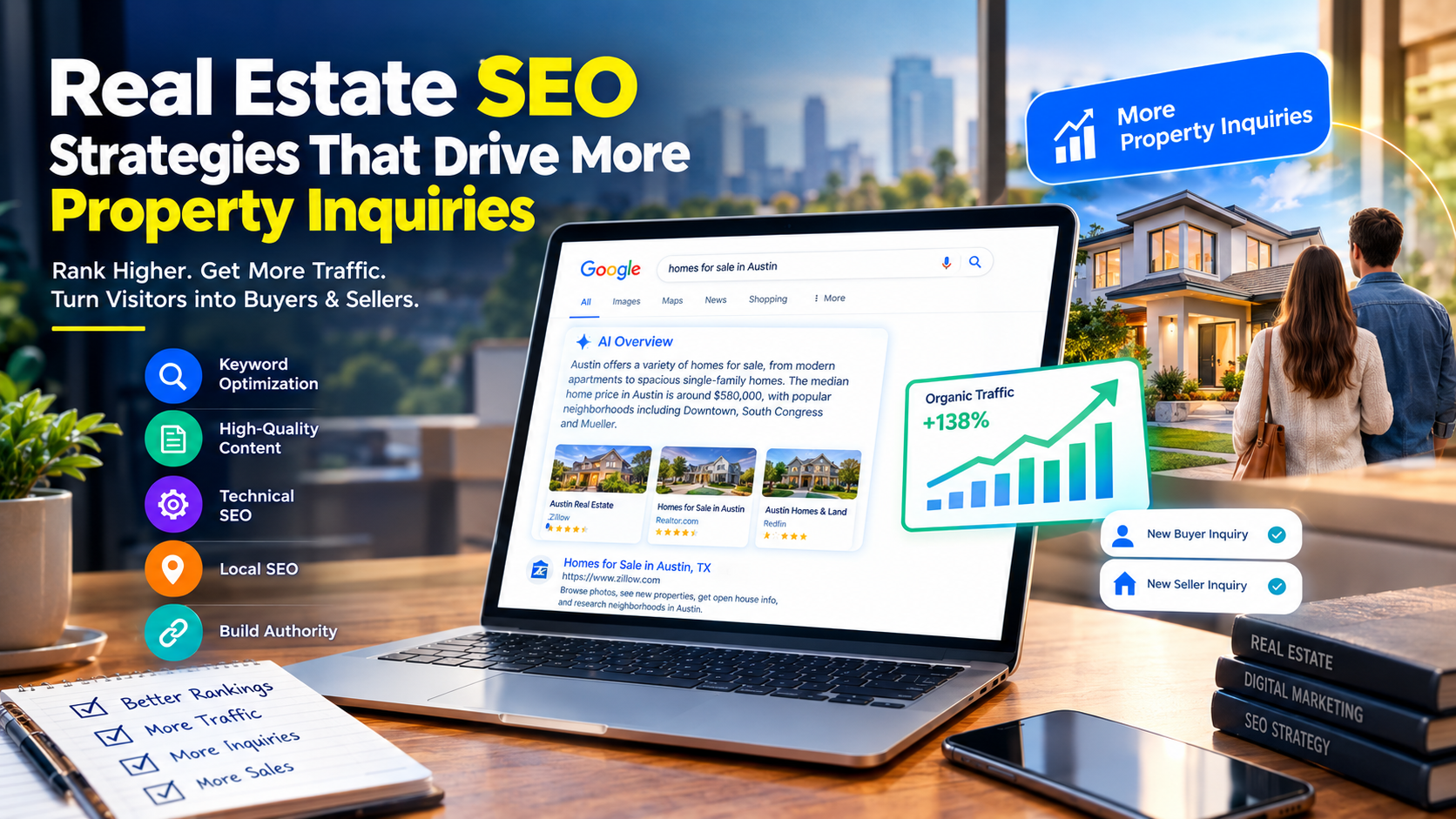
This guide walks you through the exact real estate SEO strategies that top-performing agents and brokerages use to rank higher, show up in Google’s AI Overview and featured snippets, and turn website visitors into real property inquiries. We will keep the language simple and the advice practical, so you can start using it today.
Why Real Estate SEO Matters More Than Ever
Search behavior has changed a lot in the past few years. Buyers no longer type one search and click the first blue link. They ask detailed questions, compare neighborhoods, and now often get instant answers from Google’s AI Overview before they even visit a website.
According to one 2026 industry report, real estate SEO delivered an estimated 1,389% ROI in 2025, with agents typically breaking even after just ten months of steady work. That is a huge return compared to most paid ad campaigns, which stop working the moment you stop paying.
Search is also no longer just about Google’s classic results page. As one recent guide on real estate SEO strategies for 2026 explains, AI-powered search tools like ChatGPT, Perplexity, and Google’s AI Overviews now shape how homebuyers and sellers discover agents, neighborhoods, and market data. Agents who want more property inquiries need to optimize for both classic search rankings and these newer AI-driven answers.
Video also plays a growing role in real estate marketing. Research summarized by SEOprofy’s real estate SEO guide notes that video content can help generate up to 66% more leads, since it increases engagement, time on site, and trust — all signals that support your rankings.
The bottom line: real estate SEO is no longer optional. It’s the foundation of a real estate business that grows without burning through your marketing budget.
What Is Real Estate SEO, Exactly?
In simple words, real estate SEO means making your website easy for Google to find, understand, and trust — so it shows up when someone searches for homes, neighborhoods, or agents in your area.
As one 2026 guide puts it, real estate SEO is the process of optimizing your website and content so it ranks higher in search engine results and attracts the right visitors, and it encompasses keyword research, content strategy, technical site health, link building, and local SEO, according to Sierra Interactive’s real estate SEO guide.
It is not a one-time fix. It is an ongoing effort that pays off more the longer you stick with it. Let’s break down the strategies that matter most.
1. Start With the Right Real Estate Keywords
Keyword research is the foundation of every SEO strategy. You need to know exactly what buyers and sellers type into Google before you can create content that answers their questions.
Your primary keywords should reflect what people search for when they are close to taking action, such as “homes for sale in [city]” or “[city] real estate agent.” Your secondary keywords support these primary terms and capture more specific searches, like “best neighborhoods for families in [city]” or “how much is my home worth in [city].”
Local modifiers matter a lot here. As explained in Wowinfotech’s guide to real estate SEO, including local modifiers such as city names, neighborhoods, and postcodes in your keyword targeting captures the phrases users actually type when they are ready to act. Tools like Google Keyword Planner, Ahrefs, and Semrush can help you find these high-intent, long-tail phrases.
Practical tip: Group your keywords by search intent.
- Informational — “how to sell a house fast,” “first-time homebuyer tips”
- Navigational — “[Brokerage Name] listings”
- Transactional — “homes for sale in [neighborhood],” “condos under $400k in [city]”
Target transactional keywords on your listing and service pages. Use informational keywords for blog posts that build trust and bring in early-stage buyers.
2. Fix Your On-Page SEO First
Even the best content will underperform if your on-page SEO is weak. This is the part of SEO you have full control over, so it’s worth getting right.
According to SEOprofy’s 2026 real estate SEO guide, strong on-page SEO starts with metadata that reflects the intent of the page. Their advice: include real estate keywords in page titles, ideally at the beginning, keep meta descriptions under 160 characters with a clear call to click, use H1 for main page headers, and use H2s and H3s to organize content around relevant keywords so it’s easy to scan.
Here is a simple on-page SEO checklist for every important page on your site:
- Title tag — Include your primary keyword near the start (example: “Homes for Sale in Austin, TX | [Your Brokerage]”)
- Meta description — Write a short, honest summary with a clear reason to click
- Headings (H1, H2, H3) — Use one clear H1 and organize the rest with keyword-rich subheadings
- Image alt text — Describe each property photo naturally, including location where relevant
- URL structure — Keep URLs short, readable, and keyword-focused
- Internal links — Link between related listings, neighborhood guides, and blog posts
Adding modifiers like “best,” “top,” or the current year to your titles can also help capture more clicks, since these words match how people naturally search.
3. Win Local SEO With Your Google Business Profile
If you only do one thing after reading this guide, make it this one. Local SEO is often the fastest way to start seeing more property inquiries, and your Google Business Profile is the centerpiece of it.
The numbers here are hard to ignore. According to SocialRealtr’s 2026 local SEO guide, the Google 3-Pack, which shows the top three map results, captures 79% of all local search clicks. That means getting into the map pack can matter more than almost anything else you do online.
The same guide breaks ranking down into three simple factors: proximity, meaning you target your specific city; relevance, meaning you optimize your Google Business Profile with keywords in your services, categories, and posts; and activity, meaning you post weekly, collect reviews with the right keywords, and respond to every review.
Real numbers back this up. One case study cited by DMR Media’s Google Business Profile guide for real estate agents noted that agents have received up to 50 inbound leads each month simply by setting up and maintaining their Google Business Profile effectively.
How to optimize your Google Business Profile
- Choose the correct category. Select “Real Estate Agent,” not a generic category like “Consultant.” Choosing the wrong category is a common mistake that Jeff Lenney’s 2026 GBP guide warns can make Google show you for the wrong searches entirely.
- Keep your NAP consistent. Your Name, Address, and Phone number should match exactly across your website, Zillow, Realtor.com, Yelp, and every other directory. Inconsistent listings confuse Google and hurt your rankings.
- Write a keyword-rich business description. Mention your city, your specialty (like luxury homes or first-time buyers), and the neighborhoods you serve.
- Post weekly updates. According to Jamil Academy’s Google Business Profile guide, agents who post weekly maintain higher Local Pack rankings and generate 5 to 15 extra inbound calls per month.
- Collect and respond to reviews. Reviews are one of the strongest local ranking signals, and responding to each one shows both Google and future clients that you’re active and trustworthy.
- Upload keyword-friendly photos. Renaming image files with descriptive names before uploading (for example, “downtown-condo-austin-your-name.jpg” instead of “IMG4832.jpg”) gives Google extra context about your content and service area.
4. Build a Content Strategy That Actually Attracts Buyers and Sellers
Your blog and resource pages are where you can capture searches your listing pages simply can’t. This is one of the most overlooked real estate SEO strategies, and also one of the most powerful.
As explained by Houzez’s complete 2026 SEO guide for real estate agents, content marketing is one of the most powerful real estate SEO strategies available, and by publishing valuable, locally focused content, you attract organic visitors and build authority in your market.
Here are the content types that consistently perform well:
- Neighborhood guides. These rank well for high-intent local searches. Include details on schools, dining, commute times, parks, and local market trends. Example title: “Living in Wynwood, Miami: The Ultimate Neighborhood Guide.”
- Market reports. Publish these monthly or quarterly to attract sellers who want to understand current conditions. Example title: “Austin Real Estate Market Report: Q3 2026 Update.”
- Buyer and seller guides. Step-by-step content like “How to Sell Your Home Fast in 12 Proven Steps” tends to generate strong, consistent organic traffic.
- Investment content. This attracts a highly motivated, often repeat-client audience. Example title: “Best Neighborhoods for Real Estate Investment in 2026.”
Consistency matters more than volume. As the same guide points out, publishing content consistently, even just one well-researched article per week, can significantly increase organic traffic over six to twelve months.
One more thing worth remembering: your content doesn’t need to be created from scratch every time. A single market report can be turned into a social media post, a short video, an email newsletter, and a podcast talking point, as noted in Sierra Interactive’s real estate SEO guide.
5. Get Your Technical SEO Right
Technical SEO is the behind-the-scenes work that determines whether Google can properly crawl, understand, and rank your website. You can write the best content in the world, but if your site is slow or broken, it won’t rank.
Page speed is one of the biggest factors here. As noted by Houzez’s real estate SEO guide, Google considers page speed a direct ranking factor, and a slow website also frustrates visitors and increases bounce rates.
A quick technical SEO checklist for real estate websites:
- Mobile optimization. Most property searches now happen on phones and tablets, so your site must load fast and look great on small screens.
- Fast page speed. Compress images, use lazy loading for property photos, and avoid heavy, unnecessary scripts.
- Secure site (HTTPS). This is a baseline trust signal for both Google and visitors entering personal information into contact forms.
- Clean site structure. Organize listings, neighborhood pages, and blog content into logical categories so both users and search engines can navigate easily.
- Fix broken links and duplicate content. Old, expired listings often create dead links or duplicate pages that hurt your crawl efficiency.
- XML sitemap and robots.txt. Keep these updated so Google can find and index new listings quickly.
6. Use Structured Data to Win Featured Snippets and Rich Results
Structured data (also called schema markup) is code you add to your website that helps search engines understand exactly what your content is about. It won’t guarantee a featured snippet, but it gives Google the context it needs to consider your page for one.
Google’s own documentation is clear about how this works. According to Google Search Central’s general structured data guidelines, the more recommended properties you provide in your structured data, the higher quality the result is for users. Google also states that including the structured data type that reflects a page’s main focus increases your chances of appearing in relevant search features.
It’s important to understand the difference between structured data and featured snippets, since they’re often confused. As explained in a recent structured data and AI search guide, a featured snippet is normally extracted from visible page content to answer a query directly, and while schema markup does not force a featured snippet, clear content structure can help Google understand and extract answers.
For real estate sites, focus on these schema types:
- LocalBusiness / RealEstateAgent schema — Helps your business appear correctly in local search and map results
- Review / AggregateRating schema — Displays star ratings directly in search results, which boosts click-through rate
- FAQ schema — Marks up common questions and answers, increasing your odds of showing up in featured snippets and AI-generated answers
- Article schema — Helps blog posts and market reports get properly categorized and understood
7. Write Content That Wins Google’s AI Overview
Since Google introduced AI Overviews, the way people find information has shifted again. Instead of clicking through several websites, many searchers now get a direct, AI-written answer at the top of the page — and that answer often cites specific websites as sources.
To be one of those cited sources, structure your content the way you’d structure a direct answer to a real question:
- Answer the question in the first 1–2 sentences. Don’t bury the answer under a long introduction.
- Use clear headings that match real search queries. For example, “How much does it cost to sell a house in [city]?” as an H2, followed immediately by a direct answer.
- Use lists, tables, and short paragraphs. AI systems and featured snippets both favor content that’s easy to extract and summarize.
- Back up claims with real data. Specific numbers, dates, and local statistics make your content more citable than vague generalizations.
This approach lines up with what industry experts already recommend for classic SEO. As one 2026 guide on real estate SEO strategies puts it, publishing in-depth, locally specific content on a consistent schedule is the single strongest signal you can send to both search engines and AI tools, because it builds topical authority, earns backlinks naturally, and gives AI systems material to cite when generating answers about your area, according to Luxury Presence’s 2026 real estate SEO strategies guide.
8. Build Local Citations and Backlinks
Backlinks (links from other websites pointing to yours) remain one of the strongest ranking signals in SEO. For real estate specifically, local citations matter just as much.
A citation is any online mention of your business name, address, and phone number, even without a link. According to INSIDEA’s 2026 local SEO guide for real estate agents, you should aim to keep your NAP identical across real estate directories like Zillow, Realtor.com, and Redfin, local business listings like Yelp and the Chamber of Commerce, and social media platforms like Facebook Business and LinkedIn.
Simple ways to build real estate backlinks:
- Get featured in local news stories or community blogs
- Sponsor a local youth sports team or charity event (many will link back to you)
- Guest post on local lifestyle or home improvement blogs
- Partner with local businesses for co-marketing content
- List your business on niche real estate directories
9. Combine SEO With a Smart Local Strategy
SEO builds your long-term, low-cost lead engine, but it works even better alongside a broader local marketing strategy. As pointed out in a 2026 real estate SEO guide from SEOAlive, SEO builds your long-term foundation by establishing authority and delivering sustainable, cost-effective lead generation, while paid search provides immediate visibility for time-sensitive opportunities like new listings or open houses.
The data on buyer behavior supports this focus on digital visibility. The same source references the National Association of Realtors’ 2024 Profile of Home Buyers and Sellers, noting that all home buyers used the internet to search for a home — which means there is no segment of your audience that SEO doesn’t reach.
Common Real Estate SEO Mistakes to Avoid
Even well-meaning agents make mistakes that quietly hurt their rankings. Watch out for these:
- Inconsistent NAP information across directories and social profiles
- Keyword stuffing your business name or page titles
- Ignoring mobile users, even though most searches now happen on phones
- Letting old listings pile up as dead or duplicate pages
- Posting once and quitting on your Google Business Profile or blog
- Copying competitor content instead of writing locally specific, original insights
How Long Does Real Estate SEO Take to Work?
This is one of the most common questions agents ask, and it deserves an honest answer. According to Wowinfotech’s 2026 SEO guide for real estate, you can typically expect 3 to 6 months for initial visibility, and 6 to 12 months or more for competitive keywords to rank well. The same source recommends starting with your core landing pages — location, listings, and services — then supporting them with helpful blog content that addresses real buyer and seller questions.
SEO is not a quick fix, but it compounds over time. The content and authority you build this year will keep generating property inquiries next year, without extra cost per lead.
Frequently Asked Questions
What is the most important SEO strategy for real estate agents?
Publishing in-depth, locally specific content on a consistent schedule is widely considered the single most important action, since it builds authority with both search engines and AI tools over time.
How long does real estate SEO take to show results?
Most sites see initial visibility in 3 to 6 months, with competitive local keywords taking 6 to 12 months or more to rank well.
Does Google Business Profile really help generate leads?
Yes. A well-optimized, actively managed profile can generate dozens of inbound calls per month, and the Google 3-Pack alone captures the large majority of local search clicks.
Is SEO better than paid ads for real estate agents?
They serve different purposes. SEO builds long-term, low-cost visibility, while paid ads deliver immediate exposure for time-sensitive listings. The strongest strategies use both together.
Final Thoughts
Real estate SEO isn’t about chasing algorithm tricks. It’s about consistently answering the real questions your buyers and sellers are asking, making your website fast and easy to use, and staying visible across Google search, the map pack, and now AI-generated answers too.
Start with the fundamentals: solid keyword research, a fully optimized Google Business Profile, clean on-page SEO, and a steady content calendar built around your local market. Layer in structured data and locally focused backlinks, and give it time to compound. The agents who commit to this approach consistently outrank competitors and turn their website into a real source of property inquiries — not just a digital business card.