Is Traditional SEO Enough to Win Search Visibility in 2026?
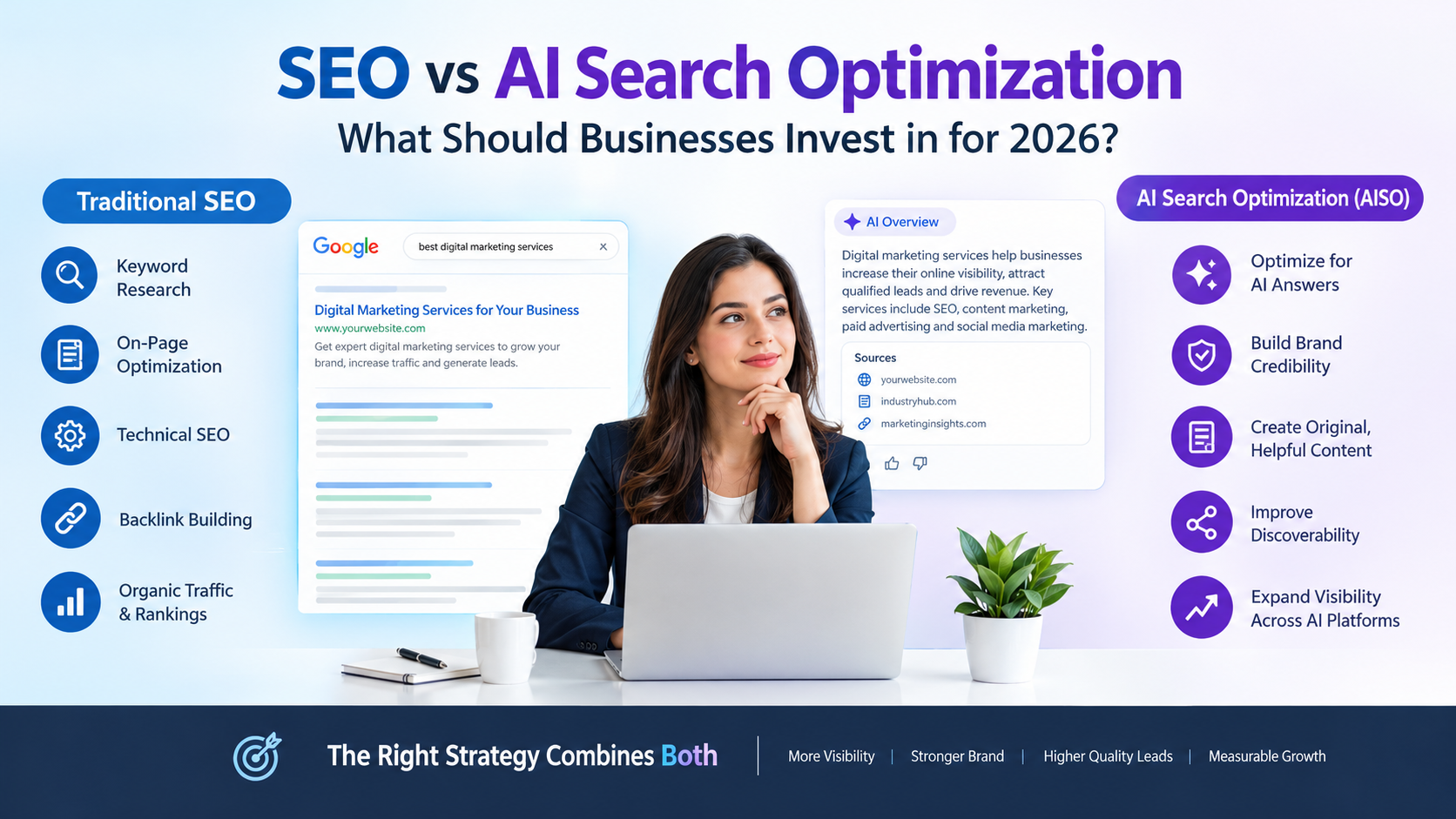
Search behavior is changing rapidly as customers use traditional search engines, AI-generated answers, and conversational tools to research products, compare services, and make purchasing decisions. For businesses, SEO vs AI Search Optimization is no longer just a debate about which strategy is better. It is about understanding how potential customers discover brands and ensuring your business remains visible throughout their buying journey. While traditional SEO helps websites attract organic traffic through search engine results, AI Search Optimization (AISO) focuses on improving a brand’s discoverability and representation in AI-powered search experiences.
For years, businesses have invested in keyword research, technical SEO, content marketing, and link building to improve their Google rankings and generate qualified leads. These activities remain essential, but search visibility is becoming more complex. Potential customers may now receive AI-generated summaries, explore conversational recommendations, or discover companies through cited sources without following the same search journey they used in the past. As a result, businesses need to consider not only whether their websites rank well but also whether their content provides reliable information that search engines and AI systems can discover, understand, and potentially reference.
This shift raises an important question for business owners, marketing leaders, and decision-makers: Should you continue investing primarily in traditional SEO, allocate more resources to AI Search Optimization, or combine both strategies? The right approach depends on your current organic performance, target audience, industry competition, marketing budget, and business objectives. A local service provider may need to prioritize local search rankings and high-converting service pages, while a B2B technology company may also benefit from publishing expert-led research, detailed comparisons, and evidence-backed content that supports AI-assisted discovery.
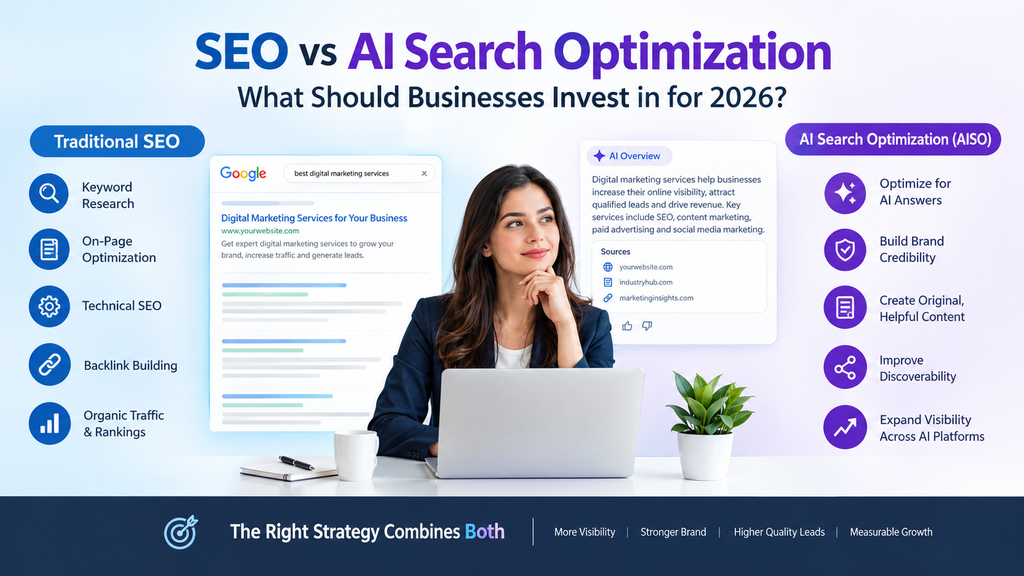
The most practical strategy for 2026 is to build on strong SEO fundamentals while expanding into AI Search Optimization where it supports measurable business goals. Instead of treating these approaches as competing investments, businesses should evaluate how they work together to increase search visibility, strengthen brand credibility, attract qualified prospects, and generate revenue. Understanding their differences, benefits, limitations, and measurement requirements will help you invest in the right activities without chasing every new search marketing trend.
2. What Is Traditional SEO?
Search Engine Optimization (SEO) is the process of improving a website’s visibility in unpaid search engine results to attract relevant visitors and support business growth. It involves optimizing website content, technical performance, user experience, and online authority so search engines can discover, understand, and rank relevant pages. For businesses, traditional SEO provides a structured way to reach potential customers who are actively searching for information, products, or services related to their needs.
A well-planned SEO strategy goes beyond achieving higher keyword rankings. It focuses on matching content to search intent, creating useful landing pages, improving website accessibility, and guiding visitors toward meaningful actions such as requesting a consultation, submitting an inquiry, or making a purchase. When these elements work together, SEO can become a sustainable source of qualified traffic and customer acquisition.
2.1 Key Components of Traditional SEO
Successful SEO combines several activities that help search engines understand a website and help users find the information they need.
Keyword Research and Search Intent Analysis
Keyword research identifies the search terms potential customers use when looking for products, services, and solutions. Businesses need to understand whether a query reflects informational, commercial, transactional, or navigational intent. For example, someone searching for “what is AI automation” may want educational information, while someone searching for “AI automation consulting services” is more likely to be evaluating potential providers. Aligning content with these different needs helps attract relevant visitors at each stage of the buying journey.
On-Page SEO and Content Optimization
On-page SEO improves individual web pages through descriptive title tags, relevant headings, clear URLs, contextual internal links, and naturally integrated keywords. Content should answer the user’s question accurately, explain important concepts, and provide practical information that supports decision-making. Rather than repeating keywords excessively, businesses should prioritize topical relevance, readability, originality, and a clear connection between the page content and the visitor’s needs.
Technical SEO, Crawlability, and Indexability
Technical SEO helps search engines access, crawl, interpret, and index a website’s content. Important activities include reviewing robots.txt directives, XML sitemaps, canonical tags, redirects, duplicate pages, structured data, and internal linking. A technically sound website reduces avoidable barriers to search discovery. However, crawlability and indexability do not guarantee rankings; search engines also consider relevance, content quality, competition, and other signals.
Website Speed and Mobile Usability
A responsive, accessible, and fast-loading website helps visitors navigate content and complete important actions across devices. Businesses should monitor Core Web Vitals, including Largest Contentful Paint (LCP), Interaction to Next Paint (INP), and Cumulative Layout Shift (CLS), to identify performance and user-experience issues. Improving these areas can support usability and search performance, although website speed alone does not guarantee higher rankings.
Link Building and Digital Authority
Relevant, editorially earned backlinks can help search engines discover pages and understand their prominence across the web. Businesses can develop these links by publishing original research, contributing expert commentary, creating useful industry resources, and building relationships with reputable publications. The focus should be on relevance, credibility, and genuine editorial value rather than purchasing low-quality links or pursuing backlink volume without considering quality.
Local SEO and Google Business Profile Optimization
Local SEO helps businesses reach customers searching for nearby services or providers in specific locations. Essential activities include maintaining an accurate Google Business Profile, updating business hours and contact information, creating relevant location and service pages, and encouraging genuine customer reviews. For businesses that depend on local inquiries, calls, appointments, or visits, local SEO can be an important source of qualified leads.
Conversion Optimization and Organic Traffic Analysis
Generating traffic is only part of an effective SEO strategy. Conversion optimization helps turn relevant visitors into leads or customers through clear calls to action, useful service information, straightforward forms, and trustworthy website experiences. Businesses should analyze organic landing-page performance, engagement, lead submissions, purchases, and revenue to understand which pages contribute to commercial outcomes. Tools such as Google Search Console and Google Analytics can help connect search visibility with website activity and conversions.
2.2 How Traditional SEO Helps Businesses Grow
Traditional SEO can support business growth by connecting a company’s products, services, and expertise with people who are already searching for relevant solutions.
Attracts High-Intent Visitors
A well-optimized website can reach people at different stages of the buying journey, from researching a problem to comparing providers and selecting a solution. By targeting relevant commercial and transactional queries, businesses can attract prospects who are more likely to request a quote, book a consultation, or make a purchase. The quality and intent of this traffic matter more than raw visitor numbers alone.
Builds Long-Term Organic Visibility
Unlike paid advertising, organic search visibility does not depend on paying for every click. Creating useful content, maintaining technical SEO, and developing a credible online presence can support continued discovery over time. However, organic performance requires ongoing maintenance because search algorithms, competitors, customer behavior, and market conditions change.
Strengthens Brand Credibility
Appearing prominently for relevant searches can help customers discover a business when researching a product, service, or industry problem. Detailed service pages, expert insights, customer evidence, and transparent business information can further strengthen trust. Rankings alone do not establish credibility, but they can create opportunities for a brand to demonstrate its expertise to prospective customers.
Supports Lead Generation and E-commerce Sales
SEO can direct visitors to service pages, product categories, product descriptions, case studies, and comparison guides that support purchasing decisions. For B2B companies, this can generate consultation requests and qualified sales inquiries. For e-commerce businesses, it can improve product discovery and attract shoppers with specific purchasing needs. The commercial impact depends on search intent, competition, website experience, and the effectiveness of conversion paths.
Makes Marketing Performance More Measurable
Businesses can evaluate SEO through organic impressions, clicks, search queries, landing-page traffic, leads, conversion rates, and revenue. These measurements help marketers identify successful pages, uncover content gaps, and prioritize improvements. Although attribution can be imperfect, combining search analytics with CRM and sales data provides a stronger understanding of SEO’s contribution to business growth.
2.3 Limitations of a Traditional SEO-Only Strategy
Traditional SEO remains an essential part of digital marketing, but relying exclusively on keyword rankings and conventional organic traffic can leave gaps in a business’s search visibility strategy.
High Rankings Do Not Guarantee AI Search Mentions
A page that ranks well in conventional search results is not automatically guaranteed to appear as a citation or recommendation in an AI-generated answer. AI-powered search experiences may draw on different sources and retrieval processes depending on the platform and query. Businesses should continue improving their SEO while also evaluating whether their content is accurate, clearly structured, authoritative, and useful for the questions their audiences ask AI tools.
Zero-Click Searches Can Limit Website Visits
Some users receive enough information directly from search results, featured snippets, knowledge panels, or AI-generated summaries that they do not click through to a website. This can reduce visits for certain informational queries, although the impact varies by query type, industry, and search experience. Businesses should therefore evaluate search visibility alongside qualified traffic, conversions, brand awareness, and the value of attracting users with stronger purchase intent.
Keyword Rankings Do Not Show the Complete Search Journey
Traditional rank tracking measures performance for selected keywords and locations, but it cannot fully explain how a brand appears across conversational AI tools, generated answers, or recommendation-style queries. A company may perform well for a target keyword while remaining less visible when potential customers ask broader questions, compare providers, or seek recommendations. Monitoring relevant AI search experiences can provide additional context, although results may vary between users, platforms, and sessions.
Businesses May Miss Opportunities to Become Trusted AI Sources
Companies that focus only on conventional rankings may overlook opportunities to publish original research, demonstrate subject-matter expertise, answer specific customer questions, and establish consistent brand information across credible sources. These activities can improve the usefulness and credibility of a company’s digital presence and may support discovery in AI-powered search experiences. However, no content format, schema implementation, or optimization technique guarantees that an AI system will cite a business.
3. What Is AI Search Optimization (AISO)?
AI Search Optimization (AISO) is the practice of improving a brand’s discoverability, accuracy, and potential visibility across AI-powered search experiences and answer engines. These experiences include AI-generated search summaries, conversational assistants, and tools that synthesize information from multiple sources to answer user questions. Unlike a strategy focused primarily on traditional search rankings, AISO considers how clearly a brand communicates its expertise, how reliably its information can be verified, and whether its content can serve as a useful source for AI-generated responses.
For businesses, AI Search Optimization creates an opportunity to reach potential customers who research solutions through conversational questions rather than relying exclusively on short keyword searches. A prospective buyer might ask an AI assistant to compare software providers, recommend an automation partner, or explain which solution is best for a specific business problem. Companies with clear service information, credible evidence, original insights, and relevant content may be better positioned to be discovered during this research process. However, appearing in an AI-generated response depends on the platform, query, available sources, and retrieval mechanisms; no optimization strategy guarantees a mention or citation.
AISO should therefore complement traditional SEO rather than replace it. Search accessibility, useful content, internal linking, website quality, and brand authority remain important foundations. The additional focus is on making information easy to understand, verify, and contextualize while evaluating how the business appears across relevant AI-powered discovery channels. For companies investing in digital marketing in 2026, this broader approach can help connect search visibility with brand credibility, qualified leads, and long-term growth.
3.1 How AI Search Optimization Works
AI Search Optimization combines content quality, technical accessibility, brand credibility, and performance monitoring to improve the chances that relevant information will be discovered and represented accurately in AI-powered search experiences.
Helps AI Systems Discover and Understand Website Content
AI search experiences may use search indexes, retrieval systems, available web sources, and other information sources to generate answers. Businesses should ensure that important pages are accessible to relevant crawlers, internally linked, indexable where appropriate, and supported by clear navigation. Accurate page titles, descriptive headings, useful metadata, and relevant structured data can help clarify what a page contains. Technical accessibility does not guarantee inclusion, and different AI platforms have different crawling and retrieval requirements.
Organizes Information Into Clear, Context-Rich Answers
Content should answer real customer questions directly while providing enough context to explain why the answer matters. For example, a page about AI automation for e-commerce should explain the operational problem, describe the proposed workflow, identify relevant integrations, and discuss implementation considerations. Descriptive headings, concise explanations, practical examples, and clearly stated limitations help readers understand the subject without sacrificing depth. The goal is to make information genuinely useful rather than simply formatting every paragraph to target an AI system.
Strengthens Brand Entity Information and Consistency
AI systems may encounter information about a business across its website, industry directories, professional profiles, news coverage, and other public sources. Consistent company names, service descriptions, leadership information, locations, and factual claims can reduce confusion about the brand. Businesses should maintain accurate profiles and ensure that important details agree across credible sources. This supports a clearer digital identity, although consistency alone does not guarantee that a brand will appear in AI recommendations.
Supports the Visibility of Relevant Pages in AI-Generated Responses
Some AI-powered search experiences display citations or links to sources used in their answers. Businesses can improve the usefulness of potential source material by publishing original research, detailed explanations, relevant examples, and evidence-backed recommendations. Content should address the topic comprehensively and distinguish verified facts from opinions or assumptions. Whether a page is cited depends on the platform’s retrieval and ranking processes, the user’s query, and the relevance and reliability of competing sources.
Aligns Content With Conversational Questions and Buying Decisions
People often use natural-language questions when researching a complicated purchase or business problem. Instead of targeting only a broad phrase such as “AI development services,” a company can address questions about implementation costs, integration requirements, expected business benefits, security considerations, and provider selection. Comparison pages, service guides, FAQs, and case studies can support different stages of the buying journey. This approach also benefits conventional SEO when the content matches genuine search intent.
3.2 Core Elements of AI Search Optimization
An effective AISO strategy focuses on creating trustworthy information, improving website accessibility, strengthening brand recognition, and measuring performance across relevant AI search experiences.
Answer-Focused Content and Conversational Query Coverage
Create content that responds to the questions customers ask before choosing a product, service, or provider. Start important sections with a direct answer, then explain the reasoning, evidence, examples, and practical implications. Cover informational, commercial, and transactional questions instead of producing repetitive pages for minor keyword variations. For example, an AI consulting company could address questions about identifying automation opportunities, evaluating implementation readiness, integrating existing systems, and measuring return on investment.
Clear Headings, Concise Definitions, and Logical Structure
Organize pages with descriptive headings, short introductory definitions, meaningful subheadings, and logical transitions between ideas. Tables and lists can help readers compare options or follow implementation steps when they genuinely improve clarity. Longer articles should provide sufficient detail to answer the user’s question without burying important information beneath unnecessary introductions. Clear structure improves usability, but there is no universally required word count, paragraph length, or formatting template for AI visibility.
Original Research, Expert Insights, and Verifiable Evidence
Publish information that offers value beyond generic summaries of existing material. Original surveys, practical implementation lessons, transparent case studies, expert commentary, and carefully sourced statistics can distinguish a business from competitors. Cite primary sources when discussing market trends, technical requirements, or regulatory obligations. If performance data comes from a limited sample or illustrative scenario, label it accordingly. Unsupported statistics and exaggerated success claims can undermine credibility with customers and damage the reliability of the content.
Entity Clarity and Consistent Brand Information
Explain what the company does, whom it serves, which problems it solves, and how its services differ from alternatives. Use consistent business details across the website and credible external profiles. Create detailed service pages that identify relevant industries, use cases, capabilities, implementation requirements, and limitations. Where appropriate, use accurate Organization, Person, Product, or Service-related structured data supported by the visible page content. Structured data helps describe information but does not guarantee AI citations or enhanced search visibility.
Author Credibility, Trustworthy References, and E-E-A-T Signals
Demonstrate experience, expertise, authoritativeness, and trustworthiness through transparent authorship, relevant qualifications, editorial accountability, and reliable references. Include real examples of work, clearly explain methodology, and update content when important facts change. For technical or high-stakes topics, provide appropriate expert review and link to authoritative documentation. E-E-A-T is Google’s quality-evaluation framework rather than a single measurable ranking factor, so businesses should focus on demonstrating genuine credibility instead of treating it as a checklist that guarantees results.
Relevant Third-Party Mentions and Digital PR
Earn relevant visibility through industry publications, expert interviews, original research, professional associations, and credible partner resources. Independent coverage can help customers validate a company’s expertise and discover its services through channels beyond its own website. Prioritize accurate, editorially justified mentions over paid placements designed to manipulate rankings or AI responses. Third-party coverage may support brand awareness and authority, but the quantity of mentions alone does not determine whether an AI system will recommend a business.
Structured Data and Accurate Technical Implementation
Use supported structured data to describe eligible content clearly and consistently with the information users can see on the page. Review canonical URLs, internal links, robots directives, XML sitemaps, mobile usability, and page performance as part of the wider technical SEO process. Check the documentation for each relevant search or AI platform to understand its crawler access requirements and content policies. Do not assume that adding schema markup, creating a special AI file, or allowing every crawler automatically improves AI visibility.
Monitoring AI Citations, Brand Mentions, and Business Outcomes
Build a repeatable measurement process that tests a defined set of relevant customer questions across the AI platforms that matter to the target audience. Record whether the brand appears, which pages are cited, whether descriptions are factually accurate, and which competitors are mentioned. Track identifiable AI referral traffic through analytics and connect it with CRM records, qualified leads, and sales wherever possible. Because AI responses can vary between queries, sessions, and platforms, use consistent testing methods and treat visibility scores as directional indicators rather than definitive measures of revenue impact.
3.3 AI Search Optimization vs. Generative Engine Optimization (GEO)
AI Search Optimization (AISO) and Generative Engine Optimization (GEO) are closely related terms used to describe efforts to improve a brand’s visibility in AI-powered search and generative answer experiences. Both approaches emphasize useful content, clear explanations, reliable sources, technical accessibility, and a credible digital presence. In practice, the terms often overlap, and many of the activities that support one can also support the other.
What Is Generative Engine Optimization (GEO)?
Generative Engine Optimization is commonly used to describe strategies for improving the likelihood that a brand’s information will be surfaced, referenced, or cited in responses produced by generative AI systems. These may include conversational assistants and search tools that synthesize information into answers. GEO often places particular emphasis on source credibility, original information, contextual relevance, and how a brand is represented in generated responses. However, there is no universal GEO standard or established formula that guarantees inclusion.
How Are AISO and GEO Different?
The distinction is mainly one of terminology and strategic emphasis rather than a strict technical boundary.
- AI Search Optimization (AISO): Often used as a broad term for improving discoverability across AI-powered search experiences, answer engines, and conversational discovery channels.
- Generative Engine Optimization (GEO): Commonly emphasizes improving visibility and representation within content generated by AI systems, including source citations and brand mentions.
- Traditional SEO: Focuses on improving visibility across conventional organic search results while maintaining the technical and content foundations that can also support AI search.
These categories overlap substantially. A company that publishes well-researched content, maintains accessible web pages, demonstrates subject-matter expertise, and earns credible editorial coverage may be improving its SEO, AISO, and GEO performance through the same activities.
Which Approach Should Businesses Prioritize in 2026?
Businesses should not choose between AISO and GEO based solely on which term is more popular. Instead, identify where customers discover information, which platforms are relevant to the industry, and what measurable business outcomes the strategy needs to support. Begin with strong technical SEO, useful content, and accurate brand information. Then introduce AI visibility monitoring, targeted content improvements, and relevant digital PR based on observed gaps and business priorities.
It is also important to recognize that AI platforms differ in how they access information, generate answers, and display citations. A page may be referenced in one platform and absent from another, even when the underlying content has not changed. No single optimization technique guarantees inclusion in AI-generated answers.
4. SEO vs AI Search Optimization: Key Differences
Although traditional SEO and AI Search Optimization (AISO) share many foundational practices, they focus on different aspects of online discovery. SEO primarily helps websites gain visibility in conventional organic search results, while AISO focuses on improving how brands and their information may be discovered, understood, and represented in AI-generated answers. For businesses in 2026, understanding these differences is essential for allocating marketing resources effectively and building a search strategy that supports both website traffic and broader brand visibility.
Neither approach operates in isolation. High-quality content, technical accessibility, relevant expertise, and a trustworthy online presence can support both strategies. The main differences lie in their optimization priorities, visibility indicators, measurement methods, and the additional work required to evaluate performance across AI-powered platforms.
4.1 Primary Objective
Traditional SEO: Improve Organic Search Rankings
The primary objective of traditional SEO is to improve a website’s visibility in unpaid search engine results for relevant queries. Businesses optimize their pages to help search engines understand their content and determine its relevance to users. Strong organic visibility can attract potential customers searching for specific services, products, solutions, or industry information.
For example, an AI consulting company may optimize its service page for “AI automation consulting services” to reach businesses actively evaluating automation providers. The goal is to attract relevant search traffic and convert interested visitors into qualified inquiries.
AI Search Optimization: Improve Brand Discoverability in AI Answers
AISO focuses on increasing the likelihood that a business’s information will be discovered and accurately represented across relevant AI-powered search experiences. These may include AI-generated summaries, conversational responses, and recommendations that reference external sources.
For example, the same consulting company might publish detailed information explaining how AI automation reduces repetitive administrative work, which processes are suitable for automation, and how businesses should evaluate implementation partners. This content can help prospective customers understand the company’s expertise and may provide useful source material for AI-generated answers. Inclusion is not guaranteed, even when the content is well optimized.
4.2 Content Strategy
Traditional SEO: Match Search Intent and Build Relevant Landing Pages
SEO content strategies focus on understanding customer queries and creating pages that satisfy their informational, commercial, or transactional intent. Keyword research helps identify relevant topics, while on-page optimization, internal linking, and topical coverage help search engines and visitors understand the page’s purpose.
Typical SEO content includes service pages, product descriptions, comparison articles, educational blogs, location pages, and buying guides. Each page should have a clear purpose and provide useful information rather than merely repeat target keywords.
AI Search Optimization: Make Information Clear, Credible, and Contextual
AISO places additional emphasis on providing direct answers, explaining complex topics clearly, demonstrating expertise, and supporting claims with reliable evidence. Content should help readers understand not only what a product or service does but also when it is useful, what limitations it has, and how it compares with alternatives.
For instance, a page about AI agents for supply chain management could explain how agents coordinate supplier follow-ups, monitor shipment exceptions, connect with existing systems, and escalate decisions requiring human approval. Including realistic workflows, implementation considerations, and verifiable results can make the content more informative for prospective buyers and potentially useful to AI search systems.
The distinction is not that SEO content uses keywords while AISO content does not. Both require relevant topics and clear language. AISO extends the focus toward contextual completeness, source credibility, and accurate brand representation.
4.3 Visibility and Discovery
Traditional SEO: Organic Results and Search Features
SEO performance is commonly associated with rankings, organic impressions, clicks, featured snippets, local search visibility, and other search features. Businesses can use these indicators to understand how frequently their pages appear for relevant queries and whether users visit their websites.
For local businesses, visibility in relevant local search results and an accurate Google Business Profile can also help generate calls, directions requests, appointments, and inquiries.
AI Search Optimization: Generated Answers, Citations, and Brand Mentions
AISO evaluates how a business appears in AI-powered discovery experiences. Depending on the platform, useful indicators may include whether the brand is mentioned in generated answers, whether its website is cited, which pages are referenced, and whether the business is described accurately.
For example, a company may rank for a commercial keyword in conventional search results but remain absent when users ask an AI assistant to compare providers for a particular industry. Testing relevant customer questions can help identify such visibility gaps.
However, AI visibility is not uniform across platforms. Some experiences provide clickable citations, while others may mention brands without linking to their websites. Responses can also vary by question, context, location, and time. Businesses should therefore evaluate several relevant discovery channels rather than assume that one AI platform represents the entire market.
4.4 Performance Measurement
Measuring both approaches requires different indicators, although their business outcomes should ultimately be evaluated together.
| Measurement area | Traditional SEO | AI Search Optimization |
| Visibility | Organic rankings and impressions | AI answer visibility and brand mentions |
| Website traffic | Organic clicks and sessions | Identifiable AI referral sessions |
| Content performance | Landing-page traffic and query performance | Cited pages and source frequency |
| Brand presence | Branded search demand and search-result presence | Brand representation and citation accuracy |
| Lead generation | Organic leads and conversion rates | AI-associated leads where attribution is possible |
| Business impact | Revenue, acquisition cost, and conversion value | Attributable revenue and assisted conversions where measurable |
How Businesses Should Measure SEO ROI
Businesses can use Google Search Console to evaluate search impressions, clicks, click-through rates, and average positions. Web analytics and CRM data can help connect organic visits with form submissions, qualified leads, purchases, and revenue.
These metrics reveal more about commercial performance than rankings alone. A page with moderate traffic but a strong qualified-lead rate may contribute more value than a high-traffic article that attracts visitors unlikely to become customers.
How Businesses Should Measure AISO ROI
AI visibility measurement begins by identifying relevant customer questions and testing them consistently across selected platforms. Businesses can record brand mentions, citations, cited URLs, factual accuracy, and competitor presence. Analytics may also identify referral visits from certain AI platforms, allowing marketers to evaluate associated engagement and conversions.
However, AI citation counts and visibility scores are not equivalent to revenue. Some AI-assisted journeys may not generate identifiable referral traffic, and available reporting varies by platform. Businesses should combine visibility indicators with measurable leads, sales, and customer acquisition outcomes wherever possible.
4.5 Timeframe and Predictability
Traditional SEO: Gradual Improvements With Established Measurement Methods
SEO often requires sustained work across technical optimization, content development, website improvements, and authority building. The time needed to see meaningful results depends on factors such as the website’s existing condition, competition, content quality, crawlability, and the difficulty of the target queries.
Businesses can track changes in organic impressions, rankings, clicks, and conversions over time. Although SEO outcomes are not guaranteed, established analytics tools provide useful ways to assess progress and identify opportunities for improvement.
AI Search Optimization: Platform-Dependent Visibility and Additional Measurement Challenges
AISO involves many of the same foundational activities, but visibility in AI-generated answers can be harder to predict and measure consistently. Different platforms may retrieve information differently, use different sources, and generate different responses to similar questions. A brand may appear for one query but not another, even when both concern the same service.
Businesses can establish a baseline, improve relevant content, and repeat a consistent set of tests to identify changes. However, there is no universal timeline for appearing in AI answers, and a short-term increase in mentions does not necessarily demonstrate sustained visibility or business impact.
For both approaches, results vary according to industry, competition, website maturity, available resources, and implementation quality. Businesses should set realistic review periods based on their objectives and use evidence from their own performance rather than rely on fixed promises.
4.6 Cost and Resource Requirements
The cost of SEO and AISO depends on the scope of work, internal expertise, website complexity, competition, and whether a business manages its marketing in-house or hires external specialists. Neither approach has a universal price, and AISO does not necessarily require an entirely separate marketing team.
Typical SEO Investment Areas
- Keyword research, search intent analysis, and content planning.
- Technical SEO audits and website improvements.
- Content creation, on-page optimization, and internal linking.
- Relevant link acquisition, digital PR, and local SEO.
- Analytics, conversion optimization, and performance reporting.
Typical AISO Investment Areas
- Updating important pages to provide clearer, evidence-backed answers.
- Creating original research, expert-led content, and detailed comparisons.
- Improving brand information and factual consistency across credible sources.
- Expanding relevant digital PR and third-party authority-building activities.
- Testing AI-generated answers, monitoring citations, and evaluating referral attribution.
Many of these activities overlap. A company with a strong SEO program may be able to expand its AI visibility efforts by improving existing content and adding targeted measurement rather than rebuilding its entire strategy. Businesses with weak technical foundations or outdated content may need to address those problems before investing heavily in specialized AI visibility tools.
How Should Businesses Allocate Their Budget?
The best investment decision depends on the current state of the business’s search performance and its commercial objectives.
- If organic visibility is weak: Prioritize technical SEO, high-intent landing pages, useful content, and conversion tracking before expanding into extensive AI monitoring.
- If SEO is established: Maintain core SEO activities while testing AI visibility for important customer questions and improving pages where gaps are identified.
- If the business operates in a competitive market: Consider a coordinated investment in expert content, digital PR, technical SEO, AI visibility measurement, and conversion optimization.
- If marketing resources are limited: Start with existing high-performing pages, improve factual accuracy and answer quality, and measure results before purchasing additional tools or expanding production.
Ultimately, businesses should compare the total cost of each activity against its contribution to qualified leads, customer acquisition, and revenue. The objective is not to maximize rankings or AI mentions in isolation, but to improve the company’s ability to reach relevant customers and turn that visibility into measurable business results.
5. How Traditional SEO and AI Search Optimization Work Together
Traditional SEO and AI Search Optimization are most effective when treated as complementary parts of a unified search visibility strategy. SEO helps businesses improve their presence in conventional search results, while AISO expands the focus to how their expertise, services, and content may be discovered or referenced in AI-generated answers. Both approaches benefit from technically accessible websites, relevant information, credible sources, and a clear understanding of customer needs.
For businesses, this means there is no need to abandon an established SEO strategy to pursue AI search visibility. Instead, companies can build on their existing investments by improving high-value content, strengthening brand credibility, answering specific customer questions, and measuring visibility across multiple discovery channels. This integrated approach helps businesses attract relevant organic traffic while creating additional opportunities to reach potential customers who use AI-powered tools during their research and buying journeys.
5.1 Why SEO Remains the Foundation
Maintain Crawlable, Indexable Pages and a Technically Sound Website
Search visibility begins with making important website content accessible to relevant search systems. Businesses should review crawlability, indexability, internal links, canonical tags, XML sitemaps, mobile usability, and page performance to identify technical barriers. They should also review the access requirements of the AI platforms they want to reach, since crawling and retrieval practices differ across services. Technical improvements establish a stronger foundation for discovery, although they do not guarantee rankings or AI citations.
Publish Relevant, Original Content That Satisfies Real User Needs
Content remains central to both traditional search and AI-assisted discovery. Businesses should create pages that address genuine customer problems, explain available solutions, and provide information that supports informed decisions. Rather than producing large volumes of repetitive articles, focus on original insights, practical examples, detailed service information, and reliable evidence. Content that clearly answers a user’s question can serve conventional search visitors while also providing useful information for AI-powered experiences.
Build Authority Through Credible References, Expert Contributions, and Quality Links
A credible digital presence develops through consistent expertise, useful resources, relevant editorial mentions, and trustworthy references. Businesses can strengthen their authority by publishing original research, sharing expert perspectives, contributing to reputable industry publications, and earning relevant backlinks. They should prioritize genuine editorial value rather than manipulative link-building tactics. These activities help customers evaluate the business and may support its broader search visibility, but no single authority signal guarantees inclusion in AI-generated answers.
Preserve Strong Conversion Paths From Organic Search
Search visibility creates business value when visitors can easily take the next step. Service pages should explain the problems addressed, available capabilities, implementation approach, and expected business benefits without making unsupported promises. Clear calls to action, accessible contact forms, relevant case studies, and transparent business information can help turn interested visitors into qualified leads. Businesses should continue monitoring conversion rates and lead quality as they expand their search strategy into AI-powered channels.
5.2 How AISO Extends Existing SEO Efforts
AISO builds on established SEO practices by improving how effectively a company’s information answers customer questions, communicates expertise, and represents the brand across AI-powered discovery experiences.
Turn Existing High-Value Pages Into Clearer, More Complete Answers
Begin by reviewing service pages, product pages, comparison articles, and educational resources that already attract relevant traffic or generate leads. Identify questions these pages do not answer, unclear explanations, outdated claims, and missing implementation details. Add useful information that helps readers understand the subject and make decisions. For example, an AI automation service page could explain which workflows are suitable for automation, how integrations work, what human oversight is required, and how results will be measured.
Add Useful Comparisons, Definitions, Decision Criteria, and FAQs
Prospective customers often need more than a basic service description before making a purchase. They may want to compare providers, understand implementation costs, evaluate security requirements, or determine which solution fits their business. Add definitions, comparison tables, decision frameworks, and FAQs when they address genuine audience needs. Avoid adding repetitive questions simply to increase page length; every section should provide meaningful information.
Strengthen Author Profiles, Source Attribution, and Brand Consistency
Make it easy for readers to understand who created the content, why the author is qualified to discuss the subject, and which sources support important claims. Maintain accurate company details, service descriptions, leadership information, and contact information across relevant platforms. Use named authors and expert reviewers where appropriate, and link to original research or official documentation when discussing technical or regulatory matters. These practices support trust and help reduce ambiguity about the brand’s expertise.
Create Content That Supports Traditional and AI-Powered Discovery
Develop a connected content strategy around the questions customers ask throughout their buying journey. A company offering data analytics services, for example, could publish an educational guide to analytics, a comparison of data warehouse architectures, an industry-specific use case, and a detailed service page explaining its implementation capabilities. Internal links should connect these resources logically so visitors can move from understanding a problem to evaluating a solution.
This approach supports organic search while creating multiple useful resources that may be discovered through AI-generated answers. The objective is not to write exclusively for algorithms but to make the company’s expertise accessible, verifiable, and relevant across different search experiences.
5.3 A Unified Search Visibility Strategy
Businesses can combine traditional SEO and AI Search Optimization through a six-part framework that connects website accessibility, content quality, brand authority, visibility monitoring, and commercial performance.
<box border radius=”xl” padding={4} gap={4}> <row align=start gap={3}> <box background=”surface-secondary” radius=”lg” size=”44px” align=center justify=center> <icon name=”network” size=”xl”/> </box> <box flex=”1″ gap={1}> **1. Technical Accessibility**
Ensure important pages are crawlable and indexable where appropriate. Review website structure, internal links, mobile usability, performance, structured data, and relevant AI platform access requirements.
<text color=”secondary” size=”sm”>Measure: Indexing status, technical errors, and page experience.</text>
</box>
</row> <divider color=”subtle”/> <row align=start gap={3}> <box background=”surface-secondary” radius=”lg” size=”44px” align=center justify=center> <icon name=”search” size=”xl”/> </box> <box flex=”1″ gap={1}> **2. Search Intent and Audience Research**
Identify the problems, questions, comparisons, and purchase decisions that matter to customers. Map each need to an appropriate service page, guide, comparison article, or other resource.
<text color=”secondary” size=”sm”>Measure: Relevant search queries, impressions, clicks, and engagement.</text>
</box>
</row> <divider color=”subtle”/> <row align=start gap={3}> <box background=”surface-secondary” radius=”lg” size=”44px” align=center justify=center> <icon name=”file-check” size=”xl”/> </box> <box flex=”1″ gap={1}> **3. Helpful, Evidence-Based Content**
Publish clear explanations, original insights, accurate examples, relevant comparisons, and credible supporting references. Update existing pages when information becomes outdated or incomplete.
<text color=”secondary” size=”sm”>Measure: Content usefulness, organic performance, and conversions.</text>
</box>
</row> <divider color=”subtle”/> <row align=start gap={3}> <box background=”surface-secondary” radius=”lg” size=”44px” align=center justify=center> <icon name=”shield-check” size=”xl”/> </box> <box flex=”1″ gap={1}> **4. Brand Authority and Digital PR**
Strengthen the company’s reputation through expert contributions, original research, relevant editorial coverage, credible backlinks, and consistent business information.
<text color=”secondary” size=”sm”>Measure: Relevant referring domains, editorial mentions, and branded search demand.</text>
</box>
</row> <divider color=”subtle”/> <row align=start gap={3}> <box background=”surface-secondary” radius=”lg” size=”44px” align=center justify=center> <icon name=”chart-no-axes-combined” size=”xl”/> </box> <box flex=”1″ gap={1}> **5. AI Visibility Monitoring**
Test relevant customer questions across selected AI platforms. Track brand mentions, citations, cited pages, competitor visibility, and the accuracy of generated descriptions.
<text color=”secondary” size=”sm”>Measure: Visibility across a consistent set of queries and platforms.</text>
</box>
</row> <divider color=”subtle”/> <row align=start gap={3}> <box background=”surface-secondary” radius=”lg” size=”44px” align=center justify=center> <icon name=”target” size=”xl”/> </box> <box flex=”1″ gap={1}> **6. Lead and Revenue Attribution**
Connect search analytics, website activity, CRM records, and sales data to determine which channels and pages contribute to qualified leads and revenue. Account for assisted conversions where attribution data is available.
<text color=”secondary” size=”sm”>Measure: Qualified leads, conversion rate, acquisition cost, and revenue.</text>
</box>
</row> </box>
How to Put the Framework Into Practice
A business can begin by auditing its existing SEO performance and selecting a small group of commercially important pages. After addressing technical issues and improving the usefulness of those pages, it can establish a baseline for AI visibility using relevant customer questions. The next step is to strengthen credible brand references, monitor changes consistently, and connect findings to qualified leads and sales.
This process should be iterative rather than a one-time optimization project. If a page attracts organic traffic but fails to generate inquiries, the priority may be improving its relevance and conversion path. If customers frequently ask AI tools questions that the business could answer but its content does not address, creating a useful resource may be the better next step.
6. SEO vs AI Search Optimization: Which Strategy Should Your Business Choose?
Choosing between traditional SEO and AI Search Optimization (AISO) depends on your business model, customer acquisition goals, current search performance, and the way your target audience discovers solutions. While SEO remains important for organic search visibility, AISO can extend your strategy to AI-generated answers, conversational discovery, and source citations. The right investment is not necessarily the same for every company.
For most businesses, the practical approach is to maintain strong SEO fundamentals and introduce AISO activities according to measurable opportunities. A startup with limited marketing resources may need to fix technical issues and improve its service pages before investing in specialized AI monitoring. An established B2B company, on the other hand, may benefit from combining industry-specific content, original research, digital PR, and AI visibility tracking. The following recommendations explain how different business types can prioritize their investments in 2026.
6.1 Small Businesses and Startups
Small businesses and startups often operate with limited marketing budgets, small teams, and strong pressure to generate leads quickly. Their first priority should be building a search-friendly website that clearly communicates what they offer, whom they serve, and why customers should choose them.
Where to Invest in SEO
- Conduct keyword research focused on relevant products, services, and customer problems.
- Create clear service pages with pricing information where appropriate, benefits, differentiators, and strong calls to action.
- Fix technical SEO issues that prevent important pages from being crawled or indexed.
- Invest in local SEO if the business serves a defined geographic market.
- Set up search and conversion analytics to identify which pages generate qualified inquiries.
How to Introduce AISO
Start by improving the content that already matters most to the business. Add clear explanations of services, practical answers to common customer questions, relevant comparisons, and accurate supporting evidence. Maintain consistent company information across the website and credible external profiles. Test a small set of commercially relevant questions in AI-powered search experiences to establish whether the brand is being discovered and represented accurately.
For example, a startup offering website development services could create a detailed page explaining its development process, supported technologies, integration capabilities, project timelines, and maintenance options. This information can help prospective customers compare providers and may also support AI-assisted discovery.
Recommended priority: Build SEO foundations first, then expand into targeted AISO improvements without unnecessarily increasing marketing costs.
6.2 E-commerce Businesses
E-commerce companies need to help shoppers discover products, compare alternatives, evaluate product suitability, and complete purchases. Their search strategy should cover both product-focused queries and the research questions customers ask before buying.
Where to Invest in SEO
- Optimize product and category pages with descriptive titles, accurate product specifications, and useful descriptions.
- Improve site architecture, internal linking, mobile performance, and indexability.
- Implement applicable product structured data and maintain consistency between visible product information and markup.
- Encourage genuine customer reviews and provide clear shipping, return, warranty, and availability information.
- Create category pages and buying guides that match relevant commercial and transactional search intent.
How to Introduce AISO
Make product information comprehensive, consistent, and easy to compare. Explain important features, compatibility, use cases, limitations, and differences between product models. Create buying guides that answer questions such as which product is appropriate for a particular budget or use case. Keep stock availability, pricing, delivery details, and return policies accurate wherever they are displayed.
For example, an electronics retailer could publish a comparison guide explaining the differences between smartphones based on battery capacity, display specifications, camera capabilities, software support, and price. This can support conventional search traffic and provide useful information for shoppers researching products through AI-powered tools.
Product feeds, marketplace listings, reviews, and third-party references may also influence discovery on relevant platforms, depending on their systems and requirements. Businesses should verify platform-specific eligibility rather than assume that optimizing a website alone guarantees product recommendations.
Recommended priority: Maintain product-level SEO while improving product data, buying guides, and the consistency of information across relevant discovery channels.
6.3 B2B and SaaS Companies
B2B and software-as-a-service (SaaS) companies often face longer buying cycles, multiple decision-makers, and complex purchasing requirements. Prospects may research business problems, compare vendors, evaluate technical compatibility, and seek evidence of return on investment before contacting a provider.
Where to Invest in SEO
- Build solution-focused service pages targeting specific business problems and high-intent searches.
- Develop industry landing pages that explain how the solution addresses sector-specific requirements.
- Publish detailed case studies, implementation guides, comparison articles, and product documentation.
- Strengthen internal linking between educational content and relevant commercial pages.
- Track qualified leads, demo requests, consultation bookings, and pipeline contribution rather than relying only on organic traffic.
How to Introduce AISO
Publish expert-led content that helps buyers understand the problem, evaluate available approaches, and make informed decisions. Include original research, detailed implementation workflows, integration requirements, security considerations, measurable results where verified, and transparent explanations of limitations.
For example, a company offering AI agent development could publish a guide explaining how agents coordinate purchase orders, supplier follow-ups, and shipment exception alerts. The article could outline system integrations, approval controls, exception handling, and the operational metrics businesses should monitor. Such content demonstrates practical expertise to prospective buyers and may become a useful source for AI-assisted research.
B2B businesses should also monitor whether their brand appears in relevant vendor comparisons and industry-specific questions across selected AI platforms. This can reveal opportunities to improve existing content or strengthen credible third-party coverage.
Recommended priority: Combine commercial SEO with expert-led content, original insights, credible industry references, and systematic AI visibility monitoring.
6.4 Local Service Businesses
Local service providers, including clinics, consultants, repair companies, agencies, and home-service businesses, need to reach customers looking for a provider in a particular location. For these businesses, local relevance, accurate business details, and customer trust can be more immediately valuable than a broad national content strategy.
Where to Invest in SEO
- Maintain an accurate Google Business Profile with the correct name, address, phone number, hours, and service information.
- Create useful service pages and genuinely relevant location pages.
- Encourage authentic customer reviews and respond professionally.
- Improve mobile usability and make calls, bookings, directions, and inquiry forms easy to access.
- Monitor local search visibility, phone inquiries, form submissions, and appointment conversions.
How to Introduce AISO
Make the information customers need before contacting the business easy to find and verify. Answer practical questions about service coverage, availability, qualifications, pricing factors, appointment procedures, and what customers should expect. Keep business information consistent across credible directories and relevant professional platforms.
For example, an HVAC service provider could publish a guide explaining the warning signs of an inefficient air-conditioning system, the factors that influence repair costs, and when professional maintenance may be necessary. A separate service page could clearly identify the areas served and explain how customers can request an appointment.
Local businesses should evaluate AI-powered recommendations alongside local search performance, but they should not assume that consistent listings or positive reviews guarantee inclusion in AI-generated answers.
Recommended priority: Focus on local SEO and conversion-ready service pages first, then use targeted AISO improvements to strengthen discoverability and customer confidence.
6.5 Enterprise Businesses
Enterprise organizations typically manage larger websites, multiple service lines, multiple geographic markets, and substantial content libraries. Their search strategies need to account for technical complexity, brand governance, regulatory requirements, and the challenge of measuring performance across business units.
Where to Invest in SEO
- Conduct regular technical SEO audits across important website sections and domains.
- Establish content governance, editorial standards, and clear ownership of priority pages.
- Optimize large content libraries, internal linking, templates, and applicable structured data.
- Coordinate SEO with digital PR, product marketing, localization, and conversion optimization.
- Connect search analytics with CRM and business intelligence systems where feasible.
How to Introduce AISO
Develop a structured approach to monitoring AI visibility across priority brands, products, industries, and markets. Define a consistent set of relevant customer questions, test them across selected platforms, and record citations, brand mentions, factual accuracy, and competitor presence. Create clear processes for reviewing outdated or inconsistent brand information and improving content where evidence indicates a gap.
Enterprises should also evaluate access requirements, privacy considerations, security policies, and ownership of AI monitoring data. Teams should distinguish between verified AI-referred conversions and visibility indicators that cannot be directly attributed to revenue.
For example, a multinational technology provider could coordinate SEO and AISO across industry-specific service pages, technical documentation, research reports, and regional websites. A shared reporting framework could help marketing teams compare search visibility while preserving local relevance and content accuracy.
Recommended priority: Build an integrated search governance and measurement program that combines technical SEO, expert content, digital PR, brand consistency, and AI visibility reporting.
How to Decide Which Strategy Deserves Your Investment
Use your business’s current performance and customer acquisition priorities to determine where resources will have the greatest impact.
| Business situation | Initial priority | Next step |
| Website has technical SEO problems | Fix accessibility and indexability issues | Improve priority content and track results |
| Organic traffic is growing but leads are weak | Improve search intent alignment and conversion paths | Test relevant AI discovery opportunities |
| Established SEO program with strong commercial pages | Maintain core SEO performance | Expand AI visibility monitoring and targeted content improvements |
| Customers rely on local discovery | Strengthen local SEO and business information | Improve answers to common customer questions |
| Enterprise with multiple brands or markets | Establish governance and measurement | Coordinate SEO, digital PR, and AI visibility reporting |
These priorities are a practical planning framework, not a universal budget formula. Businesses should review their results periodically and shift investment toward activities that demonstrably improve qualified demand and commercial performance.
7. How Much Should Businesses Invest in SEO vs AI Search Optimization in 2026?
The right investment in SEO vs. AI Search Optimization (AISO) depends on your website’s current performance, business objectives, competitive landscape, and how your target audience discovers information. In 2026, businesses should avoid treating AI search as a replacement for traditional SEO. Instead, they should build a strong organic search foundation and expand their AI search efforts according to measurable business needs.
For some companies, the immediate priority will be fixing technical SEO issues and improving high-converting service pages. Others may already have a strong SEO program and need to test how their brand appears in AI-generated answers, strengthen expert-led content, and build broader online authority. The goal is to allocate resources where they have the greatest potential to improve qualified traffic, brand discovery, leads, and revenue.
7.1 Allocate Budget Based on Business Priorities
There is no universal budget split that works for every business. A startup with a technically weak website and limited organic visibility has different priorities from an established e-commerce company or an enterprise with a mature SEO program. Allocating a fixed percentage to AISO simply because AI search is growing may divert resources from more urgent opportunities.
Before deciding how much to spend, assess five areas:
- Current organic performance: Review organic traffic, keyword rankings, qualified leads, sales, conversion rates, and the pages that contribute most to revenue.
- Technical website health: Identify crawling and indexing issues, slow pages, mobile usability problems, weak internal linking, and other barriers to search visibility.
- Competitive pressure: Examine the quality of competing websites, their content depth, brand authority, digital PR activity, and visibility for commercially important queries.
- Revenue and growth goals: Determine whether the priority is increasing qualified leads, reducing customer acquisition costs, improving e-commerce sales, or entering a new market.
- AI search exposure: Test relevant customer questions across available AI search experiences to understand whether your business is mentioned, which sources are cited, and how competitors are represented.
These findings should guide the investment decision. If your website struggles to rank for relevant commercial queries because of technical problems or weak content, fixing those issues is usually a more defensible first step than committing a large budget to standalone AISO activities.
If your SEO foundations are strong, however, it may be appropriate to dedicate additional resources to AI search visibility, answer-focused content, digital PR, and measurement.
Important: Any budget percentages used for planning should be treated as illustrative scenarios, not verified industry benchmarks or guaranteed formulas for success. Businesses should adjust their allocation as performance data, customer behavior, and search experiences change.
7.2 Example Budget Allocation Framework
The following framework illustrates how businesses at different stages of SEO maturity could distribute a combined organic search and AI search optimization budget. These percentages are examples for planning purposes, not recommendations that every business should follow.
| Business stage | Illustrative SEO allocation | Illustrative AISO allocation | Primary investment priorities |
| SEO foundations not yet established | 85% | 15% | Technical SEO, high-intent pages, content quality, conversion tracking, and initial AI search testing |
| Established SEO with growing AI search needs | 65% | 35% | Maintaining SEO performance, answer-focused content, AI visibility testing, digital PR, and authority building |
| Mature enterprise search program | 55% | 45% | Integrated SEO and AISO operations, analytics, governance, experimentation, and cross-team coordination |
These allocations are hypothetical examples. They are not based on a universal industry spending average. The actual split will depend on business goals, existing capabilities, and the resources required for each activity.
Scenario 1: SEO Foundations Are Not Yet Established
Businesses with limited organic visibility should generally direct most of their budget toward building a reliable search foundation. Without technically accessible pages, useful content, relevant commercial landing pages, and accurate conversion tracking, it becomes difficult to generate sustainable results or evaluate the contribution of AI search.
Priority investments may include:
- Resolving crawling, indexing, site architecture, and mobile usability issues.
- Creating or improving service pages, product pages, and other high-intent landing pages.
- Publishing helpful content that directly addresses customer questions and purchase considerations.
- Improving internal links and strengthening relevant, credible external authority signals.
- Setting up analytics and conversion tracking to connect organic activity with business outcomes.
- Conducting limited AI search tests to establish an initial visibility baseline.
For example, a B2B services company with weak rankings for its main service pages should first improve those pages, clarify its value proposition, demonstrate expertise, and measure qualified enquiries. It can then expand AI search optimization as the underlying content and website become more competitive.
Scenario 2: Established SEO With Growing AI Search Needs
Businesses with consistent organic traffic, sound technical performance, and useful content can begin expanding their AISO activities without neglecting existing SEO investments.
An illustrative allocation might devote 65% of the budget to core SEO and 35% to additional AI search optimization activities. The appropriate split depends on how much work is needed to maintain existing rankings and how much opportunity exists to improve discovery through AI-generated answers.
Priority investments may include:
- Maintaining technical SEO, content updates, internal linking, and commercial landing pages.
- Creating concise, well-structured answers to specific customer questions.
- Adding original research, expert commentary, transparent methodology, and relevant case studies.
- Testing how the business appears in AI-generated answers for important buyer queries.
- Improving digital PR and earning relevant, credible third-party mentions.
- Tracking AI referral traffic where available and monitoring changes in qualified leads and conversions.
For example, an e-commerce company may already attract visitors through product and category searches. It could preserve that performance while developing detailed buying guides, product comparisons, sizing advice, and clear product information that help customers evaluate options across both traditional search and AI-powered discovery experiences.
Scenario 3: Mature Enterprise Search Program
Large organizations with established SEO teams, substantial content libraries, multiple markets, and complex analytics requirements may benefit from a more integrated SEO and AISO operating model.
In this scenario, the budget should support not only content and optimization but also governance, measurement, experimentation, and coordination across marketing, communications, product, and data teams.
Priority investments may include:
- Maintaining technical SEO and international or multi-location search operations.
- Integrating SEO and AISO planning into a shared content and digital strategy.
- Establishing repeatable AI search visibility tests for priority topics, markets, and competitors.
- Developing editorial standards for accuracy, expertise, evidence, and content updates.
- Improving digital PR, brand authority, and access to credible third-party sources.
- Evaluating analytics tools and documenting the limitations of AI visibility measurements.
- Running controlled experiments to understand which activities contribute to qualified demand.
Enterprise teams should avoid assuming that a higher AI visibility score automatically means more revenue. They should connect visibility indicators with referral sessions, branded search activity, lead quality, sales opportunities, and customer lifetime value wherever reliable data is available.
7.3 Factors That Determine the Right Investment
Budget allocation should be based on evidence rather than the assumption that every business needs to spend more on AI search. The following factors can help determine where additional investment is most likely to produce meaningful results.
1. Organic Search Traffic and Conversion Trends
Review whether organic traffic, qualified leads, sales, and conversion rates are increasing, declining, or remaining stable. Traffic alone is not enough: a smaller volume of relevant visitors may create more business value than a large volume of low-intent sessions.
If organic traffic is declining because important pages have lost visibility or no longer satisfy customer intent, investigate those issues before shifting a significant portion of the budget. If traditional SEO is performing well but customers increasingly use AI-powered tools during research, a measured AISO expansion may be justified.
2. Website Health and Existing Content Quality
A website with crawling problems, outdated information, thin service pages, or unclear navigation needs foundational improvements. These issues can limit search performance regardless of whether customers discover the business through conventional search results or AI-powered experiences.
Businesses with a healthy website and a strong content library can focus more on improving answer clarity, demonstrating expertise, adding original evidence, and making important information easier to understand and verify.
The objective is not to create a separate version of every page for AI systems. It is to make existing content more useful, trustworthy, accessible, and relevant to real customer questions.
3. Industry Competitiveness and Customer Acquisition Costs
Competitive industries often require sustained investment in content quality, technical performance, authority building, and differentiation. If paid acquisition is expensive, stronger organic visibility may help diversify lead generation over time, although SEO and AISO should not be assumed to replace paid channels immediately.
Assess which competitors dominate traditional search results, which brands are discussed in AI-generated responses, and what information customers need before making a purchase. This analysis can reveal opportunities for more useful comparisons, specialist expertise, original research, and better commercial landing pages.
4. Audience Adoption of AI-Powered Search
AISO investment should reflect how your actual customers research products and services. The importance of AI search may vary by industry, audience, purchase complexity, and stage of the buying journey.
For example, buyers researching enterprise software may use conversational tools to compare vendors, understand implementation requirements, and evaluate technical trade-offs. Local customers looking for an emergency service may still rely heavily on maps, reviews, and conventional local search results.
Use customer research, sales-team feedback, website referral data, and relevant search-query patterns to identify where AI search may influence decisions. Avoid increasing spending solely because AI tools receive widespread media attention.
5. Availability of Reliable AI Visibility Measurement
AI search measurement is still developing, and results may vary by platform, prompt wording, location, personalization, and the time of testing. A brand appearing in one generated answer does not prove consistent visibility or commercial impact.
Before purchasing expensive monitoring tools or scaling AISO activities, establish a practical measurement process. Test a defined set of customer questions, record brand mentions and cited sources where available, compare results over time, and document the limitations of the method.
Use AI visibility metrics as directional indicators alongside more established measures such as organic sessions, qualified enquiries, sales, and conversion rates. Avoid treating a single AI visibility score as a complete measure of performance.
6. Expected Contribution to Qualified Leads, Sales, and Customer Lifetime Value
Ultimately, the investment decision should connect to business outcomes. More rankings, citations, and mentions are useful only when they support meaningful goals such as attracting relevant prospects, improving customer understanding, generating sales opportunities, or strengthening long-term brand demand.
Define success metrics before launching new activities. Depending on the business, these may include:
- Qualified organic leads and sales opportunities.
- Organic conversion rate and revenue.
- Cost per qualified lead, where costs can be attributed reliably.
- AI-referred sessions and conversions, where referral data is available.
- Brand mentions and source citations across a consistent set of AI search tests.
- Assisted conversions and changes in branded search demand.
- Customer lifetime value and the quality of acquired customers.
Not every AI-influenced interaction will be visible in website analytics. For that reason, combine quantitative data with customer feedback and sales insights, and be cautious when attributing revenue to a single channel.
8. A Step-by-Step Roadmap to Implement SEO and AI Search Optimization
Implementing SEO and AI Search Optimization (AISO) does not require two completely separate marketing strategies. Businesses can build on their existing SEO activities and gradually incorporate practices that improve how their content is discovered, understood, referenced, and evaluated in AI-powered search experiences.
The most effective approach is to prioritize activities according to business value, establish measurable goals, and improve performance through regular testing. The following seven-step roadmap provides a practical starting point for businesses that want to strengthen traditional search visibility while preparing for the evolving AI search landscape.
Step 1: Audit Existing Search Performance
Start by understanding how your website performs across conventional search engines and which pages contribute to business results. An initial audit helps identify technical barriers, content gaps, declining rankings, and opportunities to attract more qualified visitors.
Review the following areas:
- Technical SEO: Check crawling and indexing, broken links, redirect issues, duplicate pages, canonical tags, XML sitemaps, and mobile usability.
- Organic search performance: Analyze clicks, impressions, click-through rates, average positions, and relevant search queries using tools such as Google Search Console.
- Website analytics: Review organic landing-page sessions, engagement, conversions, qualified leads, and revenue using available analytics data.
- Commercial landing pages: Identify service pages, product pages, comparison pages, and industry pages that attract visitors or influence purchase decisions.
- Content performance: Find outdated articles, overlapping pages, weak explanations, missing evidence, and topics where competitors provide more useful information.
- AI search visibility: Test a representative set of customer questions across relevant AI-powered search tools and record whether your brand, website, or competitors appear in the responses.
Do not treat AI visibility checks as definitive rankings. Generated answers can vary by query, platform, location, and time. Use consistent questions and repeatable testing methods to establish a baseline.
Expected outcome: A prioritized list of technical fixes, content improvements, commercial opportunities, and initial AI search visibility gaps.
Step 2: Identify High-Value Customer Questions
Keyword research should go beyond search volume. Businesses need to understand what customers want to learn, compare, evaluate, or purchase at different stages of the buying journey.
Build a question and keyword map that covers four major types of search intent.
- Informational intent: Customers want to understand a topic, solve a problem, or learn how something works. Examples include “What is AI-powered demand forecasting?” and “How does website modernization reduce maintenance costs?”
- Commercial investigation: Customers compare potential solutions before making a decision. Examples include “SEO vs. AI search optimization,” “Best AI automation solutions for e-commerce,” and “Custom software development vs. off-the-shelf software.”
- Transactional intent: Customers are ready to take action, request a consultation, or purchase a solution. Examples include “Hire an AI automation company” and “AI voice agent development services.”
- Conversational intent: Customers ask detailed questions in natural language, often including multiple requirements or constraints. Examples include “How can a manufacturer predict equipment failures without replacing its existing systems?” and “Which AI automation solution can reduce repetitive order-processing work?”
Use keyword research tools, Search Console queries, customer support conversations, sales-call insights, competitor analysis, and frequently asked questions to build this map.
Next, prioritize questions based on their relevance to your products or services, potential commercial value, customer demand, and the quality of the answers you can provide. A highly specific question from a decision-maker may be more valuable than a broad query that attracts visitors with little purchase intent.
Expected outcome: A prioritized keyword and question map that guides content creation, page improvements, and AI search testing.
Step 3: Improve Priority Pages
Focus on improving the pages that have the greatest potential to influence discovery, trust, and conversions. Creating large volumes of new content is not always necessary; strengthening existing pages can be a more efficient starting point.
Prioritize these page types:
- Service pages: Explain the business problem, proposed solution, implementation approach, expected benefits, limitations, and next steps.
- Product pages: Provide accurate specifications, pricing information where appropriate, availability, compatibility details, product benefits, and answers to common purchase questions.
- Comparison articles: Present meaningful differences between solutions, including costs, capabilities, limitations, use cases, and selection criteria.
- Case studies: Describe the business challenge, implementation process, solution, and verified outcomes. Clearly distinguish measured results from illustrative examples.
- Industry-specific content: Address the operational challenges, regulations, workflows, and buying considerations relevant to a particular industry.
- Supporting educational content: Answer related questions that help customers understand the problem and evaluate possible solutions.
For each priority page, ensure that the main topic and intended audience are clear. Include relevant terminology naturally, explain technical concepts in accessible language, and link to related pages where additional information would help the reader.
Avoid repeating keywords unnaturally or creating separate pages for every minor variation of a question. Each page should provide a distinct benefit and satisfy a genuine user need.
Expected outcome: More useful, differentiated pages that support organic search visibility, AI-assisted discovery, and conversion opportunities.
Step 4: Make Content Easier to Understand and Verify
Search engines and AI systems need to interpret website content, but the primary objective should be to help people understand the information and assess its credibility.
Organize content so readers can quickly find direct answers while still having access to the details needed for informed decisions.
Follow these practices:
- Use descriptive headings: Organize information into logical sections that clearly communicate what each section covers.
- Define important concepts: Explain unfamiliar terminology, acronyms, and technical ideas before relying on them.
- Answer questions directly: Provide a concise, useful response near the beginning of a relevant section, followed by supporting context and examples.
- Support claims with evidence: Link to credible primary sources, original research, official documentation, and relevant industry data when making factual claims.
- Demonstrate subject-matter expertise: Include appropriate expert commentary, author information, practical examples, and transparent editorial standards.
- Explain methods and limitations: When presenting research, case studies, or performance figures, clarify how results were obtained and what they do or do not demonstrate.
- Keep content current: Review information that can change, including product features, regulations, pricing, technical guidance, and industry statistics.
- Use structured data appropriately: Implement relevant schema markup where eligible, ensuring that it accurately reflects the visible page content.
A clear structure can improve usability and make information easier for automated systems to interpret. However, no heading format, schema type, or answer length guarantees that an AI system will cite or recommend a page.
Expected outcome: Accurate, well-organized content that builds reader confidence and provides clear, verifiable answers.
Step 5: Strengthen Technical Accessibility
High-quality content cannot perform effectively if search engines cannot access, crawl, index, or interpret important pages. Technical accessibility should therefore remain a core part of both SEO and AISO.
Review the following technical areas:
- Crawlability: Ensure important pages can be discovered through working internal links and are not unintentionally blocked from crawling.
- Indexability: Check that valuable pages are eligible for indexing and that canonical tags, robots directives, and noindex instructions are configured correctly.
- Internal linking: Connect relevant service pages, supporting articles, case studies, and industry pages using descriptive anchor text.
- Mobile usability and performance: Ensure pages work well on mobile devices and avoid unnecessary delays or disruptive experiences.
- Structured data: Use relevant, valid schema markup to describe supported content types accurately. Structured data can help search engines interpret content but does not guarantee enhanced visibility.
- Content rendering: Confirm that important text, links, and page information are accessible to search crawlers and do not depend unnecessarily on inaccessible interactions.
- Platform-specific access requirements: Review the documentation and access controls of the search and AI platforms that matter to your audience. Different systems may use different crawlers, retrieval methods, and eligibility requirements.
Do not assume that every AI-powered search experience uses the same crawler or that allowing one crawler guarantees inclusion in AI-generated answers. Review platform-specific documentation before changing robots.txt rules, security settings, or other access controls.
Also, avoid treating a technical checklist as a substitute for quality. A technically accessible page still needs to provide relevant, trustworthy, and useful information.
Expected outcome: A website that is easier for users and relevant automated systems to access, with fewer technical barriers to search visibility.
Step 6: Build Brand Authority
Both traditional search visibility and AI-assisted discovery can be influenced by how well a business demonstrates credibility within its field. Authority building should focus on earning trust through useful contributions and reliable references rather than simply accumulating backlinks or brand mentions.
Consider these activities:
- Publish original research: Share surveys, benchmarks, technical analyses, or other findings that provide genuinely useful information. Explain the methodology and limitations.
- Develop expert commentary: Contribute informed perspectives to industry publications, professional communities, relevant interviews, and specialist discussions.
- Earn relevant digital PR coverage: Create newsworthy resources, data-led stories, and expert insights that credible publications have a reason to reference.
- Strengthen case studies: Show how your team approaches real business problems. Use verified client results when available and obtain appropriate permission before publishing client details.
- Maintain consistent business information: Keep company descriptions, service offerings, contact details, and other important information accurate across relevant platforms.
- Build useful professional partnerships: Collaborate with credible industry organizations, technology partners, and subject-matter experts where there is a genuine shared benefit.
Prioritize relevance, accuracy, and editorial quality. A credible mention in a respected industry publication may be more valuable than numerous low-quality links from unrelated websites.
Do not assume that a third-party mention will automatically produce an AI citation. Authority-building activities should be evaluated through a combination of referral traffic, brand discovery, organic performance, lead quality, and repeatable AI visibility observations.
Expected outcome: A stronger, more credible brand presence supported by useful expertise and relevant third-party references.
Step 7: Measure and Refine
SEO and AISO should be treated as ongoing optimization programs rather than one-time projects. Establish a baseline, define business outcomes, and review results at regular intervals to understand which activities deserve additional investment.
Use a measurement framework that combines conventional search metrics, AI visibility indicators, and commercial outcomes.
| Measurement area | What to track | Why it matters |
| Traditional SEO | Organic clicks, impressions, rankings, and relevant landing-page traffic | Shows how the website performs in conventional search |
| Content performance | Engagement, page usefulness, content updates, and assisted conversions | Helps identify which content supports customer decisions |
| AI search visibility | Brand mentions, cited pages, and answer presence across a consistent set of prompts | Provides directional insight into AI-assisted discovery |
| Referral performance | AI-referred sessions and conversions where identifiable | Helps measure observable visits from AI platforms |
| Lead generation | Qualified enquiries, conversion rates, and sales opportunities | Connects marketing activity with potential business value |
| Revenue contribution | Closed sales, revenue, and customer lifetime value where attribution is available | Evaluates the commercial impact of search-related activity |
Use tools such as Google Search Console and website analytics for conventional performance measurement, alongside a documented process for AI search testing. Where possible, annotate significant website changes, content updates, campaigns, and technical releases so that performance shifts can be investigated more accurately.
Set realistic review periods. Technical fixes and content updates may take time to affect conventional search performance, while AI-generated answers can change more frequently. Avoid drawing conclusions from a small number of AI responses or attributing revenue changes to AISO without supporting evidence.
Use the findings to refine your strategy. Improve pages that attract relevant visitors but fail to convert, investigate declining commercial rankings, update content that no longer reflects customer needs, and expand AI search experiments when the results suggest a credible opportunity.
Expected outcome: A repeatable optimization process that connects search visibility with customer engagement, qualified leads, and business results.
9. How to Measure SEO and AI Search Optimization ROI
Investing in SEO and AI Search Optimization (AISO) is only part of the process. Businesses also need to understand whether these activities improve search visibility, attract relevant audiences, generate qualified leads, and contribute to revenue.
Traditional SEO provides established performance indicators such as organic clicks, search impressions, landing-page conversions, and revenue attributed to organic sessions. AI search optimization requires additional measurements, including brand mentions in AI-generated answers, cited website pages, brand-description accuracy, and identifiable referrals from AI platforms.
The challenge is that visibility does not always translate directly into measurable revenue. A business may appear in an AI-generated answer without receiving a website visit, while a customer may discover a brand through AI search and return later through a different channel. Therefore, businesses should combine visibility indicators with website analytics, CRM data, and commercial outcomes rather than relying on a single metric.
9.1 Traditional SEO KPIs
Traditional SEO measurement helps businesses understand how effectively their websites attract relevant search traffic and convert visitors into customers. These metrics provide a foundation for evaluating organic search performance before expanding into AI-specific reporting.
1. Organic Impressions and Clicks
Track organic impressions and clicks using Google Search Console. Impressions indicate how often eligible website results appear in Google Search, while clicks show how often users select those results.
Review these metrics alongside click-through rates, search queries, landing pages, and average positions. Rising impressions without corresponding clicks may indicate an opportunity to improve title tags, meta descriptions, search intent alignment, or content relevance. However, changes in search result layouts can also influence click-through rates.
2. Branded and Non-Branded Search Visibility
Separate branded queries, which include your company or product name, from non-branded queries related to your services, products, or industry.
Branded search can help reveal how customers seek out your business directly, while non-branded visibility shows how effectively you reach people who may not yet know your brand.
Monitor both categories to understand whether your business is strengthening its existing brand demand and attracting new audiences. Keep the query definitions consistent when comparing performance over time.
3. Organic Landing-Page Engagement
Evaluate the performance of individual landing pages using website analytics. Relevant indicators may include engaged sessions, engagement rate, conversion events, form submissions, product interactions, and the next steps visitors take.
A high-traffic page is not necessarily a high-value page. For example, an educational article may attract many visitors but generate few enquiries, while a specialized service page may attract fewer visitors with a much stronger likelihood of conversion.
Analyze engagement in the context of each page’s purpose and the customer journey.
4. Qualified Leads and E-Commerce Conversions
Track the business outcomes that organic visitors generate, including qualified enquiries, demo requests, consultation bookings, purchases, and other meaningful conversion events.
Where possible, connect website activity to CRM records so that you can distinguish between raw form submissions and leads that match your target audience or become sales opportunities.
For e-commerce businesses, track transactions, revenue, average order value, and relevant product or category page performance. For B2B businesses, measure qualified leads, sales opportunities, pipeline contribution, and closed deals.
5. Organic Customer Acquisition Cost and Revenue
Estimate organic customer acquisition cost (CAC) by dividing the relevant SEO and organic acquisition costs by the number of new customers attributable to that activity under your chosen attribution method.
For example, if a business spends $12,000 on SEO-related activities during a defined period and acquires 30 new customers attributed to organic search, the estimated organic CAC is $400 per customer.
This calculation is only as reliable as the cost allocation and attribution method. Include relevant expenses, such as agency fees, content production, SEO tools, and internal labor where appropriate, and avoid counting the same costs across multiple channels.
Also track organic-attributed revenue and, where possible, gross profit or customer lifetime value. Revenue alone may not fully represent profitability, particularly when product margins, implementation costs, or customer retention differ across acquisition channels.
9.2 AI Search Optimization KPIs
AI Search Optimization requires a different set of indicators because AI-powered search experiences may answer questions directly, cite external sources, or recommend businesses without generating a measurable website visit.
The following KPIs help businesses monitor AI search presence while recognizing the limitations of current measurement methods.
1. Brand Mentions Across Relevant AI Queries
Create a defined set of customer questions related to your services, products, industry, and commercial use cases. Test those questions across the AI search platforms most relevant to your audience and record whether your brand appears in the responses.
For example, an AI automation company might test questions such as:
- Which companies develop AI agents for e-commerce order management?
- How can manufacturers use AI to predict equipment downtime?
- What should businesses consider when choosing an AI voice agent development partner?
- Which solutions can automate supplier follow-ups and shipment exception management?
Record the platform, exact prompt, date, location or market where relevant, and whether the brand is mentioned. Distinguish between an incidental mention and a recommendation that is relevant to the customer’s needs.
Brand mention frequency is a visibility indicator, not proof that the brand influenced a purchase or generated incremental revenue.
2. Citation Frequency and Cited Landing Pages
When an AI search experience provides source citations, track how frequently your website is cited and which pages appear as supporting sources.
This can reveal whether your service pages, research, documentation, comparison articles, or other resources are being used to support answers to relevant questions.
Measure citation frequency across a consistent prompt set and review the context of each citation. A citation to a relevant, authoritative page may be more useful than a citation to a page that is unrelated to the buyer’s decision.
Not all AI-generated answers provide citations, and the absence of a visible citation does not necessarily establish that a website had no influence on the response.
3. Accuracy and Consistency of Brand Descriptions
Check whether AI-generated responses describe your business correctly. Relevant details include your services, target industries, product capabilities, geographic coverage, and key differentiators.
For example, if your company develops custom AI automation solutions but an AI-generated answer describes it only as a generic website development agency, the mismatch may indicate a need to clarify your positioning across your website and other credible sources.
Track recurring errors, outdated information, unsupported claims, and inconsistencies across platforms. Then investigate the underlying sources and update information that your business controls.
You cannot directly control every AI-generated description, but clear website content, consistent business information, and credible supporting references can help reduce ambiguity.
4. AI-Referred Sessions
Use website analytics and referral reports to identify sessions originating from AI platforms when the source is identifiable. Depending on the platform and analytics configuration, this may include referrals from AI-powered assistants or search experiences.
Review referral sessions alongside landing pages, engagement, conversion events, and returning visits.
AI-referred traffic is useful because it measures observable visits rather than only generated-answer visibility. However, it will not capture every AI-influenced journey. Visitors may arrive through direct traffic, branded search, another referral source, or a later session after an earlier AI interaction.
Therefore, treat identifiable AI referrals as a measurable subset of AI-assisted discovery, not a complete count of all AI-influenced visitors.
5. Qualified Leads and Conversions Associated With AI Referrals
Where analytics and CRM data permit, measure the leads, purchases, and sales opportunities associated with identifiable AI referral sessions.
For B2B companies, useful metrics may include qualified enquiries, booked consultations, sales opportunities, and closed-won revenue. For e-commerce businesses, track transactions, revenue, conversion rate, and average order value.
Use consistent definitions for qualified leads and conversions. Where possible, connect analytics events to CRM records to understand whether AI-referred visitors progress beyond the initial website visit.
Keep attribution limitations in mind. A conversion following an AI referral does not prove that AI search was the only influence on the decision, and conversions influenced by AI may not always retain an identifiable AI referral source.
6. Changes in Visibility Across a Consistent Prompt Set
Measure changes in AI visibility over time using the same core prompts, platforms, and recording rules. This creates a more useful comparison than testing different questions every month.
For example, a monthly report might track:
- The percentage of tested responses that mention the brand.
- The percentage of eligible responses that cite the website.
- Which landing pages are cited most frequently.
- Whether brand descriptions are accurate and relevant.
- How often competitors appear for the same questions.
- Whether visibility changes coincide with content updates or other marketing activities.
These metrics should be interpreted carefully. AI responses can vary by platform, wording, location, personalization, and time. A change in mention or citation frequency may reflect response variability rather than a lasting improvement in visibility.
Use repeated observations to identify patterns, and avoid presenting a small prompt sample or a proprietary visibility score as definitive evidence of business impact.
9.3 Build a Unified Reporting Dashboard
The most useful reporting system combines traditional search metrics, AI visibility observations, website analytics, and CRM outcomes in one view. This helps businesses evaluate the relationship between discovery, website engagement, lead generation, and revenue without assuming that every metric measures the same thing.
A practical dashboard can combine five data sources.
| Data source | Key information | Reporting purpose |
| Google Search Console | Impressions, clicks, CTR, average positions, and search queries | Measure conventional Google Search performance |
| Website analytics | Landing-page sessions, referral sources, engagement, conversions, and revenue events | Understand observable website behavior |
| CRM and sales data | Lead qualification, opportunities, closed deals, revenue, and customer value | Connect marketing activity with business outcomes |
| Rank-tracking tools | Keyword visibility, ranking trends, and competitor performance | Monitor traditional search competitiveness |
| AI visibility checks | Brand mentions, citations, cited pages, description accuracy, and competitor presence | Monitor AI-generated answer visibility across a consistent test set |
Step 1: Establish a Shared Measurement Framework
Define the main business objectives before building the dashboard. These may include increasing qualified organic leads, improving e-commerce revenue, growing non-branded visibility, or expanding brand presence in AI-powered search.
For each objective, select a primary KPI and supporting indicators. For example, qualified organic leads may be the primary KPI, while organic clicks, landing-page conversions, and relevant AI visibility observations help explain changes in performance.
Use consistent definitions for conversions, qualified leads, attribution windows, reporting periods, and acquisition costs. This makes comparisons more meaningful across channels.
Step 2: Create a Reliable SEO Baseline
Record current organic impressions, clicks, rankings, landing-page performance, and conversion outcomes before making significant changes.
Segment performance by branded and non-branded searches, page type, service or product category, and target market where appropriate.
Use this baseline to identify existing strengths and weaknesses. It also helps distinguish ongoing SEO performance from the additional visibility or traffic observed after new optimization activities begin.
Step 3: Establish an AI Visibility Baseline
Select a representative set of customer questions based on search intent, business relevance, and the buying journey. Include informational, comparison, and high-intent commercial questions where appropriate.
Test the prompts across relevant AI search experiences and record the exact wording, platform, date, market, brand mentions, visible citations, cited landing pages, and description accuracy.
Repeat the tests using consistent procedures. Where possible, document differences in settings or response conditions so that comparisons are not misleading.
Step 4: Connect Visibility With Website and CRM Outcomes
Combine identifiable referral data with landing-page performance and CRM records. This makes it possible to examine whether observable AI-referred visits generate engagement, qualified leads, purchases, or sales opportunities.
Use suitable attribution models and clearly label what the data can and cannot establish. Some AI-influenced visits will be difficult to identify, and some sales journeys will involve multiple channels.
Do not add AI visibility scores directly to revenue calculations. Mention frequency, citations, referral sessions, and sales are different measurements and should remain distinct unless a validated analytical method connects them.
Step 5: Review Performance and Make Decisions
Review operational indicators regularly and evaluate business outcomes over an appropriate period. The reporting cadence may vary by business size, sales cycle, traffic volume, and the amount of optimization work being undertaken.
Use the dashboard to answer practical questions:
- Are important commercial pages gaining or losing organic visibility?
- Are visitors from organic search engaging with the pages and converting?
- Is the brand appearing in relevant AI-generated answers more consistently?
- Are cited pages accurate, useful, and aligned with customer needs?
- Can identifiable AI referrals be connected to qualified leads or sales?
- Which improvements appear to contribute to business outcomes, and which require further testing?
Document major changes, review unexpected fluctuations, and prioritize actions that have a credible connection to business goals.
Important measurement limitation: AI-generated responses can vary by platform, query, location, personalization, and time. Citation counts and AI visibility scores are therefore directional indicators, not guaranteed measures of incremental traffic or revenue. Strong reporting combines these indicators with established SEO metrics, analytics, CRM outcomes, and careful interpretation.
10. Common SEO and AI Search Optimization Mistakes to Avoid
Businesses must avoid common SEO and AI search optimization mistakes that can reduce organic visibility, weaken brand credibility, and limit qualified lead generation. While optimizing for AI-powered search experiences is becoming increasingly important, it should complement—not replace—a strong SEO strategy. Focus on creating reliable, useful content, building genuine authority, and measuring performance against meaningful business goals.
10.1 Abandoning Traditional SEO to Chase AI Search Trends
Traditional SEO remains essential for improving search visibility, attracting relevant visitors, and generating organic leads. Abandoning established SEO practices to focus exclusively on AI search optimization can undermine long-term performance. Instead, combine technical SEO, search intent optimization, quality backlinks, and helpful content with strategies that improve your brand’s discoverability across AI-powered search platforms.
10.2 Publishing Mass-Produced, Low-Value AI Content
Using AI tools to generate content at scale without meaningful human review can result in repetitive articles, factual inaccuracies, and limited value for readers. Search engines and AI-powered discovery systems benefit from content that demonstrates relevance, accuracy, originality, and genuine expertise. Use AI to support research, outlining, and content development, but ensure every published page provides useful insights, verified information, and practical solutions to real customer problems.
10.3 Treating Keyword Stuffing as an AI Visibility Strategy
Repeating keywords unnaturally does not guarantee higher rankings or AI-generated citations. Excessive keyword usage can make content difficult to read and weaken its usefulness. Instead, organize content around search intent, related concepts, natural language questions, and clear explanations. Include primary and secondary keywords where they fit naturally, and prioritize answering the questions your target audience actually asks.
10.4 Assuming Schema Markup Guarantees AI Citations
Structured data helps search engines interpret information about your website, products, services, and organization. However, adding schema markup does not guarantee better rankings, inclusion in AI-generated answers, or citations from AI search platforms. Implement relevant schema types accurately, ensure they match the visible page content, and combine structured data with accessible website architecture, credible information, and high-quality content.
10.5 Using Fabricated Statistics, Unsupported Claims, or Unverified Testimonials
Unverified statistics, exaggerated performance claims, and fabricated customer testimonials can damage brand trust and undermine content credibility. Businesses should verify factual claims using reliable sources, provide appropriate references, and publish genuine case studies with clear context. When presenting results, distinguish measured outcomes from estimates or projections. Transparent, evidence-based content gives potential customers stronger reasons to trust your expertise.
10.6 Buying Irrelevant Backlinks or Manipulating Third-Party Mentions
Purchasing irrelevant backlinks, generating artificial brand mentions, or manipulating reviews to influence search visibility can create reputational and search-policy risks. Sustainable authority comes from earning relevant links, publishing original research, contributing expert insights, and building genuine relationships with industry publications. Focus on relevant, trustworthy references that demonstrate your brand’s expertise rather than pursuing backlinks or mentions solely to influence rankings and AI visibility.
10.7 Measuring Visibility Without Connecting It to Business Outcomes
Tracking keyword rankings, organic traffic, AI-generated mentions, and citations provides useful insights, but visibility alone does not establish business value. Businesses should also monitor qualified leads, conversion rates, assisted conversions, customer acquisition costs, and revenue. Use analytics and CRM data where available to understand whether SEO and AI search optimization attract the right audience and contribute to measurable business outcomes.
10.8 Assuming Every AI Platform Uses the Same Crawling, Indexing, or Citation Processes
Different AI-powered search platforms may use different combinations of web crawling, search indexes, retrieval systems, third-party data, and content selection methods. A technical or content change that improves discoverability on one platform may not produce the same result on another. Review each platform’s published documentation, verify relevant crawler access and technical requirements, and monitor your brand’s visibility across the AI search experiences that matter to your audience.
11. The Future of Search Marketing: What Businesses Should Prepare for Beyond 2026
The future of search marketing will increasingly involve a combination of traditional search engines, AI-assisted discovery, and direct interactions with business websites. As users explore products, compare services, and research solutions through different digital channels, businesses will need a more comprehensive approach to online visibility. Rather than focusing exclusively on keyword rankings, organizations should prioritize helpful content, brand credibility, technical accessibility, and measurable business results.
11.1 Increasing Overlap Between Traditional Search and AI-Assisted Discovery
Traditional search engines and AI-powered search experiences are creating additional ways for users to discover information, evaluate options, and identify potential service providers. Businesses should continue investing in established SEO practices while making their content easy to understand, access, and reference across relevant discovery channels. This integrated approach helps organizations adapt to evolving search behavior without abandoning the SEO foundations that support long-term organic visibility.
11.2 Greater Importance of Original Information, Clear Brand Identity, and Trustworthy Sources
As more businesses use AI tools to produce content, original research, practical expertise, and clearly documented evidence can help distinguish a brand from competing sources. Companies should publish verified case studies, expert insights, proprietary research, and detailed explanations of how their solutions address specific customer challenges. Consistent business information, transparent authorship, reliable references, and accurate claims can also strengthen brand credibility across search and discovery experiences.
11.3 More Complex Customer Journeys Across Search Results, AI Answers, and Websites
Customers may discover a business through traditional search results, encounter its information in an AI-generated answer, visit its website later, and convert through another channel. These interactions can make it more difficult to attribute leads and sales to a single source. Businesses should develop consistent messaging across digital touchpoints and use available analytics, conversion tracking, and CRM data to understand how different discovery channels contribute to customer acquisition.
11.4 Continued Need for Technical Accessibility, Quality Content, and Conversion-Focused Experiences
Regardless of how search technology evolves, businesses need websites that load reliably, present information clearly, and provide useful experiences across devices. Technical SEO, crawlable content, descriptive page structures, relevant internal links, and appropriate structured data remain important components of a strong search strategy. Equally important are clear service descriptions, compelling calls to action, accessible contact options, and landing pages designed to turn relevant visitors into qualified leads.
11.5 A Shift From Rankings Alone to Total Search Visibility and Business Impact
Keyword rankings remain useful for understanding traditional search performance, but they provide only part of the picture. Businesses should also evaluate organic traffic quality, relevant brand mentions, AI citations where measurable, referral visits, qualified leads, conversion rates, and revenue contribution. Because AI visibility reporting and attribution capabilities vary across platforms, organizations should document their measurement methods, establish consistent benchmarks, and avoid treating incomplete visibility data as a definitive measure of business success.
What Businesses Should Do Now
To prepare for search marketing beyond 2026, businesses should:
- Strengthen SEO fundamentals: Maintain technical health, relevant content, internal linking, and a well-structured website.
- Invest in original expertise: Publish useful research, verified case studies, expert commentary, and evidence-backed insights.
- Improve brand consistency: Keep company descriptions, service information, and business details accurate across relevant digital channels.
- Review AI discoverability: Check crawler accessibility, platform-specific documentation, and whether important website information can be accessed and understood.
- Measure commercial outcomes: Connect search performance with qualified leads, conversions, customer acquisition costs, and revenue wherever possible.
- Test and adapt responsibly: Evaluate emerging search experiences using repeatable methods rather than assuming that one optimization technique works across every platform.
12. Conclusion: Invest in SEO and AI Search Optimization, Not One at the Expense of the Other
Traditional SEO and AI Search Optimization (AISO) should work together as part of a unified digital growth strategy. SEO helps businesses improve their visibility in organic search results, attract relevant website visitors, and generate qualified leads. AISO extends this approach by helping businesses make their expertise, services, and content discoverable across AI-powered search and information discovery experiences. Neither approach should replace the other; both should support the same business objectives.
The right strategy depends on your business maturity, target audience, customer search behavior, competitive landscape, and available resources. If your website has technical SEO issues, weak content, or limited organic visibility, address these foundational problems first. Once your SEO foundation is strong, systematically test AI search optimization techniques, monitor brand mentions and citations where measurable, and evaluate their contribution to traffic, leads, and revenue.
Businesses should prioritize measurable improvements over unverified visibility claims or optimization shortcuts. By combining technically sound websites, useful and evidence-based content, consistent brand information, and conversion-focused landing pages, organizations can build a more adaptable search marketing strategy for 2026 and beyond.
Ready to Strengthen Your SEO and AI Search Visibility?
Your next growth opportunity may involve improving traditional search rankings, increasing your brand’s discoverability in AI-powered experiences, or converting more existing organic traffic into qualified leads. The first step is understanding where your current strategy stands and which improvements are most likely to deliver business value.
HT Business Group can help your business assess its digital visibility, identify SEO and AI search optimization opportunities, and develop a practical strategy aligned with your growth goals.
13. Frequently Asked Questions
Q1. What Is the Difference Between SEO and AI Search Optimization?
Search Engine Optimization (SEO) improves a website’s visibility in traditional search results through relevant content, technical optimization, keyword targeting, and authoritative backlinks. AI Search Optimization (AISO) focuses on making a brand’s information discoverable, understandable, and potentially citable in AI-generated answers and AI-powered search experiences. SEO primarily targets organic search performance, while AISO extends visibility into emerging AI-driven discovery channels. Both strategies work best together to increase brand awareness, attract relevant audiences, and generate qualified leads.
Q2. Is Traditional SEO Still Worth Investing in for 2026?
Yes, traditional SEO remains a valuable investment in 2026 because search engines continue to help users discover businesses, compare solutions, and find relevant information. A strong SEO strategy improves website accessibility, content relevance, organic visibility, and opportunities to attract qualified leads. AI-powered search experiences also rely on various information sources, which may include search indexes and accessible web content. Businesses should strengthen their SEO foundations while adapting to changes in search behavior and measuring performance against conversions and revenue.
Q3. Can AI Search Optimization Replace Traditional SEO?
No, AI Search Optimization should complement traditional SEO rather than replace it. SEO supports organic discoverability through technical performance, relevant content, internal linking, and authoritative references, while AISO focuses on visibility across AI-assisted discovery experiences. Neglecting SEO fundamentals can limit a website’s ability to attract search traffic and communicate information effectively. Businesses should integrate both approaches into one strategy that supports organic growth, brand credibility, and measurable business outcomes.
Q4. How Can a Business Appear in Google AI Overviews and Other AI-Generated Answers?
Businesses can improve their chances of being discovered in AI-generated answers by publishing accurate, helpful, original content that directly addresses relevant user questions. Maintain accessible website architecture, follow technical SEO best practices, demonstrate subject-matter expertise, and support factual claims with reliable sources. Use appropriate structured data where relevant, but remember that schema markup does not guarantee inclusion or citations. Each AI platform has its own systems and eligibility requirements, so monitor performance and follow its published documentation.
Q5. How Much Should a Business Invest in SEO and AI Search Optimization?
The appropriate SEO and AI Search Optimization budget depends on business goals, competition, website condition, target markets, and available resources. Small businesses may begin with a focused budget for technical SEO, high-priority landing pages, useful content, and basic AI visibility monitoring. Larger organizations may require dedicated teams, original research, digital PR, analytics, and ongoing experimentation. Rather than following a universal spending figure, allocate resources according to measurable opportunities, expected returns, and the cost of acquiring qualified customers.
Q6. How Long Does AI Search Optimization Take to Show Results?
AI Search Optimization has no guaranteed timeline because results depend on website accessibility, content quality, brand authority, platform behavior, and competition. Improvements to existing content or technical issues may produce observable changes sooner, while building brand recognition and earning relevant citations can take considerably longer. Businesses should establish baseline measurements, track a consistent set of relevant AI queries, and review visibility trends alongside website analytics. Treat early results as directional evidence rather than a promise of rankings, mentions, or citations within a fixed period.
Q7. How Can Businesses Measure ROI From AI Search Optimization?
Businesses can measure AI Search Optimization ROI by connecting optimization costs with attributable business outcomes, including qualified leads, conversions, assisted revenue, and customer acquisition costs. Supporting metrics include brand mentions in relevant AI answers, citation frequency, referral traffic from AI platforms, and engagement on cited landing pages. Because tracking capabilities vary across platforms, use analytics, CRM records, and consistent manual or automated visibility checks where appropriate. Compare results against a defined baseline and reporting period to determine whether AISO contributes measurable commercial value.
Q8. Does Schema Markup Help a Website Appear in AI Search Results?
Schema markup helps search engines interpret structured information about a website, organization, product, service, or other supported entity. Implementing accurate, relevant schema can clarify page content and support eligible search features, but it does not guarantee inclusion in AI-generated answers or citations. Businesses should ensure structured data matches visible content and follows the relevant platform’s guidelines. High-quality content, technical accessibility, factual accuracy, and clear information architecture remain essential parts of a broader search optimization strategy.
Q9. What Is Generative Engine Optimization (GEO), and How Does It Relate to AISO?
Generative Engine Optimization (GEO) is the practice of improving content and brand discoverability in responses generated by AI-powered search and answer systems. AI Search Optimization (AISO) is a broader, commonly used term for optimizing visibility across AI-assisted search experiences, although terminology varies across the industry. Both approaches emphasize helpful content, factual accuracy, clear information, relevant sources, and recognizable brand expertise. Businesses can incorporate GEO techniques into an integrated SEO and AISO strategy without assuming that any single tactic guarantees AI citations.
Q10. Which Is Better for Lead Generation: SEO or AI Search Optimization?
SEO is often a strong foundation for lead generation because it can attract users actively searching for specific services, solutions, or providers. AI Search Optimization can complement this foundation by increasing opportunities for brand discovery and consideration within AI-generated answers. Which approach delivers better results depends on the target audience, search behavior, industry, competition, and conversion journey. For sustainable lead generation, combine both strategies, optimize high-intent landing pages, and measure qualified leads, conversion rates, and revenue rather than visibility alone.