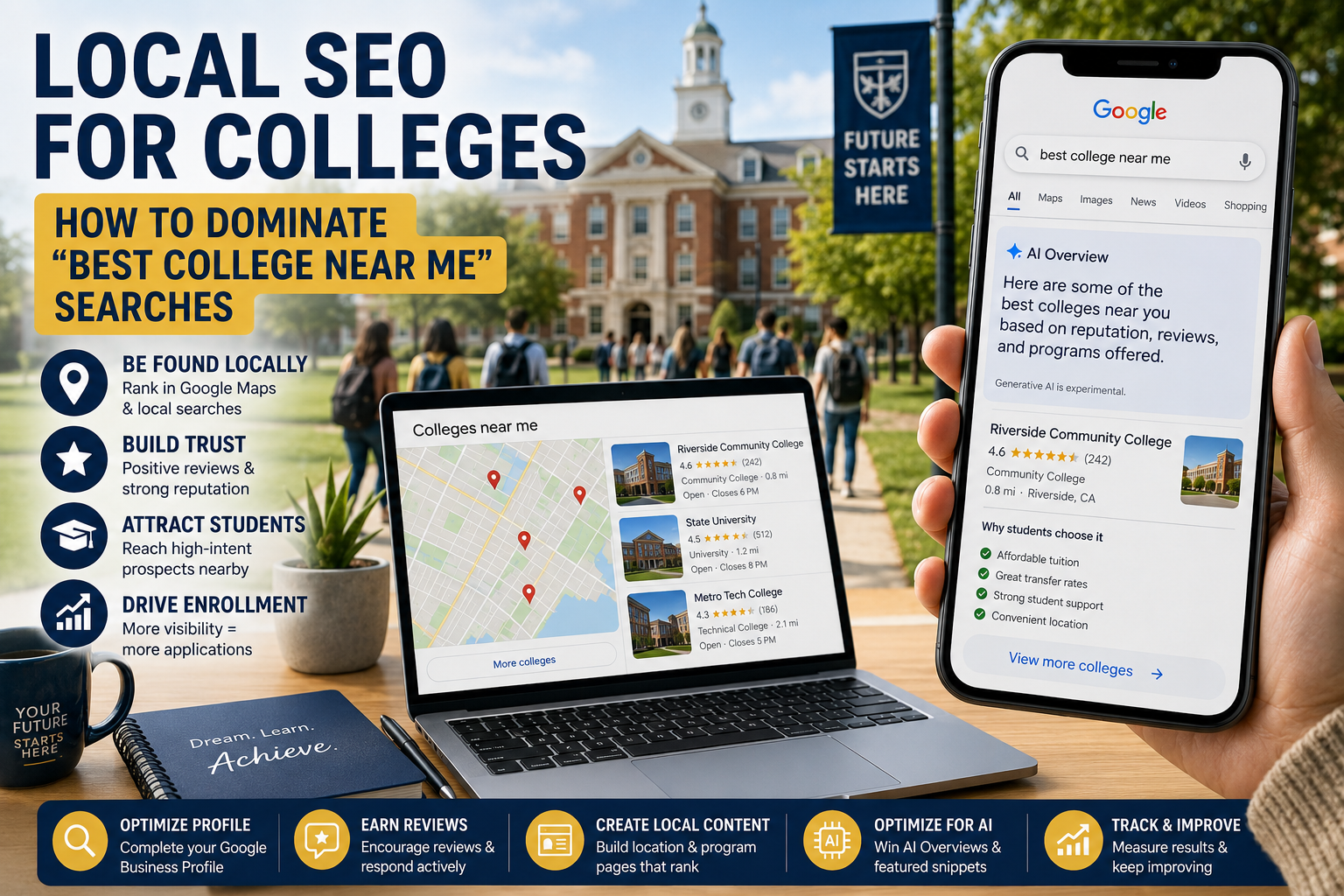
Picture a high school senior sitting on her bed at 11 p.m., phone in hand, typing “best college near me” into Google. She is not reading a 40-page viewbook. She is not calling an admissions counselor. She is scrolling. In the next ten seconds, she will form a first impression of five or six schools, and most of them will come from what shows up on her screen right now — not from your website’s homepage, but from your Google Business Profile, your reviews, and a short AI-written summary at the top of the page.
This is the new reality of college search. Local SEO for colleges is no longer a “nice to have” tucked under the marketing department’s to-do list. It is the front door to your admissions funnel. If your school is not optimized to show up, get clicked, and get trusted in that moment, a student never even reaches your homepage — she moves to the next name on the list.
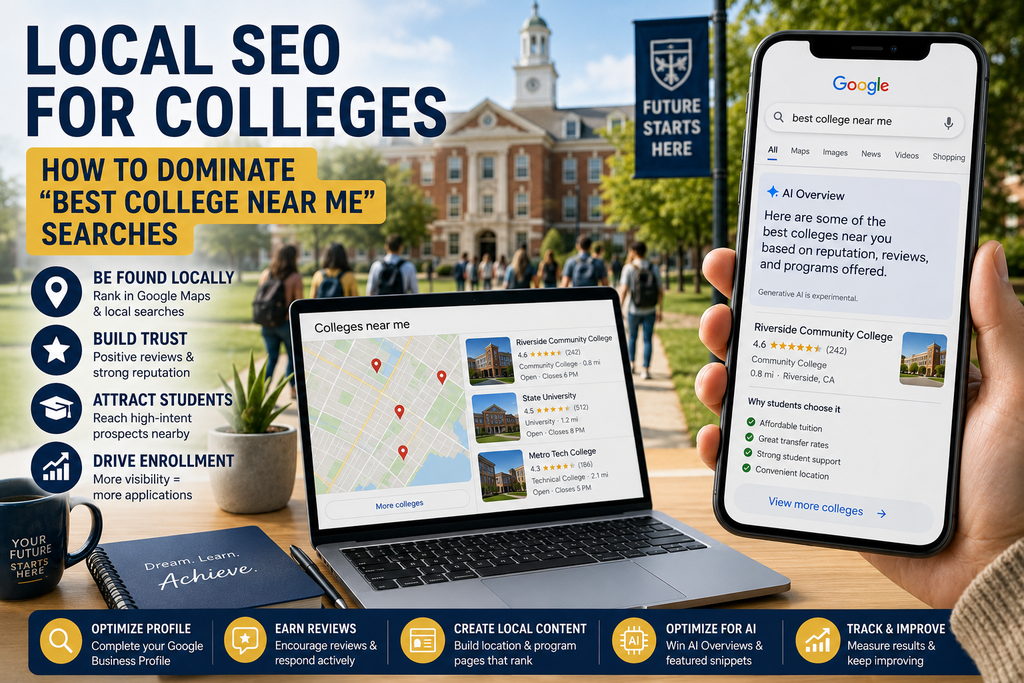
This guide walks you through exactly how to win “best college near me,” “colleges near me,” and every local, buyer-intent search a prospective student types in — in plain, simple language, with real steps you can hand to your marketing team today.
Think of this as your complete playbook: primary keywords like local SEO for colleges and best college near me, alongside secondary keywords like Google Business Profile optimization, campus location pages, AI Overview optimization, and enrollment marketing, all explained in the order you should actually tackle them.
What “Local SEO for Colleges” Actually Means
Local SEO is the practice of optimizing your school’s online presence so it shows up when people search for something “near” them — a place, a program, or a service tied to a location. For a business, that might mean “plumber near me.” For a college, it means searches like:
- Best college near me
- Colleges near me
- Community college in [city]
- Nursing programs near me
- [City] university admissions
Local SEO is particularly valuable for community colleges, satellite campuses, and programs that rely on regional enrollment, helping schools appear in geo-specific search results and connect with nearby students. Because many students study close to home, optimizing for local search and maps is essential for higher education marketing.
In short: local SEO is how your college gets discovered by the students who are most likely to actually enroll — the ones already searching in your backyard.
This matters most for a specific slice of your prospect pool: commuter students, transfer students, adult learners going back to school part-time, and families who have already decided their child will stay close to home. These groups don’t care about your national rankings. They care about one thing — is this school close, credible, and right for me? Local SEO is how you answer that question before they even click through to your site. For a broader look at how this fits into the bigger picture of enrollment strategy, the Search Influence guide to higher education SEO is a helpful starting point.
Why “Best College Near Me” Searches Matter So Much
Three shifts have made local search the most important channel in college marketing today.
1. Search behavior has changed. Students don’t browse college rankings lists first anymore — they Google a question and expect an instant answer.
2. AI Overviews now sit above everything else. By August 2025, about 83% of featured snippets had been replaced by AI Overviews — meaning Google is increasingly answering the question directly on the results page, before a student ever clicks a link.
3. Local intent equals enrollment intent. Optimizing for geographic search terms, such as “colleges in Chicago with data science programs,” ensures a school shows up in local map packs, directory listings, and mobile searches — right when students are ready to act. Local searchers are closer to a decision than someone casually browsing “best colleges in America.” They already know roughly where they want to study — they just need to be shown the right option.
The colleges that win these searches don’t just get more website traffic. Some institutions using strong local and AI-search strategies have seen non-branded search traffic jump 17 times over, while a public research university generated $148,000 in monthly traffic value from new content. That is the size of the opportunity sitting inside “best college near me.”
Step 1: Claim and Fully Optimize Your Google Business Profile
Your Google Business Profile (GBP) — the free listing that shows your school’s name, map pin, hours, photos, and reviews — is the single most important local SEO asset you own. Claim your institution’s Google Business Profile and keep its details up to date; make sure your name, address, and phone (NAP) are consistent on your site and across the web, since accurate information helps your college show up in Google Maps and local searches.
Here’s how to build it out properly:
Get Your Business Information Exactly Right
Use your school’s official name, exactly as it appears on your website and signage. Ensure precise and consistent address formatting across all platforms like Yelp, YellowPages, and Facebook — this consistency (often called NAP: Name, Address, Phone) is a trust signal Google actively checks.
Write a Keyword-Rich, Honest Description
Google Business Profile guidelines prohibit marketing taglines and trademarks, plus anything irrelevant to the business, so keep your description factual: founding year, location, programs, and accreditation, written naturally with the terms students actually search.
Choose the Right Categories and Attributes
Select the primary category that matches what you are (college, university, community college) and add secondary categories for specific programs. Attributes help highlight facilities and special features, so use them to flag things like on-campus housing, financial aid offices, or accessibility services.
Add Photos, Videos, and Regular Posts
Photos and videos show prospective students what to expect before they ever set foot on campus. The typical Business Profile only averages 1,260 views a month, and just 59 actions come from those views — meaning most institutions are leaving huge amounts of visibility on the table simply by not maintaining their listing.
Post Regularly
Effective posts are concise, include relevant keywords, and feature photos or videos to boost engagement, and Google Business Profiles offer three standard post types: update, offer, and event. Use these for open house dates, application deadlines, and new program launches — each post is a fresh, indexable signal to Google that your school is active.
Keep Q&A and Booking Features Active
Many prospective families use the Questions & Answers section on your profile to ask about parking, tour scheduling, or application deadlines before they ever visit your website. Assign someone on your admissions team to monitor and answer these promptly — an unanswered question sitting there for weeks quietly tells searchers nobody is paying attention.
For a full walkthrough of every profile field, the BrightLocal Google Business Profile optimization guide is one of the most thorough references available, and the WordStream guide to Google Business Profile optimization offers a useful side-by-side look at what an incomplete profile costs you compared to a fully optimized one.
Step 2: Win the Local Pack With Proximity and Prominence Signals
Google ranks local results using three main factors: relevance, distance, and prominence. Google Maps ranking depends partly on the physical proximity to the user’s location — businesses that are closer appear higher in local search results, which is especially important when people search “near me.”
Since you can’t move your campus closer to every searcher, you need to win on the two factors you can control:
- Relevance: Relevance is gained by optimizing the Google Business Profile with the right keywords and the right category.
- Prominence: This comes from reviews, citations, backlinks, and overall online authority — covered in the next sections.
Step 3: Turn Reviews Into a Ranking and Trust Engine
Reviews are not just social proof for nervous parents — they are a direct ranking signal. Reviews aren’t just for credibility; they’re search signals, and encouraging students to mention specific services and locations in their reviews helps your profile get found for those exact terms.
Build a simple, repeatable system:
- Ask at the right moment. Prompt graduating students, recent alumni, and satisfied parents to leave a review right after a positive touchpoint — orientation, a great advising session, or graduation.
- Respond to every review with purpose. Using keywords in your review replies helps boost indexation, while generic responses like “Thanks for the review!” should be avoided.
- Never fake or incentivize reviews. Always adhere to Google’s guidelines and never misrepresent your institution — keep information factual, accurate, and up to date to avoid penalties.
Step 3.5: Manage Citations Across Every Directory Your Students Already Trust
Beyond Google, students and parents cross-reference schools on education-specific directories like Niche, Cappex, and Peterson’s, as well as general local directories like Yelp and Bing Places. Every one of these listings should carry the exact same name, address, and phone number as your Google Business Profile. Inconsistent details across even two or three of these sites can quietly erode the trust signals Google uses to decide who deserves the top local spots.
Step 4: Build Location Pages for Every Campus and Program
If your institution has more than one campus, satellite location, or regional program, each one needs its own dedicated page. If your institution has multiple campuses, create a page for each location with that campus’s address, contact info, and unique details.
Go further than the basics by targeting the specific way local students phrase their searches. Instead of just targeting a broad term like “MBA program,” optimize for something like “part-time MBA in Phoenix for working professionals” if that matches what you actually offer — these long-tail, local queries show high intent and typically face lower competition, making them gold mines for enrollment marketing.
To find these opportunities systematically: research city-specific variations of your key programs, map the local search volume to prioritize your efforts, analyze the intent behind each query, and then create content that directly addresses those local searches.
Each location page should include the campus address and embedded map, a short paragraph on what makes that specific campus unique, program offerings available at that site, transportation and parking details, and photos taken on that actual campus — not stock imagery. This level of specificity is exactly what separates a page that ranks for “[city] campus” from one that gets ignored. For a deeper walkthrough of building out multi-campus local pages the right way, the Manaferra guide to local SEO for universities is worth reading in full.
Step 5: Optimize for Google AI Overviews (Not Just Rankings)
This is the part most college marketing teams are missing in 2026. Ranking #3 organically used to be good enough. Today, an AI-generated summary can sit above every blue link — including yours — and answer the student’s question before she ever scrolls down.
The content patterns that win featured snippets — clear question framing, direct first-sentence answers, and properly formatted lists and tables — are the same patterns Google’s AI systems use to select and construct AI Overviews. And the connection is strong: while top-ranking URLs are more likely to be included in AI Overviews, ranking alone isn’t enough — only about 50% of top-ranking pages were included, but if a page had a featured snippet, there was a 60% chance it would also be pulled into an AI Overview.
Here’s how to structure your college’s pages to win both:
Answer the Question in the First Sentence
Whatever the page is about — “best community college near [city]” or “how to apply for financial aid” — open the section with a direct, one- or two-sentence answer before adding detail. Design your content in self-contained sections, since AI systems often extract individual sections from longer articles, so every block should be able to stand alone as a complete answer.
Use Clear, Descriptive Headings
Well-structured content with clear H1, H2, and H3 headings makes it easy for AI to navigate your page — use descriptive headings that include your target keywords and clearly signal what each section covers.
Format for Scanning
AI Overviews favor content with clear hierarchical structure using H2 and H3 headings, plus scannable formatting like bullet points, numbered lists, and short paragraphs. Short sentences and paragraphs help, and writing in second person — using “you” — tends to perform better than a purely first-person tone.
Add Schema Markup
Implementing schema markup, like FAQ Page or Article schema, helps enhance context for search engines and AI systems alike. For colleges, this means adding FAQ schema to admissions pages, Event schema to open house listings, and Course schema to program pages.
Build Real Expertise Into the Page (E-E-A-T)
Demonstrating E-E-A-T — Experience, Expertise, Authoritativeness, and Trustworthiness — with credible, expert-driven content is crucial, since Google prioritizes trustworthy sources for its AI-generated answers. For a college, that means bylines from real admissions counselors or faculty, updated statistics, and links to your official financial aid or accreditation pages.
Keep Content Fresh
Update your admissions FAQ, tuition figures, and program pages at least once a semester. Google and its AI systems both favor pages that show recent, accurate updates over ones that have gone stale — a stale tuition figure is one of the fastest ways to lose a family’s trust once they notice.
For a deeper technical breakdown of query structures that trigger AI Overviews versus traditional snippets, see this 2026 guide to featured snippets in the AI Overview era, and for a broader explanation of how AI Overviews work compared to classic search results, the ResultFirst guide to optimizing for Google AI Overviews breaks it down clearly.
Step 6: Build Local Citations and Community Backlinks
Citations — mentions of your school’s name, address, and phone number on other websites — reinforce your legitimacy to Google. Get listed accurately on:
- Local chamber of commerce directories
- State higher education boards
- Education-specific directories (like Niche, Cappex, or your regional accreditor’s site)
- Local news outlets and community organizations
Beyond citations, build genuine local relationships. Tailor content to resonate with the local community while aligning with your institution’s goals — showcase stories of students, faculty, alumni, and community members who have made an impact locally, or engage with local influencers, organizations, and businesses to co-create content or cross-promote initiatives, which expands both reach and credibility within the community.
Local backlinks are especially valuable when they come from sources students already trust: your local newspaper covering a campus event, a high school counselor’s resource page linking to your admissions site, or a local business partnering with your career center on an internship program. These links do more than help your rankings — they put your school’s name in front of students at the exact moments they’re already paying attention.
Step 7: Create Content That Answers Real Student Questions
Local SEO isn’t only about your Google profile — it’s also about the content on your website. SEO helps higher ed institutions prioritize content that addresses real student needs, and the impact is easiest to understand through real-world enrollment results.
Build out pages and blog posts answering the exact questions local students and parents are typing into Google:
- “How much does [Your College] cost per year?”
- “What financial aid does [Your College] offer?”
- “Is [Your College] a good school for nursing?”
- “What’s it like living near [Your College]’s campus?”
Optimized admissions FAQs, application checklists, and explainers on cost, scholarships, and financial aid reduce friction and address students’ common concerns — these are the pages that nudge students across the finish line.
Ultimately, local SEO helps students and families understand the place behind the program, judge whether the school fits their needs, and move one step closer to enrolment — so every page should be written to build that trust, not just to rank.
Write every page for a real, nervous 17-year-old and her parents sitting at the kitchen table, not for a search engine. If the content answers their actual worries — cost, safety, class size, job placement after graduation — the rankings tend to follow. The 8-Bit Content guide to local SEO for higher education makes this same point well: local SEO succeeds when it helps families judge fit, not just when it hits a keyword quota.
Step 8: Track the Right Metrics
Don’t just watch overall traffic. Track:
- Map pack rankings for your top “near me” and city-based keywords
- Google Business Profile insights — calls, direction requests, and website clicks
- Review volume and average rating, tracked monthly by campus
- Local organic rankings for program + city keyword combinations
- Conversion rate from local landing pages to inquiry or application form submissions
Tools like Google Search Console and dedicated local SEO tracking platforms can help monitor and improve local SEO performance over time.
Common Mistakes Colleges Make With Local SEO
- Inconsistent NAP data. A mismatched address on your website versus your Google profile quietly damages your rankings.
- One page trying to represent every campus. Prospective students searching “near me” need a page built around their specific location.
- Ignoring reviews. An unanswered negative review sits at the top of your profile for every future visitor to see.
- Writing for search engines, not students. Content stuffed with keywords but light on real answers won’t earn trust — from students or from Google’s AI.
- Treating local SEO as a one-time project. Google’s AI heavily favors fresh, up-to-date content, so profiles and pages need regular updates, not a single setup-and-forget effort.
- No clear owner. Local SEO tends to fall through the cracks between the marketing, admissions, and IT teams. Assign one person to own the Google Business Profile, reviews, and location pages so nothing goes stale.
- Forgetting mobile. Most “best college near me” searches happen on a phone, often while a student is between classes or lying in bed. If your location pages load slowly or don’t display cleanly on mobile, you lose the click before the student even reads your answer.
Frequently Asked Questions
How long does local SEO take to show results for a college?
Most schools start seeing movement in Google Business Profile visibility within 4 to 8 weeks of a full optimization, while organic rankings for location pages typically take 3 to 6 months to mature, depending on competition in your area.
Do small or community colleges benefit from local SEO more than large universities?
Yes. Community colleges and regional schools rely almost entirely on nearby students, which makes local, “near me” searches an even bigger share of their enrollment funnel than for large national universities.
What’s the single highest-impact first step?
Claim, verify, and fully complete your Google Business Profile. It is free, it directly affects your map pack ranking, and it’s usually the most neglected asset a college owns.
Does AI Overview optimization replace traditional SEO?
No. Traditional SEO — solid content, clean site structure, and backlinks — is still the foundation. AI Overview optimization simply layers formatting and schema on top so that same strong content can also be pulled into AI-generated answers.
Bringing It All Together
Winning “best college near me” searches comes down to a simple formula: be accurate everywhere, be genuinely helpful on the page, and be structured in a way that both students and Google’s AI can quickly understand. Claim and fully build out your Google Business Profile. Earn and respond to reviews. Build a dedicated page for every campus and program. Write content that answers real questions in plain language, formatted so it can be pulled straight into an AI Overview. Then track what’s working and keep refining it.
Local SEO for colleges is not a side project anymore — it has become one of the most important enrollment strategies, since visibility within a geographic radius can genuinely make or break enrollment goals. The schools that treat it that way are the ones showing up — and getting chosen — the next time a student searches “best college near me.”