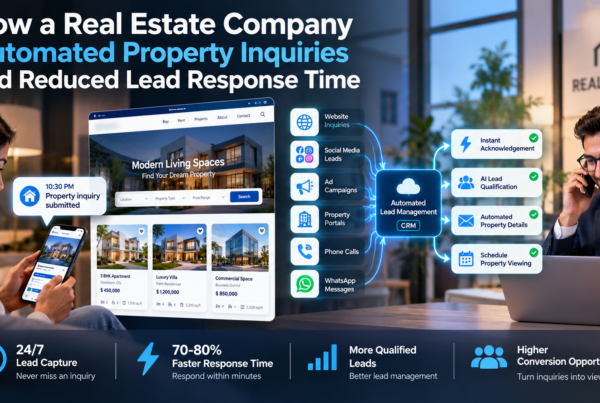

Real estate companies spend money on websites, digital advertising, property listings, and sales teams to attract potential buyers and tenants. However, generating inquiries does not guarantee a sale. Businesses must also capture every inquiry, assign it to the right agent, provide accurate property information, and follow up at the right time.
Consider a common situation. A buyer visits a real estate website and submits a form to schedule a property tour. The inquiry reaches a shared email inbox, but the sales team does not respond. Another agent contacts the same buyer without knowing that a colleague has already started the conversation. Meanwhile, the property the buyer wants is no longer available.
These disconnected processes can damage customer trust and waste valuable sales opportunities.
Real estate CRM integration helps solve this problem by connecting website inquiries, customer relationship management (CRM) software, automated lead assignment, and property availability data in one coordinated workflow. When these systems share information correctly, agents can respond faster, managers can track every opportunity, and customers can receive more accurate property information.

In this guide, we explain how real estate companies can integrate these systems, automate lead management, prevent missed inquiries, and build a more efficient sales process.
What Is Real Estate CRM Integration?
Real estate CRM integration connects a company’s website, CRM software, property database, and sales tools so they can exchange information automatically.
For example, when a potential buyer submits a property inquiry, the integrated system can:
✅ Capture the inquiry and save the buyer’s contact details.
✅ Create or update the buyer’s CRM record.
✅ Assign the inquiry to an appropriate real estate agent.
✅ Retrieve current property availability and listing details.
✅ Notify the agent about the new opportunity.
✅ Create follow-up reminders and appointment tasks.
✅ Track the lead from the first inquiry to the final sale.
The purpose is to eliminate disconnected records and manual tasks that prevent sales teams from acting on opportunities.
A real estate company does not necessarily need to replace its existing software. It can often connect its website, CRM, property management platform, and scheduling tools through application programming interfaces (APIs), webhooks, or supported integration services.
The best solution depends on the company’s existing technology, data quality, and business requirements.
Why Do Real Estate Companies Lose Website Leads?
Real estate businesses can lose opportunities even when their websites receive a steady flow of inquiries. The problem often occurs after a customer submits a form.
1. Website Inquiries Get Lost
Real estate websites can collect inquiries through property pages, contact forms, live chat, callback requests, and appointment booking tools.
When these channels operate separately, employees may need to check multiple inboxes and spreadsheets. Some inquiries receive immediate attention, while others remain unnoticed.
How integration helps:
✅ Send inquiries from all supported website forms to a centralized CRM.
✅ Record the inquiry source, submission time, and property of interest.
✅ Check for duplicate customer records before creating a new lead.
✅ Alert the sales team when an inquiry fails to reach the CRM.
This creates a reliable record of each opportunity and makes it easier to track customer communication.
2. Leads Are Assigned to the Wrong Agents
An agent who specializes in luxury homes may not be the best person to handle a rental inquiry. Similarly, an agent covering one city may not have the expertise or availability to serve a buyer in another market.
Manual assignment can create delays and uneven workloads.
How integration helps:
✅ Assign leads based on location, property type, price range, and agent expertise.
✅ Consider agent availability and current workload.
✅ Route urgent inquiries to the appropriate team.
✅ Escalate unassigned leads when they exceed the company’s response target.
Automated lead assignment gives every inquiry a clear owner and helps sales managers maintain accountability.
3. Property Availability Data Is Outdated
A property may become reserved, leased, sold, or unavailable while its website listing remains unchanged.
When agents rely on outdated records, they may contact buyers about properties that are no longer available. This wastes time and can damage the company’s reputation.
How integration helps:
✅ Connect the CRM and website to the authoritative property database.
✅ Synchronize important fields such as listing status and asking price.
✅ Notify agents when a property status changes.
✅ Flag listings that have not been updated successfully.
A connected system can reduce inconsistencies, although the actual results depend on data quality and synchronization reliability.
4. Follow-Ups Are Delayed or Forgotten
Real estate agents often handle several buyers, property tours, negotiations, and paperwork tasks simultaneously. Without clear reminders, important follow-ups can fall through the cracks.
How integration helps:
✅ Create follow-up tasks when a new inquiry arrives.
✅ Remind agents about unanswered leads.
✅ Trigger appointment confirmations and approved follow-up messages.
✅ Stop or adjust automated messages when a customer responds or opts out.
Automation supports the sales team without removing the personal attention customers need.
5. Sales Managers Lack Visibility
Disconnected systems make it difficult to understand which leads need attention and which marketing activities produce meaningful results.
How integration helps:
✅ Track inquiry sources and lead assignment history.
✅ Measure first-response and follow-up times.
✅ Identify agents with overdue tasks.
✅ Compare inquiry-to-appointment and lead-to-sale conversion rates.
These insights help managers identify process problems and make better decisions.
What Does Industry Research Say About Real Estate Technology?
Recent industry research highlights the importance of connecting lead generation, customer information, and customer service.
1. CRM Software Helps Real Estate Agents Generate Quality Leads
The National Association of REALTORS® published its 2025 REALTORS® Technology Survey on September 18, 2025. The survey included responses from more than 1,200 real estate professionals.
The survey found that 23% of respondents identified CRM software as the technology providing the highest number of quality leads. Social media ranked first at 39%.
Business takeaway: Real estate companies should connect lead generation channels with their CRM systems instead of treating website inquiries, advertising, and customer records as separate activities.
2. Buyers Continue to Rely on Real Estate Agents
The National Association of REALTORS® reported in its 2025 Profile of Home Buyers and Sellers that 88% of home buyers purchased through an agent or broker.
Business takeaway: Property websites should make it easy for buyers to connect with knowledgeable agents. Accurate listing information, clear inquiry forms, and timely follow-ups help support that relationship.
3. Customer Expectations Make Efficient Service More Important
Salesforce’s 2025 State of Service research found that 82% of surveyed service professionals agreed that customer expectations were higher than they had been in the past.
Business takeaway: Real estate companies need organized processes for handling inquiries, providing relevant information, and responding consistently. CRM integration and workflow automation can support these goals.
These findings provide context for investing in better lead management. They do not establish that CRM integration alone guarantees a particular increase in sales.
How to Connect Website Inquiries, CRM Lead Assignment, and Property Availability Data
Real estate companies can build an integrated lead management workflow in several practical steps.
Step 1: Centralize All Website Inquiries
Start by identifying every channel through which buyers and tenants contact the business.
Common sources include:
✅ Property listing inquiry forms.
✅ General contact and callback forms.
✅ Property tour booking pages.
✅ Website chat and chatbots.
✅ Advertising landing pages.
✅ Approved email and messaging integrations.
✅ Mobile applications and property portals.
Connect these channels to the CRM wherever supported.
Each inquiry should create a record containing relevant details such as the customer’s name, contact information, property of interest, preferred location, budget, source, and submission time.
Use validation rules to identify missing information and duplicate records. A returning buyer should not have to start from scratch every time they inquire about another property.
Recommended practice: Assign each inquiry a unique identifier so the business can track its progress from initial submission to appointment, negotiation, and closure.
Step 2: Connect the Website to the CRM Through APIs
An application programming interface allows different software systems to exchange information through defined rules.
For example, when a visitor submits a website form, the website can send the inquiry to the CRM through an API. The CRM validates the data and creates or updates the lead record.
A reliable integration should include:
✅ Field mapping between website forms and CRM records.
✅ Input validation and duplicate detection.
✅ Secure authentication and access controls.
✅ Error logging and retry mechanisms.
✅ Alerts for failed data transfers.
✅ Monitoring for delayed synchronization.
Webhooks can also notify connected systems when events occur, such as a new inquiry, an assignment change, or a property status update.
Before development begins, review the APIs, permissions, rate limits, and data formats supported by the existing platforms.
The goal is to create a dependable connection rather than simply transfer data as quickly as possible.
Step 3: Automate Real Estate CRM Lead Assignment
Once an inquiry reaches the CRM, the system must decide which agent should handle it.
A basic round-robin workflow distributes inquiries among agents in a rotating order. This may work for a small brokerage, but larger businesses often need more specific rules.
| Assignment rule | Business benefit |
|---|---|
| Property location | Connects buyers with agents covering the relevant area. |
| Property type | Matches customers with suitable specialists. |
| Budget range | Helps agents focus on relevant properties. |
| Agent availability | Reduces assignments to unavailable employees. |
| Current workload | Supports more balanced distribution. |
| Language preference | Improves communication. |
| Lead priority | Directs time-sensitive requests appropriately. |
For example, a buyer submits an inquiry about a two-bedroom apartment in Austin. The CRM reads the location, budget, and property type, then assigns the inquiry to an available agent who covers that market.
The agent receives a notification, and the CRM records the assignment time.
If the agent does not acknowledge the lead within the configured response window, the system can send a reminder or escalate the inquiry to a backup agent.
Review assignment rules regularly to ensure they reflect the actual responsibilities and availability of the sales team.
Step 4: Integrate the CRM With Property Availability Data
A CRM typically stores customer information, communication history, and sales activities. A separate property management system or listing database may control property details and availability.
Connecting these systems helps agents work with consistent information.
First, identify the authoritative source for each important field.
For example:
✅ Property status: the approved listing or property management system.
✅ Asking price: the authorized property record.
✅ Property features and address: the verified listing database.
✅ Customer preferences: the CRM.
✅ Assigned agent: the CRM lead assignment workflow.
✅ Appointment details: the connected scheduling system.
The integration should synchronize the fields required by each platform while preventing conflicting updates from overwriting trusted information.
Suppose a property changes from available to under contract. The listing platform can send an update to connected systems, allowing the website and CRM to reflect the new status.
When an agent opens the buyer’s record, the system should display the latest successful update and flag information that requires verification.
Important: Do not assume that every update happens instantly. Synchronization delays, failed API calls, and incomplete records can still occur. Monitor these issues and avoid presenting outdated availability data as confirmed information.
Step 5: Automate Follow-Ups and Appointment Scheduling
After capturing and assigning a lead, the system should help the agent take the next action.
Useful automated workflows include:
✅ Sending an inquiry acknowledgment.
✅ Creating a task for the assigned agent.
✅ Reminding agents about unanswered inquiries.
✅ Scheduling property tours and sending confirmations.
✅ Recording visit outcomes and buyer feedback.
✅ Suggesting suitable alternative properties when a listing becomes unavailable.
✅ Updating the lead’s status after important sales activities.
AI can also summarize inquiry details, classify requests, suggest matching listings, and draft follow-up messages.
However, important information about prices, contractual terms, financing, property condition, and legal requirements should be verified before it is communicated to customers.
Respect customer communication preferences and consent, and stop inappropriate automated messages when a customer responds or opts out.
The best approach combines automated administration with personal service from real estate professionals.
What Does an Integrated Real Estate Lead Management Workflow Look Like?
A typical workflow follows these steps:
Website inquiry → CRM record → Lead assignment → Property availability check → Agent notification → Follow-up → Property visit → Sales outcome
For example, a buyer submits a form asking to visit a three-bedroom home.
The website sends the inquiry to the CRM, which checks for an existing customer record and assigns the lead to an appropriate agent. The system retrieves the property’s latest status and creates a follow-up task.
If the property is available, the agent can contact the buyer and arrange a visit. If the listing becomes unavailable, the system flags the change so the agent can verify the situation and discuss suitable alternatives.
This process reduces unnecessary manual work and gives the sales team a clearer view of each opportunity.
Key Features to Include in a Real Estate CRM Integration
Real estate companies should prioritize features that solve their most important operational problems.
Essential Features
✅ Centralized lead capture: Collect inquiries from supported channels in one CRM workflow.
✅ Automated lead routing: Assign leads using clear business rules.
✅ Property availability synchronization: Keep important listing details aligned across connected platforms.
✅ Follow-up reminders: Help agents complete scheduled activities.
✅ Appointment integration: Coordinate property visits and consultations.
✅ Duplicate detection: Prevent fragmented customer records.
✅ Mobile CRM access: Allow agents to update information while working outside the office.
✅ Sales dashboards: Monitor lead status, response times, and conversion metrics.
✅ Integration monitoring: Identify failed transfers and outdated data.
Advanced Features
Businesses with more complex needs may also benefit from:
✅ AI-assisted inquiry classification.
✅ Automated property recommendations.
✅ Conversational chatbots for routine questions.
✅ Lead scoring based on transparent business rules.
✅ Predictive reporting using reliable historical data.
Advanced features should be added only when the underlying CRM records, property data, and core workflows are reliable.
How to Measure the Success of Real Estate CRM Integration
The purpose of integration is to improve business operations, not simply connect software. Real estate companies should establish baseline measurements before implementation and compare performance after the new workflow is established.
1. First-Response Time
Measure the time between an inquiry arriving and the first meaningful response from an agent.
Track median response time and the percentage of leads receiving a response within the company’s target window.
Keep automated acknowledgments separate from actual agent responses.
2. Lead Assignment Time
Measure how long new inquiries remain unassigned.
Use alerts to identify leads that exceed the defined assignment threshold.
3. Follow-Up Completion Rate
Track how many scheduled calls, emails, and other approved follow-up activities are completed on time.
This helps managers identify gaps in the sales process.
4. Property Data Accuracy
Monitor listing discrepancies, failed synchronization events, and delays in reflecting approved status changes.
These measures help identify whether connected systems are sharing reliable information.
5. Inquiry-to-Appointment Conversion
Calculate the percentage of qualified inquiries that result in scheduled property visits or consultations.
Compare results by marketing source, property type, location, and agent.
6. Lead-to-Sale Conversion
Measure how many qualified leads eventually become completed transactions.
Because real estate sales cycles can be lengthy, evaluate results over an appropriate period and consider pipeline progress alongside completed sales.
These metrics provide evidence of operational improvements without assuming that integration alone causes every change in sales performance.
Common Real Estate CRM Integration Challenges and Solutions
Even a well-designed integration can fail when data quality, system reliability, or employee adoption is overlooked.
Inconsistent Property Records
The same property may have different identifiers or addresses across systems.
✅ Solution: Establish unique property IDs, standardize fields, and define which system controls each data element.
API Failures and Delayed Updates
Expired credentials, rate limits, network failures, or unexpected data formats can interrupt information transfer.
✅ Solution: Implement controlled retries, error logging, alerts, and reconciliation checks. Route unresolved failures to a monitored exception queue.
Incorrect Lead Assignment
Leads may be assigned to unavailable agents or employees who do not cover the relevant market.
✅ Solution: Maintain accurate agent availability, test routing rules, and configure backup assignments.
Low CRM Adoption
Agents may avoid updating records if the workflow is complicated or duplicates existing work.
✅ Solution: Simplify forms, provide mobile access, automate repetitive tasks, and train employees.
Data Privacy and Security Risks
Real estate inquiries can contain personal contact details and financial preferences.
✅ Solution: Use secure authentication, appropriate access permissions, encryption, audit logs, and suitable data retention policies. Review applicable privacy laws and data-sharing requirements.
Overreliance on Automation
Automated systems may share incorrect information if source records are outdated.
✅ Solution: Define authoritative data sources, monitor synchronization, and require human verification for important or consequential decisions.
A Practical Implementation Plan for Real Estate Companies
A phased approach helps real estate businesses improve their systems without unnecessarily disrupting daily sales activities.
Phase 1: Audit Existing Systems
✅ List all website inquiry channels, CRM platforms, property databases, and scheduling tools.
✅ Identify where leads are lost, delayed, or duplicated.
✅ Record baseline response times and conversion metrics.
Phase 2: Define Integration Rules
✅ Decide which system owns each important data field.
✅ Establish lead assignment and escalation rules.
✅ Define how property status changes should be communicated.
Phase 3: Build Core Integrations
✅ Connect website forms to the CRM.
✅ Configure lead routing and follow-up reminders.
✅ Connect the authoritative property data source.
Phase 4: Test Real-World Scenarios
✅ Verify that new inquiries are captured and assigned correctly.
✅ Test duplicate inquiries and unavailable properties.
✅ Simulate failed transfers and delayed synchronization.
Phase 5: Launch a Pilot
✅ Start with one team, location, or property category.
✅ Collect agent feedback and resolve workflow issues.
✅ Expand gradually after the process becomes reliable.
Phase 6: Monitor and Improve
✅ Review response times, assignment accuracy, and listing discrepancies.
✅ Compare conversion metrics with the original baseline.
✅ Update rules as the business and technology requirements change.
This phased approach helps companies control implementation risk and prioritize the improvements that matter most.
How HT Business Group Can Help Real Estate Companies Connect Their Systems
Real estate businesses often need more than a new website or an off-the-shelf CRM. They need their existing tools to work together around the way their sales teams operate.
HT Business Group can help businesses explore technology solutions involving real estate website development, CRM development, API integrations, and workflow automation.
Companies can explore its real estate website development services to learn how property websites can support inquiry capture and CRM connectivity.
Businesses interested in centralized customer records and property-related workflows can also review its real estate CRM development case study.
The right solution should reflect the company’s current software, data quality, sales processes, security requirements, and growth plans.
The objective is to reduce manual work, improve information accuracy, and help employees manage customer opportunities more consistently.
Conclusion
Real estate companies can prevent missed opportunities by connecting website inquiries, CRM lead assignment, and property availability data through a reliable integration strategy.
Centralized lead capture helps ensure that inquiries are recorded. Automated assignment gives every opportunity a clear owner. Property data synchronization helps agents provide accurate listing information, while follow-up automation supports consistent communication.
The most effective systems also include error monitoring, secure data access, clear data ownership, and performance reporting.
Real estate businesses do not need to automate every process immediately. They can start by connecting their most important systems, measuring the results, and expanding the workflow as their needs evolve.
When website inquiries, customer records, property information, and agent workflows work together, real estate companies can manage leads more effectively, reduce operational gaps, and create a more reliable experience for potential buyers and tenants.
Frequently Asked Questions
1. How can real estate companies prevent missed website inquiries?
Real estate companies can connect website forms, live chat, and property inquiry pages directly to a centralized CRM. Each inquiry should receive a unique record, a timestamp, and an assigned owner. Automated notifications can flag unanswered or unassigned leads. Regular integration monitoring helps identify inquiries that fail to reach the CRM.
2. How does CRM integration improve real estate lead assignment?
CRM integration allows real estate companies to assign leads according to location, property type, budget, agent expertise, and availability. Automated rules reduce manual distribution and make lead ownership easier to track. If an agent does not acknowledge an inquiry within the defined response window, the system can send a reminder or escalate it to a manager.
3. Why should real estate websites connect to property availability databases?
Connecting a real estate website to an authoritative property database helps keep listing status, prices, and important property details consistent across systems. When a property’s status changes, connected platforms can receive the update automatically. Monitoring synchronization and verifying source data help reduce the risk of promoting unavailable properties.
4. Can AI automate real estate lead management?
Yes. AI can classify inquiries, summarize buyer preferences, answer routine questions, suggest relevant properties, and draft follow-up messages. CRM workflows can then assign leads and create tasks for agents. Important property details should come from verified sources, and human agents should remain involved in negotiations and consequential customer decisions.
5. What is the best way to integrate a real estate website with a CRM?
Start by mapping website forms to CRM fields and connecting the systems through supported APIs or integration tools. Configure validation, duplicate detection, lead assignment, and follow-up workflows. Then connect the authoritative property database and test failed transfers, duplicate inquiries, and delayed updates before launch. Ongoing monitoring helps maintain reliability as the business grows.
6. What are the benefits of automated real estate lead management?
Automated real estate lead management helps centralize inquiries, assign leads to the right agents, create follow-up reminders, and track sales activities. Connecting property availability data also helps agents provide more accurate listing information. The overall benefits depend on data quality, workflow design, employee adoption, and integration reliability.
7. How can real estate companies keep property availability data accurate?
Real estate companies should identify one authoritative source for each important property field and synchronize approved changes with connected systems. Integration monitoring should detect failed updates, conflicting records, and delays. When the latest status cannot be confirmed, the system should flag the information for verification rather than treating outdated data as current.