Choosing the right e-commerce platform can affect everything—from your website costs and store speed to customization, SEO, payments, and long-term growth.
Two platforms often considered by growing online businesses are nopCommerce and Shopify.
Shopify is known for being easy to launch, hosted, and beginner-friendly. nopCommerce takes a different approach. It is an open-source e-commerce platform built on ASP.NET Core, giving businesses more control over the code, hosting, customization, and integrations.
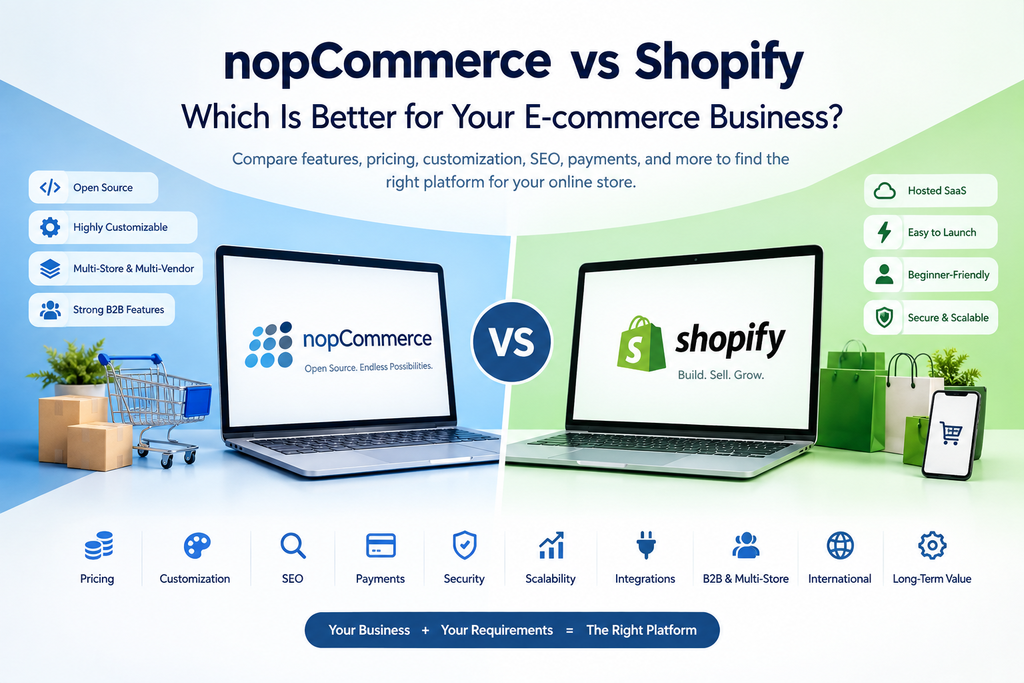
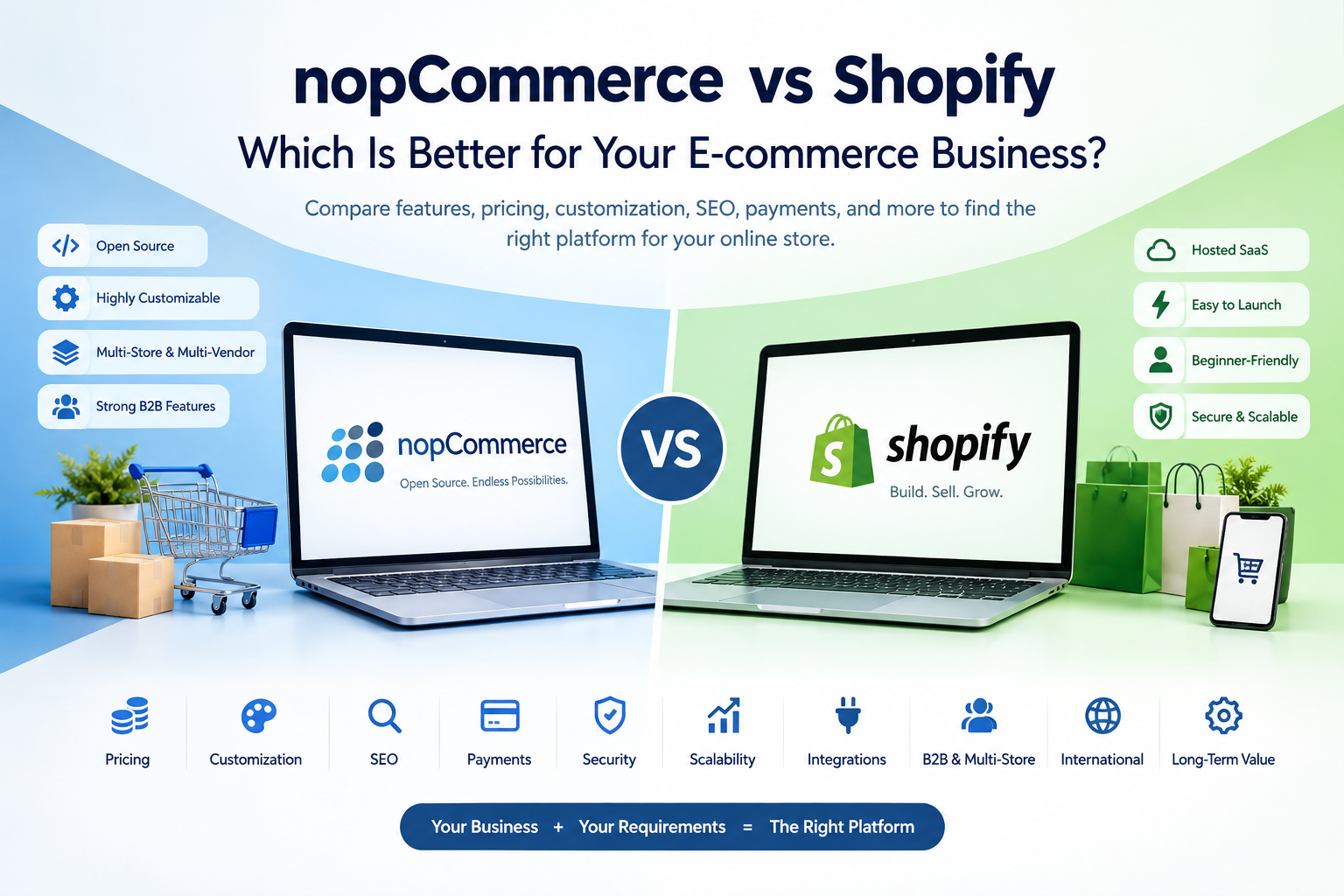
So, which is better: nopCommerce or Shopify?
The short answer is:
Shopify is usually the better choice for businesses that want a fast, simple, hosted e-commerce solution. nopCommerce can be the better choice for businesses that need deep customization, multi-store capabilities, B2B functionality, or greater control over their technology stack.
The right choice depends on your business model, technical requirements, budget, growth plans, and how much control you want over your online store.
In this guide, we will compare nopCommerce vs Shopify in detail, including features, pricing, customization, SEO, security, scalability, B2B e-commerce, integrations, ease of use, and long-term business value.
Quick Answer: nopCommerce vs Shopify
If you need a quick answer, here is the comparison:
| Feature | Shopify | nopCommerce |
| Platform type | Hosted SaaS | Open-source |
| Hosting | Included | You choose hosting |
| Coding required | Low for basic stores | More technical |
| Customization | High | Very high |
| Source code access | Limited | Full access |
| Multi-store | Available, plan-dependent | Built-in capability |
| Multi-vendor | Available through apps/solutions | Built-in capability |
| B2B features | Available, with plan/features | Strong built-in B2B features |
| SEO | Strong | Strong |
| Payment options | Large ecosystem | Large ecosystem |
| Hosting control | Limited | Full control |
| Maintenance | Mostly handled by Shopify | Business/developer responsibility |
| Transaction fees | May apply depending on payment setup | No platform transaction fee |
| Best for | Fast launches and easy management | Custom and complex e-commerce |
| Technical skill | Beginner-friendly | Developer-friendly |
Shopify describes itself as an all-in-one commerce platform that handles online stores, payments, inventory, marketing, analytics, and multiple sales channels from one system.
nopCommerce is a free, open-source e-commerce platform built on ASP.NET Core. Its official feature set includes multi-store, multi-vendor, B2B, advanced SEO, multi-currency, and international e-commerce functionality.
What Is Shopify?
Shopify is a hosted e-commerce platform designed to make it easier for businesses to launch and manage online stores.
You do not need to purchase separate web hosting to start a Shopify store. Shopify includes hosting, security features, a store builder, checkout, inventory tools, analytics, and other commerce features as part of its platform.
This makes Shopify attractive to:
- Startups
- Small businesses
- Direct-to-consumer brands
- Online retailers
- Dropshipping businesses
- Growing e-commerce companies
- Businesses that want to launch quickly
Shopify also supports multiple sales channels, including online stores, social platforms, marketplaces, and in-person selling.
For businesses that want simplicity, Shopify can remove many technical headaches.
You do not have to manage a server, install the platform manually, or maintain the core infrastructure yourself.
Shopify’s biggest advantage
Simplicity.
You can create a store, add products, configure payments, select a theme, and start selling without being an experienced developer.
However, simplicity can also create limitations when a business needs highly specialized functionality.
What Is nopCommerce?
nopCommerce is an open-source e-commerce platform based on Microsoft ASP.NET Core.
Unlike a hosted platform, nopCommerce gives businesses much more control over the underlying application and infrastructure.
The official nopCommerce documentation describes it as a customizable, secure, stable, and extendable e-commerce platform.
nopCommerce is designed for different types of businesses, including:
- B2C stores
- B2B businesses
- Manufacturers
- Wholesalers
- Distributors
- Multi-vendor marketplaces
- Multi-store businesses
- International businesses
- Enterprise e-commerce companies
Its official feature set includes multi-store and multi-vendor functionality, advanced SEO tools, multi-currency support, multiple languages, payment integrations, shipping integrations, and B2B capabilities.
nopCommerce’s biggest advantage
Control and flexibility.
Because the platform is open source, developers can modify the code and create custom functionality around a business’s requirements.
That can be extremely valuable when your e-commerce operation does not fit a standard store model.
nopCommerce vs Shopify: The Biggest Difference
The most important difference is the way these platforms are built.
Shopify is a hosted SaaS platform.
nopCommerce is an open-source platform that you can host and customize.
Think about it this way:
Shopify
You are essentially saying:
“I want a powerful e-commerce system without worrying about the underlying infrastructure.”
nopCommerce
You are saying:
“I want an e-commerce system that I can control and customize around my business.”
Neither approach is automatically better.
The question is:
Which approach fits your business?
1. Ease of Use: Shopify vs nopCommerce
Shopify
Shopify wins when it comes to simplicity.
A business owner can manage products, orders, inventory, payments, themes, and other basic store operations through the Shopify admin.
Shopify itself says that users do not need to be designers or developers to use the platform.
This is a major advantage for:
- New entrepreneurs
- Small teams
- Businesses without technical employees
- Businesses that want a fast launch
nopCommerce
nopCommerce is also designed to be manageable, but its full potential often requires technical knowledge.
For example, if you want to make deep changes to the platform, customize the checkout, connect a complex ERP, modify business rules, or create custom functionality, you will likely need an experienced developer.
Winner: Shopify
If ease of use is your top priority, Shopify is usually the better option.
2. Customization
This is where the comparison becomes much more interesting.
Shopify customization
Shopify provides themes, apps, APIs, integrations, and development tools.
You can customize many parts of your store without touching the underlying platform.
For most standard e-commerce businesses, this is enough.
But highly complex requirements may require additional apps, custom development, or Shopify Plus.
Shopify’s higher-tier offerings provide additional capabilities for larger businesses, while Shopify Plus is designed for high-volume and enterprise commerce.
nopCommerce customization
nopCommerce is open source.
That means developers can work directly with the platform’s code and architecture.
The official nopCommerce documentation highlights its customizable and extensible architecture, while its feature pages emphasize open-source code and a pluggable architecture.
This can be especially useful if you need:
- Custom checkout logic
- Complex pricing rules
- Custom customer roles
- ERP integration
- CRM integration
- PIM integration
- WMS integration
- Custom shipping rules
- Custom B2B workflows
- Multi-store architecture
- Custom product configurations
- Unique business processes
Winner: nopCommerce
For deep technical customization, nopCommerce has a major advantage.
3. Pricing: Is nopCommerce Cheaper Than Shopify?
This is one of the most important questions businesses ask.
But comparing only the platform price can be misleading.
You should calculate the total cost of ownership.
Shopify pricing
Shopify uses a subscription model.
Current official pricing lists plans such as Basic, Grow, Advanced, and Shopify Plus, with pricing varying by plan, billing cycle, country, and other factors.
Shopify also notes that third-party transaction fees can apply when using certain third-party payment providers.
You may also have costs for:
- Premium themes
- Paid apps
- Custom development
- Marketing tools
- Specialized integrations
- Shopify Plus for enterprise requirements
nopCommerce pricing
The nopCommerce software itself is free and open source.
The official nopCommerce website states that its platform has no monthly platform fee and no transaction fee.
However, “free software” does not mean a store has zero costs.
You may need to pay for:
- Hosting
- Development
- Customization
- Premium plugins
- Themes
- Security management
- Maintenance
- Technical support
- Third-party services
Which one is cheaper?
There is no universal answer.
A simple Shopify store may be less expensive to launch because hosting and much of the infrastructure are included.
A highly customized nopCommerce store may require a larger upfront development investment but can provide more control over long-term architecture and business functionality.
Winner: It depends
Shopify can be more cost-effective for simple stores.
nopCommerce can become attractive for businesses that need extensive customization and want to avoid platform transaction fees or proprietary limitations.
4. SEO: Shopify vs nopCommerce
SEO matters because your e-commerce website needs more than a beautiful design.
You need customers to find your products on search engines.
Both platforms can support e-commerce SEO.
Shopify SEO
Shopify provides a number of built-in tools and supports additional SEO functionality through its ecosystem.
You can work on:
- Product titles
- Meta descriptions
- URLs
- Content
- Images
- Structured data through themes/apps
- Internal linking
- Site performance
- Redirects
- Content marketing
The platform also provides built-in analytics and commerce tools.
nopCommerce SEO
nopCommerce has strong built-in SEO functionality.
Its official documentation and feature pages highlight SEO-friendly URLs, customizable URLs, SEO settings, product optimization, and other search-friendly features.
This can be particularly useful for businesses that need greater control over technical SEO.
Winner: Tie
Both platforms can support a strong SEO strategy.
The platform alone will not guarantee rankings.
Your results will depend on:
- Technical SEO
- Keyword targeting
- Product content
- Search intent
- Internal linking
- Site architecture
- Page speed
- Backlinks
- Content quality
- User experience
- Structured data
A poorly optimized Shopify website can lose to a well-optimized nopCommerce store—and vice versa.
5. B2B E-commerce
This is an area where nopCommerce becomes especially interesting.
B2B companies often need functionality that a basic online store does not.
For example:
- Customer-specific pricing
- Wholesale pricing
- Multiple customer roles
- Purchase orders
- Tier pricing
- Minimum order quantities
- Multiple warehouses
- ERP integration
- Custom catalogs
- Sales representative workflows
- Quote requests
nopCommerce has built-in B2B functionality including customer roles, tier pricing, multi-store support, multi-vendor functionality, integrations, and other tools designed for wholesalers, manufacturers, and distributors.
Shopify also supports B2B commerce, with B2B capabilities varying by plan and setup. Shopify’s current plan information includes B2B functionality, with more extensive capabilities available on higher tiers.
Winner: nopCommerce for highly customized B2B
If your B2B business has complex pricing, customer rules, ERP workflows, or custom ordering processes, nopCommerce deserves serious consideration.
6. Multi-Store E-commerce
Imagine you operate:
- Store A for the United States
- Store B for Canada
- Store C for Europe
- Store D for wholesale customers
Managing everything separately can become complicated.
nopCommerce includes multi-store functionality that allows businesses to manage multiple storefronts from a single installation.
You can use multiple stores for:
- Different brands
- Different countries
- B2B and B2C
- Different product groups
- Regional markets
- Separate storefronts
Shopify can also support multiple stores and enterprise setups, but the structure and cost can differ depending on the business requirements.
Winner: nopCommerce for control-heavy multi-store environments
7. Multi-Vendor Marketplace
Want to build something similar to a marketplace where multiple sellers can list products?
nopCommerce includes multi-vendor functionality as part of its platform capabilities.
That makes it attractive for businesses considering:
- Marketplace websites
- Supplier marketplaces
- Wholesale platforms
- Multi-vendor stores
- Distributor networks
Shopify can support marketplace models through apps and custom solutions, but the architecture may require more external components depending on your exact requirements.
Winner: nopCommerce for built-in flexibility
8. Hosting and Infrastructure
This is another major difference.
Shopify
Shopify handles hosting for you.
That means you don’t have to manage:
- Web servers
- Core platform updates
- Basic infrastructure
- Server scaling
Shopify includes secure hosting and unlimited bandwidth with its plans.
This is convenient.
nopCommerce
With nopCommerce, you have more control over where and how your store runs.
The platform can be installed on different hosting environments, including Windows, Linux, Azure, and private cloud infrastructure according to its documentation.
That control can be valuable for organizations with specific infrastructure, compliance, performance, or integration requirements.
Winner:
Shopify for simplicity.
nopCommerce for infrastructure control.
9. Security
Security is critical for any online store.
Shopify handles much of the platform-level infrastructure and provides PCI-compliant commerce infrastructure. Shopify states that stores powered by Shopify are PCI compliant by default.
With nopCommerce, the platform includes security-focused capabilities, but because you control hosting and deployment, your development and infrastructure team also has responsibilities.
That includes:
- Server security
- Updates
- Backups
- Access control
- Monitoring
- SSL/TLS
- Application configuration
- Security testing
Winner: Shopify for businesses that want managed infrastructure
For businesses with a capable development and infrastructure team, nopCommerce can provide much greater control.
10. Integrations
Modern e-commerce rarely operates alone.
Your store may need to connect with:
- CRM
- ERP
- Accounting software
- Shipping systems
- Payment gateways
- Warehouse systems
- Marketing platforms
- PIM systems
- Analytics platforms
nopCommerce is designed with integration and extensibility in mind. Its official B2B documentation highlights integrations with CRM, PIM, ERP, and WMS systems.
Shopify also has a large ecosystem of apps, integrations, APIs, and commerce tools.
Winner: Tie
Shopify wins for its large ecosystem and ease of connecting common tools.
nopCommerce wins when you need deep, custom integrations and direct control over the application.
11. Scalability
The real question isn’t:
“Can this platform handle my store today?”
The better question is:
“Can this platform support my business five years from now?”
Both platforms can support growing businesses.
Shopify provides managed infrastructure and multiple plans designed for businesses at different stages. Shopify says its Advanced plan is intended for high-volume businesses, while Shopify Plus targets larger-scale commerce.
nopCommerce provides features aimed at SMB and enterprise businesses, including multi-store, multi-vendor, international commerce, and customizable architecture.
Winner: Depends on your growth model
Choose Shopify when you want managed scaling with minimal infrastructure work.
Choose nopCommerce when scalability also means custom architecture, infrastructure control, and complex business processes.
12. International E-commerce
If you plan to sell internationally, your platform needs to support more than different currencies.
You may need:
- Multiple languages
- Regional pricing
- International payments
- Tax rules
- Shipping providers
- Regional stores
- SEO localization
nopCommerce provides multi-currency, multi-language, international payment, shipping, tax, and multi-store functionality.
Shopify also supports international selling and multiple sales channels, with features varying by plan and market.
Winner: Tie
Both can support international e-commerce.
Your choice should depend on the complexity of your international business model.
Shopify vs nopCommerce: Which Is Better for Small Businesses?
For a small business launching its first online store, Shopify is usually the easier choice.
Why?
Because you can:
- Launch quickly
- Use pre-built themes
- Manage products easily
- Avoid server management
- Use built-in commerce features
- Add apps as needed
If your requirements are straightforward, Shopify can get you selling without a large technical team.
Shopify vs nopCommerce: Which Is Better for Enterprise?
For enterprise businesses, the answer becomes more complicated.
If your business needs:
- Complex B2B workflows
- Multiple stores
- Multiple vendors
- Custom pricing
- Deep ERP integration
- Custom business logic
- Complete source-code access
- Infrastructure control
then nopCommerce may be the stronger choice.
On the other hand, if your enterprise wants a managed commerce platform with a large ecosystem and less infrastructure responsibility, Shopify Plus may be a better fit. Shopify’s official documentation positions Plus for high-volume businesses and enterprise use cases.
Shopify vs nopCommerce: Which Is Better for B2B?
If your business is primarily B2B, don’t choose based only on design.
Think about your actual sales process.
Ask:
- Do customers have different prices?
- Do customers have different catalogs?
- Do you need purchase orders?
- Do you need customer-specific discounts?
- Do you need sales representatives?
- Do you need ERP integration?
- Do you need multiple warehouses?
- Do you need different checkout rules?
If the answer to several of these questions is yes, nopCommerce deserves a serious look.
Its B2B functionality includes customer roles, tier pricing, multi-store, ERP/CRM/PIM/WMS integrations, quote-related functionality, and multi-vendor capabilities.
When Should You Choose Shopify?
Shopify is a strong choice if you:
- Want to launch quickly
- Don’t have a technical team
- Want managed hosting
- Prefer a simple admin interface
- Sell standard products
- Need common integrations
- Want a large app ecosystem
- Prefer predictable platform management
- Want to focus more on marketing and sales than infrastructure
For many small and medium-sized online stores, Shopify can be the practical choice.
When Should You Choose nopCommerce?
nopCommerce may be the better choice if you:
- Need extensive customization
- Want access to source code
- Need custom business logic
- Operate a B2B business
- Need multi-store functionality
- Need multi-vendor functionality
- Need complex ERP integration
- Want control over hosting
- Want to avoid platform transaction fees
- Need custom checkout workflows
- Have an experienced development team
- Need an ASP.NET Core-based e-commerce platform
The platform’s open-source architecture is particularly valuable when your business requirements do not fit neatly into a standard e-commerce template.
The Biggest Mistake Businesses Make
The biggest mistake is choosing an e-commerce platform based only on its popularity.
A platform can be extremely popular and still be the wrong choice for your business.
Instead, start with your requirements.
For example:
If your priority is:
Fast launch → Shopify
Simple management → Shopify
Managed hosting → Shopify
Large app ecosystem → Shopify
Deep customization → nopCommerce
Open-source control → nopCommerce
Complex B2B → nopCommerce
Multi-store requirements → nopCommerce
Custom ERP integration → nopCommerce
Full infrastructure control → nopCommerce
This approach is much more useful than simply asking which platform is “better.”
nopCommerce vs Shopify: Final Verdict
So, is nopCommerce better than Shopify?
Not for everyone.
And is Shopify better than nopCommerce?
Again, not for everyone.
Choose Shopify if:
You want a fast, easy-to-manage, hosted e-commerce platform that lets you focus on products, customers, marketing, and sales.
Choose nopCommerce if:
You need a flexible, open-source e-commerce platform that can be deeply customized around your business processes.
The decision ultimately comes down to simplicity vs control.
Shopify gives you a managed environment where much of the technical infrastructure is handled for you.
nopCommerce gives you more freedom to control the technology, customize the platform, and build functionality around complex business requirements.
For a simple D2C store, Shopify may be the smarter starting point.
For a complex B2B, multi-store, multi-vendor, or highly customized e-commerce operation, nopCommerce may provide the flexibility you need.
Frequently Asked Questions
Is nopCommerce better than Shopify?
nopCommerce is not automatically better than Shopify. Shopify is generally easier to launch and manage, while nopCommerce provides greater control and open-source customization. The best platform depends on your business requirements.
Is nopCommerce free?
Yes. nopCommerce is free and open source. However, businesses may still pay for hosting, development, customization, plugins, themes, maintenance, and support.
Is Shopify free?
Shopify is not permanently free. Shopify currently offers a free trial, after which you select a paid plan. Pricing varies by plan, billing cycle, and location.
Which is better for SEO, nopCommerce or Shopify?
Both can support strong e-commerce SEO. nopCommerce provides extensive control over URLs and technical SEO settings, while Shopify provides built-in SEO capabilities and a large ecosystem. Your SEO strategy and implementation matter more than the platform name alone.
Which is better for B2B e-commerce?
nopCommerce can be a strong choice for complex B2B businesses because it provides features such as customer roles, tier pricing, multi-store functionality, integrations, and other B2B capabilities. Shopify also supports B2B commerce, particularly through its higher-level plans.
Which platform is easier to use?
Shopify is generally easier for beginners because it is a hosted platform with a simple administration system and managed infrastructure.
Which platform is more customizable?
nopCommerce generally offers deeper customization because it is open source and built on ASP.NET Core.
Which is better for a large e-commerce business?
Both can support large businesses. Shopify can be attractive when you want managed infrastructure and enterprise commerce capabilities. nopCommerce can be attractive when you need extensive customization, complex integrations, multi-store functionality, or infrastructure control.
Final Decision Checklist
Before choosing between Shopify and nopCommerce, answer these questions:
1. How complex is your business model?
Simple → Shopify may be enough.
Complex → Consider nopCommerce.
2. Do you need custom business logic?
Yes → nopCommerce may be a better fit.
3. Do you need complete source-code access?
Yes → nopCommerce.
4. Do you want managed hosting?
Yes → Shopify.
5. Do you operate a complex B2B business?
Consider nopCommerce.
6. Do you need to launch quickly?
Shopify is usually the easier route.
7. Do you need multiple stores or vendors?
nopCommerce deserves serious consideration.
8. Do you have an experienced development team?
If yes, you can take greater advantage of nopCommerce’s open-source architecture.
Need Help Choosing Between nopCommerce and Shopify?
Choosing an e-commerce platform is not just a technology decision. It is a business decision.
The wrong platform can create unnecessary development costs, difficult migrations, poor performance, limited integrations, and frustrating growth problems later.
The right platform should match your:
- Business model
- Product catalog
- Customer journey
- B2B/B2C requirements
- SEO strategy
- Integrations
- Budget
- Growth plans
- Custom functionality
- Long-term technology strategy
If you are evaluating nopCommerce vs Shopify for a new store, migration, redesign, custom development, or enterprise e-commerce project, an experienced development team can help you compare your requirements before you commit to a platform.
For businesses that need custom e-commerce development, you can explore HT Business Group’s nopCommerce development services and discuss your project requirements with a development team.