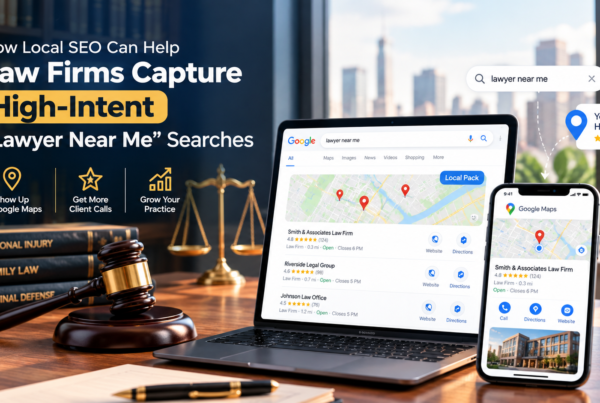

If someone in your city needs a lawyer today, here’s what they do. They pull out their phone. They type “personal injury lawyer near me” or “divorce attorney near me.” Then they call one of the first three names that show up on Google. They rarely make it to page two.
That’s the whole game now. Local SEO for lawyers isn’t a nice-to-have marketing extra anymore. It’s the front door to your law firm. If you’re not visible in that first screen of results, you’re invisible to a huge share of people who need legal help right now.

This guide walks you through exactly how “lawyer near me” searches work, why some firms show up and others don’t, and the step-by-step local SEO strategy that gets law firms into the map pack and keeps them there. No fluff, no jargon you need a marketing degree to understand — just what works.
Why “Near Me” Searches Matter So Much for Law Firms
Let’s start with the numbers, because they explain everything.
“Near me” searches have exploded over the past few years. There are now more than 200 million monthly “near me” searches happening on Google, and this type of search carries some of the highest buying intent of any query type. Someone typing “car accident lawyer near me” isn’t casually browsing. They just got in an accident, or they’re facing a legal problem, and they need help fast.
The behavior data backs this up. Roughly 76% of “near me” searches lead to a business visit or contact within 24 hours, and nearly half of all Google searches now carry local intent. For law firms, this means the person searching isn’t planning to “think about it.” They’re ready to call.
Here’s the part that should really grab your attention: businesses that appear in Google’s local 3-pack (the three map listings that show up at the top of local searches) get 126% more traffic and 93% more actions — calls, direction requests, website clicks — compared to firms sitting in positions four through ten. If you’re not in that map pack, you’re not just losing a little traffic. You’re losing the majority of it to competitors who are.
And yet, most law firms still aren’t set up to win this. A large share of small and local businesses don’t optimize for local search at all, and only a small percentage have an actual local SEO plan. That gap is your opportunity. If your competitors are ignoring local SEO, a focused effort can move you to the top of your market faster than you’d expect.
What Is Local SEO for Lawyers, Exactly?
Local SEO is the process of optimizing your law firm’s online presence so you show up when people in your area search for legal help. It’s different from regular SEO because it’s tied to geography. Instead of trying to rank for “personal injury lawyer” nationally (which is nearly impossible), local SEO helps you rank for “personal injury lawyer in [your city]” — a search you can actually win.
Three things drive local rankings, according to the industry’s most trusted research:
- Relevance — how well your law firm profile and website match what the searcher is looking for
- Distance — how close your office is to the person searching, or to the location they typed
- Prominence — how well-known and well-reviewed your firm is, both online and offline
Local SEO experts who track Google’s algorithm each year confirm that proximity is the single biggest factor for map pack rankings, often outweighing every other factor combined. That doesn’t mean you’re powerless if you’re not in the perfect spot — it means your Google Business Profile, reviews, and website content have to work even harder to earn your place.
Step 1: Master Your Google Business Profile (This Is Non-Negotiable)
If you do only one thing from this guide, do this one. Your Google Business Profile (GBP), formerly called Google My Business, is the single biggest lever you control for local rankings. It’s also usually the first thing a potential client sees — before your website, before your reviews, before anything else.
Pick the right category (this is the easiest win you’ll ever make)
Most law firms make the same mistake here: they set their primary category as “Law Firm” or “Attorney.” That’s too broad, and it’s a wasted opportunity.
Google’s own guidance is clear: choose categories that are as specific as possible while still representing your business. If you handle personal injury cases, your primary category should be “Personal Injury Attorney,” not “Law Firm.” If you’re a divorce lawyer, use “Divorce Lawyer” or “Family Law Attorney.” Correcting a mismatched category has been shown to move firms up in local pack rankings almost overnight, even for competitive terms like “car accident lawyer.”
Google gives you room for secondary categories too — you can add up to nine additional ones beyond your primary category. Use them for every practice area you genuinely handle. Just don’t list a practice area you don’t actually work in; misrepresenting your services violates Google’s guidelines and can get your profile suspended.
Fill out every section completely
An incomplete profile is a red flag to both Google and potential clients. Complete profiles get roughly seven times more clicks than incomplete ones. Make sure you fill in:
- Business name — use your exact legal firm name, no keyword stuffing (adding “Best Divorce Lawyer Chicago” to your name violates Google’s policies and can get you penalized)
- Address — accurate and matching what’s on your website exactly
- Phone number — a working local number, not a call center line
- Hours — including holiday hours
- Website URL — link to your homepage or a dedicated local landing page
- Services — list specific offerings like “auto accident litigation,” “wrongful death claims,” or “child custody representation”
- Photos — real photos of your office, your team, and your building exterior (this helps clients feel confident before they even call)
Consider individual attorney profiles
If your firm has multiple lawyers with different specialties, each attorney can create their own Google Business Profile in addition to your main firm listing. This lets each attorney target their own specific practice area, which multiplies your visibility across different searches. Just make sure each profile has a unique phone number or clear designation so Google doesn’t merge or flag them.
Step 2: Get Serious About Reviews
Reviews aren’t just a trust signal for potential clients — they’re a direct local ranking factor. Local search experts now rank reviews as one of the top three ranking signals for local pack visibility, right behind Google Business Profile signals and on-page optimization.
The numbers make the case on their own:
- 99% of people read online reviews when searching for local businesses, and 81% specifically use reviews when choosing an attorney
- Businesses that respond to reviews get about 12% more reviews on average and a slightly higher star rating than businesses that don’t respond
- A single negative review on your profile can cost you 22% of potential customers; three or more negative reviews on the first page can cost you nearly 60%
- Top-ranking local businesses average 561 Google reviews
How to build a review pipeline (the right way)
- Ask at the right moment. The best time to ask a client for a review is right after a positive outcome — a case resolution, a successful settlement, a closed matter. Don’t wait weeks; ask while the experience is fresh.
- Make it easy. Google Business Profile gives you a direct review link and even a QR code you can text or email to clients.
- Respond to every review. Thank clients for positive reviews. For negative ones, respond calmly and professionally, and take the conversation offline if needed. Never argue publicly — potential clients are watching how you handle criticism, not just what was said.
- Stay within bar association rules. Many state bars have specific ethics rules about soliciting and responding to client reviews, especially around confidentiality. Check your jurisdiction’s rules before building a review-request process, and never offer anything in exchange for a review.
Step 3: Fix Your NAP Consistency (Name, Address, Phone Number)
NAP consistency sounds boring, but it’s foundational. Your firm’s name, address, and phone number need to match exactly across every platform — your website, Google Business Profile, Yelp, Facebook, legal directories, and local citation sites. Even small differences (like “Ave” vs. “Avenue,” or a missing suite number) can confuse Google and weaken your rankings.
Consistent NAP data across platforms has been shown to improve local rankings by an average of 23%. Do a quick audit: search your firm name on Google, check your listings on Yelp, Bing Places, Apple Maps, and any legal directories you’re on. Fix any mismatches you find.
Step 4: Get Listed on Legal Directories (These Are Not Optional)
General local SEO advice tells you to build citations on generic directories. For lawyers, the highest-value citations come from legal-specific directories, because these carry authority in your exact industry and often rank well themselves for “lawyer near me” type searches.
Priority directories for attorneys include:
- Avvo — one of the most trusted attorney directories, with peer and client review features
- Justia — strong for legal content and directory visibility
- FindLaw — long-established legal directory with strong domain authority
- Martindale-Hubbell — respected for peer-reviewed attorney ratings
- Super Lawyers — prestige directory that can boost credibility signals
- State bar association directories — often overlooked but carry strong local trust signals
Claim your profile on each one, fill it out completely, and keep your NAP data identical to your Google Business Profile. Each of these acts as a vote of trust that feeds back into your overall local authority.
Step 5: Build Location-Specific Landing Pages
If your firm serves multiple cities or practice areas, don’t rely on one generic homepage to rank for everything. Google rewards content that specifically matches search intent. Create individual pages for each combination of location and practice area — for example:
- “Personal Injury Lawyer in [City]”
- “Divorce Attorney in [Neighborhood/City]”
- “DUI Defense Lawyer Serving [County]”
Each page should include:
- A clear headline with your practice area and city
- Real, specific content about how you help clients in that area — not copied-and-pasted text across pages
- Local landmarks, courthouses, or neighborhoods you serve, mentioned naturally
- Client testimonials specific to that practice area when possible
- A clear call to action (call now, schedule a consultation, request a free case review)
- Embedded Google Maps showing your office location
Thin, duplicate content across location pages can actually hurt you, so make sure every page adds genuine value and answers a real question a potential client would have.
Step 6: Optimize for Featured Snippets and AI Overviews
Search has changed. Google increasingly answers questions directly at the top of the results page through featured snippets and AI Overviews — meaning some searchers never scroll down to a traditional list of links at all. Local SEO research now tracks this shift closely, and citation and on-page signals are proving to be foundational for AI visibility just as much as for traditional local rankings.
To position your firm to be pulled into these AI-generated answers:
- Answer questions directly, near the top of the page. If you have a page titled “What Should I Do After a Car Accident in [City]?” answer it in the first two or three sentences, plainly and clearly.
- Use clear headers formatted as questions. This mirrors how people actually search and how AI systems extract answers.
- Add FAQ sections to your practice area pages and use FAQ schema markup so Google can easily pull your answers into rich results.
- Keep answers concise first, then expand. Give a short, direct answer immediately, then follow with detail. AI Overviews and snippets tend to favor content structured this way.
- Use structured data (schema markup) for your law firm, attorney profiles, reviews, and FAQs. This gives search engines and AI systems clean, structured information to pull from — something raw paragraph text can’t offer as reliably.
This matters more every year. AI-driven local search tools are already processing hundreds of millions of queries a month, and firms that keep their information accurate and consistent across the web are the ones getting recommended by these systems.
Step 7: Build Local Backlinks and Community Authority
Backlinks from local, relevant websites tell Google your firm is a trusted, established part of your community — not just another directory listing. For law firms, strong local link opportunities include:
- Sponsoring local events, sports teams, or charity drives (many will link back to your firm’s website)
- Getting quoted in local news stories on legal topics in your area
- Guest contributing to local business associations or Chamber of Commerce sites
- Publishing helpful legal guides that local news outlets or community blogs might reference
- Joining local bar association member directories that link back to your site
These links, combined with directory citations and press mentions, build the kind of prominence signal that search engines use to judge how established and trustworthy your firm really is in your market.
Step 8: Use the Right Keywords — Without Sounding Like a Robot
Keyword strategy for lawyer SEO isn’t about stuffing “lawyer near me” into every sentence. It’s about understanding the different ways potential clients actually search, and making sure your website naturally answers each type of search.
Broadly, legal searches fall into a few buckets:
- “Near me” and location-based searches — “personal injury lawyer near me,” “divorce attorney in [city].” These carry the highest intent and are largely won through your Google Business Profile and location pages.
- Practice-area searches — “car accident lawyer,” “child custody attorney,” “DUI defense lawyer.” These need dedicated pages, not a single generic “practice areas” page that briefly mentions everything.
- Question-based searches — “how long does a personal injury case take,” “do I need a lawyer for a DUI.” These are your best opportunities for featured snippets and AI Overview visibility, and they’re also excellent top-of-funnel content that builds trust before someone is ready to call.
- Comparison and reputation searches — “best divorce lawyer in [city],” “[Firm Name] reviews.” These are won primarily through reviews, directory listings, and brand reputation rather than pure on-page optimization.
Your primary keyword (your main practice area plus your city) should appear naturally in your page title, your H1 heading, your meta description, and once or twice in the body copy. Secondary keywords — related practice areas, nearby neighborhoods, common legal terms clients search for — should be woven into subheadings and body content where they genuinely fit. If a keyword doesn’t fit naturally into a sentence, don’t force it. Search engines today are very good at detecting keyword stuffing, and it can actively hurt your rankings rather than help them.
Step 9: Track the Metrics That Actually Matter
You can’t improve what you don’t measure. Most law firms either track nothing, or they track vanity metrics like total website visits that don’t tell them much about actual client acquisition. Focus instead on:
- Google Business Profile insights — track how many people called you, requested directions, or clicked through to your website directly from your profile
- Local pack rankings — use a rank-tracking tool to see where you show up for your priority keywords, ideally checked from multiple points around your service area, since local rankings can shift block by block
- Call tracking — use a dedicated tracking phone number on your website and GBP so you know exactly how many calls come from your online presence versus referrals or other channels
- Conversion rate on location pages — are visitors to your city-specific landing pages actually filling out a contact form or calling?
- Review velocity — new reviews earned per month, not just your total review count. A steady trickle of two or three new reviews a month is a stronger ranking signal than a big batch once a year followed by silence.
Review these numbers monthly. Local SEO is not a “set it and forget it” project — profiles change, competitors adjust, and Google’s algorithm updates regularly. A quarterly full audit of your Google Business Profile, directory listings, and top-performing pages keeps you from quietly losing ground.
Voice Search and the Rise of “Near Me” Without Saying “Near Me”
Voice search is changing how local queries are phrased. Instead of typing “family lawyer near me,” someone might ask their phone, “who’s a good family lawyer close to me?” or “find a divorce attorney I can talk to today.” Google is increasingly good at understanding local intent even when the words “near me” never appear at all.
To capture this traffic:
- Structure your FAQ content around natural, conversational questions, the way someone would actually speak them out loud
- Keep your Google Business Profile information airtight, since voice assistants pull directly from it for local recommendations
- Make sure your hours, phone number, and address are accurate everywhere, since a single trusted source of truth is what most voice results rely on
The firm that Google (or Siri, or Alexa) trusts most for accurate, consistent local information tends to win the single answer that gets read aloud — there’s rarely a “second place” in a voice search result.
What Sets Top-Ranking Law Firms Apart From Everyone Else
After walking through all of these steps, it’s worth zooming out. What separates the firms sitting comfortably in the local 3-pack from the ones stuck on page two? It usually comes down to a handful of habits, repeated consistently over time:
- They treat their Google Business Profile like a living asset, not a one-time setup task. They post updates, add new photos, and keep services current.
- They ask for reviews systematically, not sporadically. Every satisfied client gets a request, built into their intake or case-closing process.
- They build real, specific content for each practice area and location instead of one thin page trying to cover everything.
- They respond to every review, good or bad, professionally and promptly.
- They keep their information consistent across every platform, from their website to the smallest legal directory.
None of this requires a massive marketing budget. It requires consistency, and a clear understanding of what actually moves the needle — which is exactly what this guide has walked through.
Step 10: Make Sure Your Website Is Mobile-Friendly and Fast
A huge share of “near me” searches happen on mobile phones, often from someone standing outside a courthouse, sitting in an ER waiting room, or dealing with a legal crisis in real time. If your website is slow to load or hard to navigate on a phone, you’ll lose that potential client before they even read your first sentence.
Make sure:
- Your site loads in under three seconds on mobile
- Your phone number is clickable (tap to call) on every page
- Your contact form is short and simple — name, phone, brief case description
- Your site doesn’t require pinching or zooming to read
Mobile experience isn’t just about user comfort — it directly affects how Google ranks you, since page experience and mobile usability are baked into modern search ranking systems.
Common Local SEO Mistakes Law Firms Make
Even firms that are trying can trip up on the basics. Watch out for these:
- Choosing “Law Firm” as the primary GBP category instead of a specific practice area
- Inconsistent NAP data across directories and the website
- Ignoring negative reviews instead of responding professionally
- Thin or duplicate location pages that don’t actually add unique value
- Keyword stuffing the business name on Google Business Profile, which can trigger a suspension
- Letting the GBP profile go stale — outdated hours, old photos, no recent posts
- No review generation process, leaving review counts and ratings to chance
- Overlooking legal-specific directories in favor of only general business listings
Frequently Asked Questions
How long does local SEO take to work for a law firm?
Most firms start to see meaningful movement in local pack rankings within three to six months of consistent effort, though a properly optimized Google Business Profile can produce visible gains within weeks. Full authority-building — reviews, backlinks, and content — tends to compound over six to twelve months.
Do I need a website if I already have a strong Google Business Profile?
Yes. Your GBP is often the first touchpoint, but your website is where you build deeper trust, host location and practice-area pages, and capture leads who want more detail before calling. The two work together, not as substitutes for each other.
Can I buy or incentivize reviews to rank faster?
No. Google’s guidelines prohibit incentivized or fake reviews, and most state bar associations have their own ethics rules around client testimonials. Violating either can result in profile suspension or professional discipline. Focus on making it easy and natural for genuinely satisfied clients to leave honest feedback instead.
Is local SEO different for solo attorneys versus large firms?
The fundamentals are the same, but solo attorneys often benefit from an individual Google Business Profile in addition to (or instead of) a firm-wide one, since it lets them target their specific niche directly. Larger firms typically need both a strong firm-wide profile and, where relevant, individual attorney profiles for each specialty.
Your 30-Day Local SEO Action Plan
If this feels like a lot, here’s how to prioritize it over your first month:
Week 1: Audit and fully optimize your Google Business Profile — correct your category, complete every section, add photos.
Week 2: Fix NAP consistency across your website, GBP, and top directories (Avvo, Justia, FindLaw, Martindale-Hubbell).
Week 3: Set up a review request process and personally reach out to past clients for reviews. Respond to any existing reviews you haven’t addressed.
Week 4: Build or improve one location-specific landing page for your top practice area, adding FAQ content and structured data.
From there, keep the momentum going — request a couple of new reviews every week, publish new local content monthly, and revisit your GBP quarterly to keep it fresh.
The Bottom Line
Local SEO for lawyers isn’t about chasing algorithm tricks. It’s about making sure the person who needs a lawyer right now — scared, stressed, searching from their phone — can actually find you, trust you, and call you before they call someone else. Nearly half of all law firms are still leaving this opportunity on the table by ignoring the basics. A firm that gets its Google Business Profile right, builds a steady stream of genuine reviews, keeps its information consistent everywhere, and creates real local content will consistently out-rank competitors who are only investing in generic marketing.
Start with your Google Business Profile today. It’s free, it’s the highest-leverage move you can make, and for most firms, it’s the difference between showing up in that first screen of results — or not showing up at all.