Nearly half of all Google searches now carry local intent, and travelers overwhelmingly research “near me” and city-specific options before they book. For travel agencies, that means the businesses that show up first in local search — not the ones with the biggest ad budgets — are the ones winning bookings. This guide breaks down exactly how to get there.
Quick Answer
Local SEO helps travel agencies rank higher in Google’s Maps Pack and local search results by optimizing their Google Business Profile, building consistent citations, earning reviews, targeting location-based keywords, and publishing destination-specific content. Agencies that do this well capture high-intent travelers already searching to book, without paying for every click.
Key Takeaways
- Roughly 46% of all Google searches have local intent, and most people research a business online before contacting it, so an incomplete or inactive profile costs bookings every day.
- A fully completed Google Business Profile generates significantly more visibility than an incomplete one, making profile completeness the single highest-return local SEO task for a travel agency.
- Review volume and recency directly influence both local rankings and booking conversion; agencies in the top local search positions tend to carry hundreds of reviews.
- Near-me and “open now” searches have grown dramatically in the past two years, and a large share of these searchers visit or contact a business within 24 hours.
- Online-only agencies without a physical, Google-verified address generally cannot appear in the Maps Pack and need to lean harder on location-specific content and organic authority.
- Local SEO produces a lower cost per lead than most paid channels, making it one of the most sustainable ways for independent travel agencies to compete with large online travel agencies (OTAs).
1. Why Local SEO Matters for Travel Agencies
Travel planning almost always starts with a search engine. Consumer research consistently shows that around 98% of people search online to find local businesses, and a large majority check a company’s online presence before visiting or booking. For travel agencies specifically, this happens twice: once when a traveler is choosing an agency in their own city, and again when a traveler is researching a destination and looking for a local operator once they arrive.
Direct answer: Local SEO matters because it puts a travel agency in front of travelers at the exact moment they are ready to book, at a lower cost than advertising and with more lasting value.
Supporting explanation: Unlike paid search, which stops producing leads the moment the budget runs out, a well-optimized Google Business Profile and website keep generating visibility for months or years. Local intent searches also convert unusually fast — a large share of “near me” searchers take action, such as calling or visiting, within 24 hours.
Real example: A boutique agency in a mid-sized city that ranks in the local 3-pack for “travel agent near me” and “[city] vacation planner” captures a steady stream of high-intent inquiries without paying per click, while a competitor relying only on paid ads sees inquiries stop the moment the campaign pauses.
Bullet summary:
- Local search drives immediate action, not just awareness.
- It costs less per lead than most outbound and paid channels.
- It compounds over time instead of resetting with every budget cycle.
- It works whether a traveler is planning from home or searching once they’ve arrived at a destination.
2. How Google Ranks Local Travel Businesses
Google’s local ranking algorithm weighs three main factors: relevance, distance, and prominence.
| Ranking Factor | What It Means for a Travel Agency | How to Improve It |
| Relevance | How well your profile and website match what the searcher typed | Use accurate categories, list every service you offer, mirror the language travelers actually search |
| Distance | How close your business address is to the searcher (or the location in their query) | Keep your address accurate; use service-area settings correctly if you don’t see walk-in clients |
| Prominence | How well-known and well-reviewed your business is, both online and off | Earn reviews, build citations, get mentioned on trusted travel and local sites |
Agencies without a physical, Google-verified location generally cannot appear in the Maps Pack under Google’s service-area business rules, even if they operate legitimately. In that case, prominence and on-page relevance have to carry more of the weight, since distance-based ranking isn’t in play the same way.
3. Google Business Profile Optimization
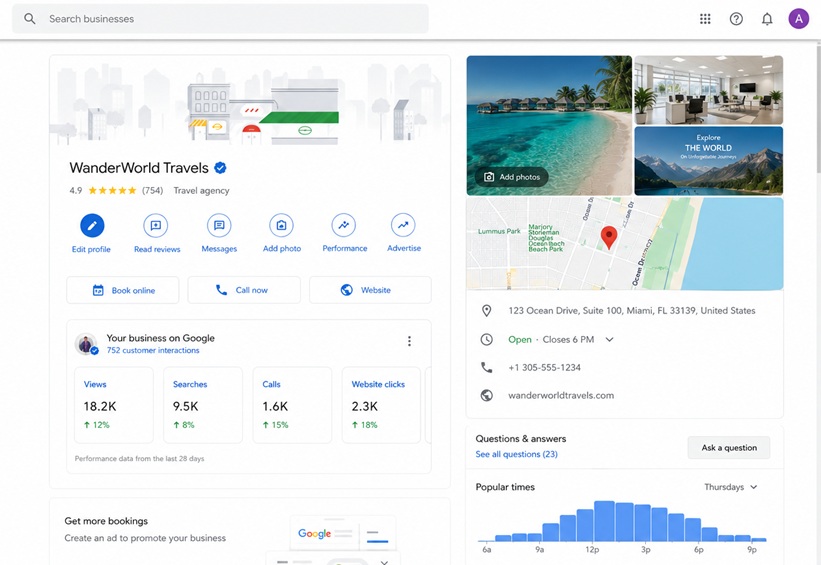
Your Google Business Profile (GBP) is the single most important local SEO asset a travel agency has. Profiles with complete information tend to generate far more search visibility than incomplete ones, and Google Business Profiles now appear in the large majority of local map-based searches.
Direct answer: A fully built-out, regularly updated Google Business Profile is the fastest way for a travel agency to improve local visibility.
Step-by-step setup:
- Claim and verify your listing using the exact legal business name — no keyword stuffing (e.g., don’t add “Best Travel Agency” to your name).
- Choose the most specific primary category, such as “Travel Agency” or “Tour Operator,” and add secondary categories like “Cruise Agency” or “Corporate Travel Planner” if applicable.
- List every service you offer — honeymoon planning, group tours, corporate travel, visa assistance, cruise bookings — since Google matches searches like “vacation packages near me” against your listed services.
- Add your service area if you serve clients beyond your storefront, in addition to your physical address.
- Upload real photos of your office, team, and past trips or client events; profiles with strong photo libraries earn more engagement and trust.
- Fill in business hours precisely, including holiday hours, since incorrect hours are one of the most common reasons customers choose a competitor.
- Add booking or appointment links where possible; profiles with booking links convert noticeably better than those without.
- Post updates weekly, covering seasonal deals, new destinations, or travel advisories, to signal an active, trustworthy business.
- Answer the Q&A section proactively with common questions like “Do you charge planning fees?” or “Do you book international flights?”
Expert tip: Treat your GBP like a landing page, not a static directory listing. Agencies that update it weekly outperform those that set it up once and forget it.
4. Local Keyword Research for Travel Agencies
Direct answer: Local keyword research for travel agencies should combine location modifiers with service and intent terms, not just broad travel keywords.
Keyword categories to target:
- Primary keywords: “travel agency near me,” “[city] travel agent,” “local travel agency”
- Service-based long-tail keywords: “honeymoon planner in [city],” “group tour operator near me,” “corporate travel agency [city]”
- Destination + origin combinations: “[city] agency for Caribbean cruises,” “[city] travel agent for Europe trips”
- Semantic and NLP keywords: vacation package, all-inclusive resort booking, itinerary planning, travel consultant, visa and passport assistance
- People Also Ask style questions: “Is it worth using a travel agent?”, “How much do travel agents charge?”, “Do travel agents get better deals than booking online?”
Bullet summary:
- Mix “near me” phrasing with your city and neighborhood names.
- Include the specific trip types you specialize in (cruises, luxury, family, adventure).
- Write content around the questions travelers actually ask before booking an agent instead of an OTA.
5. Location Pages and On-Page SEO
If your agency serves multiple cities, regions, or has more than one office, dedicated location pages help Google understand exactly where and who you serve.
Best practices for location pages:
- Create one unique page per physical office or clearly defined service area — never duplicate the same content with only the city name swapped.
- Include the local address, phone number, embedded map, and hours on each page.
- Add locally relevant content: nearby airports, popular destinations from that city, and testimonials from clients in that area.
- Use the city name naturally in the page title, H1, meta description, and a few times in the body copy — never stuff it unnaturally.
- Link each location page back to your homepage and relevant service pages to strengthen internal SEO.
On-page checklist for every page:
- One clear H1 that includes the primary keyword
- A meta title under 60 characters and meta description between 150–160 characters
- Descriptive, keyword-rich image alt text (e.g., “family booking a Caribbean cruise with a [city] travel agent”)
- Internal links to related destination guides or service pages
- Schema markup (see Meta SEO section below)
6. NAP Consistency and Citation Building
Direct answer: NAP consistency — making sure your Name, Address, and Phone number match exactly across every platform — is one of the simplest and most overlooked local ranking factors.
Supporting explanation: When your business information differs across your website, Google Business Profile, Yelp, TripAdvisor, and travel directories, Google has less confidence in which version is correct, which can suppress your local rankings.
Where to build citations:
- General directories: Google Business Profile, Bing Places, Apple Maps, Yelp
- Travel-specific directories: TripAdvisor, ASTA (American Society of Travel Advisors) member directory, Travel Weekly, local chamber of commerce
- Industry associations: CLIA (Cruise Lines International Association) for cruise-focused agencies
Bullet summary:
- Audit your NAP data quarterly across all platforms.
- Fix inconsistent listings before building new ones.
- Prioritize travel-specific directories over generic ones for stronger topical relevance.
7. Review Generation and Reputation Management
Reviews influence both rankings and conversions more than almost any other local SEO factor. Research shows a measurable lift in Google Business Profile conversions for every batch of new reviews a business earns, and agencies in the top local search positions typically carry hundreds of reviews. Most consumers also say they only consider businesses rated four stars or higher.
Direct answer: Consistently generating and responding to reviews is one of the highest-impact local SEO activities a travel agency can do.
Step-by-step review strategy:
- Ask for a review immediately after a trip is completed, when satisfaction is highest — not months later.
- Send a direct link to your Google review page via email or text to reduce friction.
- Respond to every review, positive and negative, within 48 hours.
- When responding to negative reviews, stay professional, acknowledge the concern, and move the conversation offline.
- Never buy or fake reviews — Google actively penalizes this, and it undermines the trust your brand depends on.
Important note: A single unanswered negative review can be more damaging than the low rating itself, since a large share of readers interpret a lack of response as a business that doesn’t care about its clients.
8. Content Marketing for Local and Destination Search
Direct answer: Publishing destination guides, local travel tips, and origin-city content helps a travel agency rank for both local searches and the broader research phase of trip planning.
Content ideas that support local SEO:
- “Best Caribbean Cruises for [City] Travelers” — combines a destination keyword with a local audience angle
- “Why Use a [City] Travel Agent Instead of Booking Online” — targets high-intent comparison searches
- Seasonal guides tied to your service area, such as “Spring Break Packages for Families Near [City]”
- Client trip recaps and case studies with real photos, which double as social proof and fresh content signals
- FAQ-style pages answering common booking questions, which are strong candidates for featured snippets
Bullet summary:
- Blend destination content with local relevance instead of writing generic travel blog posts.
- Update seasonal content annually to keep it fresh and accurate.
- Repurpose client stories as both content and reputation-building material.
9. Local Link Building
Direct answer: Earning links and mentions from locally relevant, trustworthy sites strengthens the “prominence” signal Google uses to rank local businesses.
Effective local link opportunities for travel agencies:
- Sponsor or participate in local community events, chambers of commerce, or tourism boards, which often link back to sponsors
- Partner with local wedding planners, corporate event companies, or relocation services for cross-referral links
- Contribute expert quotes to local news outlets covering travel trends
- Get listed in university alumni travel programs or local business association directories if applicable
Expert tip: A handful of links from genuinely relevant local organizations will do more for your rankings than dozens of low-quality, unrelated directory submissions.
10. Mobile, Technical, and AI Search Readiness
A large share of local searches and Google Business Profile views happen on mobile devices, so a slow or hard-to-navigate mobile site directly costs bookings.
Technical checklist:
- Site loads in under 3 seconds on mobile
- Click-to-call buttons are easy to tap on every page
- Booking or inquiry forms work smoothly on small screens
- Structured data (schema) is implemented so Google and AI tools can understand your business details
- Your site uses HTTPS and has no broken links or outdated NAP information
AI Overview and AI search readiness: More travelers are now using AI tools for business recommendations, but these results are not always accurate, so keeping your Google Business Profile, website, and directory listings consistent and current makes it more likely that AI-driven search experiences surface correct, favorable information about your agency.
11. Local SEO vs. Paid Ads vs. OTA Listings
| Channel | Cost Over Time | Speed to Results | Long-Term Value | Best For |
| Local SEO | Lower, mostly time/effort investment | Weeks to months | High — compounds over time | Sustainable, repeat local visibility |
| Paid Search Ads | Ongoing cost per click | Immediate | Low — stops when budget stops | Short-term promotions, launches |
| OTA Listings (Expedia, etc.) | Commission per booking | Immediate | Low — customer belongs to the OTA, not you | Extra visibility, not primary strategy |
Pros and cons of relying on local SEO:
Pros:
- Lower long-term cost per lead than paid channels
- Builds a durable, owned asset (your website and profile) rather than renting visibility
- Captures high-intent travelers ready to book now
Cons:
- Takes longer to show results than paid ads
- Requires ongoing maintenance (reviews, posts, content) to stay competitive
- Highly competitive in large metro areas with many established agencies
12. Real-World Example
Consider a two-person travel agency operating out of a single office. Before investing in local SEO, its Google Business Profile was unclaimed, and its website had no location-specific content. After completing the profile, adding 15 services, uploading real trip photos, and requesting reviews from the last 12 months of clients, the agency moved from page two of local search results into the local 3-pack for its core “[city] travel agent” search within a few months. The combination of profile completeness and review volume — the two factors research shows matter most — did the heavy lifting, without any paid advertising spend.
13. Step-by-Step 30-Day Local SEO Plan
Week 1 — Foundation
- Claim and fully complete your Google Business Profile
- Audit NAP consistency across your website, GBP, and top three directories
- Set up or verify Google Search Console and Google Analytics
Week 2 — Content and On-Page
- Publish or update location pages for every office/service area
- Add schema markup to your homepage and location pages
- Optimize meta titles and descriptions for your top 10 pages
Week 3 — Reviews and Reputation
- Email or text your last 20–30 clients a direct review link
- Set up a system to request reviews automatically after every trip
- Respond to all existing reviews, including old unanswered ones
Week 4 — Content and Outreach
- Publish one destination or local comparison blog post
- Reach out to two to three local organizations for partnership or link opportunities
- Post a Google Business Profile update and review your GBP Insights data
14. Mistakes to Avoid
- Leaving your Google Business Profile incomplete or unclaimed — this alone can push you far below competitors with a full profile.
- Inconsistent NAP data across your website and directories, which confuses Google’s local algorithm.
- Buying or incentivizing fake reviews, which risks profile suspension and destroys trust.
- Duplicating location pages with only the city name changed, which Google treats as thin, low-value content.
- Ignoring negative reviews instead of responding professionally and quickly.
- Keyword stuffing business names or page content instead of writing naturally for travelers.
- Treating local SEO as a one-time project rather than an ongoing habit of posting, requesting reviews, and updating content.
15. Expert Tips
- Update your Google Business Profile at least weekly, and more often during peak booking seasons like early spring and post-holiday.
- Use booking or appointment links directly on your profile — profiles with these links convert measurably better.
- Segment your review requests by trip type so you build a visible track record in each specialty (cruises, honeymoons, group travel).
- Monitor GBP Insights monthly to see which searches are driving views, and adjust your services and content to match.
- If you don’t have a walk-in storefront, focus extra effort on content depth and citations, since you may not be eligible for full Maps Pack placement.
16. Frequently Asked Questions
1. What is local SEO for a travel agency?
Local SEO is the process of optimizing your online presence — especially your Google Business Profile, website, and directory listings — so your agency appears in local search results and Google Maps when nearby travelers search for travel services.
2. How long does local SEO take to show results for a travel agency?
Most agencies begin seeing measurable improvement in local visibility within 8–12 weeks of consistent optimization, though competitive metro markets can take longer.
3. Do online-only travel agencies need local SEO?
Yes, but the strategy shifts. Without a Google-verified physical address, an agency generally can’t appear in the Maps Pack, so the focus should shift toward strong organic content, citations, and reviews on relevant directories.
4. How many Google reviews does a travel agency need to rank well?
There’s no fixed number, but agencies that rank in the top local search positions typically have significantly more reviews than lower-ranked competitors, so consistent review generation should be an ongoing priority rather than a one-time push.
5. What’s the difference between local SEO and general SEO for a travel agency?
General SEO focuses on ranking for broad destination or travel-planning content nationally or globally, while local SEO focuses specifically on ranking for searches tied to your service area, such as “[city] travel agent.”
6. Should a travel agency list on OTAs like Expedia in addition to doing local SEO?
It can add extra visibility, but OTA listings come with commission fees and don’t build owned, long-term visibility the way a strong Google Business Profile and website do. Most agencies benefit from treating OTAs as supplemental, not primary.
7. How often should a travel agency post on its Google Business Profile?
Weekly posting is a reasonable baseline, with more frequent updates during peak booking seasons or when promoting time-sensitive deals.
8. Can a travel agency improve rankings without a big marketing budget?
Yes. Profile completeness, review generation, and NAP consistency cost time rather than money, and research shows these factors carry significant ranking weight.
9. What categories should a travel agency choose on Google Business Profile?
Choose the most specific primary category available, such as “Travel Agency” or “Tour Operator,” and add relevant secondary categories like “Cruise Agency” if those services apply.
10. Do reviews from third-party sites like TripAdvisor help Google rankings? They help build overall online prominence and trust signals, but Google Business Profile reviews carry the most direct weight in local map rankings specifically.
11. What’s the biggest local SEO mistake travel agencies make?
Treating their Google Business Profile as a one-time setup instead of an actively maintained marketing channel.
12. How does mobile search affect travel agency bookings?
A large share of local searches and profile views happen on mobile, so a slow-loading or hard-to-navigate mobile site can directly reduce inquiries and bookings.
13. Is it worth targeting “near me” keywords for a travel agency?
Yes. “Near me” and “open now” searches have grown substantially in recent years, and a large share of these searches lead to contact or a visit within 24 hours.
14. Should each office location have its own webpage?
Yes, if an agency operates in more than one city or service area, each location should have a unique, non-duplicated page with local details and testimonials.
15. How does local SEO help a travel agency compete with big OTAs?
Local SEO lets a smaller agency win visibility for highly specific, local, and service-based searches that large OTAs typically don’t target as precisely, giving independent agencies a realistic path to ranking above much bigger competitors for those queries.
Final Conclusion
Local SEO gives travel agencies a way to compete for bookings without depending entirely on paid ads or commission-heavy OTA listings. The fundamentals are straightforward but require consistency: a complete and active Google Business Profile, accurate information everywhere it appears online, a steady flow of genuine reviews, and content that speaks directly to the travelers in your service area. Agencies that treat these as ongoing habits — not a one-time setup — are the ones travelers find first, and the ones that turn searches into booked trips.