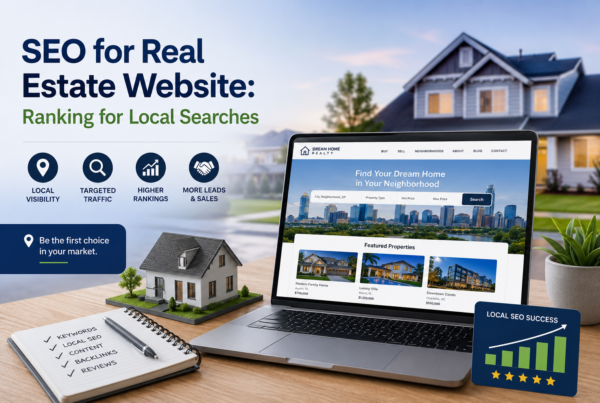
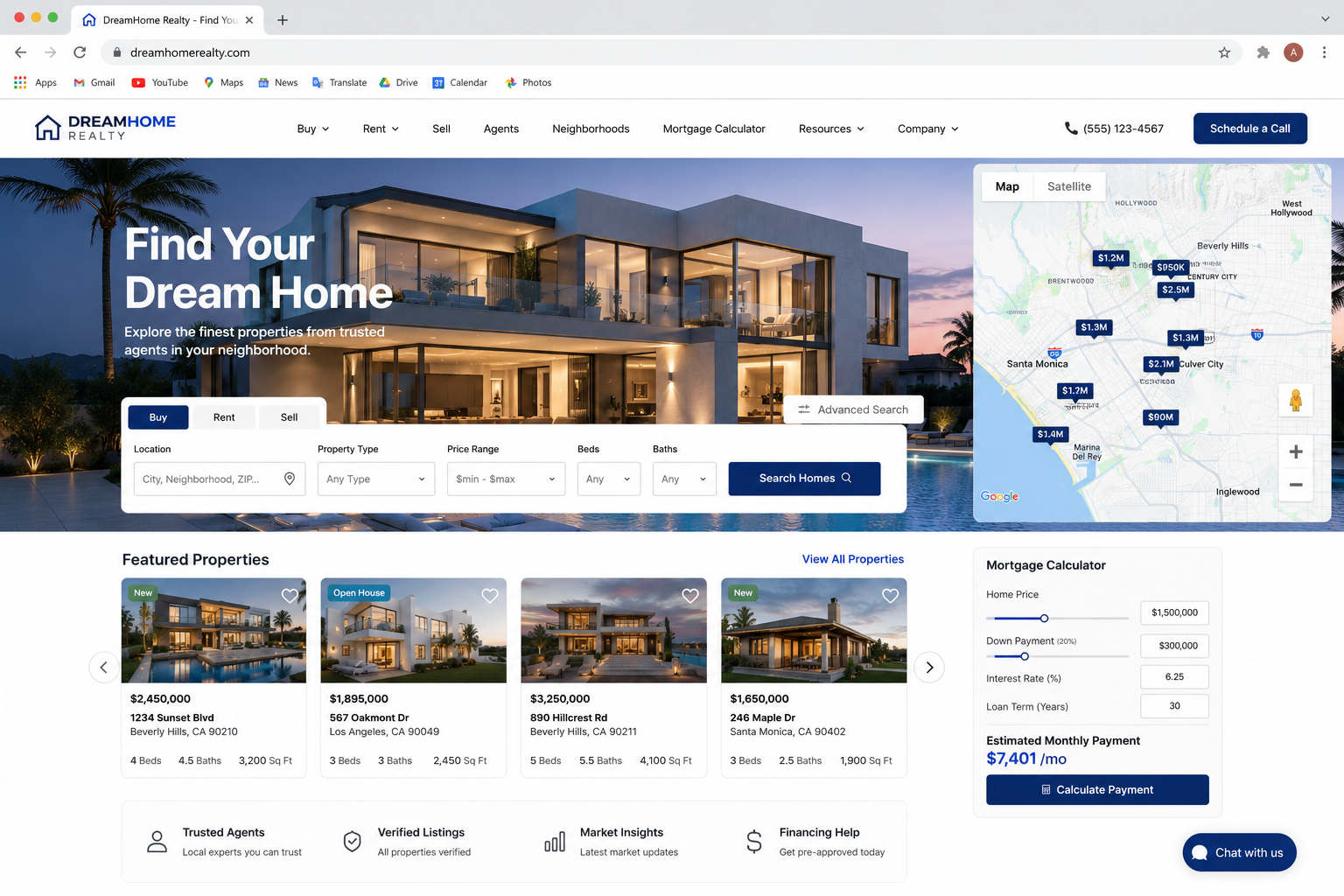
A practical, research-backed playbook for agents, brokerages, and property portals that want more qualified leads from organic search — covering local SEO, on-page optimization, content, technical SEO, and AI Overview visibility.
| Quick Answer: Real estate SEO drives more property inquiries by combining three things: a fully optimized Google Business Profile and local citations, content built around neighborhoods and buyer intent (not just listings), and technical performance (speed, mobile, schema) that keeps both Google and AI search engines able to read and trust your site. Agents who do all three consistently outrank portals for local, high-intent searches and convert organic visitors at roughly double the rate of paid or social traffic. |
Key Takeaways
- 97% of home buyers search online during their property journey, and the average buyer spends about 4.7 months browsing roughly 14 listings before contacting an agent — SEO has to hold their attention across a long research window, not just at the moment of search.
- Organic search sends over half of all traffic to real estate websites and converts at roughly double the rate of paid search, making it the highest-ROI channel most agencies have.
- Neighborhood and lifestyle-based content out-performs generic listing pages — guide pages built around a specific area rank higher and generate more leads than a standard “homes for sale” page.
- Google Business Profile is still the single biggest local ranking lever; profiles with 20+ reviews consistently out-convert thin profiles.
- AI search (Google AI Overviews, ChatGPT, Perplexity) is now a real discovery channel for real estate, but most agents are invisible in it — structured data and clear, quotable content close that gap.
- Site speed and mobile usability are non-negotiable: most property searches now start on a phone, and slow listing pages lose buyers before they see a single photo.
1. What Real Estate SEO Actually Means
Real estate SEO is the practice of optimizing an agent, brokerage, or property portal’s website and online listings so it ranks for the searches buyers and sellers actually type — from “3 bedroom homes in Surrey BC” to “best real estate agent near me.” It combines local SEO, content strategy, on-page optimization, and technical performance.
Unlike general SEO, real estate SEO is built around two overlapping goals: getting found for a specific property (transactional intent) and getting found as the trusted local expert for an area (informational and local intent). Most agencies over-invest in the first and under-invest in the second — which is exactly where the opportunity sits, because portals like Zillow and Realtor.com already dominate raw listing searches.
Who this guide is for
- Independent agents and small brokerages competing against national portals
- Real estate marketing teams managing SEO for multiple agents or offices
- Property developers and PropTech platforms building organic acquisition
- Agencies (like SEO consultancies) building or auditing real estate SEO programs for clients
2. Why Real Estate SEO Matters More Than Ever
The numbers make the case better than any pitch deck. Buyer behavior has shifted almost entirely online, and the agents who show up consistently across that months-long research window are the ones who get the call.
| Metric | Data Point | Source |
|---|---|---|
| Buyers who use the internet during their search | 97% | National Association of Realtors |
| Average online home search duration | 4.7 months, ~14.2 listings viewed | SearchLab, 2026 |
| Website traffic from organic + paid search | 57% (organic search alone: 53%) | REsimpli / SearchLab, 2026 |
| Organic search conversion rate vs. paid search | 3.2% vs. 1.5% | Industry benchmark, 2026 |
| Neighborhood guide pages vs. generic pages | 28% higher rankings, 3.2x more leads | BrightEdge, 2026 |
| Long-form content (2,000+ words) ranking lift | 56% higher than short posts | Semrush Real Estate Study, 2026 |
| Agents with 20+ Google reviews vs. under 5 | 2.7x more leads | BrightLocal, 2026 |
| “Homes for sale near me” search growth since 2019 | +340% | Google Trends |
The takeaway isn’t just “SEO works.” It’s that the format of SEO that works has changed: hyper-local, long-form, review-backed, and structured for machines to read — not thin listing pages with a paragraph of boilerplate copy.
3. Local SEO and Google Business Profile Optimization
Direct answer: Google Business Profile (GBP) is the single largest local ranking factor for real estate, responsible for roughly a third of all local clicks — so it should be the first thing optimized, before content or link building.
Set up GBP correctly
- Choose the most specific category available (e.g., “Real Estate Agent” rather than just “Real Estate Agency”) and add secondary categories for specialties (luxury homes, condos, relocation).
- Keep name, address, and phone number (NAP) identical across your website, GBP, and every directory — inconsistent NAP is one of the most common reasons local rankings stall.
- Fill in service areas precisely instead of a broad radius; buyers searching “agent in [specific neighborhood]” match against this data.
- Add high-quality photos of yourself, your team, and recognizable local landmarks — not just logo graphics.
- Publish GBP posts (new listings, open houses, market updates) at least weekly; profiles that post regularly are treated as more active and relevant.
- Ask every closed client for a review within 48 hours of closing, and respond to every review, positive or negative, within a few days.
Build local citations and reviews
Beyond GBP, real estate-specific directories still carry real weight: Zillow, Realtor.com, Redfin, Homes.com, and local chamber-of-commerce or MLS-affiliated directories. Consistency across these listings is what search engines use to confirm a business is legitimate and active in a given market.
| Expert Tip: Reviews with a bit of specificity — a neighborhood name, a price range, a type of transaction (first-time buyer, relocation, investment) — do more for local SEO than generic five-star praise, because they add unique, locally relevant text that Google can associate with your listing. |
4. On-Page SEO for Listing and Service Pages
Direct answer: Every listing and service page should target one clear search intent, use a descriptive URL and title, and include unique, factual detail — duplicate MLS descriptions copied across every agent’s site are a major reason listing pages fail to rank.
Listing pages
- Rewrite MLS-syndicated descriptions in your own words; identical boilerplate across hundreds of sites gets filtered as duplicate content.
- Use descriptive URLs, e.g. /listings/123-oak-street-surrey-bc rather than a numeric ID.
- Include neighborhood context in the page: nearby schools, commute times, walkability, recent comparable sales.
- Add unique, compressed, descriptively-named images (e.g., kitchen-oak-street-surrey.jpg) with alt text describing the room and style, not just “IMG_2031.”
- Mark listings clearly as sold, pending, or withdrawn — stale “available” listings hurt both user trust and search quality signals.
Service and location pages
- Create a dedicated page per city or major neighborhood you serve, rather than one page trying to rank for every location.
- Target the primary keyword in the H1, the first 100 words, one H2, and the meta title — naturally, not stuffed.
- Answer the searcher’s real question in the first 2–3 sentences before going into detail; this is also what AI Overviews and featured snippets pull from.
5. Content Strategy: Neighborhood Guides and Buyer-Intent Content
Direct answer: Content built around neighborhoods, lifestyle, and the buying/selling process consistently outperforms generic real estate blog posts, because it matches how people actually search and it can’t be easily replicated by national portals.
Neighborhood guides
A strong neighborhood guide answers the questions a buyer would ask a knowledgeable local friend: What’s the vibe here? What do homes typically cost? Which schools serve this area? What’s the commute like? What’s changing in the next few years? Cover market data, amenities, schools, transit, and recent price trends, and update the page at least twice a year so it doesn’t go stale.
Content types that convert
| Content Type | Search Intent It Matches | Example Query |
|---|---|---|
| Neighborhood guide | Local / lifestyle research | “Living in [neighborhood], what to know” |
| Market report / trend post | Informational, seasonal | “[City] housing market forecast 2026” |
| Buyer/seller process guide | Informational, high intent | “How to buy a house with no down payment” |
| Comparison content | Consideration stage | “Condo vs. townhouse in [city]” |
| Agent/service page | Transactional, branded | “best real estate agent in [city]” |
| FAQ / glossary content | Long-tail, voice + AI search | “what does contingent mean in real estate” |
Long-tail keywords such as “homes for sale near me” or “3-bedroom homes near [school name]” drive a disproportionate share of real estate search traffic. Structure content around these specific, location-and-feature combinations rather than only the broad head term.
6. Technical SEO for Real Estate Websites
Direct answer: Real estate sites lose the most organic traffic to slow load times, poor mobile experience, and duplicate content from MLS feeds — fixing these three issues usually produces a faster ranking lift than adding new content.
Priorities, in order
- Core Web Vitals: compress and lazy-load property photos (often the single biggest speed drag), and audit any IDX/MLS plugin, since these are notorious for bloating page weight.
- Mobile-first design: with the large majority of property searches starting on a phone, test every template — search filters, map view, contact forms — on mobile first, not as an afterthought.
- Canonicalization for syndicated listings: when the same listing appears on your site and MLS/portal syndication, use canonical tags or noindex rules so Google doesn’t treat them as duplicate content competing against each other.
- Clean site architecture: organize by City > Neighborhood > Listing so both users and crawlers can move logically from broad to specific pages, and internally link between them.
- XML sitemaps that update automatically as listings go live, sell, or expire, so Google isn’t crawling and indexing outdated inventory.
- HTTPS, clean redirects for expired listings (301 to the relevant neighborhood or agent page instead of a dead end), and a working robots.txt that doesn’t accidentally block listing pages.
7. Schema Markup for Real Estate
Direct answer: Structured data won’t force a ranking increase by itself, but it is how Google and AI systems accurately parse price, location, agent, and availability — and it is increasingly what AI Overviews and chat-based search cite directly.
Schema types worth implementing
- RealEstateAgent / RealEstateListing — describes agent, brokerage, and property details as connected entities
- LocalBusiness — for the brokerage or agent’s business profile, including hours, address, and service area
- FAQPage — for FAQ sections, giving one clear, authoritative answer per question
- BreadcrumbList — clarifies site hierarchy (City > Neighborhood > Listing)
- Review / AggregateRating — only when reviews are genuinely collected and displayed on the page itself, per Google’s structured data policies
| Important NoteGoogle’s structured data guidelines are explicit: markup must reflect content that is actually visible on the page. Do not fabricate ratings, mark up listings that no longer exist, or use schema types that misrepresent the business. Validate every deployment with Google’s Rich Results Test before publishing. |
8. Link Building and Local Authority
Direct answer: Local, relevant links from community and industry sources build far more trust for real estate sites than high-volume generic backlinks — a link from the local chamber of commerce or a school district site can outweigh dozens of low-quality directory links.
- Sponsor or get listed by local community organizations, sports leagues, and school PTAs
- Contribute market commentary to local news outlets and business journals
- Partner with complementary local businesses (mortgage brokers, home inspectors, interior designers) for co-marketing and natural link exchanges
- Get listed in reputable, real estate-specific directories (MLS, national association directories, brokerage directories) rather than generic link farms
- Publish original local market data or reports that journalists and other sites want to cite
9. Optimizing for AI Overviews and AI Search (GEO)
Direct answer: AI-driven search is becoming a real discovery channel for real estate, and most agents currently have little to no visibility inside it — which makes this one of the highest-leverage, lowest-competition opportunities in the category right now.
Recent industry research tracking millions of real estate queries found that a growing share of buyer-side searches now begin in an AI interface rather than a traditional search engine, and that AI citation coverage for individual agents remains very low — most are effectively invisible in AI-generated answers, even when they rank normally in classic Google results.
How to improve AI visibility
- Write direct, quotable answers in the first 1–2 sentences of each section — this is the exact format AI Overviews and chat tools pull from
- Use clear, well-labeled statistics and comparisons rather than vague marketing language
- Maintain consistent structured data (schema) so AI systems can confirm facts like price range, service area, and credentials without guessing
- Build a genuine third-party citation footprint — press mentions, association listings, review platforms — since AI systems tend to trust businesses that are corroborated across multiple independent sources, not just the business’s own site
- Keep FAQ content genuinely useful and specific to your market rather than generic, copy-pasted questions
10. Video and Visual Content SEO
Direct answer: Listings with video and virtual tours generate substantially more inquiries than static listings, and YouTube functions as a second major search engine for real estate content — so video should be treated as a core SEO asset, not just a nice-to-have.
- Add a short walkthrough video to every listing page, hosted or embedded so it contributes to on-page engagement
- Publish neighborhood tour and market update videos to YouTube with keyword-optimized titles, descriptions, and timestamps
- Use VideoObject schema so Google can surface key moments and thumbnails in search results
- Compress and properly name all photos; a slow-loading gallery is one of the fastest ways to lose a mobile visitor
- Add descriptive alt text to every image — it helps accessibility, image search, and gives AI systems more context about the property
11. SEO vs. Paid Portals: A Comparison
Paid leads from portals like Zillow Premier Agent aren’t a replacement for SEO — they solve different problems. The table below frames when each channel earns its budget.
| Factor | Organic SEO | Paid Portal Leads |
|---|---|---|
| Cost over time | Front-loaded effort, low marginal cost after ranking | Ongoing cost per lead, scales with volume |
| Lead quality / conversion | Higher intent, ~3.2% conversion | Shared leads, lower exclusivity, ~1.5% conversion |
| Time to results | Weeks to months to rank | Immediate, but stops when spend stops |
| Ownership | You own the traffic and content asset | Rented visibility on someone else’s platform |
| Best use case | Long-term brand and local authority | Fast lead volume during slow organic periods |
12. Common Mistakes to Avoid
- Copying MLS listing descriptions verbatim instead of rewriting them uniquely
- Leaving expired or sold listings live and indexed, hurting trust signals
- Inconsistent NAP (name, address, phone) across GBP, website, and directories
- Treating the blog as a place for generic “5 tips for buying a home” posts instead of specific, local, data-backed content
- Ignoring page speed on listing galleries, which are often the heaviest pages on the site
- Fabricating or misapplying schema markup, which risks manual penalties and erodes trust with search engines
- Chasing every keyword with a thin location page instead of building a smaller number of genuinely useful pages
- Neglecting reviews — both asking for them and responding to them
13. Step-by-Step 90-Day Implementation Plan
Days 1–30: Foundation
- Audit and fully optimize Google Business Profile, fix NAP inconsistencies across directories
- Run a technical audit: Core Web Vitals, mobile usability, indexation, duplicate content from MLS syndication
- Implement core schema (LocalBusiness, RealEstateAgent, BreadcrumbList)
Days 31–60: Content and On-Page
- Publish 3–5 neighborhood guide pages for your top-performing service areas
- Rewrite top 20 listing/service page descriptions to remove duplicate MLS text
- Launch a review-request workflow for every closed transaction
Days 61–90: Authority and Expansion
- Secure 3–5 local, relevant backlinks (community orgs, local press, partner businesses)
- Publish video walkthroughs for active listings and one neighborhood tour video
- Review search performance, double down on the content and pages driving the most inquiries, and expand to secondary neighborhoods
14. Frequently Asked Questions
How long does real estate SEO take to show results?
Most agents see measurable movement in 3–6 months for less competitive local terms, and 6–12 months for competitive city-wide keywords. Local SEO fixes like Google Business Profile optimization tend to show impact faster than content-driven rankings.
Is SEO worth it for a single independent agent, or only for brokerages?
SEO is arguably more valuable for independent agents, since a well-optimized local presence lets a single agent compete directly against large brokerages and portals for hyper-local searches where personal expertise matters most.
Should I focus on ranking my own site or just optimizing my portal profiles (Zillow, Realtor.com)?
Both, but prioritize your own site for anything long-term. Portal profiles help with immediate visibility, but you don’t control that platform’s algorithm, design, or lead-sharing rules — your own site is the asset you can fully own and improve.
Do I need a blog if I’m a real estate agent?
Yes, but only if it’s specific. A blog of neighborhood guides, local market updates, and process explainers builds long-term organic traffic; a blog of generic national advice rarely ranks or converts.
How many neighborhood pages should I create?
Start with the 3–5 areas that generate the most transactions or inquiries today, do them thoroughly, and expand gradually. A handful of deep, well-maintained guides outperforms dozens of thin ones.
Does video actually help SEO, or is it just for social media?
Both. Video increases on-page engagement time (a positive signal), gives you a presence on YouTube (the second-largest search engine), and with VideoObject schema, can appear directly in Google search results.
What’s the biggest technical SEO issue for real estate sites specifically?
Duplicate content from MLS/IDX syndication. When the same listing text appears on hundreds of agent sites, none of them rank well for it — rewriting descriptions and adding unique local context is the fix.
How important are Google reviews compared to backlinks?
For local SEO specifically, reviews often matter more than backlinks. Review volume and recency are a direct local ranking signal and also drive click-through rate once you appear in results.
What is AI Overview optimization and does it apply to real estate?
It’s the practice of structuring content so AI-generated search summaries (Google AI Overviews, ChatGPT, Perplexity) can accurately extract and cite it. It applies to real estate — buyer research increasingly starts in AI tools, and most agents currently have little visibility there.
Can I do real estate SEO myself, or do I need an agency?
Solo agents can realistically manage Google Business Profile optimization, reviews, and basic on-page fixes themselves. Technical SEO (Core Web Vitals, schema, duplicate content architecture) and a sustained content program usually benefit from specialist help, especially across multiple markets or agents.
How does SEO for a brokerage differ from SEO for an individual agent?
A brokerage site typically needs to support many agent profiles and locations at once, which raises the stakes on site architecture and internal linking. Individual agents can go deeper and more personal in a smaller number of neighborhoods.
What should I track to know if real estate SEO is working?
Organic traffic to listing and neighborhood pages, keyword rankings for your priority local terms, Google Business Profile calls/direction requests/website clicks, and — most importantly — inquiries and appointments attributed to organic search, not just traffic volume.
15. Actionable Checklist
- Google Business Profile fully completed, categorized, and posting weekly
- NAP consistent across website, GBP, and all directories
- Review-request workflow running for every closed transaction
- Top 3–5 neighborhood guide pages published and kept current
- Listing descriptions rewritten to remove duplicate MLS text
- Core Web Vitals and mobile experience tested and passing
- Canonical/noindex rules set for syndicated listing duplicates
- LocalBusiness, RealEstateAgent, FAQPage, and BreadcrumbList schema implemented and validated
- 3–5 local, relevant backlinks secured from community or industry sources
- Video walkthroughs added to active listings and published to YouTube
- FAQ section written to directly answer real buyer/seller questions
- Monthly report tracking organic traffic, rankings, GBP actions, and inquiries
Final Conclusion
Real estate SEO in 2026 isn’t about chasing more keywords — it’s about becoming the most trustworthy, locally specific source of information for the areas you actually serve, in a format that both people and AI systems can read cleanly. Agents who fix the fundamentals — a strong Google Business Profile, fast and mobile-friendly pages, unique listing content, and a small set of genuinely useful neighborhood guides — consistently out-earn competitors who spend more on paid leads but never build owned organic visibility.
The gap between agents who treat SEO as infrastructure and those who treat it as an occasional blog post is only getting wider, especially as AI search reshapes how buyers discover agents in the first place. Start with the 90-day plan in Section 13, measure inquiries rather than just traffic, and expand what’s already working.