For years, online shopping started with a simple Google search. A shopper typed a few keywords, scanned the results, clicked a product page, compared prices, and made a purchase. But that search journey is changing.
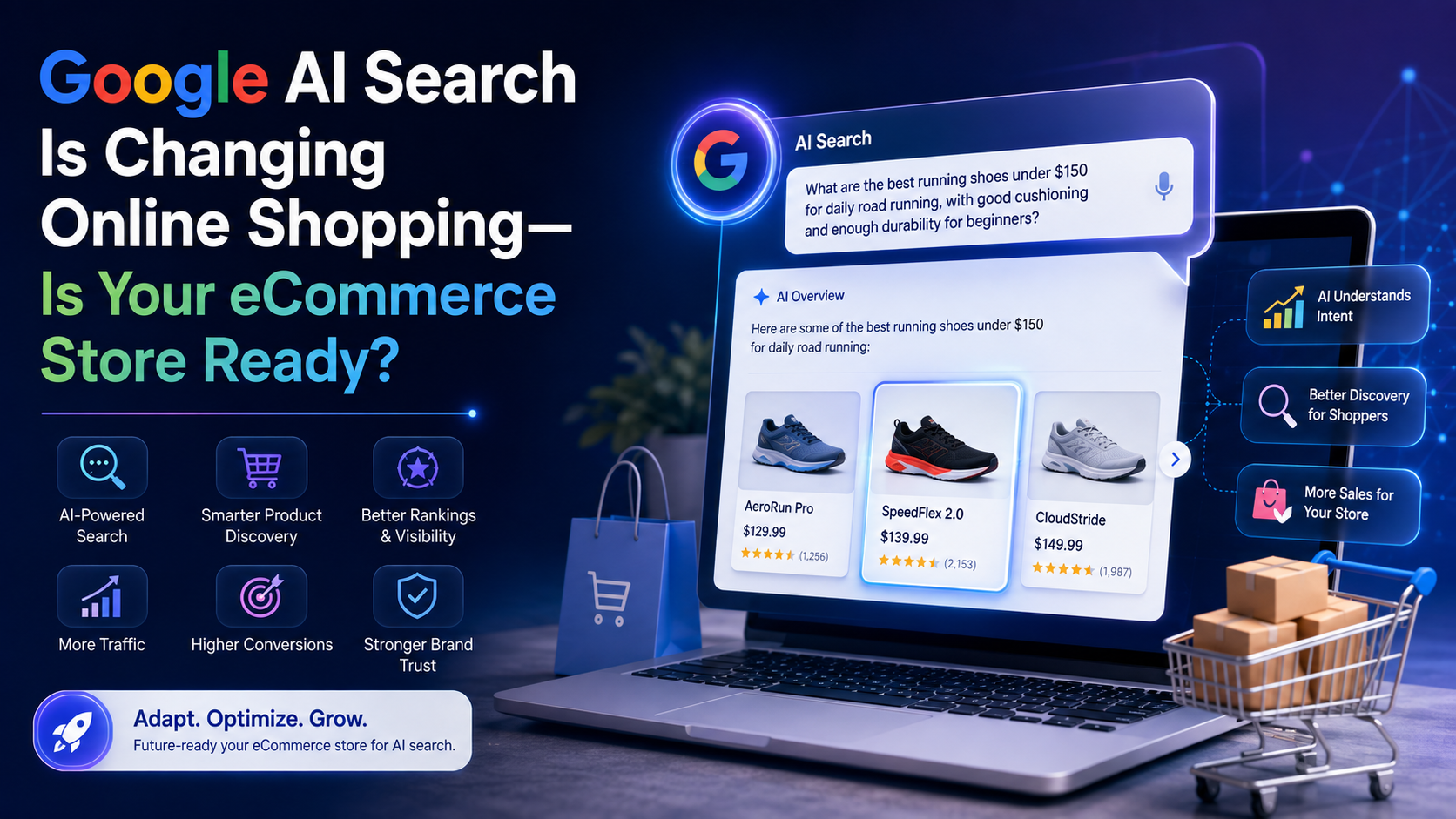
Today, shoppers can ask much more detailed questions in natural language. Instead of searching only for “best running shoes,” someone might ask, “What are the best running shoes under $150 for daily road running, with good cushioning and enough durability for beginners?”
That shift matters because Google AI Search can understand more context around what a person wants instead of relying only on a short list of keywords. Google says its generative AI search features, including AI Overviews and AI Mode, are built on its existing Search ranking and quality systems, which means strong SEO fundamentals still matter.
For eCommerce businesses, this creates both an opportunity and a challenge. Your store no longer needs to compete only for traditional blue-link rankings. Your products, categories, buying guides, reviews, and other useful content need to provide information that helps search engines understand what you sell, who it is for, why it is useful, and how it compares with alternatives.
Why eCommerce Brands Need to Rethink Search Visibility
Traditional eCommerce SEO is still essential. You need crawlable pages, useful product descriptions, strong category pages, relevant keywords, good internal linking, fast performance, and technically sound websites.
But AI-powered search adds another layer.
A shopper may no longer follow a simple path like:
Google Search → Website → Product Page → Purchase
Instead, the journey may look more like:
Question → AI-generated answer → Product discovery → Comparison → Research → Brand validation → Purchase
That means your website needs to answer more than “What keyword do I want to rank for?”
You also need to consider:
- What questions are shoppers asking before purchasing?
- What product attributes matter to them?
- What problems are they trying to solve?
- What comparisons are they making?
- What information helps them choose between products?
- Why should they trust your brand?
- Is your product information accurate and complete?
- Can search engines easily understand your products and website?
Google’s current guidance specifically emphasizes that SEO best practices remain relevant for generative AI features in Search. Google also recommends providing unique, helpful content rather than relying on content created primarily to manipulate search visibility.
This is why AI search optimization should not be viewed as a replacement for eCommerce SEO. It is better understood as an evolution of how you make your website useful, understandable, and discoverable.
What This Guide Will Teach You
In this guide, you’ll learn how Google AI Search is changing online shopping and what eCommerce businesses can do to prepare.
We’ll cover how to:
- Optimize product pages for modern search behavior
- Create content around real customer questions
- Improve product and category information
- Use structured data correctly
- Build topical authority around your products
- Create useful buying guides and comparison content
- Strengthen customer reviews and trust signals
- Optimize your website’s technical SEO foundation
- Prepare content for conversational and AI-driven searches
- Measure organic visibility, traffic, conversions, and search performance
You’ll also learn an important distinction: you cannot guarantee that Google will show your website in an AI Overview or AI-generated answer. The goal is to build a website that follows strong search fundamentals and provides clear, reliable, useful information that search systems can understand.
Google’s documentation also makes clear that structured data can help search engines understand content, but there is no guarantee that a structured-data feature will appear in search results.
Traditional SEO vs. AI Search Optimization
Traditional SEO often starts with a question like:
“Which keyword should this page rank for?”
AI-focused search optimization starts with a broader question:
“What information does the customer need to make a decision?”
That difference is important.
For example, a traditional product page targeting “wireless headphones” might focus heavily on the keyword, product title, description, and technical specifications.
A stronger AI-search-ready product experience could also answer:
- Are these headphones good for working from home?
- How long does the battery last?
- Are they comfortable for long meetings?
- How good is the microphone?
- Do they work with Windows and Mac?
- Are they better for calls or music?
- How do they compare with similar models?
- Who should buy them?
The second approach provides much more context and decision-making information.
That is the direction eCommerce SEO needs to move: from simply optimizing pages around keywords to building a complete information ecosystem around products, customers, questions, comparisons, and buying decisions.
And the opportunity is significant. Google’s current search documentation continues to emphasize SEO fundamentals for AI-powered Search, while Google’s commerce initiatives are also moving toward more direct AI-assisted shopping experiences.
The bottom line: AI Search is changing how shoppers discover and evaluate products, but the fundamentals have not disappeared. The eCommerce brands most prepared for this shift will be those that combine technical SEO, strong product data, helpful content, genuine expertise, trustworthy information, and an excellent customer experience.
The real question is no longer simply “Can my store rank on Google?”
It’s:
“Can my store provide the information an AI-powered search experience needs to understand, recommend, and help shoppers choose my products?”
What Is Google AI Search and Why Does It Matter for eCommerce?
What Is Google AI Search?
Google AI Search refers to Google’s use of artificial intelligence to understand complex searches and provide more useful, context-based answers. Instead of simply matching a search query with webpages containing similar keywords, AI-powered search can understand the meaning behind a question, connect related information, and help users explore a topic in greater depth.
For eCommerce businesses, this changes how online shoppers discover products. A customer can ask a detailed question such as, “What are the best office chairs for someone who works 8 hours a day and has a small home office?” rather than searching only for “best office chair.”
Traditional Google Search primarily presents a list of links, while AI-powered search can provide a synthesized response along with supporting sources and opportunities to continue exploring. Google explains how its AI features work alongside its existing Search ranking systems and SEO fundamentals in its official guidance on AI features and your website.
What Are Google AI Overviews?
Google AI Overviews are AI-generated summaries that can appear in Google Search for some queries. They are designed to give users a quick understanding of a topic while also providing links that allow them to explore information from relevant websites.
For eCommerce, this can become important when shoppers ask questions that require research rather than a simple product lookup. For example:
“What should I look for when buying a standing desk for a small home office?”
An AI-generated response may discuss desk size, height adjustment, stability, weight capacity, and other considerations before the shopper visits individual websites.
This means product discovery can begin with an informational question, rather than a direct product keyword. Google’s documentation on AI features in Search explains how AI Overviews fit into the broader Google Search experience.
For retailers, the opportunity is to create accurate product information and genuinely helpful content that addresses the questions customers ask before they buy.
Why eCommerce Brands Should Pay Attention
Online shopping behavior is becoming more conversational. Instead of typing short queries such as “running shoes,” “laptop under $1,000,” or “best coffee maker,” shoppers can ask detailed questions that include multiple needs, preferences, and constraints.
For example:
Traditional search:
“Best laptops under $1,000”
Conversational search:
“What’s the best laptop under $1,000 for college students who need long battery life and want to edit videos occasionally?”
This creates new opportunities for eCommerce SEO. Product pages are still important, but brands should also provide buying guides, comparison content, FAQs, detailed specifications, reviews, and educational resources.
AI-powered search may also change how users interact with traditional search results. Some shoppers may get useful information before clicking a website, while others may continue into deeper searches and visit multiple sources.
That is why depending only on ranking for a handful of traditional keywords can be risky. AI search optimization requires a broader strategy focused on search intent, helpful content, product information, technical SEO, authority, and trust.
The goal isn’t to “optimize for an AI” with shortcuts. It’s to build an eCommerce website that gives both search engines and shoppers enough accurate information to understand your products and make confident buying decisions.
How AI Search Is Changing the Online Shopping Journey
The way people shop online is moving beyond simple keyword searches. With Google AI Search, shoppers can describe what they need in everyday language and explore products through more detailed questions, comparisons, and recommendations.
For eCommerce brands, this means eCommerce SEO is no longer just about ranking a product page for a single keyword. Brands need to provide complete, useful information that helps customers at every stage of the buying journey.
From Keyword Search to Conversational Shopping
Traditional search usually starts with a short keyword or phrase. A shopper might search:
Traditional: “best running shoes under $150”
With conversational search, the shopper can provide much more context:
Conversational: “What are the best running shoes under $150 for someone who runs five miles every day?”
The second query tells Google much more about the shopper’s search intent. It includes the budget, product type, activity level, and expected use.
This is important for AI search optimization because AI-powered search can better understand the relationship between these details and the shopper’s actual goal.
Instead of creating content only around “running shoes,” an eCommerce brand should answer related questions about cushioning, durability, running distance, terrain, fit, price, and different types of runners.
Google’s guidance on AI features and Search explains that AI features are built on Google’s broader Search systems, making strong SEO fundamentals an important part of an AI-search strategy.
AI-Assisted Product Discovery
AI-powered search can make product discovery more conversational and specific. A shopper may describe a problem, preference, budget, or use case instead of knowing exactly which product they want.
For example, a customer might ask:
“I need a lightweight backpack for a three-day business trip that fits under an airplane seat and has a separate laptop compartment.”
This type of query includes several product attributes and constraints.
For eCommerce businesses, this creates an opportunity to provide detailed information about:
- Product features
- Size and dimensions
- Materials
- Compatibility
- Use cases
- Price ranges
- Available options
- Ideal customer
- Product limitations
The more complete and accurate your product information is, the easier it is for shoppers—and search systems—to understand what your products actually offer.
AI-Powered Product Comparisons
Online shoppers rarely want to know only what a product is. They often want to know which product is better for their specific needs.
AI-powered search can help users explore comparisons involving price, features, specifications, reviews, performance, durability, and use cases.
For example, instead of searching:
“Laptop A”
a shopper may ask:
“Should I buy Laptop A or Laptop B for college, light video editing, and all-day battery life?”
This makes complete product information extremely important.
Your website should clearly explain product specifications, benefits, limitations, pricing, warranty, compatibility, and ideal use cases. Useful product comparison content can also help customers understand which option fits their needs.
However, comparison content should be factual and transparent. Do not make unsupported claims simply to make your product look better.
The New eCommerce Search Funnel
The modern shopping journey can be viewed as:
Question → Discovery → Comparison → Validation → Purchase
At the question stage, create helpful educational content. During discovery, make product and category information easy to understand. For comparison, publish useful guides and comparison pages. During validation, provide genuine reviews, policies, specifications, and trust information. Finally, make the purchase process simple, fast, mobile-friendly, and secure.
This approach turns AI search optimization into something bigger than rankings: it helps your eCommerce store become a useful source of information throughout the customer’s entire buying journey.
Traditional eCommerce SEO vs. AI Search Optimization
Traditional eCommerce SEO and AI search optimization are not competing strategies. They work together. Traditional SEO helps search engines crawl, understand, and rank your website, while an AI-search strategy focuses more on context, intent, complete answers, product information, and trustworthy content.
For online stores, the best approach is to build a strong SEO foundation and then make the website useful for the more complex questions shoppers are asking.
What Traditional eCommerce SEO Focuses On
Traditional eCommerce SEO focuses on helping product and category pages appear in relevant Google searches. This includes researching keywords, improving rankings, building backlinks, optimizing website structure, and increasing organic traffic.
For example, an online shoe store may optimize a product page for “men’s running shoes” and a category page for “running shoes for beginners.”
Important areas include:
- Keywords: Finding terms customers actually search for.
- Rankings: Improving visibility for relevant search queries.
- Product and category pages: Optimizing titles, descriptions, content, URLs, and other page elements.
- Backlinks: Earning relevant links that can help build authority.
- Technical SEO: Improving crawlability, indexability, mobile usability, and site performance.
- Organic traffic: Attracting potential customers without paying for every click.
Google’s SEO Starter Guide continues to emphasize creating content that is useful to people while making websites accessible to search engines.
What AI Search Optimization Adds
AI search optimization takes these SEO fundamentals and applies them to a broader search experience. Instead of focusing only on the keyword a person types, it considers the intent, context, entities, questions, and information behind the search.
For example, someone searching for “office chair” may actually need an ergonomic chair for eight-hour workdays, a small home office, and a specific budget.
An AI-search-ready eCommerce website should provide information that addresses those needs. That means using natural language, answering related questions, explaining product attributes, creating useful comparisons, and building topical authority around important subjects.
It also means providing accurate, structured product information and demonstrating genuine expertise and trust. Google’s documentation on AI features in Search explains that the same fundamental SEO practices remain relevant for Google’s AI-powered search experiences.
Comparison: Traditional SEO vs. AI Search
| SEO Element | Traditional eCommerce SEO | AI Search Optimization |
| Keywords | Important for identifying relevant searches | Important, but combined with intent and context |
| Content | Often focused on ranking for target queries | Focused on answering questions and satisfying the full search intent |
| Product data | Important for product and shopping visibility | Increasingly important for helping systems understand product attributes and use cases |
| Reviews | Important for trust and conversions | Useful information that can help shoppers evaluate products |
| Structured data | Helps search engines understand page content | Provides machine-readable information about products, offers, reviews, and other entities |
| Authority | Often built through quality content and relevant links | Requires a broader picture of expertise, trust, useful information, and entity relationships |
| Search queries | Often targets specific keywords | Also considers longer, conversational, multi-part questions |
| Product comparisons | Useful for commercial SEO | Especially valuable when shoppers ask which product best fits their needs |
| Search intent | Important ranking consideration | Central to creating content that answers complex shopping questions |
| User experience | Supports rankings and conversions | Helps users quickly understand, compare, and act on information |
The biggest takeaway is simple: don’t abandon traditional SEO to chase AI search. Instead, strengthen your technical SEO, keyword targeting, product pages, and authority while expanding your content to answer real customer questions.
The eCommerce brands best positioned for AI-driven search are likely to be those that make their websites easy for search engines to understand and genuinely useful for shoppers to trust.
The 10 Biggest Ways Google AI Search Could Change eCommerce SEO
Google AI Search is changing how people discover, research, and compare products online. Instead of relying only on short keywords and traditional search results, shoppers can ask detailed questions and expect useful answers.
For eCommerce businesses, this means AI search optimization is becoming an important part of a broader eCommerce SEO strategy. The goal is not to chase a special ranking trick. It is to make your website easy to understand, trustworthy, useful, and helpful throughout the customer’s buying journey.
1. Conversational Queries Will Become More Important
Shoppers can use longer, natural-language questions instead of short keywords. For example, they may ask, “What are the best running shoes for beginners with flat feet under $150?” eCommerce brands should create content that answers these detailed questions while naturally covering relevant keywords, product attributes, and use cases.
2. Product Comparison Searches Will Become More Complex
Customers often want help choosing between several products, not simply finding one. Searches may include price, features, durability, compatibility, and specific needs. Creating useful product comparison content can help shoppers make decisions. Explain meaningful differences clearly instead of simply declaring one product the winner.
3. Product Data Accuracy Will Matter More
AI-powered search needs reliable information to understand what products offer. Your product name, price, availability, specifications, dimensions, materials, images, and other attributes should be accurate and consistent. Google also provides guidance for retailers through structured product data documentation, which explains how product information can be communicated to Search.
4. Brand Authority Will Become Increasingly Important
Shoppers want information they can trust, especially before spending money. A strong eCommerce brand should demonstrate expertise through helpful content, transparent business information, accurate product claims, useful customer support resources, and genuine experience. Don’t build authority by publishing large amounts of generic content. Build it by becoming a reliable source in your product category.
5. Product Reviews Can Strengthen Buyer Confidence
Reviews can help shoppers understand how products perform in real situations. Detailed reviews can provide information about quality, sizing, durability, comfort, performance, and common problems. Encourage genuine customer feedback and respond professionally to both positive and negative reviews. Never create fake reviews simply to improve SEO or conversions.
6. Long-Tail Commercial Questions Will Create New Opportunities
A customer searching for “coffee maker” has broad intent. Someone searching for “best coffee maker for a small apartment under $200 with an automatic timer” has much clearer buying intent. These long-tail eCommerce keywords can reveal specific customer needs. Create useful pages and sections that answer these detailed commercial questions naturally.
7. Buying Guides Can Support Product Discovery
A shopper may not know which product to purchase yet. A detailed eCommerce buying guide can explain what to consider, which features matter, common mistakes, and which type of product fits different needs. For example, a mattress store could create a guide covering firmness, sleeping positions, materials, body types, and temperature control before recommending suitable products.
8. Structured Data Will Help Search Engines Understand Products
Product structured data gives search engines machine-readable information about products and offers. Depending on the implementation, this can communicate details such as product names, prices, availability, ratings, and reviews. Google’s Product structured data guidelines explain recommended implementation practices. However, structured data does not guarantee rankings or special search appearances.
9. Zero-Click Searches May Change Organic Traffic Patterns
AI-generated answers can sometimes provide useful information directly within the search experience, potentially reducing the need for a user to click immediately. This makes brand visibility, product discovery, and informational authority increasingly important alongside clicks. Businesses should monitor impressions, traffic, conversions, branded searches, and other available signals rather than judging SEO success by rankings alone.
10. eCommerce Brands Will Need Broader Topical Authority
Ranking for one product keyword is not the same as becoming a trusted resource. A strong topical SEO strategy connects product pages with buying guides, comparisons, FAQs, educational content, reviews, and supporting resources. This gives shoppers more useful information while helping search engines understand the broader relationship between your brand, products, and topics.
Strategic Takeaway: Optimize the Entire Search Ecosystem
The biggest mistake an eCommerce business can make is treating AI Search as another keyword-ranking exercise.
Your customers don’t think in isolated keywords. They think in problems, preferences, budgets, questions, comparisons, and buying decisions.
Your SEO strategy should reflect that journey:
Product Data → Product Pages → Category Pages → Buying Guides → Comparisons → Reviews → FAQs → Internal Links → Trust → Conversion
Traditional eCommerce SEO remains the foundation. AI search optimization expands that foundation by focusing more deeply on context, natural-language questions, product information, helpful answers, and trustworthy content.
Google’s SEO guidance for AI features reinforces an important point: there is no separate shortcut or special “AI SEO” requirement that replaces fundamental SEO. The strongest approach is to create helpful, reliable, people-first content while maintaining a technically sound website.
In other words, don’t optimize just one product page for one keyword.
Build an eCommerce search ecosystem that helps customers discover, understand, compare, trust, and buy your products.
How to Optimize Your eCommerce Store for Google AI Search
Optimizing an eCommerce website for Google AI Search does not mean finding a secret SEO trick or creating content only for AI. The foundation is still strong eCommerce SEO: useful pages, accurate product information, a technically healthy website, and content that genuinely helps shoppers.
The difference is that shoppers can now ask more detailed, conversational questions. Your store needs to provide enough clear information for search engines and customers to understand your products, compare options, and make confident decisions.
Here are 10 practical steps to make your eCommerce website more prepared for AI-powered search.
Step 1: Strengthen Your Product Data
Your product data is the foundation of product SEO. Search engines need clear information to understand what you sell and how each product differs from similar products.
Include Complete Product Information
Every important product page should clearly provide:
- Product name
- Brand
- Model number
- Key specifications
- Materials
- Dimensions
- Sizes
- Colors
- Compatibility
- Availability
- Current pricing
Don’t hide important information inside images or vague descriptions. Use clear, readable text wherever possible.
For example, instead of saying “premium laptop with excellent performance,” provide specific details such as processor, RAM, storage, screen size, battery information, and operating system.
Keep Product Information Consistent
Make sure important product details match across your:
- Website
- Merchant feeds
- Product listings
- Structured data
Google’s Product structured data documentation provides guidance on communicating product information to Google.
Accurate and consistent data also creates a better shopping experience. If your website says a product costs $99 but another source shows $129, customers can become confused and lose trust.
Step 2: Optimize Product Pages for Search Intent
A product page should do more than describe what you sell. It should help a shopper decide whether the product is right for them.
Write Helpful Product Descriptions
A strong product description should explain:
- Features: What does the product have?
- Benefits: Why do those features matter?
- Use cases: How can customers use it?
- Ideal customer: Who is this product best suited for?
For example, don’t simply write “noise-canceling headphones with 30-hour battery life.”
Explain how that battery life benefits someone who travels, works remotely, or attends long meetings.
Answer Buyer Questions
Think about the questions customers ask before purchasing:
- Who is this product for?
- What problem does it solve?
- How does it compare with similar products?
- What should buyers know before purchasing?
- What are its limitations?
- Is it compatible with my device?
- What does the warranty cover?
This approach helps you target search intent rather than simply repeating a keyword.
Step 3: Implement Product Structured Data Correctly
Structured data helps search engines understand specific information on your pages. For eCommerce websites, it can be particularly useful for communicating product and offer details when implemented correctly.
Important Product Schema Types
Depending on your website and content, relevant schema types can include:
- Product
- Offer
- AggregateRating
- Review
- BreadcrumbList
- Organization
Google’s structured data guidelines explain how structured data should be implemented and the requirements that apply.
Avoid Incorrect or Misleading Markup
Your structured data should accurately represent information that users can find on the page.
For example, don’t mark up a five-star rating if your page does not actually display legitimate reviews supporting that rating.
Also remember: structured data does not guarantee higher rankings, AI Overview visibility, or a special search feature. Its primary purpose is to provide search engines with machine-readable information about your content.
Step 4: Create Answer-Focused eCommerce Content
One of the best ways to prepare for AI search optimization is to answer the questions shoppers ask before they buy.
Target Real Buyer Questions
Create useful content around questions such as:
- Which product is best for…?
- Is ___ worth buying?
- What is the difference between ___ and ___?
- Who should buy ___?
- How long does ___ last?
- What size should I choose?
- Is ___ compatible with ___?
- What should I look for before buying ___?
For example, a mattress retailer could create content answering “What mattress firmness is best for side sleepers?”
A camera store could answer “What camera is best for beginners who want to shoot travel videos?”
These questions can attract people who are still researching their purchase.
The key is to provide a complete, honest answer—not simply use the question as a heading and fill the page with generic content.
Step 5: Build Topic Clusters Around Your Products
Don’t make your product pages do all the SEO work. Build a network of useful content around important product categories.
Pillar Content
Start with a comprehensive guide such as:
Complete Guide to Choosing Running Shoes
This page can explain the major factors shoppers should consider before purchasing.
Supporting Content
Then create related articles such as:
- Best running shoes for beginners
- Running shoes for flat feet
- Road vs. trail running shoes
- How often should you replace running shoes?
- Running shoe sizing guide
- How much cushioning do runners need?
- How to choose running shoes for long-distance running
Connect these pages with relevant internal links.
This creates topical authority and gives shoppers multiple ways to find useful information. More importantly, each page can target a different search intent instead of forcing every keyword onto one product or category page.
Step 6: Strengthen E-E-A-T and Brand Trust
People are more likely to buy from a business they trust. Your website should make it easy for customers to understand who is behind the business and why they should believe your information.
Strengthen trust with:
- Expert authors where appropriate
- First-hand product experience
- Transparent business information
- Clear editorial standards
- Easy-to-find contact details
- Shipping information
- Return policies
- Warranty details
- Accurate product claims
For product reviews and recommendations, explain how products were evaluated when you have first-hand experience.
Google’s guidance on creating helpful, reliable, people-first content emphasizes creating content primarily to help people rather than producing pages simply to attract search traffic.
Step 7: Optimize Genuine Customer Reviews
Customer reviews can provide useful information that product descriptions may not cover.
Encourage customers to share genuine, detailed experiences about product quality, fit, performance, durability, and usability.
Avoid fake or manipulated reviews. Respond professionally to both positive and negative feedback.
Detailed first-hand experiences can also help future shoppers make better purchasing decisions.
Step 8: Optimize for Conversational Search
People don’t always search using short keywords. They may describe exactly what they need.
Instead of targeting only “office chair,” create content that can answer questions like:
“What is the best office chair for someone who works eight hours a day and has a small home office?”
Turn important keywords into natural questions, address multiple buyer requirements, and provide complete answers.
This is a practical way to align your eCommerce SEO strategy with conversational search behavior.
Step 9: Improve Internal Linking
A clear internal-linking structure helps users and search engines discover related content.
A simple eCommerce structure can look like:
Homepage → Categories → Subcategories → Products → Guides → Comparisons → FAQs
For example, a running-shoe category page could link to a running-shoe sizing guide, beginner’s buying guide, product comparison, and relevant products.
Use descriptive, natural anchor text rather than repeatedly using the same exact keyword.
Step 10: Improve Technical SEO
AI search optimization still depends on a strong technical foundation. Search engines must be able to access, crawl, understand, and index your website.
Focus on:
- Crawlability
- Indexability
- Mobile usability
- Core Web Vitals
- JavaScript rendering
- Canonical URLs
- XML sitemaps
- Duplicate URLs
- Broken links
- Clean URL structures
Also make sure important product content is accessible to search engines and not unnecessarily hidden behind technical barriers.
Google’s SEO Starter Guide provides a useful foundation for making websites easier for search engines to understand.
The Bigger Picture
Preparing an eCommerce store for Google AI Search is not about replacing traditional SEO. It is about making your existing SEO strategy more complete.
Think beyond:
“What keyword should I rank for?”
Instead, ask:
“What does my customer need to know before buying this product?”
Then build your website around that answer.
Strong product data + helpful product pages + useful content + structured data + genuine reviews + topical authority + technical SEO + internal linking creates a much stronger foundation for both traditional search and AI-powered search experiences.
Which eCommerce Content Types Can Earn AI-Driven Visibility?
There is no single content type that guarantees visibility in Google AI Search, AI Overviews, or traditional Google Search. The stronger approach is to build a complete content ecosystem that answers different customer questions at different stages of the buying journey.
Google’s current guidance says that the fundamentals of SEO continue to matter for generative AI features in Search. It also recommends creating useful, original information rather than content made only to manipulate rankings.
For an eCommerce website, that means your content strategy should go beyond product pages. You should combine product pages, category pages, buying guides, comparison content, FAQs, reviews, and first-hand content to help customers discover, evaluate, and purchase products.
Product Pages
Your product pages are the core of your eCommerce SEO strategy. Give shoppers complete and accurate information about the product, including features, specifications, pricing, availability, compatibility, images, reviews, and use cases.
Don’t write descriptions only for keywords. Explain what the product does, who it is for, and why someone should consider buying it.
Category Pages
Category pages help shoppers discover groups of related products. A strong category page should do more than display a product grid.
Add a useful introduction, explain how to choose a product, answer common questions, and link to important products, guides, comparisons, and subcategories. This creates a better product discovery experience and gives search engines more context.
Buying Guides
Buying guides are useful when customers know what they need but don’t know which product to choose.
For example:
“How to Choose the Best Running Shoes for Your Needs”
A good guide can explain fit, cushioning, materials, price, use cases, and common mistakes. It can then link naturally to relevant product and category pages.
This type of eCommerce content marketing can support both informational and commercial search intent.
Product Comparison Pages
Comparison pages help shoppers who are already evaluating specific choices.
For example:
Product A vs. Product B: Which One Is Better for Home Office Use?
Compare meaningful factors such as:
- Price
- Features
- Performance
- Size
- Materials
- Warranty
- Ideal customer
- Pros and limitations
The goal is to help customers make the right decision—not simply declare your product the winner.
Best-of and Alternatives Content
“Best” and “alternative” searches often show strong commercial intent.
Examples include:
- Best laptops for college students
- Best running shoes for beginners
- Best coffee makers under $200
- Best alternatives to Product X
Make these pages genuinely useful. Explain why each product is included, who it is best for, and where it may not be the right choice.
FAQs and Educational Content
FAQs can answer specific questions that shoppers ask before purchasing.
Examples:
- How does this product work?
- What size should I choose?
- Is this product compatible with ___?
- How long does it last?
- What is the difference between ___ and ___?
Educational content can also cover broader topics related to your products.
One important update for 2026: Google has deprecated the FAQ rich result feature in Search, so don’t create FAQs solely because you expect a special FAQ search appearance. The value is in answering real customer questions clearly.
Reviews, Case Studies, and First-Hand Content
First-hand content can make your website more useful and credible. Genuine customer reviews, product testing, demonstrations, case studies, and real-world experiences can give shoppers information that a standard manufacturer description cannot.
For example, instead of saying a backpack is “durable,” a first-hand review could explain how it performed during frequent travel and what worked well or poorly.
Always keep reviews genuine. Don’t manufacture experiences or make unsupported claims.
eCommerce Content Types, Search Intent, and Business Value
| Content Type | Main Search Intent | Example | Business Value |
| Product Pages | Transactional | “Nike running shoes size 10” | Drives product discovery and sales |
| Category Pages | Commercial | “Men’s running shoes” | Captures broader product searches |
| Buying Guides | Informational + Commercial | “How to choose running shoes” | Educates shoppers and moves them toward products |
| Comparison Pages | Commercial | “Product A vs. Product B” | Helps customers make purchase decisions |
| Best-of Content | Commercial Investigation | “Best running shoes for beginners” | Reaches shoppers comparing options |
| Alternative Content | Commercial | “Best alternatives to Product X” | Captures competitor and substitute searches |
| FAQs | Informational | “How long do running shoes last?” | Answers specific customer questions |
| Educational Content | Informational | “How running shoe cushioning works” | Builds topical authority |
| Reviews | Commercial Investigation | “Product X review” | Builds confidence before purchase |
| Case Studies | Commercial + Informational | “How Product X helped…” | Demonstrates real-world value |
| First-Hand Content | Informational + Commercial | “Testing Product X for 30 days” | Adds original experience and useful insights |
Build a Content Ecosystem, Not Just a Blog
The biggest mistake eCommerce brands make is creating random blog posts without connecting them to products.
Instead, build a structure like this:
Category → Product → Buying Guide → Comparison → FAQ → Review → Related Products
For example:
Running Shoes
→ Running Shoe Category
→ Product Pages
→ Best Running Shoes for Beginners
→ Road vs. Trail Running Shoes
→ Product A vs. Product B
→ Running Shoe Sizing Guide
→ How Often Should You Replace Running Shoes?
→ Real Customer Reviews
This structure helps customers move naturally from research to comparison to purchase.
It can also strengthen your site’s topical coverage because related pages provide useful context around the products you sell.
Google’s documentation emphasizes that structured data and other technical signals can help Google understand page content, but Google also makes clear that using structured data does not guarantee that a particular search feature will appear.
The key takeaway: Don’t try to create content specifically to “trick” AI search. Build the best possible information system around your products. When product pages, categories, guides, comparisons, FAQs, and genuine experiences work together, your eCommerce website becomes more useful to both shoppers and search engines.
How to Create Product Comparison Content for AI Search
Creating product comparison content for AI Search is not about making one product look better than another. It is about helping shoppers understand their choices and decide which product fits their specific needs.
A useful comparison page can target commercial search intent, answer conversational queries, and give both shoppers and search engines clear information about the products being compared.
Start With the Actual Buyer Decision
Before writing a comparison, identify the decision the customer is trying to make.
Don’t start with: “Product A vs. Product B.”
Start with: “Which product is better for this type of customer?”
For example, a laptop comparison could focus on students, business users, gamers, or content creators. Understanding the buyer’s needs helps you create more useful eCommerce comparison content.
Compare Meaningful Product Attributes
Compare factors that can actually influence a purchase decision. Depending on the product, these may include:
- Price: What does each option cost?
- Features: What does each product include?
- Performance: How does each product perform in real use?
- Materials: What is each product made from?
- Durability: How well is each product designed to hold up?
- Warranty: What protection does the buyer receive?
- Ideal customer: Who is each product best suited for?
Avoid filling comparison tables with information that does not help the customer make a decision. Focus on the attributes that matter most for the specific product category.
Explain Which Product Is Best for Which Buyer
Don’t automatically declare one product the overall winner.
The better product often depends on the shopper’s budget, goals, experience, and intended use.
For example, Product A might be better for buyers who want the lowest price, while Product B may be a better choice for someone who needs premium features or longer durability.
This approach makes your product comparison page more honest, useful, and aligned with real search intent.
Add Supporting Evidence and First-Hand Insights
Strong comparisons should be supported by reliable product information and, when available, genuine first-hand experience.
Use manufacturer specifications, verified product details, testing results, legitimate customer feedback, and your own documented experience.
Explain how you reached your conclusions instead of making unsupported claims. Google’s guidance on creating helpful, reliable, people-first content encourages content that provides genuine value rather than content created primarily to manipulate search rankings.
When shoppers can understand what was compared, why it matters, and who each product is best for, your comparison content becomes useful throughout the buying journey—not just another page targeting a keyword.
How to Optimize eCommerce Category Pages for AI Search
Your category pages can play a major role in eCommerce SEO because they connect broad product searches with the individual products customers can buy. A well-optimized category page should not simply show a grid of products. It should help shoppers understand their options, answer common questions, and quickly find the right product.
For AI search optimization, focus on clear information, useful context, strong internal links, and a simple path from research to purchase.
Write Useful Category Introductions
Start each category page with a short, helpful introduction that explains what the category offers and who it is for.
For example, a running shoes category could explain the differences between road running, trail running, daily training, and racing shoes.
Naturally include relevant secondary keywords, product attributes, and customer needs without stuffing keywords into the text.
Add Buying Guidance
Help customers understand what they should consider before choosing a product.
Depending on the category, discuss factors such as:
- Price
- Size
- Materials
- Features
- Performance
- Compatibility
- Durability
- Intended use
For example, a laptop category could explain how shoppers should compare processor speed, RAM, storage, screen size, battery life, and operating system.
This turns a basic category page into a useful shopping resource.
Address Common Category Questions
Think about the questions customers ask before purchasing products in that category.
Examples include:
- Which product is best for beginners?
- What features should I look for?
- How do I choose the right size?
- Which option is best for my budget?
- What is the difference between these product types?
Answer these questions clearly and naturally. This helps satisfy conversational search intent while making the page more useful to shoppers.
Improve Internal Links and Product Discovery
Make it easy for visitors and search engines to move through your website.
A strong structure could look like:
Category → Subcategory → Product → Buying Guide → Comparison → FAQ
Link your category page to important subcategories, individual products, buying guides, comparison pages, and relevant educational content.
Use descriptive anchor text such as “running shoes for beginners” instead of generic phrases like “click here.”
Also make sure important products are easy to discover without forcing users through unnecessary clicks. Google’s SEO Starter Guide emphasizes clear site organization and making important pages accessible to both users and search engines.
The goal is simple: turn your category page from a product shelf into a useful buying hub that helps customers discover, understand, compare, and choose the right products.
Common eCommerce AI Search Optimization Mistakes
Optimizing an eCommerce website for Google AI Search is not about adding more keywords or publishing hundreds of pages. Many online stores lose visibility because their content is incomplete, repetitive, inaccurate, or created mainly for search engines.
If you want stronger eCommerce SEO and AI search optimization, avoid these common mistakes.
Thin Product Descriptions
Problem → Product pages contain only a few generic sentences.
Why It Matters → Shoppers cannot understand the product, and the page provides little useful information for search engines.
Better Approach → Explain features, benefits, specifications, use cases, limitations, and who the product is best for.
Duplicate Manufacturer Content
Problem → The same manufacturer description appears across your store and many competing websites.
Why It Matters → Your website offers little original value.
Better Approach → Rewrite product content with your own useful information, comparisons, buying advice, FAQs, and real customer insights.
Incomplete Product Information
Problem → Important details such as size, materials, compatibility, availability, or specifications are missing.
Why It Matters → Customers may leave because they cannot make a confident decision.
Better Approach → Provide complete, accurate, and easy-to-find product information.
Incorrect Structured Data
Problem → Product schema contains inaccurate information or does not match visible page content.
Why It Matters → Incorrect structured data can create confusion and may make the markup ineligible for certain search features.
Better Approach → Follow Google’s structured data guidelines and keep markup consistent with the actual page.
Fake or Low-Quality Reviews
Problem → Reviews are fabricated, copied, extremely vague, or manipulated.
Why It Matters → Fake reviews damage customer trust and can create compliance and reputation problems.
Better Approach → Encourage genuine customers to provide detailed feedback about their actual experience.
Keyword Stuffing
Problem → The same keyword is repeated unnaturally throughout product pages and articles.
Why It Matters → Keyword stuffing makes content difficult to read and does not create a better shopping experience.
Better Approach → Use your primary keyword and related secondary keywords naturally while focusing on the customer’s question or need.
Ignoring Conversational Search
Problem → Content targets only short keywords such as “running shoes.”
Why It Matters → Shoppers may ask more detailed questions involving budget, use case, features, and preferences.
Better Approach → Answer natural questions such as, “What are the best running shoes for beginners with flat feet?”
Publishing Generic AI-Generated Content
Problem → A store publishes large amounts of AI-written content with little editing, expertise, or original information.
Why It Matters → Generic content often provides little value and may simply repeat information already available elsewhere.
Better Approach → Use AI as a productivity tool, then add human expertise, first-hand experience, original insights, accurate product information, and thorough fact-checking. Google’s guidance on AI-generated content recommends focusing on helpful, accurate, people-first content.
Creating Content Only for Search Engines
Problem → Articles are written primarily to rank rather than help customers.
Why It Matters → Pages can become repetitive, shallow, and difficult to use.
Better Approach → Start with the customer’s problem. Explain the answer clearly, provide useful examples, and connect readers to relevant products or resources.
Ignoring Technical SEO
Problem → Great content exists, but the website has crawlability, indexing, mobile usability, speed, canonical, or duplicate URL problems.
Why It Matters → Search engines need to access and understand your pages before your content can compete effectively.
Better Approach → Regularly audit crawlability, indexability, Core Web Vitals, mobile experience, XML sitemaps, canonical URLs, JavaScript rendering, and internal links. Google’s SEO Starter Guide provides a solid technical foundation.
The Key Lesson
AI search optimization starts with the same principle as good eCommerce SEO: help people first.
Don’t create content simply because you found a keyword. Create the most useful answer, product information, comparison, or buying guidance for the person behind that search.
That approach gives your eCommerce website a stronger foundation for traditional search, AI-powered search, and—most importantly—better customer decisions.
AI-Generated Content vs. Helpful eCommerce Content
AI can make eCommerce content production faster, but AI-generated content and helpful content are not the same thing. The goal should never be to publish as much content as possible. Your goal should be to create accurate, useful information that helps shoppers make better decisions.
Google’s guidance on AI-generated content emphasizes the importance of content quality, accuracy, and usefulness rather than producing content simply to manipulate search rankings.
Where AI Can Help
AI can be a useful assistant throughout your eCommerce content strategy. It can help with:
- Research assistance: Organizing topics and questions customers may ask.
- Content outlines: Creating a logical structure before writing.
- Product-content drafts: Producing an initial draft from verified product information.
- Content ideation: Finding potential buying guides, FAQs, and comparison topics.
- Data organization: Turning large amounts of product information into easier-to-manage formats.
AI should speed up your workflow—not replace your SEO and content judgment.
Where Human Expertise Matters
Human expertise is critical when content involves products, recommendations, and buying decisions.
A real expert can add first-hand product experience, verify accuracy, provide original insights, and decide which information actually matters to customers.
Humans should also review product claims carefully. Statements about performance, safety, durability, health benefits, pricing, or results should never be published simply because an AI tool generated them.
The best content combines AI efficiency with human expertise, editorial judgment, and real product knowledge.
How to Use AI Responsibly
Use AI to assist—not replace—the content team.
Every important page should receive human review and fact-checking before publication. Add original information, genuine experience, useful examples, and verified product details.
Most importantly, avoid creating hundreds of nearly identical pages just to target keywords. Google’s people-first content guidance supports creating useful content designed primarily for people.
Use AI to work smarter. Use human expertise to make the content worth trusting.
How to Measure Your eCommerce AI Search Readiness
Optimizing for Google AI Search is only useful if you can measure whether your efforts are improving visibility, engagement, and sales. There is no single “AI search score” that tells you whether an eCommerce website is ready.
Instead, combine traditional eCommerce SEO metrics, business performance data, and available AI-search visibility signals. This gives you a much clearer picture of what is working and where your strategy needs improvement.
Traditional SEO Metrics
Start with the SEO metrics you already track:
- Impressions: How often your pages appear in search.
- Clicks: How many users visit from search.
- CTR: How often impressions result in clicks.
- Rankings: Where important pages appear for target queries.
- Organic conversions: Sales or leads from organic search.
- Revenue: The actual business value generated by organic traffic.
You can monitor many of these metrics through Google Search Console and Google Analytics.
eCommerce Performance Metrics
SEO traffic is valuable only when it contributes to business results. Track your add-to-cart rate, conversion rate, revenue per visitor, and product engagement.
For example, if organic traffic increases by 30% but sales remain unchanged, you need to investigate whether the traffic matches the right search intent or whether product pages and checkout experience need improvement.
AI Search Visibility
Measuring AI search visibility is more difficult than measuring traditional rankings. AI-generated responses can vary based on the query, user context, personalization, location, device, and other factors.
The same question may not always produce exactly the same response. Your brand may also be mentioned or cited without generating a website visit.
Therefore, monitor important conversational queries manually or through appropriate visibility tools, and track whether your brand, products, or content are being mentioned as relevant sources. Treat these observations as visibility signals, not guaranteed rankings.
Build a Practical Measurement Dashboard
Create one dashboard combining Search Console data, analytics, eCommerce performance, and AI-search observations.
Track trends monthly rather than reacting to individual searches. Review which pages gain visibility, which queries drive qualified visitors, which products generate revenue, and where customers drop out.
The goal is simple:
Visibility → Qualified Traffic → Engagement → Conversions → Revenue
That measurement framework helps you turn AI search optimization from a theory into a measurable eCommerce growth strategy.
90-Day Google AI Search Readiness Plan for eCommerce
Preparing an eCommerce website for Google AI Search does not happen overnight. You need a structured plan that improves your technical foundation, product information, content quality, authority, and measurement.
The following 90-day AI search optimization plan gives eCommerce businesses a practical starting point without abandoning the fundamentals of traditional SEO.
Days 1–30: Build the Foundation
Start by finding and fixing the problems that could prevent search engines from properly accessing or understanding your website.
Conduct a complete technical SEO audit covering crawlability, indexability, mobile usability, page speed, internal links, canonical URLs, XML sitemaps, and duplicate pages.
Next, perform a product-data audit. Check product names, descriptions, prices, availability, specifications, images, and other important attributes.
Review your structured data and make sure it accurately represents the visible content on your pages. Use Google Search Console to identify indexing and search-performance issues.
Finally, research your customers’ search intent and identify the questions they ask before purchasing.
Days 31–60: Build Content and Authority
Once your foundation is healthy, improve the content customers use to make purchasing decisions.
Optimize your most important product pages with complete descriptions, specifications, benefits, use cases, and buyer information.
Improve category pages with useful introductions and buying guidance. Then create targeted buying guides, product comparisons, FAQs, and educational content around important customer questions.
Strengthen your internal linking so search engines and shoppers can easily move between categories, products, guides, and comparisons.
At the same time, strengthen trust through genuine reviews, transparent business information, expert input where appropriate, clear policies, and accurate product claims.
Google’s guidance on helpful, reliable content should guide your content strategy.
Days 61–90: Measure and Improve
Now use your data to determine what is working.
Analyze organic impressions, clicks, CTR, rankings, traffic, conversions, revenue, and product engagement. Identify pages that receive visibility but generate few clicks or sales.
Expand your keyword and conversational query research based on real customer questions and performance data. Update content where information is incomplete, outdated, or not satisfying search intent.
Improve conversion elements such as product information, calls to action, trust signals, navigation, and checkout experience.
Finally, monitor AI search visibility for important queries and track brand or product mentions where practical. Remember that AI-generated results can change by query, location, device, and user context.
After 90 days, repeat the process. AI search readiness is not a one-time project—it is an ongoing cycle of audit → create → measure → improve.
Google AI Search Readiness Checklist for eCommerce
A strong Google AI Search strategy starts with the basics: a website that can be crawled, accurate product information, helpful content, trustworthy reviews, and reliable measurement. Use this eCommerce AI Search checklist to identify gaps before investing heavily in new content.
Technical SEO Checklist
- ☐ Make important pages crawlable.
- ☐ Check indexation in Google Search Console.
- ☐ Fix broken links and 404 errors.
- ☐ Use HTTPS across the website.
- ☐ Improve mobile usability.
- ☐ Monitor Core Web Vitals.
- ☐ Create and maintain an XML sitemap.
- ☐ Review robots.txt rules.
- ☐ Fix duplicate URLs and canonical issues.
- ☐ Build a clear internal-linking structure.
Google’s SEO Starter Guide provides practical guidance for building a search-friendly website.
Product SEO Checklist
- ☐ Write unique product descriptions.
- ☐ Include important product specifications.
- ☐ Clearly display price and availability.
- ☐ Explain product benefits and use cases.
- ☐ Add high-quality product images.
- ☐ Optimize image alt text naturally.
- ☐ Explain compatibility where relevant.
- ☐ Keep product information accurate and updated.
- ☐ Add useful product FAQs.
- ☐ Link products to relevant guides and comparisons.
Content Checklist
- ☐ Research real customer questions.
- ☐ Target search intent, not just keywords.
- ☐ Create useful buying guides.
- ☐ Publish product comparisons.
- ☐ Build topic clusters around important categories.
- ☐ Add original insights and expertise.
- ☐ Update outdated content.
- ☐ Avoid thin or repetitive pages.
- ☐ Review AI-assisted content before publishing.
- ☐ Write primarily for shoppers, not search engines.
Structured Data Checklist
- ☐ Implement relevant Product structured data.
- ☐ Include accurate Offer information.
- ☐ Mark up legitimate reviews and ratings where eligible.
- ☐ Add BreadcrumbList where appropriate.
- ☐ Use Organization markup when relevant.
- ☐ Ensure markup matches visible page content.
- ☐ Validate structured data regularly.
Review Google’s structured data guidelines before implementation.
Reviews & Trust Checklist
- ☐ Collect genuine customer reviews.
- ☐ Encourage detailed feedback.
- ☐ Never publish fake reviews.
- ☐ Respond professionally to customer feedback.
- ☐ Display clear shipping information.
- ☐ Publish transparent return policies.
- ☐ Provide warranty information where applicable.
- ☐ Make business contact information easy to find.
Analytics & Measurement Checklist
- ☐ Connect Google Search Console.
- ☐ Configure Google Analytics 4.
- ☐ Track organic conversions.
- ☐ Track eCommerce revenue.
- ☐ Monitor organic CTR.
- ☐ Track important search queries.
- ☐ Monitor product and category performance.
- ☐ Review AI-search visibility for important queries.
- ☐ Track brand mentions where practical.
- ☐ Review performance regularly and improve underperforming pages.
Final AI Search Readiness Test
If your store has accurate product information, technically accessible pages, helpful content, genuine expertise, trustworthy reviews, strong internal linking, and measurable business goals, you have a much stronger foundation for both traditional eCommerce SEO and AI-powered search.
Remember: this checklist can improve your search readiness, but no checklist can guarantee a #1 ranking or inclusion in a Google AI Overview. The goal is to consistently make your website more useful, understandable, and trustworthy.
How Ready Is Your eCommerce Store for AI Search?
Use this simple framework to assess how well your store is prepared for Google AI Search and AI Overviews. Give yourself 1 point for each item you can confidently answer “yes” to from your technical, product, content, trust, and measurement checklists.
Important: This is a strategic assessment framework, not an official Google ranking or AI-search score. Google does not publish a score that determines whether an eCommerce website will appear in AI-generated search results.
0–10: High Risk
Your store likely has major gaps in technical SEO, product information, content quality, structured data, or trust signals. Start with technical issues and incomplete product pages before creating large amounts of new content.
11–20: Needs Improvement
You have some solid SEO foundations, but important areas need work. Focus on improving product data, search-intent coverage, internal linking, useful content, reviews, and technical performance.
21–30: Strong Foundation
Your store has many of the elements needed for modern eCommerce SEO and AI search optimization. Focus on expanding topic coverage, improving content quality, strengthening authority, and measuring performance.
31+: Highly Prepared
Your website has a strong, well-rounded search foundation. Continue updating product information, publishing genuinely useful content, improving user experience, monitoring performance, and adapting to changes in search behavior.
The goal isn’t to achieve a perfect score. The real goal is to identify weaknesses and continuously improve how easily shoppers—and search systems—can understand, evaluate, and trust your products.
The Future of eCommerce Search
The future of eCommerce search is moving toward a more conversational and helpful shopping experience. But it is important to separate what is already happening from what is still a prediction.
More Conversational Shopping Journeys
Established development: Shoppers can already use natural-language questions and more detailed queries in modern search experiences. Instead of searching only for a product name, they can describe their budget, preferences, and intended use.
Future possibility: Shopping journeys may become even more conversational, with AI helping users refine product choices through multiple follow-up questions.
More Complex Product Questions
Established development: Consumers already search for comparisons, recommendations, specifications, and product-specific advice.
Industry prediction: AI-powered search may increasingly handle multi-step product research, allowing shoppers to compare several factors within one conversation rather than performing many separate searches.
Greater Importance of Product Data
Established development: Accurate product information is already important for eCommerce search and product-related search features. Google’s merchant listing documentation provides guidance on product information that retailers can make available to Google.
Future possibility: As AI systems become better at understanding products, complete and consistent product data may become even more valuable.
Stronger Demand for Trusted Information
Established development: Customers need accurate information to compare products and make purchasing decisions.
Industry prediction: Brands with genuine expertise, original insights, transparent policies, and trustworthy customer experiences may gain a stronger competitive advantage.
Changing Organic Click Behavior
Established development: AI-generated search features can provide information directly within the search experience.
Future possibility: The relationship between search visibility, clicks, branded searches, and conversions may continue to change as AI search develops.
The key takeaway: Don’t build your strategy around predictions alone. Strengthen the fundamentals that are valuable today—accurate product data, helpful content, technical SEO, strong user experience, and trust—while staying ready for how AI-powered shopping search evolves.
Frequently Asked Questions About Google AI Search for eCommerce
What Is Google AI Search for eCommerce?
Google AI Search uses artificial intelligence to better understand complex and conversational searches. For eCommerce, this can help shoppers discover products, compare options, and find answers based on their needs, preferences, and budget. Businesses should focus on accurate product information, helpful content, strong technical SEO, and genuine customer value rather than trying to manipulate AI-generated results.
How Does AI Search Affect Online Shopping?
AI search can make product research more conversational and detailed. Instead of searching for a simple product keyword, shoppers can ask questions about features, price, use cases, and comparisons. This gives eCommerce brands more opportunities to answer specific buyer questions through product pages, buying guides, comparison content, FAQs, reviews, and educational resources.
Will AI Search Replace Traditional eCommerce SEO?
No. AI search does not replace traditional eCommerce SEO. Technical SEO, crawlability, indexability, useful content, internal links, product information, and website experience remain important. AI search adds another layer of optimization focused on search intent, context, conversational questions, and helpful answers. The strongest strategy combines traditional SEO fundamentals with content designed for modern search behavior.
How Can an eCommerce Website Appear in AI Search Results?
There is no guaranteed method for appearing in Google AI Overviews or other AI-generated search experiences. Start with strong SEO fundamentals, accurate product information, helpful original content, clear site structure, and trustworthy information. Google recommends creating helpful, reliable, people-first content rather than content created primarily to manipulate search rankings.
Does Product Schema Help With AI Search?
Product structured data can help search engines understand product information, such as product details, offers, availability, and reviews when eligible. However, structured data does not guarantee rankings, AI Overview inclusion, or enhanced search appearances. Your markup should accurately represent visible page content and follow Google’s structured data requirements.
Are Product Reviews Important for AI Search?
Genuine product reviews can provide valuable information about real customer experiences. They can help shoppers understand product quality, performance, fit, durability, and potential limitations. Reviews should always be authentic and should not be fabricated or manipulated. Detailed first-hand experiences can strengthen buyer confidence while adding useful information to your overall eCommerce content strategy.
Should eCommerce Websites Create FAQ Content?
Yes, when FAQs answer real customer questions. Useful FAQs can explain product features, compatibility, sizing, shipping, returns, usage, and purchasing decisions. However, don’t create FAQs simply to target keywords or expect a guaranteed FAQ rich result. Focus on answering genuine questions clearly and concisely while linking users to deeper product or educational content when appropriate.
How Should I Optimize Product Descriptions for AI Search?
Write product descriptions for people first and include complete, accurate information. Explain the product’s features, benefits, specifications, use cases, limitations, and ideal customer. Naturally include relevant keywords and related terms without keyword stuffing. A strong description should help a shopper understand what the product is, who it is for, and why it may solve their problem.
Can AI Search Reduce Organic eCommerce Traffic?
It can potentially change how organic traffic is generated because some users may receive useful information directly within search results. However, the impact varies by query, search experience, industry, and user behavior. Track impressions, clicks, CTR, conversions, revenue, and branded demand together rather than assuming that rankings alone represent your SEO performance.
How Can Small eCommerce Businesses Compete in AI Search?
Small businesses can compete by becoming highly useful in a specific product category or niche. Create detailed product pages, original buying guides, comparisons, FAQs, and first-hand content. Focus on specific customer questions instead of trying to rank for every broad keyword. Accurate information, genuine expertise, strong user experience, and topical depth can create meaningful search opportunities.
Is AI-Generated Content Safe for eCommerce SEO?
AI-generated content is not automatically good or bad for SEO. The important question is whether the published content is helpful, accurate, original, and created for people. Use AI for research, outlines, organization, or drafts, then add human review, fact-checking, expertise, and original information. Avoid mass-producing generic pages that provide little value.
How Do I Measure AI Search Visibility?
AI search visibility is harder to measure than traditional rankings because AI responses can vary by query, location, device, user context, and time. Monitor important conversational searches, brand and product mentions, citations where measurable, and traditional Search Console data. Combine these observations with organic traffic, conversions, revenue, and other business metrics.
Does Traditional Keyword Research Still Matter for AI Search?
Yes. Keyword research remains useful, but it should not be your entire strategy. Use keyword data to understand the language customers use, then expand your research into questions, problems, comparisons, use cases, and purchase constraints. This helps you create content that covers both traditional search queries and longer conversational searches.
What eCommerce Content Is Best for AI Search?
No single content type guarantees AI search visibility. A strong strategy combines product pages, category pages, buying guides, comparison pages, best-of content, FAQs, educational articles, genuine reviews, and first-hand experiences. Each format should satisfy a different stage of the buying journey, from initial research and discovery to comparison, validation, and purchase.
Does E-E-A-T Matter for eCommerce AI Search?
Trust and quality are important for eCommerce websites because shoppers need reliable information before making purchasing decisions. Demonstrate experience through original insights, accurate product information, transparent business details, genuine reviews, clear policies, and expert input where appropriate. E-E-A-T should be treated as a quality framework, not as a single ranking factor or guaranteed AI-search signal.
How Often Should eCommerce Content Be Updated?
Update content whenever important information changes or when the page no longer fully satisfies customer needs. Product prices, availability, specifications, warranties, comparisons, and buying recommendations can become outdated quickly. Regularly review important pages for accuracy, outdated claims, broken links, and missing information. Content quality matters more than following an arbitrary publishing schedule.
Can Structured Data Guarantee a Google AI Overview?
No. Structured data cannot guarantee inclusion in a Google AI Overview. It helps search engines understand eligible information on your pages, but Google decides which content and search features appear for individual queries. Use structured data correctly as part of a broader SEO strategy that includes useful content, accurate product information, technical quality, and a strong user experience.
Conclusion: Is Your eCommerce Store Ready for AI Search?
Google AI Search is changing how people discover, research, compare, and buy products online. Shoppers are moving beyond short keywords and asking more detailed questions about products, prices, features, use cases, and alternatives.
But this does not mean traditional eCommerce SEO is going away. Technical SEO, crawlability, indexability, keyword research, internal linking, and strong website performance remain the foundation.
What is changing is the depth of optimization. Your store also needs accurate product data, helpful content, structured information, genuine reviews, brand authority, strong user experience, and clear answers to real customer questions. Together, these elements make your website easier for both shoppers and search systems to understand.
The best time to prepare is before AI-driven search becomes an even bigger part of the buying journey.
Ready to Find Out Where Your Store Stands?
Consider an eCommerce SEO & AI Search Readiness Audit to identify technical issues, content gaps, product-data problems, structured-data opportunities, trust weaknesses, and areas where your competitors may have an advantage.
A clear audit can give you a practical roadmap for improving search visibility, attracting qualified shoppers, and turning more organic discovery into revenue.