Quick Answer
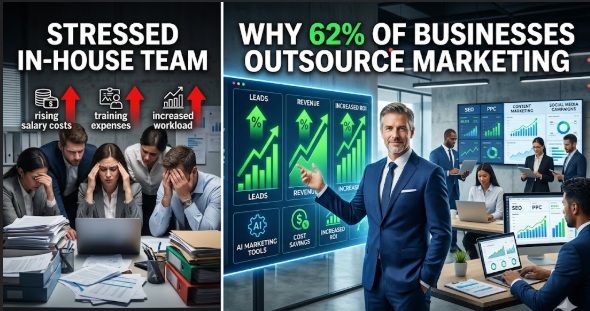
Approximately 62% of global businesses outsource digital marketing because it helps reduce costs by 20–70%, provides instant access to specialized marketing expertise, improves campaign performance, and allows companies to scale marketing efforts without hiring full-time employees.
As digital marketing becomes more complex with AI, SEO, paid advertising, social media, automation, and data analytics, businesses increasingly rely on experienced digital marketing agencies to stay competitive and achieve faster growth.
The Rise of Digital Marketing Outsourcing
The business world has changed dramatically over the last few years. Marketing is no longer limited to running a few ads or posting on social media. Today’s companies must manage:
- Search Engine Optimization (SEO)
- Pay-Per-Click (PPC) Advertising
- Social Media Marketing
- Content Marketing
- Email Marketing
- Marketing Automation
- Conversion Rate Optimization
- Analytics and Reporting
- AI-Powered Marketing Strategies
Managing all these areas internally requires significant investments in talent, software, training, and infrastructure.
As a result, businesses worldwide are increasingly turning to digital marketing outsourcing as a strategic growth solution.
Recent industry reports show:
- 63.1% of brands outsourced marketing functions in 2025
- 66% of U.S. businesses outsource at least one department
- 83% of small businesses plan to maintain or increase outsourcing budgets
- More than half of B2B companies outsource marketing activities
- Nearly 80% of small businesses outsource at least part of their marketing efforts
This trend continues to accelerate as companies seek efficiency, expertise, and measurable ROI.
What Is Digital Marketing Outsourcing?
Digital marketing outsourcing is the process of hiring an external digital marketing agency or specialized marketing professionals to manage some or all of your online marketing activities instead of building a full in-house team.
In simple terms, businesses outsource digital marketing when they want experienced experts to handle tasks such as SEO, content marketing, social media management, PPC advertising, email marketing, and lead generation. Rather than hiring multiple employees, companies can access an entire team of specialists through an outsourced marketing partner.
Quick Definition
Digital marketing outsourcing means partnering with a third-party agency or marketing expert to plan, execute, and optimize your online marketing campaigns to increase traffic, leads, sales, and brand visibility.
This business model has become increasingly popular because it helps companies reduce costs, improve marketing performance, and gain access to specialized skills without the expense of hiring full-time employees.
Why Businesses Outsource Digital Marketing
Modern digital marketing is more complex than ever before. Businesses must manage multiple channels and platforms simultaneously, including:
- Search Engine Optimization (SEO)
- Google Ads and PPC campaigns
- Social media marketing
- Content marketing
- Email marketing
- Marketing automation
- Video marketing
- Conversion rate optimization (CRO)
- Analytics and reporting
Successfully managing all these areas requires specialized knowledge, expensive tools, and continuous training. For many companies, building an in-house team with expertise in every area is simply not practical.
By outsourcing digital marketing services, businesses gain immediate access to experienced professionals who already understand the latest marketing trends, technologies, and best practices.
What Services Are Commonly Outsourced?
Most businesses outsource one or more of the following digital marketing services:
Search Engine Optimization (SEO)
SEO agencies help businesses improve their search engine rankings, increase organic traffic, and attract more qualified customers through keyword research, technical SEO, content optimization, and link building.
Pay-Per-Click (PPC) Advertising
Businesses often outsource Google Ads and paid advertising campaigns to specialists who can maximize ad performance, improve conversions, and reduce cost per acquisition.
Content Marketing
Creating high-quality content consistently requires time and expertise. Many companies outsource blog writing, website content, landing pages, and content strategy to professional content marketing agencies.
Social Media Management
From content creation and posting schedules to audience engagement and paid social campaigns, social media management is one of the most frequently outsourced marketing services.
Email Marketing
Marketing agencies help businesses create email campaigns, automated workflows, newsletters, and lead nurturing sequences that drive customer engagement and sales.
Marketing Analytics and Reporting
Outsourced marketing teams track key performance metrics, analyze campaign results, and provide data-driven recommendations to improve marketing ROI.
Digital Marketing Outsourcing vs. In-House Marketing
Many business owners wonder whether they should hire employees or work with a digital marketing agency.
With an in-house team, businesses must recruit talent, pay salaries and benefits, purchase software, and invest in ongoing training. This can be expensive and time-consuming.
With outsourced digital marketing, businesses gain access to a team of experts, advanced marketing tools, and proven strategies without the overhead costs associated with hiring full-time staff.
For this reason, many companies choose a hybrid approach—keeping marketing strategy in-house while outsourcing execution to a trusted digital marketing agency.
Example of Digital Marketing Outsourcing
Imagine a small eCommerce business wants to increase online sales.
Instead of hiring:
- An SEO specialist
- A PPC manager
- A content writer
- A social media manager
- An email marketing expert
The business partners with a digital marketing agency that provides all of these services under one monthly agreement.
The result is faster execution, lower costs, and access to a team of experienced professionals who can help the business grow more efficiently.
Key Benefits of Digital Marketing Outsourcing
Businesses choose to outsource digital marketing because it offers several advantages:
✅ Lower marketing costs
✅ Access to specialized expertise
✅ Faster campaign execution
✅ Improved marketing ROI
✅ Scalability as the business grows
✅ Access to premium marketing tools
✅ More time to focus on core business operations
These benefits explain why digital marketing outsourcing continues to be one of the fastest-growing business strategies worldwide.
Bottom Line
Digital marketing outsourcing allows businesses to leverage the expertise of professional marketers without the cost and complexity of building a large internal team. Whether a company needs SEO services, PPC management, content marketing, social media marketing, or lead generation support, outsourcing provides a flexible and cost-effective way to achieve marketing goals and accelerate business growth.
Why 62% of Businesses Choose to Outsource Digital Marketing
1. Significant Cost Savings
One of the biggest reasons companies outsource marketing is cost reduction.
Building an in-house marketing department involves much more than salaries.
Businesses must pay for:
- Employee salaries
- Health benefits
- Recruitment costs
- Training programs
- Marketing software
- Certifications
- Equipment and office space
Typical Savings From Outsourcing
✔ Reduce overall marketing costs by 20–30%
✔ Lower labor expenses by up to 70%
✔ Avoid software licensing costs
✔ Eliminate hiring and onboarding expenses
✔ Gain access to an entire team for less than one employee’s salary
Example
A U.S.-based business may spend:
- $60,000–$90,000 annually for one marketing employee
Or
- $3,000–$5,000 monthly for an agency team that includes:
- SEO specialists
- PPC experts
- Content writers
- Designers
- Marketing strategists
For many companies, outsourcing provides significantly greater value for the investment.
2. Access to Specialized Marketing Expertise
Modern marketing requires expertise across multiple disciplines.
Few businesses can afford to hire specialists for every channel.
A professional agency provides access to experts in:
- Technical SEO
- Local SEO
- Google Ads
- Meta Ads
- LinkedIn Advertising
- Content Marketing
- Email Automation
- Conversion Optimization
- Marketing Analytics
Instead of relying on one generalist, businesses gain a complete team of specialists.
Why This Matters
Algorithms change constantly.
Google updates search rankings regularly.
Advertising platforms evolve every month.
Consumer behavior shifts rapidly.
Agencies stay updated on industry changes so businesses don’t have to.
This allows brands to implement proven strategies faster and avoid costly mistakes.
3. Better Marketing ROI
One of the strongest arguments for outsourcing is performance improvement.
Experienced agencies have already worked across multiple industries and understand what drives results.
Benefits include:
- Faster campaign launches
- Better audience targeting
- Higher conversion rates
- Improved lead quality
- Lower customer acquisition costs
Businesses often see:
✔ Increased organic traffic
✔ Lower advertising costs
✔ Higher conversion rates
✔ Improved return on investment
Because agencies manage campaigns daily, they can identify opportunities and optimize performance more efficiently than inexperienced internal teams.
4. Scalability and Flexibility
Business needs change throughout the year.
Marketing requirements during:
- Product launches
- Holiday seasons
- Promotional campaigns
- Business expansions
can increase dramatically.
Hiring employees for temporary spikes is expensive and inefficient.
With an outsourced marketing agency, companies can:
- Scale campaigns up quickly
- Reduce spending when necessary
- Add new services on demand
- Enter new markets faster
This flexibility makes outsourcing particularly attractive for startups, SaaS companies, eCommerce brands, and growing businesses.
5. Faster Time-to-Market
Speed matters in today’s competitive landscape.
Businesses that move faster often gain a significant advantage.
Agencies already have:
- Established workflows
- Experienced specialists
- Proven frameworks
- Advanced tools
- Industry knowledge
This allows businesses to:
✔ Launch campaigns faster
✔ Generate leads sooner
✔ Enter new markets quicker
✔ Test new strategies efficiently
Instead of spending months building an internal team, companies can begin marketing immediately.
6. Access to Premium Marketing Tools
Professional marketing tools can cost thousands of dollars annually.
Examples include:
- Ahrefs
- SEMrush
- Google Analytics 360
- HubSpot
- Screaming Frog
- Surfer SEO
- Hotjar
- Marketing automation platforms
Most agencies already maintain subscriptions to these tools.
Clients benefit from enterprise-level technology without paying full licensing costs.
7. Staying Ahead of Marketing Trends
The marketing landscape evolves constantly.
Businesses must adapt to:
- AI-powered search
- Google algorithm updates
- Social media changes
- Voice search optimization
- Video marketing growth
- Emerging advertising platforms
Professional agencies invest heavily in ongoing education and testing.
This allows clients to remain competitive without dedicating internal resources to continuous learning.
In-House Marketing vs Outsourcing Agency
| Factor | In-House Team | Marketing Agency |
| Cost | High | Lower |
| Hiring Required | Yes | No |
| Access to Specialists | Limited | Extensive |
| Scalability | Slow | Fast |
| Software Costs | Additional | Usually Included |
| Training Expenses | Ongoing | Agency Handles |
| Campaign Launch Speed | Moderate | Fast |
| Industry Experience | Limited | Broad |
For many businesses, outsourcing offers a better balance of expertise, flexibility, and cost efficiency.
Which Marketing Functions Are Most Commonly Outsourced?
As digital marketing becomes more complex, businesses are increasingly choosing to outsource digital marketing services instead of building large in-house teams. Outsourcing allows companies to access specialized expertise, reduce costs, improve campaign performance, and focus on their core business operations.
But not every marketing task is outsourced equally.
Some marketing functions require specialized skills, advanced tools, and ongoing optimization, making them ideal for a digital marketing agency or outsourced marketing team.
Below are the marketing functions most commonly outsourced by businesses of all sizes.
1. Search Engine Optimization (SEO)
SEO is one of the most outsourced marketing services worldwide.
Search engine optimization requires technical knowledge, continuous monitoring, content optimization, and an understanding of Google’s constantly changing algorithms. Many businesses lack the time and expertise needed to manage SEO effectively in-house.
Common SEO Services Businesses Outsource
- Keyword research
- Technical SEO audits
- On-page SEO optimization
- Link building
- Local SEO
- SEO content strategy
- Website performance optimization
- Competitor analysis
Why Businesses Outsource SEO
SEO is a long-term strategy that requires consistent effort and specialized knowledge. Professional SEO agencies stay updated on algorithm changes and industry trends, helping businesses achieve better search rankings and increased organic traffic.
Benefits of Outsourcing SEO:
✅ Higher Google rankings
✅ Increased organic traffic
✅ Better lead generation
✅ Improved website performance
✅ Long-term marketing ROI
2. Content Marketing and Content Creation
Content is the foundation of successful digital marketing.
Businesses need a constant stream of high-quality content to attract visitors, build authority, and improve search visibility. However, creating valuable content consistently requires skilled writers, editors, strategists, and SEO experts.
Commonly Outsourced Content Services
- Blog writing
- Website content
- Landing pages
- Product descriptions
- Case studies
- White papers
- Press releases
- Video scripts
- Email content
Why Businesses Outsource Content Marketing
Professional content marketing agencies understand how to create content that ranks in search engines while also engaging readers and generating leads.
Benefits of Outsourcing Content Marketing:
✅ Consistent publishing schedule
✅ SEO-optimized content
✅ Improved authority and trust
✅ Better organic visibility
✅ Increased lead generation
3. Pay-Per-Click (PPC) Advertising
Running successful PPC campaigns requires more than simply launching ads. Businesses must continuously optimize keywords, audiences, budgets, bidding strategies, and conversion tracking.
This is why many companies outsource PPC management to experienced advertising specialists.
Common PPC Services Outsourced
- Google Ads management
- Microsoft Ads campaigns
- Display advertising
- Retargeting campaigns
- Shopping ads
- YouTube advertising
- Landing page optimization
Why Businesses Outsource PPC
PPC agencies have experience managing advertising budgets and improving campaign performance across multiple industries.
Benefits of Outsourcing PPC Management:
✅ Lower cost per click
✅ Higher conversion rates
✅ Better return on ad spend (ROAS)
✅ Faster campaign optimization
✅ Reduced wasted ad spend
4. Social Media Marketing
Social media has become one of the most time-consuming areas of digital marketing.
Businesses must create content, engage with followers, respond to messages, analyze performance, and stay updated on platform changes.
Because of this, social media management is one of the most commonly outsourced marketing functions.
Social Media Services Commonly Outsourced
- Content creation
- Social media strategy
- Community management
- Paid social advertising
- Influencer campaigns
- Audience engagement
- Analytics and reporting
Why Businesses Outsource Social Media
Professional social media marketers understand platform algorithms, audience behavior, and content trends.
Benefits of Outsourcing Social Media Marketing:
✅ Consistent brand presence
✅ Increased audience engagement
✅ Better content quality
✅ More followers and visibility
✅ Improved lead generation
5. Email Marketing
Email marketing continues to deliver one of the highest returns on investment among all digital marketing channels.
However, building effective email campaigns requires strategic planning, audience segmentation, automation, and ongoing testing.
Common Email Marketing Services Outsourced
- Email campaign creation
- Newsletter management
- Marketing automation
- Lead nurturing sequences
- Customer retention campaigns
- Email design
- A/B testing
Why Businesses Outsource Email Marketing
Email marketing agencies understand how to create personalized campaigns that drive opens, clicks, and conversions.
Benefits of Outsourcing Email Marketing:
✅ Higher open rates
✅ Better customer retention
✅ Increased sales
✅ Automated lead nurturing
✅ Improved customer engagement
6. Marketing Analytics and Reporting
Modern marketing is driven by data.
Without accurate reporting and analysis, businesses cannot understand what is working and what needs improvement.
Many organizations outsource analytics because it requires specialized tools and expertise.
Analytics Functions Often Outsourced
- Google Analytics setup
- Dashboard creation
- Conversion tracking
- Customer journey analysis
- Marketing attribution
- KPI reporting
- Campaign performance analysis
Why Businesses Outsource Analytics
Professional analysts help businesses make smarter marketing decisions based on real data rather than assumptions.
Benefits of Outsourcing Marketing Analytics:
✅ Better decision-making
✅ Accurate performance tracking
✅ Improved marketing ROI
✅ Data-driven growth strategies
✅ Clear reporting and insights
7. Conversion Rate Optimization (CRO)
Getting traffic is only part of the equation. Businesses must also convert visitors into customers.
Conversion Rate Optimization focuses on improving website performance and increasing sales without increasing traffic costs.
CRO Services Commonly Outsourced
- Landing page optimization
- User behavior analysis
- Heatmap analysis
- Funnel optimization
- A/B testing
- Checkout optimization
Why Businesses Outsource CRO
Specialized CRO experts understand how customers interact with websites and identify opportunities to improve conversions.
Benefits of Outsourcing CRO:
✅ More leads
✅ More sales
✅ Better user experience
✅ Higher marketing ROI
✅ Improved website performance
What Marketing Functions Should Stay In-House?
While many marketing activities can be outsourced successfully, some responsibilities are often better managed internally.
These include:
- Brand vision and positioning
- Company culture messaging
- Product development strategy
- Executive leadership communication
- Customer experience decisions
These areas require deep knowledge of the business and should typically remain under direct company control.
The Best Approach: A Hybrid Marketing Model
Many successful companies use a hybrid approach.
They keep strategic decision-making in-house while outsourcing execution to a trusted digital marketing agency.
For example:
In-House Team Handles:
- Business goals
- Brand strategy
- Budget decisions
- Customer insights
Agency Handles:
- SEO
- PPC advertising
- Content creation
- Social media management
- Email marketing
- Analytics
This model provides the perfect balance between control, expertise, and cost efficiency.
Key Takeaway
The most commonly outsourced marketing functions include SEO, content marketing, PPC management, social media marketing, email marketing, analytics, and conversion optimization. These services require specialized expertise, advanced tools, and ongoing optimization that many businesses cannot efficiently manage internally.
By outsourcing these marketing activities, companies gain access to experienced professionals, improve campaign performance, reduce costs, and accelerate business growth without the burden of hiring a large in-house marketing team.
Industries Outsourcing Marketing the Most
SaaS Companies
SaaS brands require expertise in:
- Lead generation
- Product marketing
- SEO
- Content strategy
Many outsource marketing to accelerate customer acquisition.
eCommerce Businesses
Online stores frequently outsource:
- Google Shopping Ads
- SEO
- Social media advertising
- Conversion optimization
Healthcare Organizations
Healthcare businesses often need specialized compliance-focused marketing expertise.
Local Service Businesses
Law firms, dentists, contractors, and real estate companies outsource marketing to increase visibility and generate local leads.
Common Concerns About Outsourcing Digital Marketing
Will Communication Be Difficult?
Effective agencies use:
- Weekly meetings
- Project management systems
- Shared reporting dashboards
Clear communication processes minimize misunderstandings.
Is My Data Safe?
Businesses should:
- Sign NDAs
- Verify security protocols
- Review compliance standards
- Restrict unnecessary access
Choosing a reputable agency significantly reduces risk.
Will Quality Suffer?
Quality depends on selecting the right partner.
Review:
- Case studies
- Testimonials
- Client reviews
- Certifications
before making a decision.
How to Choose the Right Digital Marketing Agency
Choosing the right digital marketing agency can have a major impact on your business growth, lead generation, and overall marketing success. The right agency can help you increase website traffic, generate qualified leads, improve conversions, and maximize your return on investment (ROI). On the other hand, choosing the wrong partner can waste time, money, and valuable growth opportunities.
With thousands of agencies offering SEO services, PPC management, content marketing, social media marketing, and lead generation services, it can be difficult to know which one is the best fit for your business.
The good news is that finding the right agency becomes much easier when you follow a proven evaluation process.
Below is a practical checklist to help you choose a digital marketing agency that can deliver real results and support your long-term business goals.
1. Review Case Studies and Proven Results
One of the first things you should look for is evidence that the agency can deliver measurable results.
Many agencies promise growth, but the best digital marketing agencies can show exactly how they helped previous clients improve their marketing performance.
What to Look for in a Case Study
- Increased website traffic
- Higher search engine rankings
- More qualified leads
- Better conversion rates
- Revenue growth
- Improved ROI
- Lower advertising costs
A strong case study should explain:
- The client’s challenge
- The strategy used
- The actions taken
- The measurable results achieved
Example
Instead of saying:
❌ “We improved SEO performance.”
Look for:
✅ “We increased organic traffic by 125% and generated 80% more qualified leads within six months.”
Specific numbers demonstrate real expertise and build trust.
Pro Tip
Prioritize agencies that have experience working with businesses similar to yours. Industry-specific experience often leads to faster results because the agency already understands your audience, competitors, and market challenges.
2. Verify Certifications and Industry Credentials
Certifications show that an agency invests in training and stays updated with the latest marketing platforms and best practices.
While certifications alone do not guarantee success, they can help you identify agencies that take professional development seriously.
Important Certifications to Look For
Google Partner Status
A Google Partner agency has demonstrated expertise in managing Google Ads campaigns and meeting Google’s performance standards.
Benefits include:
- Advanced advertising knowledge
- Access to Google resources
- Up-to-date PPC strategies
- Better campaign optimization
Meta Certifications
Meta certifications indicate expertise in:
- Facebook advertising
- Instagram advertising
- Audience targeting
- Campaign management
This is especially important for businesses that rely on social media advertising.
HubSpot Certifications
HubSpot-certified agencies often specialize in:
- Inbound marketing
- Lead generation
- Email marketing
- Marketing automation
- Customer relationship management (CRM)
These certifications demonstrate expertise in building long-term customer acquisition systems.
Additional Certifications Worth Considering
- Google Analytics Certification
- Semrush Certifications
- LinkedIn Marketing Certifications
- Microsoft Advertising Certifications
The more qualified the team, the more likely they are to deliver effective marketing campaigns.
3. Assess Industry Experience
Not all marketing strategies work for every business.
A strategy that works for an eCommerce company may not work for a law firm, healthcare practice, SaaS company, or local service business.
That’s why industry experience matters.
Ask These Questions
- Have they worked with companies in your industry?
- Do they understand your target audience?
- Can they explain common challenges in your market?
- Do they have relevant case studies?
Why Industry Experience Matters
Experienced agencies already understand:
- Customer behavior
- Industry trends
- Competitive landscapes
- Marketing regulations
- Buyer journeys
This allows them to build effective campaigns much faster.
For example, a digital marketing agency that specializes in healthcare marketing will understand compliance requirements and patient acquisition strategies better than a general agency with no healthcare experience.
4. Evaluate Communication and Transparency
Even the most skilled agency can become difficult to work with if communication is poor.
Strong communication is one of the most important factors in a successful long-term agency relationship.
Signs of a Good Agency
✔ Responds quickly to questions
✔ Explains strategies clearly
✔ Provides regular updates
✔ Offers transparent reporting
✔ Sets realistic expectations
✔ Shares both successes and challenges
Red Flags to Watch For
❌ Slow responses
❌ Unclear pricing
❌ Vague reporting
❌ Overpromising results
❌ Lack of accountability
A trustworthy digital marketing agency should act as an extension of your team rather than an outside vendor.
Regular communication helps ensure everyone stays aligned on goals, expectations, and performance.
5. Define KPIs and Success Metrics Early
One of the biggest mistakes businesses make is hiring an agency without defining success metrics from the beginning.
Before signing any contract, both parties should agree on the key performance indicators (KPIs) that will measure campaign success.
Important Marketing KPIs to Track
Website Traffic
Measures the number of visitors coming to your website through organic search, paid ads, social media, and other channels.
Leads
Tracks how many potential customers are contacting your business or completing desired actions.
Conversion Rates
Measures how effectively visitors become leads, customers, or subscribers.
Revenue Growth
Tracks how marketing efforts contribute to business growth and sales performance.
Return on Investment (ROI)
Evaluates whether your marketing spend is generating profitable results.
Why KPIs Matter
Clear KPIs eliminate confusion and create accountability.
Instead of guessing whether campaigns are successful, you can track real performance data and make informed decisions.
The best agencies focus on business outcomes, not vanity metrics.
6. Start With a Pilot Project
Signing a long-term contract without testing an agency can be risky.
A pilot project allows you to evaluate the agency’s performance before making a larger commitment.
Examples of Pilot Projects
- SEO audit
- Small PPC campaign
- Content marketing project
- Social media management trial
- Website optimization project
Benefits of Starting Small
✔ Lower risk
✔ Easier evaluation process
✔ Better understanding of communication style
✔ Opportunity to assess results
✔ Builds trust before scaling
A successful pilot project gives both parties confidence and provides valuable insights into how the agency works.
Questions to Ask Before Hiring a Digital Marketing Agency
Before making your final decision, ask these important questions:
- What industries do you specialize in?
- Can you share recent case studies?
- How do you measure success?
- How often will we receive reports?
- Who will manage our account?
- What tools and software do you use?
- What results can we realistically expect?
- How do you handle communication and project management?
The answers will help you determine whether the agency is a good fit for your business goals.
Common Mistakes to Avoid When Choosing an Agency
Many businesses choose the wrong marketing partner because they focus on price alone.
Avoid these common mistakes:
❌ Choosing the cheapest agency
❌ Ignoring case studies
❌ Failing to define goals
❌ Not checking reviews and testimonials
❌ Signing long-term contracts immediately
❌ Expecting overnight results
❌ Focusing only on rankings instead of business growth
Remember, the best digital marketing agency is not necessarily the cheapest—it is the one that can consistently deliver measurable results.
Frequently Asked Questions
Is outsourcing digital marketing worth it?
Yes, outsourcing digital marketing is worth it for many businesses because it provides access to experienced marketing professionals without the cost of hiring a full in-house team. Companies can improve SEO, paid advertising, content marketing, and lead generation while reducing operational expenses. Outsourcing also helps businesses stay updated with industry trends and achieve better marketing ROI. For small and growing companies, it is often one of the most cost-effective ways to scale marketing efforts.
How much does outsourcing digital marketing cost?
The cost of outsourcing digital marketing depends on the services required, business goals, and the agency’s experience level. Most small businesses spend between $1,000 and $10,000 per month for services such as SEO, PPC management, content marketing, and social media management. Larger companies with complex campaigns may invest significantly more. The advantage is that businesses gain access to a full team of specialists for less than the cost of hiring multiple full-time employees.
What are the most commonly outsourced marketing services?
The most commonly outsourced marketing services include search engine optimization (SEO), pay-per-click (PPC) advertising, content marketing, social media management, email marketing, and marketing analytics. These services require specialized expertise, advanced tools, and ongoing optimization. By outsourcing these functions to a digital marketing agency, businesses can improve performance, generate more leads, and focus on their core operations.
Is it better to hire an agency or build an in-house team?
For most small and mid-sized businesses, hiring a digital marketing agency is often more affordable and efficient than building an in-house team. Agencies provide access to specialists in SEO, PPC, content creation, and social media marketing without the overhead costs of salaries, benefits, and training. Larger organizations may benefit from a hybrid approach, where strategic decisions remain in-house while execution is handled by an external agency.
Can small businesses benefit from outsourcing marketing?
Absolutely. Outsourcing marketing allows small businesses to compete with larger companies without investing heavily in internal staff and expensive marketing tools. A professional digital marketing agency can help increase brand visibility, generate qualified leads, improve website traffic, and boost sales. This gives small businesses access to expert-level marketing support while staying within a manageable budget.
Final Thoughts
The reason 62% of global businesses outsource digital marketing is simple: it delivers better results with lower risk and lower costs.
Companies that outsource marketing gain:
✅ Reduced operating costs
✅ Access to experienced specialists
✅ Better campaign performance
✅ Faster growth opportunities
✅ Greater scalability
✅ Access to premium tools and technology
✅ More time to focus on core business operations
As competition continues to increase and digital marketing becomes more complex, outsourcing is no longer just a cost-saving tactic—it has become a strategic growth advantage for businesses worldwide.
Organizations that embrace the right digital marketing partnership today will be better positioned to generate leads, increase revenue, and outperform competitors in the years ahead.