Quick Answer
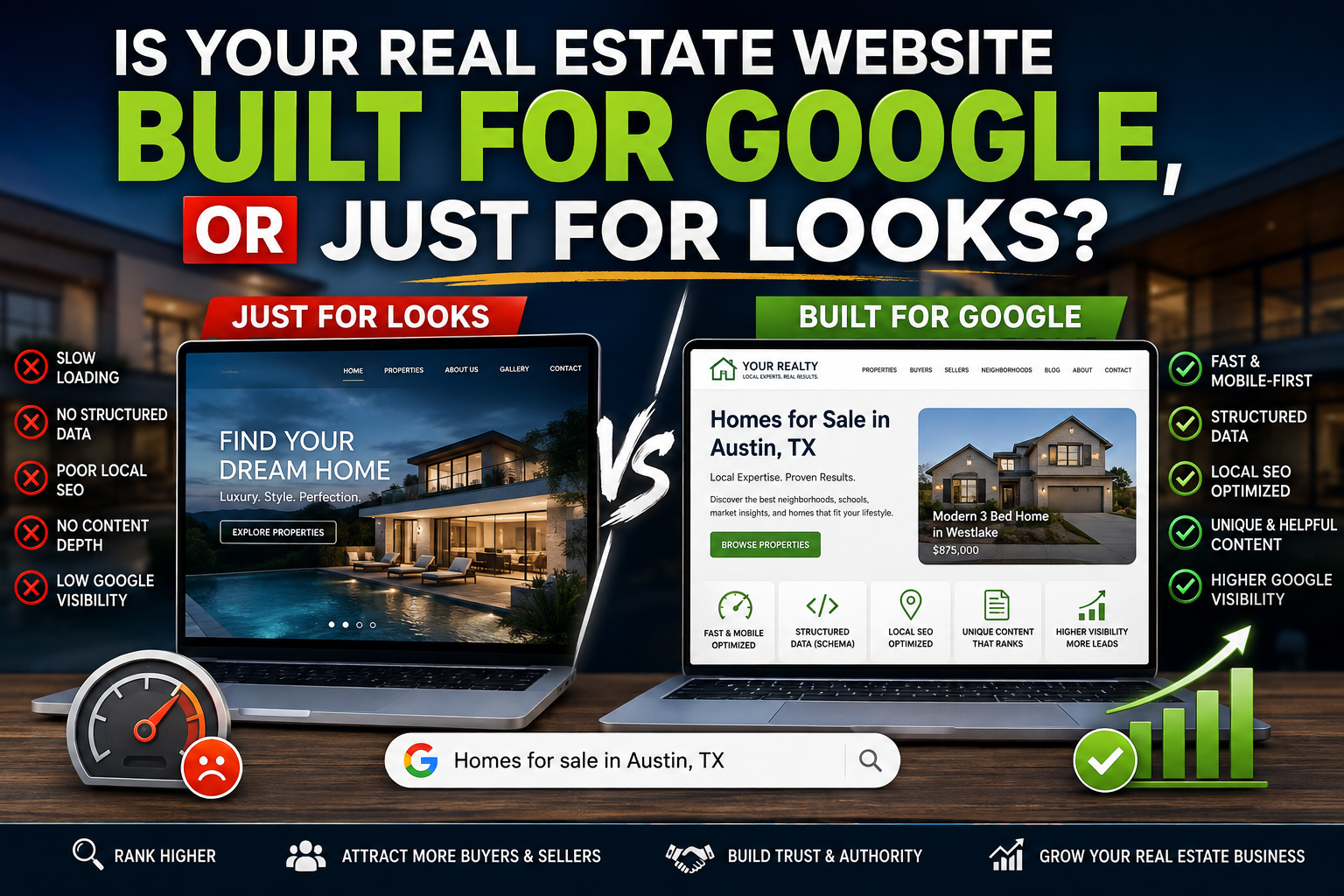
A real estate website built “just for looks” prioritizes hero images and slick design but ignores site speed, structured data, local search signals, and content depth. A website built for Google does both: it looks professional and it’s fast, mobile-first, crawlable, and stacked with helpful local content. Since virtually all home buyers now search online before contacting an agent, a beautiful site that Google can’t understand or rank is a marketing budget with no return.
Key Takeaways
- Nearly all home buyers now use the internet during their search, and over half find the home they eventually buy online — so visibility, not visual polish alone, drives leads.
- Google ranks pages that answer real buyer and seller questions better than competitors, not pages with the nicest templates.
- Site speed and Core Web Vitals are ranking and conversion factors — slow listing pages lose leads before they load.
- Syndicated MLS/IDX listings alone rarely rank; unique neighborhood content and agent commentary are what make a listing page stand out.
- Structured data (schema markup) helps Google and AI search tools understand and surface real estate content correctly.
- Local SEO — Google Business Profile, reviews, and neighborhood pages — matters as much as the website itself.
Why “Pretty” Isn’t Enough Anymore
Most real estate websites are built by agents who care about first impressions — big photography, video tours, a clean logo. That instinct isn’t wrong. But it solves only half the problem.
Home search behavior has shifted almost entirely online. Recent National Association of Realtors (NAR) survey data shows that around 41–47% of buyers say the internet is the very first step in their home search, and separate research has found that more than half of recent buyers ultimately found the home they purchased through an online listing. Other industry surveys of specific age groups put internet use during the home search at close to universal levels.
That means your website isn’t a brochure. It’s competing for a moment when a buyer or seller is actively deciding who to trust — and Google decides who gets that moment. If your site can’t be found, or loads too slowly for someone to wait around, the design underneath doesn’t matter. A visitor who never arrives never sees how good your photography is.
The real question isn’t “does my website look professional?” It’s “does Google understand my website well enough to show it to the right person at the right moment, and does the visitor stick around once they arrive?”
What Google Actually Looks For in a Real Estate Site
Google’s Search Essentials and Helpful Content guidance boil down to three practical questions it tries to answer about every page:
- Can Google’s crawlers technically access and understand the page? (technical SEO)
- Does the page genuinely help the person who searched, better than the alternatives? (content quality and search intent)
- Should this page be trusted? (experience, expertise, authoritativeness, trustworthiness — E-E-A-T)
For real estate specifically, this plays out in a few concrete ways:
- A listing page copied word-for-word from your MLS feed looks, to Google, identical to the same listing syndicated on Zillow, Redfin, and a dozen other sites. Without something unique — agent notes, neighborhood context, school data — Google has little reason to rank your version above a larger, more authoritative portal.
- A homepage full of stock photography and no local specificity gives Google no signal about which market you serve or what questions you can answer.
- A slow-loading site with layout shifts (buttons jumping as images load) actively hurts both rankings and conversions, because Core Web Vitals are a measurable part of Google’s page experience signals.
Example: Two Agents, Same Listing
Agent A syndicates 40 MLS listings with no additional text. Agent B adds a 200-word neighborhood summary, a walk-through of nearby schools, and a personal note about why the home suits a specific type of buyer. Google’s systems consistently favor pages that add unique value over pages that duplicate a feed — which is why Agent B’s listing page is far more likely to outrank Agent A’s, even on a smaller site with less domain authority.
The Technical Checklist: Is Your Site Actually Crawlable and Fast?
Before content or design matters, Google has to be able to load and read your pages. Run through this list:
| Technical Factor | Why It Matters | Target |
| Page load speed (Largest Contentful Paint) | Slow pages lose both rankings and buyers before content loads | Under 2.5 seconds |
| Mobile responsiveness | Most home searches happen on mobile devices | Fully responsive, no pinch-to-zoom |
| Crawlable IDX/MLS integration | If listings are loaded entirely via JavaScript with no server-rendered content, Google may not index them | Server-side rendering or pre-rendered HTML for listings |
| Clean URL structure | Confusing URLs waste crawl budget and confuse users | /neighborhood/listing-name style, not query strings full of IDs |
| HTTPS and valid SSL | Baseline trust and security signal | Required |
| Broken links / 404s | Wastes crawl budget, hurts user trust | Regular audits |
| XML sitemap | Helps Google discover new listings quickly | Auto-updating sitemap submitted in Search Console |
Important note: Many IDX plugins load listings through iframes or heavy client-side JavaScript for speed of setup. This is convenient for agents but can make listing content invisible to search engines unless the platform specifically supports server-side rendering. If you don’t know whether your listings are indexable, search Google for site:yourdomain.com “123 Main St” using an actual address from your site — if it doesn’t appear, Google likely can’t see it.
Content That Google
Google’s ranking systems, and the large language models powering AI Overviews and AI chat answers, both favor content that directly and clearly answers a real question. For real estate, that means moving beyond generic “About Us” and “Our Listings” pages toward content built around actual buyer and seller intent.
The Three Search Intents in Real Estate
- Informational — “how much does it cost to sell a house in [city],” “best time to buy in [neighborhood]”
- Navigational — “[Your Brokerage Name] homes for sale”
- Transactional — “homes for sale in [neighborhood],” “realtor near me”
A site built only around transactional listing pages misses the much larger volume of informational searches, where buyers and sellers are still forming their decision — and where a well-answered question builds the trust that turns into a client relationship.
What Strong Real Estate Content Looks Like
- Neighborhood guides that go beyond square footage — school ratings, commute times, walkability, market trends, recent sale prices.
- Monthly or quarterly market reports for specific neighborhoods, which map directly to what sellers search when deciding whether to list.
- “Living in [neighborhood]” content that reflects genuine local experience, not something that could have been written about any city.
- Process guides — closing costs, contingencies, inspection timelines — written in plain language.
- Video and photo content that demonstrates first-hand experience (a core E-E-A-T signal), not stock imagery.
Bullet Summary
- Build pillar pages around each neighborhood or service area you actually work in.
- Support each pillar with supporting articles answering the long-tail questions buyers and sellers ask about that area.
- Add unique agent commentary to every syndicated listing page.
- Publish consistently rather than in bursts — a content calendar beats a one-time blog sprint.
Local SEO: The Real Estate Advantage
Real estate is one of the most locally driven searches on Google, which means local SEO factors often outweigh generic on-page SEO.
Direct answer: Local SEO for real estate means optimizing your Google Business Profile, collecting genuine client reviews, and building content and citations tied to a specific geographic area, so Google associates your site and name with that market.
Priorities, in order of typical impact:
- Google Business Profile — complete, accurate, with regular posts and photos. This is often the first thing a searcher sees, before your website.
- Reviews — both volume and recency matter, and responding to reviews signals an active, trustworthy business.
- NAP consistency (Name, Address, Phone) — the same details listed identically across your website, Google Business Profile, and any directories.
- Local backlinks — being mentioned by school websites, local news, chambers of commerce, or community organizations carries more weight than generic directory links.
- Neighborhood-specific pages — one dedicated, in-depth page per service area rather than one generic “areas we serve” list.
Structured Data and Schema for Real Estate
Schema markup is code added to your pages that explicitly tells Google (and AI systems) what your content means — a listing, a review, a local business, a set of FAQs. It doesn’t change how your page looks to a visitor, but it changes how well search engines understand it.
Recommended schema types for a real estate website:
- RealEstateListing / Residence schema on listing pages, including price, address, and property details.
- LocalBusiness schema for your brokerage or agent profile, including service area.
- FAQPage schema on pages that answer common questions in a Q&A format.
- BreadcrumbList schema to reinforce site structure (Home > Neighborhood > Listing).
- Article schema on blog and guide content, including author and publish date — important for demonstrating expertise.
- Review / AggregateRating schema where genuine, verified reviews exist.
Important note: Schema should describe content that’s actually visible on the page. Marking up information that isn’t shown to users violates Google’s structured data guidelines and can lead to a manual penalty.
Design vs. SEO: Where They Conflict, and How to Fix It
Design and SEO aren’t naturally opposed, but a few common design choices in real estate sites do cause real conflicts:
| Design Choice | SEO/UX Risk | Better Approach |
| Full-screen video hero on homepage | Slows load time significantly | Compressed video or a high-quality static image with lazy-loaded video below the fold |
| Image-heavy listing carousels with no text | No content for Google to index, no context for buyers | Add descriptive text, alt tags, and captions alongside galleries |
| Infinite-scroll listing pages | Can prevent proper indexing of individual listings, hurts crawlability | Paginated listings with unique URLs, or “load more” with URL updates |
| Custom fonts and heavy animation libraries | Adds page weight, hurts Core Web Vitals | Limit to 1–2 web fonts, use CSS animation over JS libraries where possible |
| Contact forms as the only path to information | Frustrates users who want quick answers, increases bounce | Show key info (price, address, school district) directly on the page |
Expert Tip
Run your homepage through Google’s PageSpeed Insights and Search Console’s Core Web Vitals report before making any major redesign decision. A design that “feels fast” on a developer’s high-end laptop can still fail badly on a buyer’s mid-range phone over cellular data — which is where most real estate searches now happen.
Common Mistakes That Sink Real Estate Websites
- Relying entirely on syndicated MLS content with no original commentary, making every listing page a near-duplicate of larger portals.
- Ignoring page speed in favor of high-resolution, uncompressed images.
- Ignoring mobile experience while optimizing primarily for desktop.
- No content strategy beyond listings — missing the much larger pool of informational searches.
- Inconsistent NAP data across the web, confusing both users and Google’s local ranking systems.
- Keyword stuffing neighborhood names into text unnaturally instead of writing genuinely useful local content.
- No schema markup, leaving Google to guess at page content instead of being told directly.
- Treating the website as “done” after launch, instead of publishing and updating content on an ongoing basis.
Step-by-Step: Auditing Your Site This Week
- Check indexability. Search site:yourdomain.com on Google. If pages you expect to see are missing, investigate your sitemap and robots.txt.
- Test page speed. Run your homepage and a typical listing page through Google PageSpeed Insights (mobile view specifically).
- Check Core Web Vitals in Google Search Console under the “Page experience” or “Core Web Vitals” report.
- Search for a specific listing address you know is on your site, in quotes, to confirm Google can read your IDX/MLS integration.
- Audit your top 10 pages by traffic in Google Analytics or Search Console — are they listings, or content? If it’s all listings, you’re likely missing informational search volume.
- Review your Google Business Profile for completeness, recent posts, and review responses.
- Check NAP consistency across your website footer, Google Business Profile, and any directory listings.
- List every neighborhood or service area you work in, and check whether each has a dedicated, in-depth page — not just a mention in a dropdown menu.
Expert Tips
- Treat every listing page as a chance to add something a portal syndication can’t: a personal note, a comparison to similar recent sales, or context about why the home fits a certain buyer.
- Publish market reports on a fixed schedule (monthly or quarterly) per neighborhood — sellers actively search for this exact content type.
- Use descriptive, keyword-relevant alt text on property photos; it helps accessibility and gives Google additional context about page content.
- Don’t chase every keyword — a small number of deeply useful neighborhood and process pages consistently outperforms dozens of thin pages.
- Revisit and update older content periodically; a two-year-old “average home price” page with stale numbers can actively damage trust if it still ranks.
FAQs
Does a beautiful website design help SEO?
Design supports SEO when it improves user experience (fast load times, clear navigation, mobile usability) but doesn’t directly cause higher rankings on its own. A visually stunning site that loads slowly or hides content behind JavaScript can rank worse than a plainer, faster site.
How long does real estate SEO take to show results?
Most agents see initial visibility improvements within 3–6 months, with meaningful ranking gains for competitive keywords typically taking 6–12 months or longer, according to current industry guidance.
Do I need a blog on my real estate website?
Not strictly, but sites with consistent, locally specific content generally capture far more search traffic than listing-only sites, because most searches are informational rather than purely transactional.
Is IDX/MLS integration bad for SEO?
IDX integration itself isn’t bad, but many IDX widgets load listings in ways that search engines can’t fully read. Confirm with your provider whether listings are server-rendered or crawlable.
What’s more important: Google Business Profile or my website?
They work together. Your Google Business Profile often appears first in local search results and Maps, while your website is where you demonstrate deeper expertise and capture leads through content.
Should every listing page be unique, or can I use the MLS description as-is?
Add unique content beyond the MLS description whenever possible. Duplicate or near-duplicate listing content across many sites gives Google little reason to favor your version.
How does Core Web Vitals affect real estate websites specifically?
Real estate sites are especially prone to Core Web Vitals problems because of high-resolution photography, video tours, and listing carousels. Compressing images, lazy-loading media, and limiting animation libraries all help.
What is schema markup and do I really need it?
Schema markup is structured code that tells search engines exactly what your content represents (a listing, a review, an FAQ). It’s not strictly required to rank, but it improves how accurately Google and AI search tools can understand and surface your content.
Can AI search tools like AI Overviews send me traffic?
Yes, though differently than traditional search — AI Overviews often cite sources that provide clear, well-structured, directly-answered content, which is another reason to write in a direct, question-and-answer format.
Do backlinks still matter for real estate SEO?
Yes. Backlinks from local news outlets, schools, community organizations, and industry publications remain one of the strongest authority signals, particularly for competitive local markets.
Is social media important for SEO?
Social platforms don’t directly influence Google rankings, but they build brand visibility and can generate the kind of mentions and backlinks that do influence rankings and AI-driven answer engines.
What’s the single biggest mistake agents make with their websites?
Treating the website as a static brochure rather than an ongoing content and technical asset that needs ongoing publishing, monitoring, and maintenance.