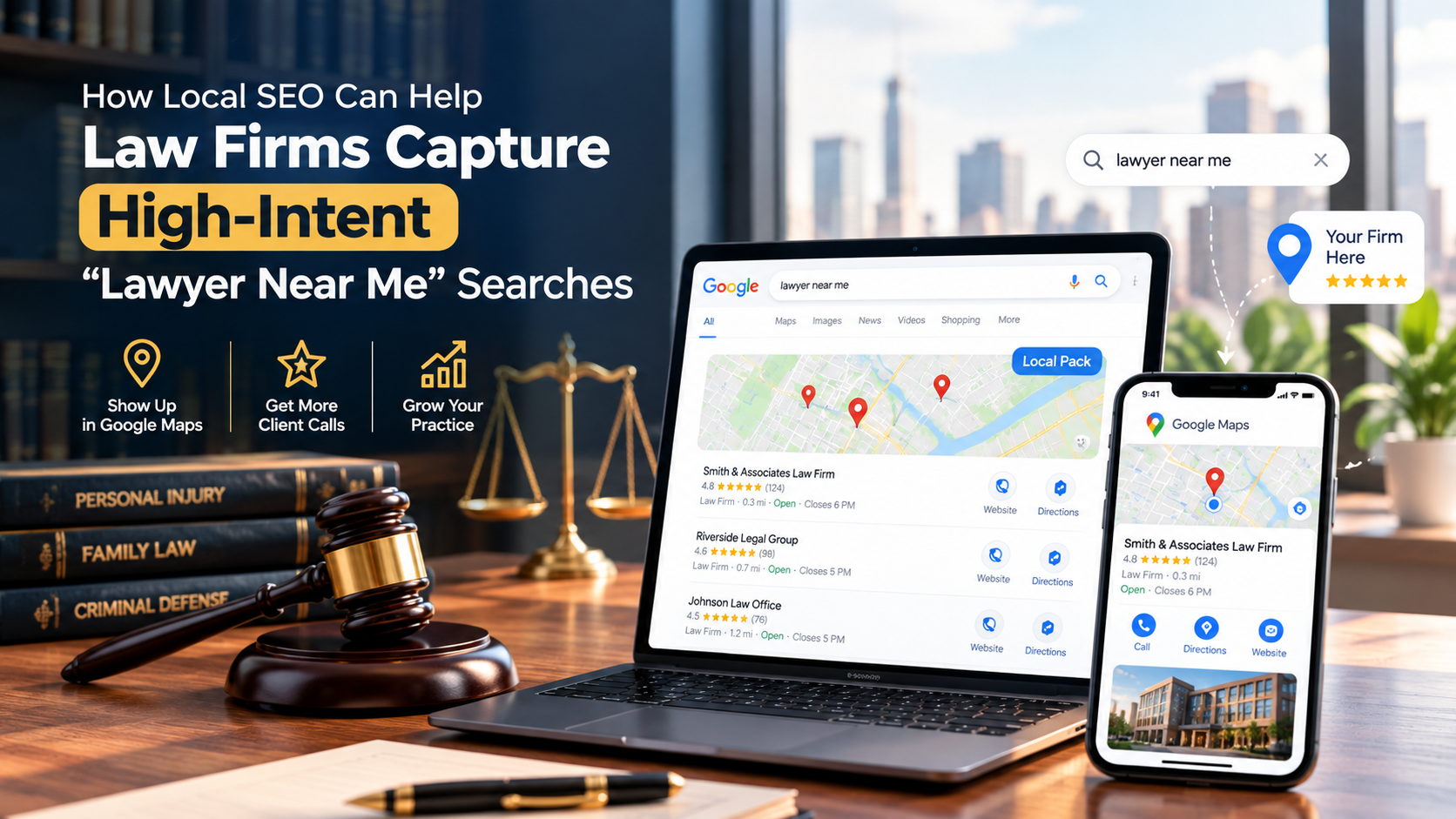
It is 9:40 p.m. A man just got rear-ended on his way home. His neck hurts, his car is damaged, and the other driver is already arguing with him. He pulls out his phone and types three words: “lawyer near me.”
Now picture a mother who just got served with divorce papers. Or a small business owner who opened a scary letter from the IRS. Different people. Same move. They search “lawyer near me” and expect an answer in seconds.
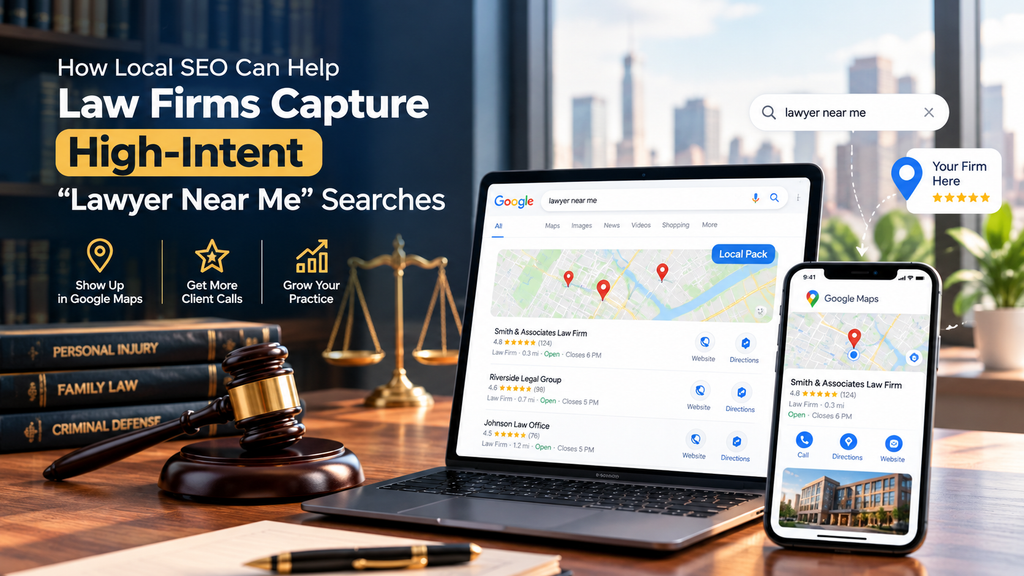
These searches are gold for a law firm. The person is not browsing for fun. They have a real problem, they need help now, and they want someone close by. If your firm shows up in the top three map results with strong reviews and a clear phone number, you have a real shot at getting that call. If not, the call goes to the firm down the street.
That is the job of local SEO for law firms. It helps your firm appear in Google Maps, the local pack, and local search results at the exact moment people are ready to hire. In this guide, you will learn how Google picks which firms to show, and the exact steps that help you win more of these searches.
Quick Answer: How Does Local SEO Help Law Firms Get More Clients?
Local SEO helps law firms rank in Google Maps and the local pack when people search for a lawyer nearby. To win “lawyer near me” searches, you need a complete Google Business Profile, steady real reviews, matching name, address, and phone details across the web, and a fast website with clear practice area and city pages. Add local links, schema markup, and quick client intake, and you give Google and clients every reason to pick your firm.
Key takeaways:
- “Lawyer near me” searches show strong intent, because the searcher wants help close by, and usually soon.
- Google ranks local results mainly by relevance, distance, and prominence.
- Your Google Business Profile is the most important local asset you own.
- Reviews and fast replies build trust with Google and with future clients.
- Your website must back up your profile with clear practice area pages.
- You must follow your state bar’s advertising rules in everything you publish.
What Is a “Lawyer Near Me” Search, and Why Does It Matter?
A “lawyer near me” search is any search where a person wants legal help close to where they are. It can look like “DUI attorney near me,” “divorce lawyer open now,” or “personal injury attorney in [city].”
Google has said for years that “near me” is a strong sign of intent. Its research found that phone users started dropping ZIP codes and neighborhood names from searches, because they assume their phone already knows where they are. You can read more in Think with Google’s report on “near me” searches. That means many people who need a lawyer never type your city. Google decides where they are and picks the firms to show.
Why these searches are high-intent
Compare two searches. One person types “what is a statute of limitations.” Another types “car accident lawyer near me.” The first person wants to learn. The second wants to hire. Here is why the second search is so valuable:
- Urgency. Arrests, accidents, court dates, and deadlines create pressure.
- Local need. Courts and laws vary by place, so people want a lawyer who knows their area.
- Ready to act. People who search this way often call the first firm that looks trustworthy.
- Less comparison. On a phone, the top few map results get most of the attention.
What about word of mouth?
Referrals still matter in law, and the two channels work together. In Clio’s 2019 consumer research, about 59% of people sought a referral to a lawyer, and 57% also searched for one on their own, as reported by the Illinois Supreme Court Commission on Professionalism. The same summary found that younger clients care more about reviews. For example, 53% of Millennials said reviews matter, compared with 25% of Boomers.
So even when a friend gives someone your name, the next step is often a Google search. They check your reviews, your website, and your map listing. Local SEO makes sure that check goes well.
What Is Local SEO for Law Firms?
Local SEO for law firms is the process of improving your firm’s visibility in Google Maps, the local pack, and local search results, so people near you can find and contact you when they need legal help.
It is different from general law firm SEO. General SEO helps you rank for broad topics across the whole country. Local SEO helps you rank for people in a certain place: your city, your county, or the area you serve.
Your firm can show up in three places when someone searches for a lawyer nearby:
- Local Services Ads. These are paid, pay-per-lead ads at the very top of the page.
- The local pack. This is the map with three business listings. It comes mostly from your Google Business Profile.
- Organic results. These are the website links below the map. They come from your website pages.
How Google Decides Which Lawyers to Show
Google explains its system in its help guide, How to improve your local ranking on Google. It says local results are based mainly on relevance, distance, and prominence.
Relevance is how well your profile matches the search. If someone searches “family law attorney” and your profile clearly says you handle family law, you look relevant. Complete and detailed information helps.
Distance is how far your office is from the person searching. You cannot move your office to win a search. But you can improve the other two factors.
Prominence is how well known your firm is. Google says it is based on things like how many websites link to you and how many reviews you have. More reviews and positive ratings can help.
Google is also clear on one more point: there is no way to pay for a better organic local ranking. You earn it with accurate information, a strong reputation, and a helpful website. To see what local experts think matters most, check the annual Local Search Ranking Factors report from Whitespark.
Step 1: Build a Complete Google Business Profile
Your Google Business Profile (GBP) is the listing that appears in Google Maps and the local pack. For most firms, it is the single most important piece of local SEO. Treat it like your digital front door.
Follow Google’s rules first
Google can suspend profiles that break its rules. Start with its guidelines for representing your business on Google. The big ideas:
- Show your firm as it appears in the real world, on your signs and letterhead.
- Make sure your address or service area is accurate.
- Use only one profile per business.
- Choose the fewest categories that describe your core business.
Do not stuff keywords into your business name. Writing “Smith Law | Best Car Accident Lawyer Austin” instead of “Smith Law” can get your profile flagged. Google also has special rules for individual attorney profiles, so read the guidelines before you create one for each lawyer.
Fill out every field
Google says businesses with complete and accurate information are easier to match with the right searches. Use this checklist:
- Primary category. Pick the most specific one, such as “Personal injury attorney.” Add a second only if it truly describes a core part of your firm.
- Address and service area. Use a real place where clients can meet you. If you travel to clients, list the areas you serve.
- Phone and website. Use one main phone number and one main website link.
- Hours. Keep them right, and update them for holidays.
- Services and description. List each practice area in plain words. Say who you help and where.
- Attributes. Add details like languages spoken and wheelchair-accessible entrance.
- Photos. Add real photos of your office, entrance, parking, and team. They build trust and help people find you.
Log in once a month to check for bad edits, old numbers, or new suggestions.
Step 2: Earn Google Reviews the Right Way
Reviews are a big part of prominence. They also decide whether a person clicks or scrolls past you. Two firms can sit side by side on the map, and the one with more recent, honest reviews often wins the call. BrightLocal’s Local Consumer Review Survey tracks each year how people use reviews to choose and trust local businesses.
How to ask
Google says it is fine to ask, and it gives you tools. In Google’s guide to getting more reviews, it explains that you can share a link or QR code that takes people straight to your review form, for example in thank-you emails. A good time to ask is after a good moment, like a settled case or a client saying thank you. Try a message like this:
“It was an honor to help you. If you have a minute, would you share your honest experience on Google? Here is the link. Thank you.”
Ask every client the same way, not just the ones you think will say yes.
What you must never do
Google says offering incentives, such as discounts, in exchange for a review is strictly prohibited. So do not offer gifts or free consults for reviews, write reviews for clients, or post reviews from staff and family. Fake reviews can lead to removed reviews, lost rankings, or a suspended profile, and they can cause trouble with your state bar.
Reply without breaking confidentiality
You must verify your business before you can reply, and replies show people you value feedback. See Google’s steps for reading and replying to reviews.
Lawyers have an extra duty here. Confidentiality rules, like Model Rule 1.6 of the ABA model rules, still apply online. The ABA covers how confidentiality and truthful advertising rules affect online marketing in its article on LinkedIn and the ABA Model Rules. The same thinking applies to review replies. A safe reply looks like this:
- Positive: “Thank you for your kind words. We are glad we could help.”
- Negative: “We take feedback seriously. Because of confidentiality rules, we cannot discuss any matter online. Please call our office so we can listen.”
Notice what is missing. The reply does not confirm the person was a client, and it shares no case facts. Google also notes that a mix of positive and negative feedback often feels more trustworthy, so a few bad reviews will not sink you.
Step 3: Build a Website That Backs Up Your Local Profile
Your profile gets you on the map. Your website helps Google understand what you do, and it helps a visitor decide to call. Google also uses your web results as part of prominence, so your site must do its part.
One strong page for each practice area
Do not cram everything onto one page. If you handle car accidents, divorce, and DUI cases, each deserves its own page. A person searching “DUI lawyer near me” should land on a page all about DUI defense. Each page should include:
- A clear title tag and H1 with the service and place. For example: “Divorce Lawyer in Austin, TX | Smith Family Law.”
- A short, plain answer near the top. Say what you do, who you help, and where.
- Steps and common questions. Explain what happens next in the process.
- Proof of trust. Add attorney bios and reviews, where your state rules allow.
- A clear call to action. Add a tap-to-call button and a short form.
- Your name, address, and phone number, the same as on your profile.
Real location pages
If you have more than one office, give each its own page with the address, a map, parking notes, hours, and the lawyers who work there. If you serve towns where you have no office, do not make dozens of near-identical pages with only the city name swapped. Google’s guide to creating helpful, reliable, people-first content asks whether your content adds real value compared with other pages in search results. A page with real local details helps. A copy-paste page does not.
Show real experience
Legal topics are serious, so people want to know who they are trusting. Add real lawyer profiles with photos, education, bar admissions, and case types. This supports what Google calls experience, expertise, authoritativeness, and trust, often shortened to E-E-A-T. Also be careful with claims. Words like “best” or “guaranteed results” can be misleading, and Rule 7.1 of the ABA Model Rules bars false or misleading statements about a lawyer’s services. Stick to facts you can prove.
Step 4: Keep Your Name, Address, and Phone Number Consistent
NAP stands for name, address, and phone number. Google checks many places online to confirm your details. When your NAP is the same everywhere, Google trusts it more. When it changes from site to site, Google may not know which is right. Common problems include an old address, “Suite 200” on one site and “Ste. 200” on another, or a firm name that changed after a merger.
Check your details in these places:
- Google Business Profile, Bing Places, and Apple Business Connect
- Your state bar’s lawyer directory
- Legal directories such as Avvo, Justia, FindLaw, and Martindale-Hubbell
- Your local chamber of commerce and social profiles
These listings are called local citations. They confirm your details, and they help people find you on other sites. Make a simple spreadsheet with each site, the date you checked it, and what it shows. Fix any mismatch, then review it once a year. If you use call tracking, follow Google’s guidelines so your main number stays consistent.
Step 5: Publish Local Content That Answers Real Questions
Guides and blog posts help you catch people earlier in their search. They can also win featured snippets and show up in AI-powered answers, but only if they are truly useful. Write about the questions a worried person types into Google:
- “What should I do after a car accident in [state]?”
- “How long do I have to file an injury claim in [state]?”
- “What happens at a first DUI hearing in [city]?”
- “How much does a divorce lawyer cost in [city]?”
Search engines and AI tools often pull short, clear answers from a page. To help them, use the question as a heading, answer it in 40 to 60 words right below, then add detail and steps. Here is a quick example:
How long do I have to file a car accident claim? Each state sets its own deadline, called a statute of limitations. Many states give two or three years for injury claims, but some are shorter, and exceptions can apply. Because missing the deadline can end your claim, talk to a local attorney as soon as you can.
Notice that it answers, warns, and invites a call, without giving advice for a specific case. Add a short note that your content is general information, not legal advice. No one can promise a spot in a featured snippet or AI Overview, but clear, accurate answers give you the best chance.
Step 6: Earn Local Links and Mentions
Google says prominence is based partly on how many websites link to you. Links from trusted local sources tell Google your firm is real and respected. Good ideas for law firms:
- Join local and practice-area bar groups and get listed.
- Sponsor a youth team, a charity 5K, or a community event.
- Offer to comment when local news covers a legal topic in your field.
- Volunteer for pro bono or legal aid work, and share it.
- Speak at schools, or offer a scholarship.
Focus on quality, not quantity. One link from a respected local news site is worth more than fifty from junk sites. Never buy links in bulk.
Step 7: Add Schema Markup So Search Engines Understand Your Firm
Schema markup is code that tells search engines exactly what your page is about. Visitors never see it. Schema.org defines LegalService as a business that provides legally oriented services, advice, and representation, such as law firms. Google also explains local business structured data, which can tell Google about your hours and more. Here is a simple example. Replace every placeholder with your real details.
<script type=”application/ld+json”>
{
“@context”: “https://schema.org”,
“@type”: “LegalService”,
“name”: “Your Firm Name”,
“url”: “https://www.yourfirm.com/”,
“telephone”: “+1-555-555-5555”,
“address”: {
“@type”: “PostalAddress”,
“streetAddress”: “123 Main Street, Suite 200”,
“addressLocality”: “Your City”,
“addressRegion”: “ST”,
“postalCode”: “00000”,
“addressCountry”: “US”
},
“openingHoursSpecification”: [{
“@type”: “OpeningHoursSpecification”,
“dayOfWeek”: [“Monday”, “Tuesday”, “Wednesday”, “Thursday”, “Friday”],
“opens”: “09:00”,
“closes”: “17:00”
}],
“areaServed”: “Your City and County”
}
</script>
Test it with Google’s Rich Results Test, and make sure the details match your Google Business Profile exactly.
Step 8: Make It Easy to Call, and Answer Fast
You can win the click and still lose the client. Most “lawyer near me” searches happen on a phone, so design for thumbs. Put a tap-to-call button at the top of every page, keep forms short, compress large images so pages load fast, and add click-to-text or live chat if you can staff it.
Then answer quickly. A person who needs a lawyer will often call two or three firms, and the first one to pick up often wins. Clio tested this by having mystery shoppers contact 1,000 law firms by email and phone, and the results showed law firms struggle to respond to client inquiries. One summary reported that about 60% of firms did not respond to the email inquiry.
That is a huge opening. If you answer calls in a few rings, reply to forms in minutes, and use a trained after-hours answering service, you beat many firms without doing anything fancy. Track every call and form so no lead falls through the cracks.
Local SEO vs. Local Services Ads: Which Is Better for Lawyers?
You do not have to pick only one. They work differently, and they help each other.
| Local SEO (Map + Organic) | Local Services Ads (LSAs) | |
|---|---|---|
| Cost model | Time and ongoing effort | Pay per lead |
| Speed | Builds over months | Can start soon after approval |
| Where it shows | Local pack and organic results | Very top of the page |
| Trust signal | Reviews, brand, content | Google Screened badge |
| Best for | Long-term, lower cost per client | Fast leads while SEO grows |
LSAs show at the top for searches like “personal injury lawyer near me,” and firms pay when a person contacts them by call or message, as this guide to Google Screened for lawyers explains. According to Rankings.io, ad ranking can depend on how close you are, your star rating, how fast you respond, and whether you hold the Google Screened badge. Notice how reviews and response speed matter in both places. Strong local SEO makes your paid ads perform better too.
Follow Your State Bar’s Advertising Rules
Lawyer marketing has extra rules that most businesses do not face. Every state sets its own. The ABA Model Rules of Professional Conduct include a section on information about legal services, Rules 7.1 to 7.3, which is the starting point for many states.
The main idea of Rule 7.1 is simple: never make a false or misleading statement about yourself or your services. A true statement can still mislead if it leaves out something important. In practice:
- Do not promise results or guarantee outcomes.
- Be careful with “best,” “top,” and “leading” unless you can prove them.
- Check your state’s rules on testimonials before you display them.
- Include required disclaimers and firm details.
- Keep client information private, including in review replies.
Your state’s version may differ from the model, so read your own rules.
Common Local SEO Mistakes Law Firms Make
- Ignoring the Google Business Profile after claiming it.
- Using a fake address or virtual office. Google wants a real place customers can visit, or a true service area.
- Stuffing keywords in the business name.
- Having inconsistent NAP details across the web.
- Not asking for reviews, or buying fake ones.
- Making thin, copy-paste city pages.
- Ignoring mobile speed and tap-to-call.
- Missing calls and slow replies to forms.
- Not tracking results. If you cannot measure it, you cannot improve it.
How to Measure Local SEO Results
Rankings are nice. Signed cases are better. Track things that connect to real business results:
- In your Google Business Profile: phone calls, direction requests, website clicks, and the searches that show your profile.
- In your analytics and Search Console: visits to practice area and location pages, queries with place names, form fills, and click-to-call taps.
- Inside your firm: new leads by source, consultations booked, signed cases from local search, and cost per signed case.
Also check how you rank in different spots across your city. Local results change from block to block. Tools that build local ranking grids, such as those from Whitespark, show how visible you are across the whole area, not just from your office door. Review your numbers monthly and look for trends over three to six months. Local SEO is a slow build, not a switch.
A Simple 90-Day Local SEO Plan for Law Firms
Days 1 to 30: Fix the foundation. Claim and verify your Google Business Profile. Fill every field and add fresh photos. Audit your name, address, and phone details, and fix your top 15 listings. Set up Search Console and a review request process for every closed matter.
Days 31 to 60: Strengthen your website. Build or improve one page for each main practice area, and one location page for each real office. Add attorney bios, tap-to-call buttons, and LegalService schema. Improve mobile speed.
Days 61 to 90: Grow authority and trust. Publish four to six local guides that answer real client questions. Reach out to local groups for links and sponsorships. Keep collecting reviews and reply to every one. Test Local Services Ads if your budget allows, then review your numbers and double down on what works.
By day 90, you will have a solid foundation and be doing what Google rewards. Big ranking gains may take longer, but you will already be ahead of many competitors.
Frequently Asked Questions About Local SEO for Law Firms
What is local SEO for law firms?
Local SEO for law firms is the work of helping your firm appear in Google Maps, the local pack, and nearby search results. It includes optimizing your Google Business Profile, collecting reviews, keeping listings consistent, and building website pages that show your location and practice areas.
How long does local SEO take to work for a law firm?
Many firms see early movement in a few weeks, such as more profile views and calls. Stronger, steady gains often take three to six months, sometimes longer in crowded cities. Results depend on your competition, reviews, website, and how consistent your work is.
How do I rank for “lawyer near me”?
You cannot target the phrase directly, because Google shows results based on where the searcher is. To rank, build a complete Google Business Profile, earn real reviews, keep your details consistent, and create strong practice area pages for your city. Being close to the searcher also helps.
How many Google reviews does a law firm need?
There is no magic number. Aim to have more recent, honest reviews than the firms you compete with, and keep getting new ones every month. Look at the top three firms on the map in your city for a fair target.
Can I pay to rank higher in the Google map results?
Google says there is no way to request or pay for a better organic local ranking. You can pay for Local Services Ads, which run on a pay-per-lead model and show at the top. Ads and organic local SEO are separate systems, and they work best together.
Do I need a separate page for each city I serve?
Only if you can make each page truly helpful. If you have an office in a city, it deserves its own page. For towns without offices, write real content about local courts, common issues, and how you serve that community, or skip the page.
Final Thoughts: Be the Firm People Find, Trust, and Call
When someone types “lawyer near me,” they are asking for help. They want a firm that is close, trusted, and ready to pick up the phone. Local SEO gives you a way to be that firm.
Here is the plan in one breath. Build a complete Google Business Profile. Earn honest reviews and reply with care. Keep your details the same everywhere. Create helpful practice area and location pages. Earn local links, add schema, and make your site fast on a phone. Then answer every call quickly, and follow your state bar’s advertising rules the whole way.
If you want a partner to build this for your firm, the team at HT Business Group can help you plan and run a local SEO strategy built for law firms. Start with a simple audit of your Google Business Profile, your website, and your local listings, and you will see exactly where your next clients are slipping away.