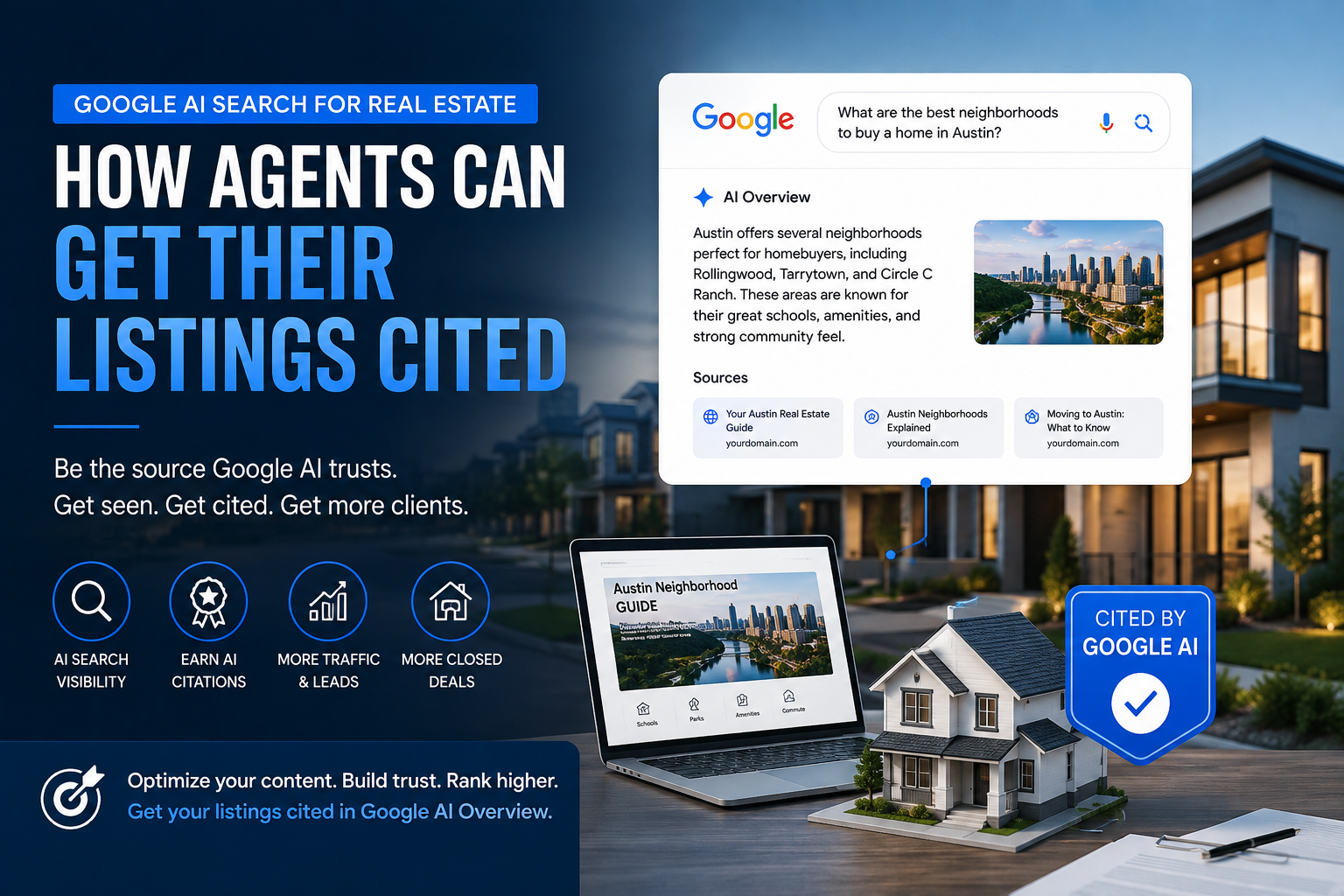
Google AI Overview now answers many home-buying questions before a person ever clicks a link. If you are a real estate agent, this changes the game. You are no longer just fighting for the number one spot on Google. You are fighting to be the source that Google’s AI picks, quotes, and links to inside that AI-generated answer box.
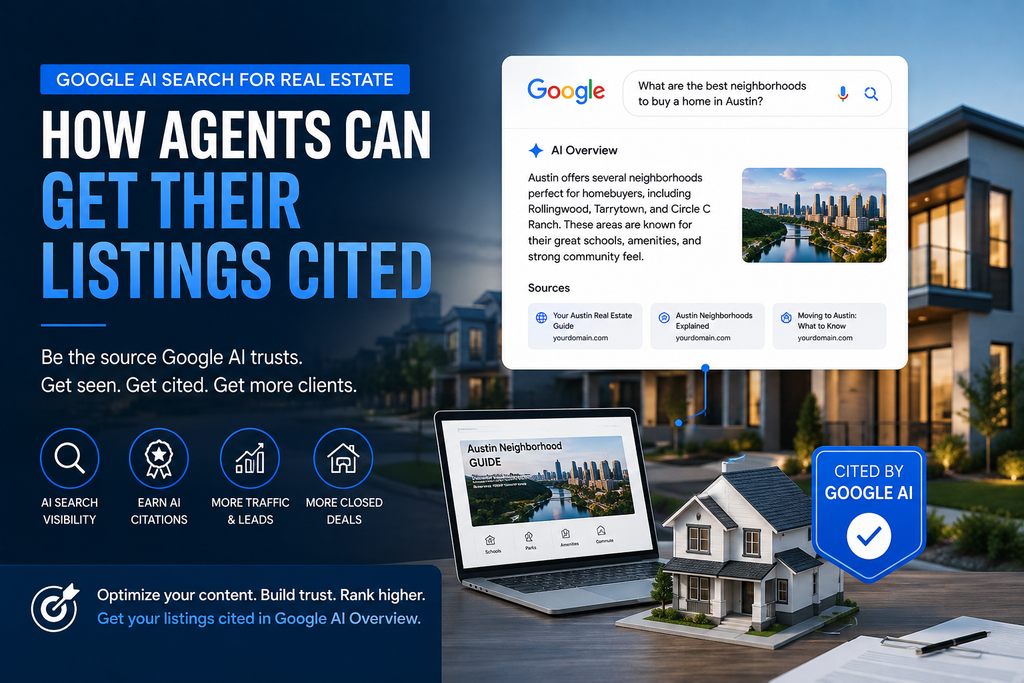
This guide breaks down, in plain simple words, exactly how Google AI Search works for real estate, why it matters for your listings and your business, and the exact steps you can take to get your content cited instead of skipped.
What Is Google AI Overview, In Simple Words
Google AI Overview is the AI-written summary box that shows up at the top of Google search results, above the normal blue links. When someone types a question like “is it a good time to buy a house in Austin” or “what documents do I need to sell my home,” Google’s AI reads through many web pages, picks the best information, and writes a short answer. Inside that answer, Google adds small citation links pointing back to the websites it pulled the answer from.
If your blog post, listing page, or neighborhood guide is one of those cited sources, your name and your brand show up right at the top of the search results, before any other real estate agent’s page. If you are not cited, your page may still exist somewhere below, but far fewer people will scroll down to find it.
Why This Matters So Much For Real Estate Agents Right Now
The numbers make this hard to ignore. When a Google AI Overview appears on a search page, most users do not click through to any website at all. Recent tracking of search behavior found that when an AI Overview shows up, a large majority of searches end with zero clicks to an outside site, and inside Google’s newer AI Mode, that number climbs even higher, according to a SparkToro analysis of Similarweb data cited by HousingWire.
That sounds scary at first. But here is the part that should get every agent’s attention: pages that do get cited inside the AI Overview recover a real share of that lost traffic. One industry study found that a cited page earns a noticeably higher click-through rate than a similar page that ranks well but is not cited, as reported by digital marketing agency Nexuro Digital. In other words, being cited is now more valuable than simply ranking on page one.
Local search behavior is shifting too. Google’s Gemini AI is now directly connected to Google Maps and Google Business Profile data through a system Google calls “Grounding with Google Maps,” which links its models to hundreds of millions of verified business locations, as HousingWire reported. When someone asks an AI assistant a local real estate question, the AI treats a complete, active Google Business Profile as a trustworthy source. This means your Business Profile is no longer just a map pin. It is part of your SEO and AI visibility strategy.
How Google’s AI Decides Which Real Estate Content To Cite
There is no secret button or paid trick that forces Google’s AI to cite your page. Google has confirmed there is no special tag or markup that guarantees a citation, as pointed out by Nexuro Digital’s 2026 guide on AI Overviews. Instead, AI Overview citations are built on top of normal SEO. A page almost always needs to already rank well in traditional Google search results before the AI system will consider quoting it, since Contently’s research on AI Overview citations found that AI Overviews draw heavily from pages that are already sitting near the top of organic search.
Once a page ranks, Google’s AI looks for content that is:
- Clear and direct. It answers the exact question in the first few sentences.
- Backed by real numbers, data, or local facts. Vague marketing language gets skipped.
- Well organized. Clean headings, short paragraphs, and lists make it easy for AI to pull a clean answer.
- Written by someone with real experience. Google’s AI favors content that shows genuine local knowledge and expertise, not generic filler.
- Current and updated. Old, outdated listing data or market stats are less likely to be trusted.
Real estate specific research from agency 12AM points out that AI citation now depends on giving property pages real context beyond the basic bed and bath count, such as whether a home is near a school, close to transit, or fits a specific lifestyle need, according to their 2026 real estate SEO guide.
Step 1: Rank First, Then Optimize For AI
Before you chase AI citations, make sure your website has the basic SEO foundation in place. This means fast page load speed, mobile-friendly design, secure HTTPS, clean site structure, and content that actually matches what buyers and sellers are searching for. Skipping this step and jumping straight to “AI optimization” will not work, because AI Overview mostly pulls from pages that already rank well, not random pages from nowhere.
Build a strong keyword foundation around your core real estate SEO keywords such as your city name plus “homes for sale,””real estate agent,””buying a house in [city],” and “selling a home in [city].” These are your primary keywords. Then layer in secondary keywords naturally throughout your content, things like “best neighborhoods for families,””home inspection checklist,””mortgage pre-approval,” and “closing costs explained.”
Step 2: Write Answer-First Content
This is the single biggest shift in how content needs to be written for Google AI Search. Old blog writing built suspense. It buried the answer deep in paragraph five. That style is dead for AI Overview purposes.
Instead, every important section should open with a short, direct answer in the first two or three sentences, then follow up with more detail underneath. According to real estate SEO agency Insomniacs, the winning approach is to rank well first, then lead every page with a direct answer, support it with real numbers, write with clear authority, and earn outside mentions so the AI has extra reasons to trust the page.
For example, if you are writing about whether now is a good time to buy in your city, do not open with a story about the weather or the local coffee shop. Open with something like: “Yes, [City] is currently a strong market for buyers because inventory has grown 12% year over year and average days on market increased from 24 to 38 days.” That single sentence is exactly the kind of extractable, fact-based statement that Google’s AI can lift straight into an AI Overview answer.
Research on what gets cited most often backs this up directly. Heavily cited AI Overview content tends to average around 18 words per sentence and leans on structured H2 and H3 headings for every distinct sub-topic, according to an analysis from Digital Applied on content strategy for AI Overviews. Short, clear sentences beat long, flowery ones every time.
Step 3: Use Schema Markup So Google’s AI Understands Your Listings
Schema markup is a small piece of code added to your website that explains your content to search engines in a structured, machine-readable way. It used to be mainly used to earn star ratings and rich snippets. In 2026, its job is bigger. Schema is now one of the main ways you feed factual, structured data directly to Google’s AI, and without it, your content is largely invisible inside AI-generated answers, according to SEO agency One Click SEO’s guide on schema for AI citation.
For real estate agents, the schema types that matter most are:
- RealEstateListing schema for individual property pages, so Google’s AI can pull exact price, address, bedrooms, bathrooms, and square footage.
- LocalBusiness schema for your brokerage or personal agent website, confirming your service area and contact details.
- Person and Organization schema to prove your identity, credentials, and connect you to your brokerage and licensing information.
- FAQPage schema for any FAQ section, which helps Google pull individual question-and-answer pairs directly into search results and AI Overviews.
- Review schema to display real client testimonials in a structured format.
Schema does not directly write the AI Overview answer for you, but it gives Google’s systems a verified, structured version of the same facts your written content is already saying. This combination of readable content plus structured schema is what turns your website into what one guide calls “a node in Google’s Knowledge Graph” rather than just a plain brochure site, as explained by One Click SEO.
Step 4: Build Real E-E-A-T Signals
E-E-A-T stands for Experience, Expertise, Authoritativeness, and Trustworthiness. Google has used this framework for years to judge content quality, and it matters even more now for AI citation. The shift agents need to understand is simple: the old model was about ranking a single page, but the new model is about becoming the source that AI systems trust enough to summarize and cite, according to a recent piece on what Google AI Overviews mean for realtors.
Practical ways to build E-E-A-T as an agent:
- Add a real author bio on every blog post, including your license number, years of experience, and specific neighborhoods you serve.
- Show real transaction data when you can, such as “sold 42 homes in [City] in the past 12 months.”
- Link out to trustworthy outside sources like your local MLS, city planning department, or school district website when you mention data.
- Keep your Google Business Profile fully filled out with correct hours, service areas, photos, and regularly answered Q&A.
- Collect and display genuine client reviews on both Google and your website.
Step 5: Build FAQ Blocks Using Real Buyer and Seller Questions
FAQ sections are some of the easiest wins for both featured snippets and AI Overview citations. The key is using the exact phrasing real buyers and sellers type into Google, not vague marketing questions. A step-by-step real estate SEO guide recommends starting key sections with a direct two to three sentence answer, then following with more detail, clear H2 and H3 headings, bullet lists, and FAQ blocks marked up with FAQPage schema at the end of important pages, based on guidance from real estate marketing platform Propphy.
Good FAQ questions for a real estate blog or listing page include things like:
- “How much are closing costs in [City]?”
- “Is [Neighborhood] a good area for families?”
- “How long does it take to sell a house in [City]?”
- “Do I need a home inspection before buying?”
- “What credit score do I need to buy a house?”
Answer each one in two to four short sentences directly under the question. This exact question-and-answer format is what both Google’s featured snippet system and AI Overview extraction tools are built to pull from.
Step 6: Build Topic Clusters, Not Random Blog Posts
Publishing one blog post about a topic and moving on is not enough anymore. AI Overview systems reward sites that show deep, connected coverage of a topic, not a single isolated article. The recommended structure is a pillar page, something like “Home Buying in [City]: The Complete Guide,” supported by multiple connected articles that all link back to that pillar page, creating what search engines read as topical authority, according to Propphy’s real estate SEO framework.
For a real estate agent, a simple cluster might look like this:
- Pillar page: “Buying a Home in [City]: Complete 2026 Guide”
- Supporting post: “Best Neighborhoods in [City] for First-Time Buyers”
- Supporting post: “Average Home Prices in [City] by Neighborhood”
- Supporting post: “Step-by-Step Mortgage Pre-Approval Process”
- Supporting post: “Closing Costs in [City]: What to Expect”
Each supporting post links to the pillar, and the pillar links to each supporting post. This tells Google your site is a genuine authority on home buying in that specific city, not just one lucky article.
Step 7: Earn Mentions From Other Trusted Sites
Getting mentioned by outside sources, local news sites, community blogs, industry publications, or partner businesses, adds another layer of trust that AI systems look for. Insomniacs’ framework for showing up in AI Overviews for real estate specifically lists earning mentions from other trusted sites as one of the core habits that makes content quotable, alongside ranking well, leading with the answer, and adding proof, based on their published guidance.
Simple ways to earn these mentions as an agent:
- Get quoted in local news stories about the housing market.
- Sponsor or write guest posts for local community and lifestyle blogs.
- Partner with local businesses for co-marketing content.
- Contribute expert commentary to national real estate publications that cover your local market.
Step 8: Keep Content Fresh and Watch Your Citations Over Time
Getting cited once is not a permanent win. AI Overview selections shift as Google’s systems update and as competing content changes. Staying cited requires ongoing attention, since the pages that keep their citations are the ones whose owners keep updating content, tracking what changes, and treating a lost citation as something worth investigating rather than ignoring, according to a 2026 guide on getting cited by Google AI Overviews.
Practical habits to build into your routine:
- Update your market stats blog posts every quarter with new numbers.
- Refresh old listing pages the moment a property status changes.
- Check quarterly which of your pages show up in AI Overview answers for your target keywords, and rewrite the ones that have dropped out.
- Remove or update any content referencing outdated prices, rates, or laws.
Common Mistakes That Keep Agents Out Of AI Overview
Many agents make the same avoidable mistakes when trying to get cited:
- Keyword stuffing instead of natural writing. Google’s Helpful Content System has continued to get stronger, and it clearly favors natural, well-explained writing over robotic keyword repetition, as noted by SEO agency Eye4Future’s 2026 guide on AI Overviews.
- Burying the answer too deep in the page. AI Overview systems pull discrete, clear claims, and pages that hide their answer inside long narrative paragraphs are less likely to get lifted into the summary box, according to SEO firm Stackmatix’s research on AI Overview impact.
- Treating virtual tours and video as a full SEO strategy. Tools like AR and VR walkthroughs are nice for presentation but do very little to help you get cited by AI or improve rankings on their own, as pointed out by real estate marketing agency Virtual Results.
- Relying on generic AI-written content with no local knowledge. Content that stops sounding like it comes from a real person who actually knows the local market quickly stops working, both for readers and for the AI systems built to detect generic filler, according to Virtual Results’ guidance for agents.
- Ignoring Google Business Profile. Since Gemini and other AI tools are directly grounded in Business Profile and Maps data, an incomplete or outdated profile can quietly remove you from local AI answers entirely.
Frequently Asked Questions
What is the difference between SEO and getting cited in Google AI Overview?
Traditional SEO focuses on ranking your page as high as possible in the list of blue links. Getting cited in Google AI Overview means your specific page is picked, summarized, and linked to inside the AI-generated answer box above those links. Good SEO is the foundation, but citation requires content that is also clear, well-structured, and easy for AI to extract.
Do I need special code to get cited by Google’s AI?
No single tag guarantees a citation. Structured data like schema markup helps Google understand your content better, but it works alongside strong writing, real E-E-A-T signals, and solid traditional SEO, not as a replacement for them.
How long does it take to get cited in an AI Overview?
Once a page already ranks well and is properly structured, it can start appearing in AI Overview citations within days. But building that ranking foundation in the first place can take weeks or months, depending on your site’s current authority.
Does Google Business Profile affect AI search results?
Yes. Google’s Gemini AI is directly connected to Google Maps and Business Profile data, so a complete, active, and accurate profile has a direct impact on whether your business shows up in local AI-generated answers.
Is it worth optimizing for AI Overview if it reduces website clicks?
Yes, because pages that are cited inside AI Overview recover a meaningfully higher click-through rate compared to pages that rank but are not cited. Being cited also builds brand visibility and trust even among users who do not click through immediately.
Final Thoughts
Google AI Search has changed what winning looks like for real estate agents. Ranking on page one is still the starting point, but the real prize now is earning a citation inside the AI Overview box itself. That takes answer-first writing, honest local expertise, clean schema markup, a fully optimized Google Business Profile, and content that is genuinely useful to real buyers and sellers, not just written for a search algorithm.
Agents who treat this as an ongoing habit, not a one-time project, will be the ones Google’s AI keeps quoting, month after month, in the market they know best.