Introduction
Travelers today expect more than just a list of destinations and hotel options. They want personalized experiences that match their interests, budget, travel style, and preferences. With thousands of travel choices available online, many users struggle to find the most relevant recommendations, making trip planning time-consuming and overwhelming.
This is where AI-powered travel apps are changing the industry. By using artificial intelligence and machine learning, travel platforms can analyze user behavior, understand preferences, and provide highly personalized travel recommendations in real time. From suggesting destinations and hotels to creating custom itineraries, AI helps travelers make faster and smarter decisions.
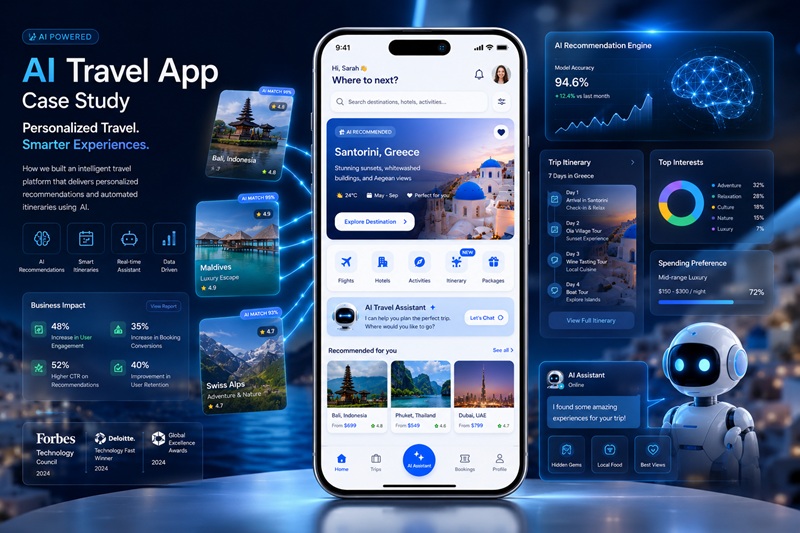
At HT Business Group, we partnered with a travel-focused client to build an innovative travel app with AI-based recommendations designed to improve user experience and increase customer engagement. The goal was simple: create a smart travel platform that understands each user and delivers personalized suggestions that make travel planning easier and more enjoyable.
The client wanted to solve several common challenges faced by modern travelers. Users often spent too much time searching for destinations, comparing accommodations, and exploring activities. Generic recommendations failed to match individual interests, leading to lower engagement and missed booking opportunities. To stay competitive in the growing travel technology market, the client needed a solution that could provide relevant recommendations based on real user data.
Our team developed a powerful AI recommendation engine that analyzes multiple data points, including user preferences, browsing behavior, previous searches, travel history, budget requirements, and activity interests. Using advanced machine learning algorithms, the system continuously learns from user interactions and improves recommendation accuracy over time.
The result was a fully scalable AI travel app capable of delivering personalized destination recommendations, intelligent itinerary planning, accommodation suggestions, and activity recommendations tailored to each traveler. The platform transformed the travel planning process by helping users discover experiences that matched their unique interests while reducing the effort required to plan a trip.
In this case study, we will walk through the entire AI travel app development process, including the challenges we faced, the technologies we used, how the AI recommendation system works, and the measurable business results achieved after launch. You will also learn how personalized travel recommendations can increase user engagement, improve booking conversions, and create better travel experiences for customers.
Quick Answer: What Did We Build?
We built an AI-powered travel app that uses machine learning and intelligent recommendation algorithms to deliver personalized travel suggestions based on user preferences, behavior, and interests. The platform helps travelers discover destinations, accommodations, activities, and travel plans that best match their needs while helping businesses increase engagement, retention, and booking conversions.
Key Highlights of the Project
- Developed a custom AI recommendation engine for personalized travel experiences.
- Created intelligent destination and activity recommendation features.
- Built a smart itinerary planning system.
- Improved user engagement through personalized content delivery.
- Designed a scalable travel technology solution capable of handling growing user demand.
- Enabled continuous learning through machine learning models that improve recommendation quality over time.
This project demonstrates how AI travel app development can help travel businesses deliver better customer experiences, increase user satisfaction, and gain a competitive advantage in an increasingly digital travel market.
Client Background
About the Client
Our client is a growing company in the travel and tourism industry that wanted to transform the way people plan and book their trips. The company offers travel-related services through a digital platform and focuses on helping travelers discover destinations, accommodations, activities, and personalized travel experiences.
As the travel market became more competitive, the client recognized a major shift in customer expectations. Modern travelers no longer wanted generic travel suggestions. Instead, they expected personalized recommendations that matched their interests, travel goals, budget, and preferences. To meet these changing demands, the client approached HT Business Group to develop an AI-powered travel app capable of delivering intelligent and personalized travel recommendations.
The client’s vision was to create a travel platform that acts like a personal travel assistant, helping users find the right destinations, activities, hotels, and travel experiences with minimal effort.
Industry
The client operates in the travel technology industry, one of the fastest-growing sectors in the digital economy. Travel technology companies use software, mobile applications, artificial intelligence, and data analytics to improve how travelers plan, book, and experience their journeys.
With millions of travelers searching online for vacation destinations, accommodations, transportation options, and local attractions every day, the travel industry generates massive amounts of user data. This creates an ideal opportunity for businesses to leverage AI travel app development and machine learning technologies to deliver more relevant and personalized experiences.
The client wanted to take advantage of these advancements by implementing an AI recommendation engine that could help users make better travel decisions while improving overall platform performance.
Business Model
The client follows a digital travel platform business model that connects travelers with travel-related products and services. The platform generates revenue through multiple channels, including:
Travel Bookings
Users can discover and book travel services directly through the platform, including accommodations, activities, tours, and other travel experiences.
Partner Commissions
The company earns commissions from travel service providers whenever users complete bookings through the platform.
Premium Travel Services
The platform offers additional features and premium travel experiences for users looking for personalized travel planning and exclusive recommendations.
Strategic Partnerships
The client collaborates with hotels, tour operators, local attractions, and travel service providers to expand available travel options and improve customer experiences.
Because revenue depends heavily on user engagement and successful bookings, the client needed a solution that could keep travelers active on the platform while increasing the likelihood of conversions.
Target Audience
The platform serves a diverse group of travelers looking for convenient, personalized, and stress-free trip planning experiences.
Leisure Travelers
Individuals and families planning vacations who want destination suggestions, accommodation recommendations, and customized itineraries.
Frequent Travelers
Users who travel regularly for personal or professional reasons and need faster access to relevant travel recommendations.
Adventure Travelers
People interested in outdoor activities, unique destinations, cultural experiences, and personalized travel experiences.
Business Travelers
Professionals looking for efficient travel planning, accommodation suggestions, and optimized itineraries.
Digital-First Consumers
Modern travelers who prefer using mobile apps to research, plan, and manage their trips.
The client wanted to create a personalized travel recommendation system that could serve the unique needs of each user segment while improving customer satisfaction and retention.
Geographic Markets Served
The client serves travelers across multiple regions and wanted to build a scalable travel app capable of supporting international growth.
North America
Travelers searching for domestic and international travel experiences across the United States and Canada.
Europe
Users exploring popular tourist destinations, cultural attractions, and cross-border travel opportunities.
Asia-Pacific
A rapidly growing market with increasing demand for mobile-first travel planning solutions.
Global Travelers
Users interested in international destinations, personalized itineraries, and location-specific recommendations.
Since traveler preferences vary significantly across different regions, the client needed an AI-powered travel app that could adapt recommendations based on geographic location, cultural preferences, travel behavior, and seasonal trends.
Business Goals
The client approached HT Business Group with a clear objective: build a smarter travel platform that uses artificial intelligence to improve user experiences and drive business growth.
The project focused on several key goals.
Improve Travel Planning Experience
Traditional travel planning often requires users to browse through hundreds of destinations, hotels, and activities before making a decision. This process can be overwhelming and time-consuming.
The client wanted to simplify the journey by creating an AI travel app that could automatically recommend relevant travel options based on each user’s interests and preferences.
The goal was to help travelers spend less time searching and more time enjoying their travel experiences.
Increase Customer Engagement
One of the biggest challenges facing the platform was keeping users engaged throughout the travel planning process.
Many visitors would browse destinations but leave before taking meaningful actions. The client wanted to increase engagement by delivering personalized content that encourages users to continue exploring the platform.
By implementing AI-based recommendations, the platform could provide more relevant suggestions, increase user interactions, and create a more engaging experience.
Personalize Recommendations
Every traveler is different. Some users prefer luxury vacations, while others focus on adventure travel, family trips, cultural experiences, or budget-friendly options.
The client wanted to move beyond generic travel suggestions and build a personalized travel recommendation engine that could understand individual user behavior and preferences.
Using machine learning algorithms, the system would analyze:
- Search history
- Browsing behavior
- Travel interests
- Budget preferences
- Previous bookings
- Activity preferences
This would allow the platform to deliver highly personalized recommendations for destinations, accommodations, and activities.
Boost Booking Conversions
Increasing bookings was one of the most important business objectives.
The client understood that users are more likely to book when they see travel options that match their interests. By improving recommendation accuracy, the platform could guide users toward more relevant choices and reduce decision fatigue.
The goal was to create a smoother customer journey that leads to higher conversion rates and increased revenue.
Differentiate from Competitors
The online travel market is highly competitive, with many platforms offering similar services.
The client wanted to stand out by offering a unique AI-powered travel experience that goes beyond basic search and filtering capabilities.
Instead of requiring users to manually search for travel options, the platform would proactively recommend destinations, activities, and travel plans tailored to individual preferences.
This innovation would position the company as a technology-driven travel platform focused on personalization, convenience, and customer satisfaction.
Project Objective Summary
In simple terms, the client wanted to build a smart travel app that could:
- Deliver personalized travel recommendations.
- Improve the overall travel planning experience.
- Increase user engagement and retention.
- Generate more bookings and revenue.
- Leverage artificial intelligence and machine learning.
- Create a competitive advantage in the travel technology market.
To achieve these goals, HT Business Group designed and developed a powerful AI-powered travel application that combines intelligent recommendation systems, advanced analytics, and user-centric design to deliver a modern travel experience.
The Challenge
Problems the Client Faced
Before partnering with HT Business Group, the client faced several challenges that were limiting user engagement, reducing booking conversions, and affecting overall customer satisfaction.
The travel industry has become increasingly competitive, and modern travelers expect personalized experiences at every stage of their journey. However, the client’s existing platform relied heavily on traditional search and filtering methods, making it difficult to provide relevant recommendations for individual users.
As a result, travelers often struggled to find destinations, accommodations, and activities that matched their interests. This created friction throughout the travel planning process and prevented the platform from reaching its full business potential.
To stay competitive and improve the customer experience, the client needed an AI-powered travel app capable of delivering intelligent, personalized travel recommendations based on user behavior and preferences.
Below are the key challenges that needed to be addressed.
Generic Recommendations
The Problem
One of the biggest issues was the platform’s inability to deliver personalized travel recommendations.
Every user received nearly identical destination suggestions, hotel recommendations, and activity listings regardless of their travel interests, budget, travel history, or preferences.
For example, a traveler interested in adventure tourism could receive the same recommendations as someone looking for luxury vacations or family-friendly destinations. This one-size-fits-all approach created a poor user experience and reduced the relevance of the platform’s recommendations.
The system lacked the intelligence needed to understand what individual travelers actually wanted.
Business Impact
Generic recommendations caused several problems:
- Lower user satisfaction.
- Reduced trust in the platform.
- Less engagement with recommended content.
- Missed opportunities for bookings.
- Difficulty building customer loyalty.
Without a personalized travel recommendation engine, users had little reason to continue exploring the platform.
Why It Mattered
Today’s travelers expect experiences tailored to their needs. Companies that fail to personalize recommendations often struggle to retain users and compete with modern AI-powered travel platforms.
The client needed a smarter solution that could analyze user preferences and deliver highly relevant travel suggestions in real time.
Poor User Engagement
The Problem
The platform was attracting visitors, but many users were not actively engaging with the content.
Users often visited the app, browsed a few destinations, and then left without exploring additional recommendations or taking meaningful actions.
The primary reason was simple: users were not finding content that matched their interests quickly enough.
Instead of discovering exciting travel opportunities, they were forced to manually search through large amounts of information.
Business Impact
Low engagement created several challenges:
- Shorter session durations.
- Fewer page views.
- Lower interaction rates.
- Reduced customer retention.
- Decreased booking opportunities.
When users do not engage with a platform, they are less likely to return in the future.
Why It Mattered
The client wanted to create an engaging travel planning experience that encouraged users to explore destinations, discover activities, and interact with personalized recommendations.
Improving engagement was essential for increasing customer satisfaction and long-term business growth.
High Drop-Off Rates
The Problem
Another major challenge was the high number of users abandoning the travel planning process before completing a booking.
Many visitors would start researching destinations or accommodations but leave the platform before making a final decision.
The client discovered that users often became frustrated by the amount of time required to find relevant travel options.
Without intelligent guidance, travelers had to compare dozens or even hundreds of choices on their own.
Business Impact
High drop-off rates directly affected revenue and growth.
The consequences included:
- Lower booking conversions.
- Increased customer acquisition costs.
- Lost revenue opportunities.
- Reduced return on marketing investments.
- Lower overall platform performance.
Even when users showed strong interest in traveling, many never reached the final booking stage.
Why It Mattered
The client needed a system that could guide users toward the most relevant options faster, helping them make confident decisions and complete bookings with less effort.
An AI recommendation engine could significantly reduce friction and improve the customer journey.
Data Overload
The Problem
Travelers today have access to an enormous amount of information.
The platform contained thousands of destinations, hotels, restaurants, attractions, tours, and travel experiences.
While having many options is valuable, it also creates a problem known as “choice overload.”
Users often became overwhelmed when presented with too many possibilities.
Instead of helping travelers make decisions, the abundance of information made the planning process more complicated.
Business Impact
Information overload led to:
- Decision fatigue.
- Slower booking decisions.
- Reduced user engagement.
- Increased abandonment rates.
- Lower conversion rates.
Many users left the platform simply because they could not quickly identify the best options for their needs.
Why It Mattered
Modern travelers want convenience and simplicity.
Rather than reviewing hundreds of options, users prefer platforms that narrow down choices and provide relevant recommendations automatically.
The client needed an AI-powered travel app capable of filtering large amounts of travel data and presenting only the most relevant suggestions to each user.
Limited Personalization
The Problem
The client’s existing system had very limited personalization capabilities.
Although the platform collected some user information, it lacked advanced tools to analyze user behavior and convert that data into meaningful recommendations.
The system could not effectively understand:
- Travel interests.
- Destination preferences.
- Budget requirements.
- Past booking behavior.
- Seasonal travel patterns.
- Activity preferences.
As a result, recommendations remained static and failed to adapt to changing user needs.
Business Impact
Limited personalization negatively affected:
- Customer experience.
- Recommendation accuracy.
- User retention.
- Booking conversions.
- Competitive positioning.
Without machine learning and behavioral analysis, the platform could not provide the personalized experiences that modern travelers expect.
Why It Mattered
Personalization has become one of the most important factors in travel technology.
Users expect platforms to understand their preferences and provide recommendations that feel relevant and helpful.
The client needed an advanced AI travel recommendation system that could continuously learn from user interactions and improve recommendation quality over time.
The Bigger Challenge
While each issue created its own difficulties, the real challenge was that all of these problems were connected.
- Generic recommendations led to poor engagement.
- Poor engagement contributed to high drop-off rates.
- Data overload made decision-making more difficult.
- Limited personalization reduced recommendation relevance.
Together, these issues created a frustrating user experience and limited the platform’s ability to generate bookings and customer loyalty.
The client needed more than a traditional travel application. They needed a modern AI-powered travel app that could understand user behavior, deliver personalized travel recommendations, simplify travel planning, and create a seamless customer journey from discovery to booking.
This challenge became the foundation for the intelligent travel recommendation solution developed by HT Business Group.
Our Solution
AI-Powered Travel Recommendation Platform
To solve the client’s challenges, HT Business Group designed and developed a powerful AI-powered travel recommendation platform that delivers personalized travel experiences for every user.
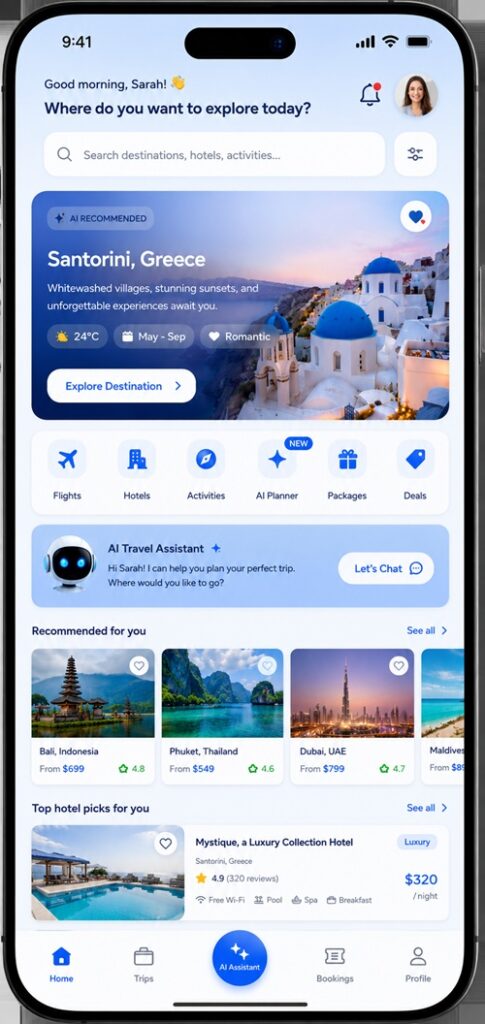
Instead of showing the same destinations and travel options to everyone, the platform uses artificial intelligence (AI), machine learning (ML), and behavioral analytics to understand what each traveler wants. The system analyzes user preferences, browsing patterns, travel history, and engagement data to provide recommendations that are relevant, useful, and personalized.
Our goal was to create a smart travel app that feels like a personal travel expert. Whether a user is looking for a relaxing beach vacation, an adventure-filled trip, a family holiday, or a business trip, the platform can recommend the best options based on their unique interests.
The result was a next-generation AI travel app that helps users discover destinations faster, plan trips more efficiently, and make booking decisions with confidence.
Quick Answer: What Solution Did We Build?
We developed an AI-powered travel app with an intelligent recommendation engine that delivers personalized destination suggestions, custom travel itineraries, hotel recommendations, activity suggestions, and real-time travel guidance based on user behavior and preferences.
The platform continuously learns from user interactions, making recommendations more accurate over time.
Core Features
Personalized Destination Recommendations
One of the most important features of the platform is its ability to provide personalized destination recommendations.
Traditional travel platforms often display popular destinations without considering individual preferences. Our AI recommendation engine takes a completely different approach.
The system analyzes multiple data points to understand each traveler’s interests and travel goals.
AI Analyzes:
- User preferences
- Search history
- Previous trips
- Budget range
- Travel style
- Favorite destinations
- Activity interests
- Seasonal travel behavior
For example, if a user frequently searches for hiking destinations and outdoor adventures, the platform may recommend national parks, mountain destinations, and adventure travel experiences.
If another user prefers luxury vacations, the system will prioritize premium resorts, luxury hotels, and high-end travel experiences.
Benefits of Personalized Destination Recommendations
- Faster destination discovery
- More relevant travel suggestions
- Improved user experience
- Reduced search time
- Higher customer satisfaction
By delivering highly targeted recommendations, the platform helps travelers find destinations that truly match their interests.
Smart Itinerary Builder
Planning a trip can be one of the most stressful parts of traveling.
Many users spend hours researching attractions, creating schedules, and organizing transportation. To simplify this process, we developed a Smart Itinerary Builder powered by artificial intelligence.
The system automatically creates customized travel plans based on user preferences and trip details.
Automatically Generates:
- Daily travel plans
- Activity schedules
- Route optimization
- Time management suggestions
- Destination recommendations
- Local attraction plans
- Travel timelines
Instead of manually building an itinerary, users receive a complete travel plan within seconds.
For example, if someone is visiting a city for three days, the platform can organize attractions, restaurants, sightseeing opportunities, and activities into a well-structured schedule.
Benefits of the Smart Itinerary Builder
- Saves planning time
- Reduces travel stress
- Creates optimized schedules
- Improves travel experiences
- Helps travelers maximize their time
This feature transforms complex travel planning into a simple and enjoyable process.
AI Travel Assistant
To provide ongoing support throughout the travel journey, we developed an intelligent AI Travel Assistant.
The assistant acts as a virtual travel companion that helps users make informed decisions before and during their trips.
Instead of searching through multiple websites for information, travelers can receive instant recommendations directly within the app.
Features Include:
- Real-time guidance
- Personalized travel tips
- Destination insights
- Contextual recommendations
- Local information
- Travel suggestions
- Activity recommendations
The AI assistant can answer travel-related questions and provide recommendations based on a user’s current location, interests, and travel plans.
For example, if a traveler arrives at a destination and wants restaurant recommendations nearby, the assistant can instantly provide personalized suggestions.
Benefits of the AI Travel Assistant
- Better travel experiences
- Faster access to information
- Increased user engagement
- Personalized support
- Greater convenience
This feature helps travelers feel supported throughout their entire journey.
Hotel and Accommodation Recommendations
Choosing the right accommodation is one of the most important parts of travel planning.
Many users become overwhelmed by thousands of hotel listings, reviews, and booking options.
To solve this problem, we integrated an AI-powered hotel recommendation system that helps travelers find accommodations that best fit their needs.
Recommendations Are Based On:
- User interests
- Budget preferences
- Hotel ratings
- Location preferences
- Previous booking behavior
- Travel purpose
- Family size
- Preferred amenities
The recommendation engine evaluates available accommodation options and ranks them according to each user’s preferences.
For example, a business traveler may receive recommendations for hotels near business districts, while a family traveler may see accommodations close to tourist attractions and family-friendly activities.
Benefits of Hotel Recommendations
- Faster accommodation selection
- Improved booking confidence
- More relevant hotel options
- Better user satisfaction
- Increased booking conversions
This feature significantly reduces the time users spend searching for suitable accommodations.
Activity Matching Engine
One of the biggest challenges in travel planning is discovering activities that match personal interests.
To address this challenge, we built a sophisticated Activity Matching Engine that connects travelers with experiences they are most likely to enjoy.
Using AI and machine learning, the system identifies user interests and recommends relevant activities based on behavioral patterns.
Suggests:
- Tourist attractions
- Restaurants
- Adventure activities
- Cultural experiences
- Entertainment venues
- Local events
- Outdoor activities
- Family-friendly experiences
For example, a traveler interested in food tourism may receive recommendations for local restaurants, culinary tours, and food festivals.
An adventure traveler may see hiking trails, water sports, and outdoor excursions.
Benefits of the Activity Matching Engine
- Personalized experiences
- Increased user engagement
- Better trip satisfaction
- Easier activity discovery
- More meaningful travel experiences
By connecting travelers with relevant experiences, the platform helps create memorable journeys.
Dynamic Learning System
A recommendation engine is only effective if it continues to improve over time.
To ensure long-term accuracy, we built a Dynamic Learning System that continuously analyzes user behavior and updates recommendations accordingly.
Unlike traditional travel platforms that rely on static recommendation rules, our AI-powered travel app learns from every interaction.
The Recommendation Engine Continuously Improves Using:
- User interactions
- Booking behavior
- Feedback signals
- Behavioral analytics
- Search activity
- Browsing patterns
- Saved destinations
- Click-through behavior
Every action helps the system better understand user preferences.
For example, if a traveler consistently chooses cultural attractions instead of adventure activities, the platform automatically adjusts future recommendations to reflect those preferences.
Benefits of the Dynamic Learning System
- More accurate recommendations
- Continuous performance improvement
- Higher engagement rates
- Better customer experiences
- Increased booking conversions
- Smarter personalization
As more data is collected, the recommendation engine becomes increasingly intelligent and effective.
Why This Solution Worked
The success of this AI travel app development project came from combining personalization, automation, and continuous learning into a single platform.
Instead of forcing users to search through endless travel options, the system intelligently identifies what matters most to each traveler and delivers personalized recommendations at the right time.
By integrating an AI recommendation engine, smart itinerary planning, hotel recommendations, activity matching, and real-time travel assistance, HT Business Group created a complete travel technology solution that improves user engagement, simplifies travel planning, and increases booking conversions.
The result is a scalable AI-powered travel platform that delivers better experiences for travelers while helping travel businesses grow faster in an increasingly competitive market.
Development Process
How We Built the AI-Powered Travel App
Building a successful AI-powered travel app requires much more than writing code. To create a platform that delivers personalized travel recommendations, intelligent trip planning, and a seamless user experience, our team followed a structured development process from research and planning to deployment and optimization.
At HT Business Group, we use a proven development methodology that combines business strategy, user-centered design, artificial intelligence, and modern software engineering practices. This approach helped us build a scalable travel technology solution that not only met the client’s goals but also exceeded user expectations.
Our development process was divided into five key stages:
- Discovery Phase
- Design Phase
- AI Model Development
- App Development
- Testing and Optimization
Each stage played an important role in creating a high-performing AI travel app capable of delivering personalized travel experiences.
Discovery Phase
The first step was understanding the client’s business, target audience, market position, and long-term goals.
Before developing any features, we conducted extensive research to identify challenges, opportunities, and user needs. This helped us create a clear roadmap for the project.
Market Research
A successful travel app must solve real-world problems. To ensure we built the right solution, our team performed detailed market research.
Travel Industry Analysis
We analyzed current trends in the travel technology industry to understand how travelers search, plan, and book trips.
Our research focused on:
- Growing demand for personalized travel recommendations
- Increased adoption of AI in travel platforms
- Mobile-first travel planning behaviors
- Customer expectations for seamless experiences
- Emerging travel technology innovations
The findings confirmed that personalization had become one of the most important factors influencing travel decisions.
Travelers increasingly expect platforms to understand their preferences and provide relevant recommendations without requiring extensive manual searches.
Competitor Benchmarking
Next, we evaluated leading travel platforms and booking applications to identify strengths, weaknesses, and market opportunities.
We examined:
- Recommendation systems
- User experience design
- Booking workflows
- Search functionality
- Personalization capabilities
- AI-powered features
This analysis helped us identify gaps in existing solutions and discover opportunities to create a more intelligent travel recommendation platform.
User Behavior Research
Understanding traveler behavior was critical to the success of the project.
Our UX and research teams studied how users interact with travel applications and identified common challenges throughout the planning process.
We analyzed:
- Search patterns
- Destination discovery behavior
- Booking decision-making processes
- Travel planning habits
- Mobile app usage trends
The research revealed that users often become overwhelmed by too many options and prefer personalized recommendations that simplify decision-making.
These insights directly influenced the design of the AI recommendation engine.
Requirement Gathering
Once research was completed, we worked closely with the client to define project requirements and establish clear success criteria.
Business Objectives
We identified the client’s primary goals, including:
- Improving travel planning experiences
- Increasing customer engagement
- Delivering personalized travel recommendations
- Boosting booking conversions
- Building a competitive advantage
These objectives became the foundation of the project roadmap.
User Expectations
We also defined what users expected from a modern travel application.
Users wanted:
- Fast destination discovery
- Personalized suggestions
- Easy trip planning
- Mobile accessibility
- Seamless booking experiences
- Relevant travel content
Understanding these expectations allowed us to prioritize features that would create the greatest value for users.
Technical Requirements
The technical planning phase focused on creating a scalable and future-ready architecture.
Key requirements included:
- AI recommendation engine integration
- Mobile app compatibility
- Cloud scalability
- Real-time data processing
- Secure authentication
- Third-party API integrations
This planning ensured the platform could support future growth and feature expansion.
Design Phase
After completing the discovery phase, we moved into design.
Our goal was to create an intuitive, user-friendly travel app that makes trip planning simple and enjoyable.
UX Research
User experience played a central role in the project.
Our design team mapped the complete traveler journey to understand how users interact with the platform from the moment they open the app until they complete a booking.
Understanding Traveler Journeys and Pain Points
We identified key friction points, including:
- Difficulty finding relevant destinations
- Information overload
- Complicated booking workflows
- Lack of personalized recommendations
- Time-consuming trip planning
By understanding these challenges, we were able to design solutions that reduce effort and improve usability.
Wireframing
Before designing the final interface, we created detailed wireframes to establish the structure of the application.
Creating User Flows and App Architecture
Wireframes helped us define:
- Navigation pathways
- User journeys
- Feature placement
- Recommendation workflows
- Booking processes
This step ensured that users could move through the platform naturally and efficiently.
UI Design
Once the wireframes were approved, our designers created the final user interface.
Building an Intuitive and Engaging Experience
The design focused on:
- Clean layouts
- Easy navigation
- Mobile responsiveness
- Visual consistency
- User engagement
Special attention was given to recommendation displays so users could quickly understand why specific destinations, hotels, or activities were being suggested.
The final design balanced functionality with visual appeal to create a modern travel planning experience.
AI Model Development
Artificial intelligence was the core technology behind the platform.
This phase focused on building and training the machine learning models that power personalized travel recommendations.
Data Collection
The quality of recommendations depends on the quality of available data.
We gathered and organized multiple data sources to train the recommendation engine.
Sources Included
User Profiles
Information about traveler interests and preferences.
Booking History
Past bookings helped identify travel patterns and behaviors.
Travel Behavior
User interactions provided insights into destinations and activities users preferred.
Destination Databases
Comprehensive travel data enriched recommendation quality.
This data formed the foundation of the machine learning system.
Model Training
After collecting the necessary data, we trained the AI models responsible for generating personalized recommendations.
User Preference Modeling
The first step involved identifying individual travel interests.
The AI system analyzed:
- Preferred destinations
- Travel styles
- Budget ranges
- Activity preferences
- Booking habits
This allowed the platform to build detailed traveler profiles.
Recommendation Engine Training
Next, we trained the recommendation engine to match users with relevant travel options.
The system learned how to recommend:
- Destinations
- Hotels
- Activities
- Attractions
- Travel experiences
As more data became available, recommendation accuracy improved significantly.
Continuous Learning Framework
One of the most powerful features of the platform is its ability to learn continuously.
The system constantly analyzes:
- User interactions
- Search behavior
- Booking activity
- Feedback signals
This allows recommendations to become smarter and more personalized over time.
App Development
With the AI models prepared, our engineering team began building the mobile application.
The goal was to create a fast, reliable, and scalable travel app capable of delivering personalized experiences in real time.
Mobile App Development
The application was developed using modern technologies and best practices to ensure performance, security, and scalability.
Several core features were implemented during this phase.
User Authentication
Secure authentication allows users to create accounts, save preferences, and access personalized recommendations.
Features included:
- Registration
- Login
- Password protection
- Account management
Travel Preference Setup
During onboarding, users can specify:
- Travel interests
- Budget preferences
- Favorite activities
- Destination preferences
This information helps the AI recommendation engine deliver more relevant suggestions from the start.
Recommendation Dashboard
The dashboard serves as the heart of the application.
Users receive:
- Destination recommendations
- Hotel suggestions
- Activity recommendations
- Personalized travel content
The dashboard updates dynamically as user preferences evolve.
Booking Integration
To create a seamless user experience, booking functionality was integrated directly into the platform.
Users can explore recommendations and complete bookings without leaving the app.
Notifications System
The notification system keeps users informed about:
- Travel recommendations
- Destination updates
- Booking reminders
- Personalized offers
This feature helps increase engagement and encourage repeat usage.
Testing and Optimization
Before launch, the platform underwent extensive testing to ensure reliability, accuracy, and security.
Functional Testing
Every feature was tested to verify that it worked as intended.
This included:
- User registration
- Recommendation generation
- Booking workflows
- Dashboard functionality
The goal was to eliminate bugs and ensure smooth performance.
AI Accuracy Testing
Because recommendation quality is critical, we conducted extensive testing of the AI models.
We evaluated:
- Recommendation relevance
- Prediction accuracy
- User satisfaction metrics
- Personalization effectiveness
Continuous adjustments helped improve recommendation quality before launch.
Performance Testing
Performance testing ensured the application could handle large volumes of users and data.
We tested:
- App speed
- Server response times
- Scalability
- Load handling
This helped ensure a smooth experience even during periods of high traffic.
Security Testing
Protecting user data was a top priority.
Security assessments included:
- Authentication testing
- Data encryption validation
- Vulnerability analysis
- API security reviews
This ensured compliance with modern security standards and best practices.
User Acceptance Testing
Before deployment, real users tested the platform to provide feedback on usability and overall experience.
Users evaluated:
- Navigation
- Recommendation quality
- Design
- Booking process
- Overall satisfaction
The feedback helped us make final improvements before launch.
Development Process Summary
The success of this AI travel app development project was driven by a structured and data-driven development process.
By combining market research, user-centered design, machine learning, mobile app development, and rigorous testing, HT Business Group successfully delivered a powerful AI-powered travel app that provides personalized travel recommendations, improves user engagement, and simplifies travel planning.
This step-by-step approach ensured that the final product was not only technically advanced but also aligned with real traveler needs and business objectives.
AI Recommendation Engine Explained
How the AI Recommendation System Works
The AI recommendation engine is the core technology behind our AI-powered travel app. It is responsible for understanding each traveler, learning from their behavior, and delivering personalized travel recommendations that match their interests and needs.
Instead of showing the same destinations, hotels, and activities to every user, the system uses artificial intelligence and machine learning to analyze data and make smart recommendations in real time.
Think of it as a digital travel expert that learns what each traveler likes and then suggests the best options based on those preferences.
This intelligent recommendation system helps users discover relevant destinations faster, reduces decision fatigue, and creates a more personalized travel planning experience.
Quick Answer: What Is an AI Recommendation Engine?
An AI recommendation engine is a machine learning system that analyzes user data, behavior, and preferences to provide personalized recommendations. In our travel app, the recommendation engine suggests destinations, hotels, activities, and travel packages that are most relevant to each traveler.
The more users interact with the platform, the smarter and more accurate the recommendations become.
Step 1: User Data Collection
Understanding Each Traveler
The first step in creating personalized travel recommendations is gathering relevant user data.
To recommend the right destinations and experiences, the system must first understand who the traveler is and what they are looking for.
When users interact with the travel app, the platform collects information that helps build a personalized traveler profile.
The System Gathers:
Interests
The platform tracks user interests to understand what types of travel experiences they enjoy.
Examples include:
- Adventure travel
- Beach vacations
- Luxury travel
- Family trips
- Cultural tourism
- Food experiences
- Nature exploration
These interests help the AI recommendation engine identify destinations and activities that align with user preferences.
Travel History
Previous travel behavior provides valuable insights into future travel decisions.
The system analyzes:
- Previously visited destinations
- Past bookings
- Favorite travel categories
- Frequently selected activities
Travel history helps the AI identify patterns and make more accurate recommendations.
Budget
Budget plays a major role in travel planning.
The platform considers:
- Preferred spending ranges
- Accommodation budgets
- Activity budgets
- Travel package preferences
This ensures that recommendations match both interests and financial expectations.
Search Patterns
The recommendation engine also monitors search behavior.
It evaluates:
- Frequently searched destinations
- Travel-related keywords
- Saved locations
- Browsing activity
For example, if a user repeatedly searches for tropical destinations, the system learns that beach vacations may be a strong interest.
Why User Data Collection Matters
The more relevant data the system collects, the better it can understand each traveler.
This creates the foundation for delivering highly personalized travel recommendations instead of generic suggestions.
Step 2: Behavioral Analysis
Turning Data Into Insights
Once user data is collected, the next step is behavioral analysis.
This is where machine learning algorithms begin identifying patterns and relationships within the data.
Rather than simply storing information, the AI recommendation engine analyzes user behavior to understand travel preferences at a deeper level.
The goal is to answer questions such as:
- What type of traveler is this user?
- Which destinations are most appealing?
- What activities are most likely to generate engagement?
- What accommodations fit their travel style?
Machine Learning Identifies:
Travel Preferences
The system determines what kind of travel experiences users prefer.
For example:
- Luxury travel
- Adventure tourism
- Budget travel
- Family vacations
- Business travel
- Solo travel
These insights help the platform tailor recommendations to individual needs.
Destination Affinity
The AI analyzes which destinations users are most interested in.
It evaluates factors such as:
- Search frequency
- Saved destinations
- Booking history
- Content engagement
This allows the system to prioritize destinations that are most likely to appeal to each traveler.
Activity Interests
The recommendation engine also identifies preferred activities.
Examples include:
- Hiking
- Food tours
- Museums
- Water sports
- Historical attractions
- Shopping experiences
By understanding activity preferences, the platform can recommend experiences that increase user satisfaction.
Why Behavioral Analysis Matters
Behavioral analysis transforms raw data into actionable insights.
Instead of making assumptions, the AI recommendation engine uses actual user behavior to understand preferences and predict future interests.
This creates a much more personalized and relevant travel experience.
Step 3: Recommendation Generation
Delivering Personalized Travel Recommendations
After analyzing user behavior, the AI recommendation engine generates recommendations specifically tailored to each traveler.
This is where the platform turns data and insights into practical travel suggestions.
The recommendation engine evaluates thousands of possible options and identifies the ones that best match a user’s profile.
AI Produces:
Personalized Destinations
The system recommends destinations based on:
- Travel interests
- Previous trips
- Budget preferences
- Search behavior
- Seasonal trends
For example, a traveler interested in outdoor adventures may receive recommendations for mountain destinations, hiking trails, and nature-focused experiences.
Hotel Recommendations
The platform suggests accommodations that align with user preferences.
Factors include:
- Budget
- Location
- Amenities
- Ratings
- Travel purpose
This helps users find suitable accommodations quickly without searching through hundreds of listings.
Activity Recommendations
The system recommends activities based on traveler interests.
Examples include:
- Adventure tours
- Cultural attractions
- Local experiences
- Food and dining options
- Entertainment venues
This helps users build richer and more enjoyable travel experiences.
Personalized Travel Packages
The recommendation engine can also suggest complete travel packages that combine:
- Destinations
- Accommodations
- Activities
- Transportation options
These packages simplify planning and help travelers make decisions faster.
Why Recommendation Generation Matters
Relevant recommendations improve the entire travel planning experience.
Users spend less time searching and more time exploring travel opportunities that genuinely interest them.
This leads to:
- Higher engagement
- Better user satisfaction
- Increased bookings
- Improved customer retention
Step 4: Continuous Optimization
Getting Smarter With Every Interaction
One of the biggest advantages of an AI-powered travel app is its ability to learn continuously.
Unlike traditional travel platforms that rely on static rules, our recommendation engine evolves as users interact with the application.
Every click, search, booking, and interaction helps the system improve its understanding of user preferences.
Recommendations Improve Using:
User Interactions
The system learns from:
- Clicks
- Searches
- Saved destinations
- Viewed recommendations
These interactions provide valuable feedback about user interests.
Booking Behavior
Completed bookings reveal strong preference signals.
The AI analyzes:
- Selected destinations
- Hotel choices
- Activity bookings
- Travel package purchases
This helps improve future recommendation accuracy.
Feedback Signals
The platform also evaluates direct and indirect feedback.
Examples include:
- User ratings
- Reviews
- Favorites
- Recommendation engagement
These signals help the system identify which recommendations are most valuable.
Behavioral Analytics
Advanced analytics track long-term behavioral trends.
The AI identifies:
- Changing interests
- Seasonal travel patterns
- Emerging preferences
- New travel habits
This ensures recommendations remain relevant over time.
Why Continuous Optimization Matters
Travel preferences are not static.
A traveler who previously preferred adventure vacations may later become interested in family travel or luxury experiences.
Continuous learning allows the recommendation engine to adapt to these changes automatically.
As a result, recommendations become:
- More personalized
- More accurate
- More relevant
- More valuable
The system continuously improves without requiring manual updates.
Real-World Example of the AI Recommendation Engine
Imagine a user who:
- Searches for beach destinations
- Books tropical vacations
- Saves luxury resorts
- Views water sports activities
The AI recommendation engine quickly identifies these patterns.
The next time the user opens the app, the platform may recommend:
- Caribbean destinations
- Luxury beachfront resorts
- Snorkeling excursions
- Private island experiences
- Tropical vacation packages
Instead of showing generic travel options, the system presents highly relevant recommendations that align with the traveler’s interests.
This creates a personalized travel experience that feels helpful, intelligent, and effortless.
Results & Business Impact
How the AI-Powered Travel App Improved Business Performance
The success of this AI travel app development project was measured not only by technical implementation but also by its impact on user experience, customer engagement, and overall business performance.
After launching the AI-powered travel recommendation platform, the client observed significant improvements in how users interacted with the application. Personalized travel recommendations helped travelers find relevant destinations, accommodations, and activities faster than before, creating a smoother and more engaging travel planning experience.
Because recommendations were tailored to individual preferences, users spent more time exploring the platform and interacting with suggested content. The recommendation engine successfully reduced the effort required to discover travel options, making trip planning simpler and more enjoyable.
Increased User Engagement
One of the most noticeable improvements was user engagement.
Before implementing the AI recommendation engine, many travelers struggled to find relevant travel suggestions and often left the platform after viewing only a limited number of options.
After deployment, users interacted with a wider range of content, including:
- Personalized destination recommendations
- Suggested accommodations
- Activity recommendations
- Custom travel itineraries
- AI-generated travel insights
The platform delivered more relevant content to each user, encouraging deeper exploration and longer engagement throughout the travel planning journey.
Key Engagement Improvements
- Higher interaction with recommended destinations
- Increased exploration of travel experiences
- Greater usage of personalized travel planning tools
- Improved engagement with suggested activities and accommodations
- More returning users exploring saved preferences and recommendations
Improved Booking Conversions
Personalization played a major role in improving the booking journey.
Instead of forcing travelers to manually search through thousands of travel options, the AI recommendation engine narrowed down choices based on user interests, travel style, budget, and past behavior.
This reduced decision fatigue and helped users discover travel opportunities that were more likely to match their expectations.
As a result, the client observed stronger booking intent and improved conversion performance across the platform.
Conversion Benefits
- More qualified travel recommendations
- Better alignment between user preferences and suggested options
- Faster decision-making during trip planning
- Improved booking journey efficiency
- Increased opportunities for travel package purchases
Enhanced Customer Satisfaction
Customer feedback became more positive after the implementation of personalized travel recommendations.
Users appreciated receiving travel suggestions that reflected their interests rather than generic recommendations shown to every traveler.
The AI-powered travel app created a more personalized experience by helping users quickly discover destinations, accommodations, and activities that matched their needs.
Customer Experience Improvements
- More relevant travel recommendations
- Better travel planning experience
- Easier destination discovery
- Reduced search effort
- Increased confidence in booking decisions
These improvements contributed to stronger customer satisfaction and improved overall platform perception.
Higher Customer Retention
The machine learning recommendation engine continuously learned from user behavior and adapted recommendations over time.
As recommendations became more accurate, users found greater value in returning to the platform.
The personalized experience encouraged repeat engagement and helped strengthen long-term customer relationships.
Retention Benefits
- Increased repeat visits
- Stronger customer loyalty
- Higher user engagement over time
- Improved long-term platform adoption
- More opportunities for repeat bookings
Improved Operational Efficiency
The implementation of intelligent recommendation systems also delivered operational benefits.
By automatically helping users discover relevant travel options, the platform reduced reliance on manual support and simplified the travel planning process.
Travelers were able to find answers and recommendations directly through the application without requiring additional assistance.
Operational Benefits
- Reduced customer support dependency
- Faster travel discovery process
- More efficient user journeys
- Improved recommendation accuracy
- Better use of customer behavior data
Long-Term Business Value
The AI-powered travel recommendation platform delivered value across multiple areas of the business.
By combining artificial intelligence, machine learning, and behavioral analytics, the client created a more personalized and engaging travel experience that supports both customer satisfaction and business growth.
The project demonstrated how AI travel app development can help travel companies:
- Improve user engagement
- Deliver personalized travel recommendations
- Increase booking opportunities
- Strengthen customer loyalty
- Enhance operational efficiency
- Create a competitive advantage in the travel technology market
Most importantly, the platform established a scalable foundation for future innovation, allowing the client to continuously improve recommendations and deliver better travel experiences as user data grows.
Why AI Recommendations Matter in Travel Apps
AI-powered recommendations have become a core part of modern travel app development. Today’s travelers do not want to search through hundreds of options. They expect fast, accurate, and personalized travel suggestions that match their interests, budget, and travel style.
This is where an AI recommendation engine changes everything. It analyzes user behavior, understands preferences, and delivers the right travel options at the right time. The result is a simpler, faster, and more enjoyable travel planning experience.
Below is a clear breakdown of why AI recommendations are so important for both travelers and travel businesses.
Benefits for Travelers
Faster Trip Planning
Planning a trip manually can take hours or even days. Travelers often compare destinations, hotels, and activities across multiple platforms.
With AI-powered travel recommendations, the process becomes much faster. The system instantly suggests relevant destinations, accommodations, and activities based on user preferences.
This reduces the time spent searching and helps users make decisions quickly with less effort.
More Relevant Suggestions
One of the biggest problems in traditional travel platforms is irrelevant recommendations.
AI solves this by analyzing user data such as search history, interests, travel behavior, and budget. It then delivers suggestions that match what the traveler actually wants.
For example, a user interested in adventure travel will see hiking spots, outdoor activities, and nature destinations instead of unrelated luxury hotel listings.
This makes the experience more useful and personalized.
Better Travel Experiences
When recommendations match user preferences, the overall travel experience improves.
Travelers can discover:
- Destinations that match their interests
- Hotels that fit their budget and style
- Activities they are more likely to enjoy
This leads to more satisfying trips and better memories.
AI ensures that every part of the journey feels more relevant and well-planned.
Reduced Decision Fatigue
Too many choices often make it harder to decide.
In travel planning, users may see thousands of options for destinations, hotels, and activities. This creates confusion and slows down decision-making.
AI recommendation systems solve this by filtering and prioritizing the best options for each user.
Instead of overwhelming users with choices, the system highlights the most relevant and meaningful recommendations.
This reduces stress and makes travel planning easier and more enjoyable.
Benefits for Travel Businesses
Higher Revenue
AI recommendations directly impact revenue by improving conversions.
When users see personalized travel options, they are more likely to complete bookings. This increases:
- Hotel bookings
- Tour bookings
- Travel package purchases
By guiding users toward relevant options, businesses can convert more visitors into paying customers.
Increased Engagement
Personalized recommendations keep users active on the platform.
Instead of leaving after a short visit, users continue exploring suggested destinations, hotels, and activities that match their interests.
This leads to:
- Longer session durations
- More page views
- Higher interaction rates
- Increased app usage
Engaged users are more likely to return and complete bookings.
Better Retention
Retention is one of the most important metrics in any travel app.
AI helps improve retention by continuously learning from user behavior and improving recommendation quality over time.
When users consistently receive relevant travel suggestions, they are more likely to return to the platform for future trips.
This builds long-term customer loyalty and repeat usage.
Competitive Advantage
The travel industry is highly competitive, with many platforms offering similar services.
AI-powered recommendations help businesses stand out by delivering a smarter and more personalized experience.
Instead of generic search results, users get tailored travel suggestions that feel more helpful and intuitive.
This creates a strong competitive advantage by:
- Improving user experience
- Increasing customer satisfaction
- Building brand trust
- Differentiating from traditional travel platforms
Summary
AI recommendations are no longer optional in travel app development. They are a key factor in improving both user experience and business performance.
For travelers, AI makes trip planning faster, easier, and more personalized. For businesses, it drives higher engagement, better retention, and increased revenue.
This is why AI-powered recommendation systems have become a core feature in modern travel technology platforms and a major driver of growth in the travel industry.
Future Enhancements
Building the Next Generation of AI Travel Apps
The travel industry is evolving quickly, and AI-powered travel apps are becoming more advanced every year. While the current AI recommendation engine already delivers personalized destinations, hotels, and activities, there is still a lot of room for innovation.
To stay ahead in the travel technology market, the platform is designed with future-ready architecture. This allows new AI features to be added easily without rebuilding the entire system.
Below are the upcoming AI features planned to further improve personalization, automation, and user experience in the travel app.
Generative AI Travel Planning
One of the most powerful future upgrades is Generative AI Travel Planning.
Instead of only suggesting destinations and activities, the system will be able to create complete travel plans automatically.
This includes:
- Full trip itineraries based on user preferences
- Day-by-day travel schedules
- Personalized destination combinations
- Custom travel routes and experiences
For example, a user could simply enter “5-day trip to Europe on a mid-range budget,” and the AI would generate a complete travel plan with destinations, hotels, activities, and travel timing.
This feature will make travel planning faster, easier, and fully automated.
Voice-Based Travel Assistant
The next enhancement focuses on making travel planning more natural and hands-free through a Voice-Based Travel Assistant.
Users will be able to speak directly to the app instead of typing searches.
They can ask questions like:
- “Show me budget-friendly beach destinations”
- “Plan a weekend trip near me”
- “Find hotels with good reviews in Paris”
The AI assistant will understand natural language, process user intent, and respond with personalized travel recommendations.
This will improve accessibility and make the app more user-friendly, especially for travelers on the go.
Real-Time Recommendation Updates
Currently, recommendations are based on user behavior and stored data. The next upgrade will introduce Real-Time Recommendation Updates.
This means the system will adjust suggestions instantly based on live user activity.
For example:
- If a user starts searching for mountain destinations, recommendations will immediately shift toward hiking and nature trips
- If a user shows interest in luxury hotels, the system will prioritize premium travel options in real time
This dynamic response will make the travel experience more responsive and accurate.
Predictive Travel Forecasting
Predictive Travel Forecasting will help users make smarter travel decisions before they even start planning.
Using AI and data analytics, the system will predict:
- Best time to travel to specific destinations
- Price trends for flights and hotels
- Popular upcoming travel spots
- Seasonal demand patterns
For example, the system may suggest booking early for a destination expected to become expensive during peak season.
This feature will help travelers save money and plan more efficiently.
Smart Budget Optimization
Budget is one of the most important factors in travel planning. The Smart Budget Optimization feature will help users get the best travel experience within their budget.
The AI system will:
- Recommend destinations based on budget range
- Suggest cost-effective travel packages
- Optimize hotel and activity combinations
- Highlight savings opportunities
For example, if a user has a limited budget, the system will prioritize affordable destinations, discounted hotels, and budget-friendly activities without reducing travel quality.
This ensures that every traveler gets maximum value from their budget.
Summary
The future of AI travel app development is focused on deeper personalization, smarter automation, and real-time intelligence.
With upcoming features like:
- Generative AI Travel Planning
- Voice-Based Travel Assistant
- Real-Time Recommendation Updates
- Predictive Travel Forecasting
- Smart Budget Optimization
the platform will move beyond simple recommendations and become a fully intelligent travel planning system.
These enhancements will not only improve user experience but also increase engagement, conversions, and long-term customer satisfaction, making the travel app even more competitive in the global travel technology market.
Why Choose HT Business Group for AI Travel App Development
HT Business Group builds smart AI-powered travel apps that help businesses improve user experience, engagement, and bookings. We combine artificial intelligence, machine learning, and travel technology to create personalized travel solutions.
Our Expertise
We specialize in:
- AI application development
- Travel technology solutions
- Machine learning integration
- Mobile app development
- Enterprise software engineering
What Sets Us Apart
- Deep industry knowledge in travel tech
- Scalable and secure architecture
- Proven step-by-step development process
- Complete end-to-end project delivery
We don’t just build travel apps—we build AI-powered travel experiences that deliver personalization, better engagement, and higher business growth.
FAQ
What is an AI-powered travel app?
An AI-powered travel app is a mobile or web application that uses artificial intelligence to help users plan trips. It studies user preferences, search history, and behavior to suggest personalized destinations, hotels, and activities. Instead of showing generic results, it delivers tailored travel recommendations. This makes trip planning faster, easier, and more relevant for each traveler.
How does an AI travel app work?
An AI travel app works by collecting user data and analyzing it using machine learning models. It identifies patterns in user behavior such as searches, clicks, and bookings. Based on this analysis, it generates personalized travel suggestions in real time. The system keeps learning and improves recommendations with every interaction.
What are AI-based travel recommendations?
AI-based travel recommendations are personalized suggestions for destinations, hotels, activities, and travel packages generated by machine learning algorithms. These recommendations are based on user interests, travel history, budget, and behavior. Instead of random listings, users see options that match their preferences. This improves decision-making and enhances the travel experience.
What problems does an AI travel app solve?
An AI travel app solves problems like information overload, poor personalization, and difficulty finding relevant travel options. It reduces the time users spend searching for destinations and accommodations. It also minimizes confusion caused by too many choices. Overall, it simplifies travel planning and improves user satisfaction.
What data does an AI travel app collect?
An AI travel app collects data such as user interests, search history, browsing behavior, travel bookings, and budget preferences. It may also track saved destinations, clicks, and activity preferences. This data helps the system understand each traveler’s needs. It is then used to generate personalized travel recommendations.
How does AI analyze user travel behavior?
AI analyzes user travel behavior by studying patterns in searches, clicks, bookings, and engagement history. Machine learning models identify preferences such as favorite destinations, travel style, and budget range. It groups users with similar behavior to improve accuracy. This allows the system to predict what each traveler is most likely to prefer.
How does an AI travel app increase bookings?
An AI travel app increases bookings by showing users highly relevant travel options that match their preferences. When users see personalized recommendations, they are more likely to make quick decisions. It also reduces the effort needed to compare options. This leads to higher booking conversions and faster purchase decisions.
How does AI improve conversion rates in travel apps?
AI improves conversion rates by guiding users toward the most relevant travel choices. It reduces decision fatigue and removes unnecessary options from the user journey. Personalized recommendations increase trust and engagement. As a result, more users complete bookings instead of leaving the platform.
How does personalization increase customer engagement?
Personalization increases engagement by showing users content that matches their interests and travel goals. When recommendations feel relevant, users spend more time exploring the app. They interact more with destinations, hotels, and activities. This creates a more engaging and satisfying user experience.
How do AI travel apps increase revenue?
AI travel apps increase revenue by improving booking conversions and encouraging users to explore more travel options. Personalized recommendations lead to higher purchase rates for hotels, activities, and travel packages. Better engagement also results in repeat bookings. This directly increases overall platform revenue.
How does AI improve customer retention in travel platforms?
AI improves customer retention by continuously learning user preferences and delivering better recommendations over time. When users consistently receive relevant travel suggestions, they return to the platform. Personalized experiences build trust and loyalty. This increases long-term user retention and repeat usage.
How does AI reduce customer support workload?
AI reduces customer support workload by helping users find answers and recommendations directly within the app. Intelligent suggestions reduce confusion during travel planning. Users do not need to contact support for basic queries or travel options. This lowers support requests and improves operational efficiency.
How does AI give a competitive advantage in the travel industry?
AI gives a competitive advantage by offering personalized and intelligent travel experiences that traditional platforms cannot match. It improves user satisfaction, engagement, and booking rates. Businesses using AI stand out in a crowded market. This helps attract more users and build stronger brand trust.
Why do travel businesses need AI recommendation systems?
Travel businesses need AI recommendation systems to meet modern user expectations for personalization and speed. These systems help users quickly find relevant destinations, hotels, and activities. They also increase conversions and revenue. Without AI, travel platforms struggle to compete in today’s digital market.
How does AI improve travel business performance?
AI improves travel business performance by increasing engagement, bookings, and customer satisfaction. It helps businesses understand user behavior and deliver better recommendations. This leads to higher conversions and stronger customer loyalty. Overall, AI makes travel platforms more efficient and profitable.
Conclusion
The AI-powered travel app developed by HT Business Group changed how users search, plan, and book their travel. Instead of showing generic results, the platform uses AI, machine learning, and smart recommendation systems to deliver personalized travel suggestions.
This made travel planning faster, easier, and more relevant for every user. It also helped the business improve engagement, increase bookings, and build stronger customer loyalty.
The project clearly shows how AI travel app development can transform the travel experience and create real business growth through personalization and automation.
Key Takeaway
AI-powered personalization is no longer optional in travel apps. It is now a key driver for better user experience, higher conversions, and long-term customer retention.
Businesses that adopt AI-based travel recommendations gain a strong competitive advantage in today’s digital travel market.
Ready to Build an AI Travel App?
If you want to build a smart, scalable, and AI-powered travel application, HT Business Group can help you turn your idea into a real product.
We specialize in:
- AI travel app development
- Machine learning recommendation systems
- Personalized travel solutions
- End-to-end product delivery
Contact HT Business Group today to build your next-generation AI travel platform.