Most real estate companies still chase leads through channels built for browsing, not buying: static websites, social feeds, and portals crowded with competitors. An Android app changes that. It turns a one-time visitor into a returning, trackable, and increasingly qualified prospect, because the company owns the channel instead of renting attention from a platform.
Quick Answer
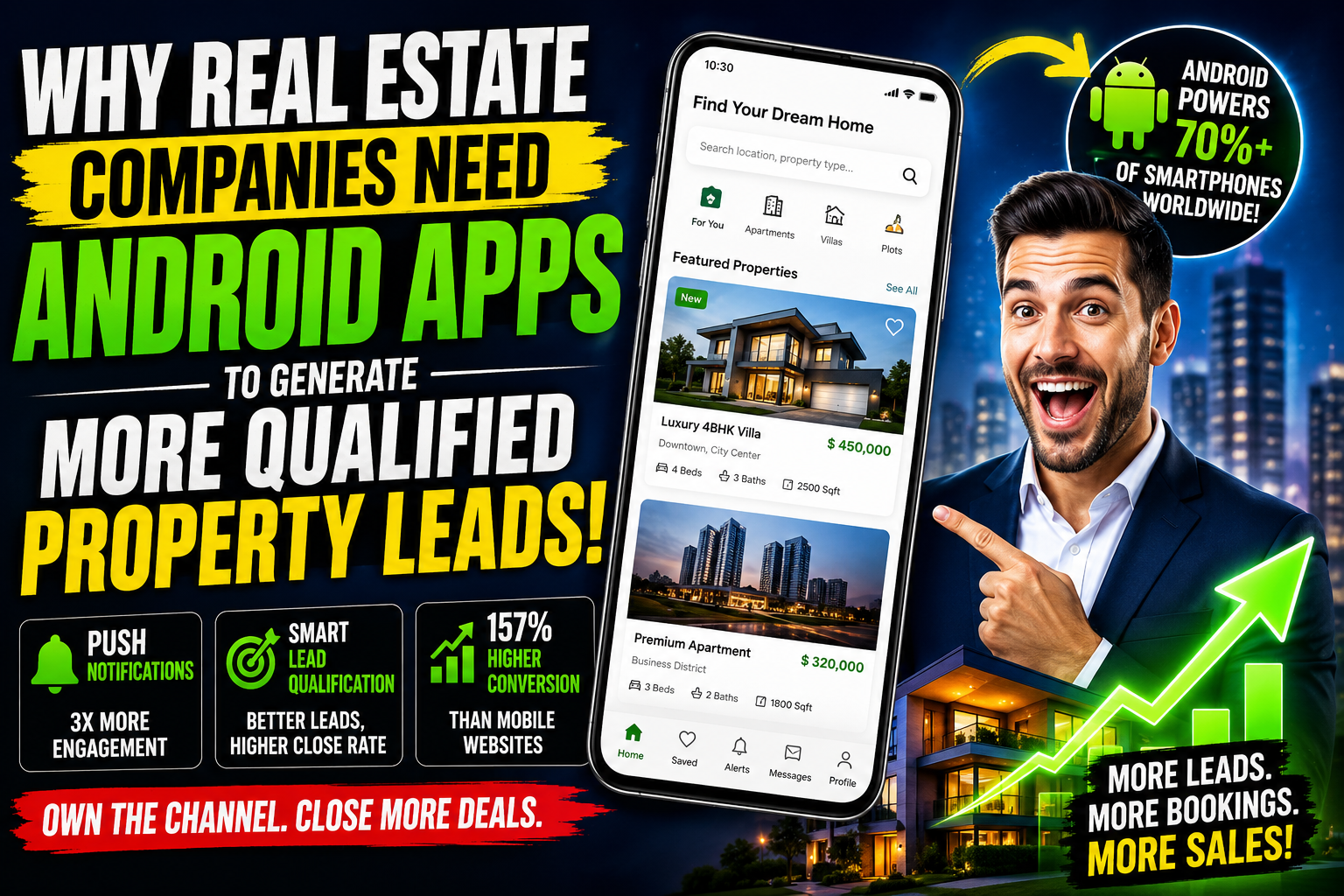
Real estate companies need Android apps because Android runs on 70.8% to 72% of smartphones worldwide, and mobile devices are where 76% of homebuyers begin their property search. An app adds push notifications, saved searches, location alerts, and instant agent contact, features a browser cannot match, which raises engagement and lets teams score and qualify leads before the first phone call.
Key Takeaways
- Android’s reach is decisive. Android holds roughly 70.8% to 72% of the global smartphone market, and dominates fast-growing property markets such as India, Brazil, and much of Asia.
- Buyers are already mobile-first. 76% of homebuyers start their search on a mobile device, and 71% end up finding the property they buy through a mobile device.
- Apps convert better than mobile sites. Industry benchmarks show apps averaging 157% higher conversion rates than mobile websites, driven by faster load times, stored preferences, and less friction.
- Push notifications keep buyers warm. App users who receive push notifications in their first 90 days show 3x higher retention than users who receive none, which matters because the average buyer searches for roughly 10 weeks before purchasing.
- Digital-first behavior is now the norm. 96% of homebuyers use online tools during their home search, yet 88% still buy through an agent or broker, so the company that owns the most useful digital tool tends to win the introduction.
- Content and automation compound the effect. Real estate companies with active blogs generate 5.4 times more leads than those without content, and combining SEO with paid advertising yields a 3.1x return, the highest blended ROI of any real estate marketing approach.
Why Mobile-First Behavior Changes Real Estate Lead Generation
Direct answer: Buyers now do almost their entire pre-contact research on a phone, so a real estate company’s mobile experience is effectively its first impression, its virtual showroom, and its lead-capture form all at once.
The numbers back this up clearly. 96% of homebuyers use online tools during their home search, and 39% of adults used a real estate listing website or app to search for homes in 2024, a figure that keeps climbing as portals and brokerages push their own apps. 71% of buyers find the property they eventually purchase via a mobile device, and the average buyer spends close to 4.7 months searching online before closing.
That long search window is the opportunity. A visitor who lands on a company’s mobile website once and leaves has to be found again, usually through paid ads or another cold search. A visitor who installs the company’s Android app stays reachable through push notifications, saved-search alerts, and in-app messages for the entire length of that multi-month decision.
Example: A mid-size brokerage running only a mobile-optimized website has no reliable way to re-engage a browser who viewed five listings last week and vanished. The same brokerage with an Android app can trigger a “new listing matches your saved search” push notification the moment a similar property is listed, re-opening the conversation without spending another dollar on ads.
Bullet summary:
- Mobile is now the default entry point for property research, not an alternative to desktop.
- The buying decision takes months, so the channel with the longest attention span wins.
- Apps extend a company’s reach across that entire window; websites only capture a single visit.
Why Android Specifically, Not Just “Mobile”
Direct answer: Android is the platform to prioritize first because it commands the largest global device base, dominates the highest-growth housing markets, and gives real estate companies deeper access to location, notification, and background-data permissions than iOS typically allows.
Globally, Android holds between 70.8% and 72% of the smartphone market, compared with 28% to 29% for iOS, and Android’s active user base sits at roughly 3.9 to 4.5 billion people worldwide. That dominance is not evenly spread; it is concentrated exactly where real estate demand is growing fastest. Android controls around 95% of the smartphone market in India and 81% in Brazil, two of the largest residential and commercial property markets in the world. Even in the U.S., where iOS leads overall, Android still represents a substantial share of buyers, and Android leads outright in markets like Australia, at roughly 54.5% versus 44.3% for iOS.
Notification behavior is another practical reason to build for Android first. Android notifications persist on the lock screen until a user actively dismisses them, while iOS clears them on unlock, and this difference gives Android apps a consistent engagement edge across industries. For a real estate company relying on time-sensitive alerts, such as a price drop or a new listing in a saved area, that persistence matters.
Example: A property developer marketing new-build homes to overseas investors in South Asia or Latin America will reach a far larger share of that audience through an Android app than through an iOS-only tool, simply because of regional device share.
Bullet summary:
- Android’s global share (roughly 70–72%) outpaces iOS in almost every region except the U.S. and a handful of Western markets.
- Emerging and high-growth property markets are overwhelmingly Android.
- Android’s lock-screen notification behavior tends to keep alerts visible longer, supporting stronger re-engagement.
App vs. Mobile Website vs. Third-Party Portal
Direct answer: A branded Android app outperforms a mobile website on conversion and repeat engagement, while a third-party portal (like a major listing aggregator) offers reach but hands the lead relationship to a competitor.
| Factor | Branded Android App | Mobile Website | Third-Party Portal |
| Lead ownership | Full — company owns the data | Full, but session-based | Shared or sold to competing agents |
| Conversion rate | Highest; apps see 157% higher conversion than mobile web on average | Moderate | Varies; high volume, low intent |
| Re-engagement tools | Push notifications, saved searches, in-app messages | Email/SMS opt-in only | Portal-controlled, not company-controlled |
| Cost to reach a user | Low after install (owned channel) | Ongoing ad/SEO spend per visit | Pay-per-lead or subscription fees |
| Offline access | Available (cached listings, maps) | Limited | Not available |
| Brand control | Full company branding | Full company branding | Portal branding dominates |
| Best use case | Retaining and converting warm, high-intent buyers | First-touch discovery, SEO traffic | Broad top-of-funnel visibility |
Bullet summary:
- Portals are useful for initial discovery, but the company competes with every other agent on the same listing.
- A mobile website is essential for SEO and first impressions but weak at long-term re-engagement.
- An app is the strongest tool for nurturing a lead across the months-long decision window and for repeat business from past clients.
How an Android App Improves Lead Quality, Not Just Lead Volume
Direct answer: An app improves lead quality by capturing behavioral data, such as which listings a user viewed repeatedly, which price ranges they saved, and how often they open the app, so agents can prioritize follow-up instead of guessing.
Lead volume is easy to inflate with ads; lead quality is harder, and it is what actually drives closings. Tracking app analytics to identify the most engaged users and the properties generating the most interest directly informs a more effective follow-up strategy. Instead of calling every form submission with the same generic script, an agent can see that a specific user has opened the same three-bedroom listing five times in a week and reach out with a tailored, timely conversation.
This kind of behavioral scoring matters because speed and relevance both affect conversion. Expired listings, one of the highest-converting lead types in real estate, convert at a 44% list rate and a 20.7% sold rate, largely because agents approach them with specific, informed context rather than a cold pitch. An app lets a company apply that same principle, informed, specific outreach, to every warm buyer lead, not just expired listings.
Example: A commercial real estate firm can use in-app engagement data to see that a prospect returned to a single office-space listing three times over two weeks. That signal justifies a personal call rather than an automated drip email, and it arrives without the prospect having to fill out another form.
Bullet summary:
- Behavioral data (repeat views, saved searches, session frequency) is a stronger qualifier than a single form submission.
- Sales teams can prioritize follow-up based on actual engagement rather than lead source alone.
- This reduces wasted outreach and shortens the path from first contact to signed agreement.
Core Features That Turn Downloads Into Qualified Leads
Direct answer: The features that convert app installs into qualified leads are push notifications, saved and alert-based searches, in-app agent messaging, map-based and location-aware browsing, and lightweight CRM integration.
- Push notifications for price drops and new matches. Notifications remain one of the most direct re-engagement tools available; 48% of app users report they have made a purchase decision as a result of a push notification, and well-targeted, segmented pushes perform far better than generic ones, with segmented and geotargeted campaigns roughly doubling both open and conversion rates.
- Saved searches and custom alerts. Buyers rarely find “the one” on their first session; giving them a way to save criteria and get notified automatically keeps them inside the company’s ecosystem for the full search period.
- In-app messaging and instant contact. Reducing the number of steps between “interested” and “talking to an agent” is one of the simplest ways to raise conversion.
- Map-based, location-aware browsing. GPS integration lets buyers explore a neighborhood in person while pulling live listing data, useful for both agents demonstrating a market and buyers relocating from out of town.
- CRM and lead-routing integration. An app that feeds directly into a CRM ensures no lead sits unclaimed; this is the same principle behind CRM-connected apps already popular with agents for exactly this reason.
Bullet summary:
- Notifications and saved searches extend engagement across the full buying timeline.
- In-app contact removes friction between interest and conversation.
- CRM integration prevents leads from going unassigned or unanswered.
Business Scenarios: How Teams Use Their App Day to Day
Direct answer: Real estate teams use their Android app differently depending on their business model, brokerages for buyer nurture, developers for pre-launch reservations, and property managers for tenant and renewal communication.
- Residential brokerage. A team sets up automated saved-search alerts by neighborhood and price band. When a matching listing goes live, buyers in that segment get a push notification before the listing even appears on major portals, giving the brokerage’s own agents first contact.
- New-development sales. A developer building a multi-phase project uses the app to let interested buyers reserve a unit, view a live floor plan, and receive updates on construction milestones, turning a single early inquiry into a year-long, ongoing relationship instead of a one-time contact.
- Property management. A management company uses the app for maintenance requests and lease-renewal reminders. Renters who have a good in-app experience are more likely to convert into buyers later, when they are ready to move from renting to owning.
- Commercial real estate. A commercial firm builds saved searches around zoning type and square footage, then uses in-app messaging when a prospect revisits a specific property, treating repeat views as a buying signal worth a direct call.
Bullet summary:
- Brokerages use apps mainly for buyer nurture and first-mover advantage on new listings.
- Developers use apps to manage long, multi-touchpoint sales cycles.
- Property managers and commercial firms use the same core technology for retention and signal-based follow-up, not just acquisition.
Step-by-Step: Building or Commissioning a Lead-Generating Android App
Direct answer: Building a lead-generating Android app involves defining the buyer journey first, then choosing a build path, integrating a CRM, and testing engagement before a full launch.
- Map the buyer journey before writing a feature list. Identify where prospects currently drop off, first search, first contact, first showing, and design app features to solve each specific point of friction.
- Choose a build approach. Options range from white-label real estate app platforms (fastest, lowest cost) to a fully custom Android build (highest cost, most control). Match the choice to budget and how differentiated the company’s process needs to be.
- Integrate MLS/IDX data feeds. Listings must stay current and accurate; a stale listing is one of the fastest ways to lose trust with a serious buyer.
- Connect the app to the CRM and lead-routing system. Every in-app inquiry, saved search, and notification click should land in the same pipeline agents already use, not a separate inbox that gets checked less often.
- Set up segmented push notification rules. Segment by location, price range, and property type rather than sending the same alert to every user; segmentation has been shown to roughly double conversion on notifications.
- Run a limited beta with existing clients. Past clients and current leads are the best group to test onboarding, notification frequency, and search accuracy before a public launch.
- Launch and promote through existing channels. Announce the app through the company’s website, email list, and social channels, and include the install prompt at natural high-intent moments, such as after a listing search on the mobile website.
- Track engagement and iterate monthly. Review push open rates, saved-search usage, and in-app contact conversions monthly, and refine notification cadence based on the data rather than a fixed schedule.
Best Practices for Android App Lead Generation
- Segment every notification. Generic blasts underperform; segmented, geotargeted push campaigns nearly double both open rates and conversion rates compared with one-size-fits-all messages.
- Respect notification frequency limits. Unsubscribe rates climb sharply once messaging becomes too frequent; unsubscribes jump from under 3% to around 7% once daily sends move from the 11–15 range to 16–20. Fewer, more relevant messages consistently outperform volume.
- Keep notification copy short. Push notifications under ten words get roughly double the engagement of longer messages.
- Pair the app with content marketing, not instead of it. Companies that also maintain an active blog see 5.4 times more leads than those without content, and that content drives the app installs in the first place.
- Use video inside listings. Listings with video receive 403% more inquiries than those without, and video performs just as well, if not better, inside an app as on a website.
- Time follow-up around buyer behavior, not just lead source. Because the median buyer searches for around 10 weeks before purchasing, nurture sequences and notification cadence should be planned for a multi-month window, not a two-week sprint.
Common Mistakes to Avoid
- Treating the app as a static listing viewer. An app with no push strategy, no saved searches, and no in-app contact option offers little advantage over a mobile website and will see low retention.
- Sending too many notifications too soon. Over-notifying is one of the fastest ways to trigger uninstalls; frequency should ramp up gradually as engagement data justifies it.
- Letting listing data go stale. Buyers lose trust quickly if a “new” listing has already sold; MLS/IDX sync needs to run in near real time.
- Ignoring Android-specific notification behavior. Copying an iOS notification strategy onto Android without adjusting for lock-screen persistence and longer visibility wastes an advantage unique to the platform.
- Skipping CRM integration. An app that generates leads no agent actually sees in time defeats the purpose; every in-app action should route into the same system the sales team already checks daily.
- Launching without a promotion plan. An app with no install strategy will sit unused; it needs the same marketing push as any new product, through email, the website, and existing client relationships.
Expert Tips
- Prioritize the notification a user can act on immediately. A “price reduced” or “new match” alert converts far better than a generic newsletter-style push.
- Use in-app messaging as a qualifying tool, not just a convenience. The questions a lead asks in-app often reveal intent (financing questions signal a serious buyer) more clearly than a form submission does.
- Build for the slow months of the search, not just the final weeks. Since the search period averages close to 4.7 months, most of an app’s value comes from sustained, low-friction engagement early in the process, not last-minute conversion tactics.
- Treat app analytics as a daily habit for agents, not a quarterly report for management. The teams that benefit most are the ones checking engagement signals often enough to act on them the same day.
Pros and Cons of Investing in a Branded Android App
Pros:
- Full ownership of lead data and the buyer relationship, unlike third-party portals
- Higher conversion rates than mobile websites, supported by industry benchmarks
- Push notifications and saved searches extend engagement across a multi-month search window
- Stronger behavioral data for lead qualification and prioritization
- Works especially well in Android-dominant, high-growth housing markets
Cons:
- Upfront development or licensing cost, which can be significant for a fully custom build
- Ongoing maintenance required to keep listing data, notifications, and CRM integration current
- Requires a promotion strategy; an app does not generate installs on its own
- Risk of over-notifying users if frequency and segmentation are not managed carefully
- Less effective as a stand-alone tool without complementary content marketing and SEO to drive installs
Frequently Asked Questions
1. Do real estate companies really need a dedicated Android app, or is a mobile website enough?
A mobile website is necessary for SEO and first-time visitors, but apps average 157% higher conversion rates than mobile websites because they remove friction and add features like push notifications that a browser cannot replicate.
2. Why prioritize Android over iOS for a real estate app?
Android holds 70.8% to 72% of the global smartphone market and dominates high-growth property markets such as India and Brazil, giving a company far broader reach than an iOS-only build.
3. How do push notifications actually help generate leads?
48% of app users say they have made a purchase decision as a result of a push notification, and segmented, targeted notifications roughly double both open and conversion rates compared with generic blasts.
4. What is the biggest risk of building a real estate app?
The most common failure is treating it as a static listing viewer with no notification strategy, no in-app contact, and no CRM integration, features that make the difference between an app and a glorified brochure.
5. How long does the average buyer spend searching before purchasing?
Roughly 10 weeks according to NAR data, and other industry analysis puts the average online search duration closer to 4.7 months, which is why sustained app engagement matters more than short-term tactics.
6. Can an app replace listing portals like Zillow or Realtor.com?
No. Portals remain valuable for initial discovery and broad visibility, but a company’s own app is where it retains and converts the leads that portals help surface, without competing against other agents on the same listing.
7. Do apps help with commercial real estate as well as residential?
Yes. Commercial firms use the same saved-search and engagement-tracking features to spot which prospects are seriously interested in a specific property based on repeat visits, rather than relying only on inbound calls.
8. How often should a real estate app send push notifications?
Frequency should be based on relevance, not a fixed schedule; unsubscribe rates climb sharply once daily sends move into the mid-teens range, so segmented, timely alerts consistently outperform frequent generic ones.
9. What role does content marketing play if a company already has an app?
A significant one. Companies with active blogs generate 5.4 times more leads than those without, and that content is often what drives the traffic and trust that lead to an app install in the first place.
10. Does video content matter inside an app, not just on a website?
Yes. Listings with video receive 403% more inquiries than listings without, and that advantage carries over to in-app listing views just as it does on the web.
11. How do property management companies benefit from a real estate app?
Beyond lead generation, apps let management companies handle maintenance requests and renewal reminders, which builds the kind of relationship that often converts long-term renters into future buyers.
12. What is the single most important feature to launch with first?
Saved searches paired with push alerts. This combination directly extends engagement across the buyer’s full search window and is the feature most closely tied to conversion in industry benchmarks.
13. Is a custom-built app worth it compared to a white-label real estate app platform?
It depends on budget and differentiation needs. White-label platforms launch faster and cost less; a custom build makes sense once a company’s process is specific enough that off-the-shelf features start to feel limiting.