Quick Answer
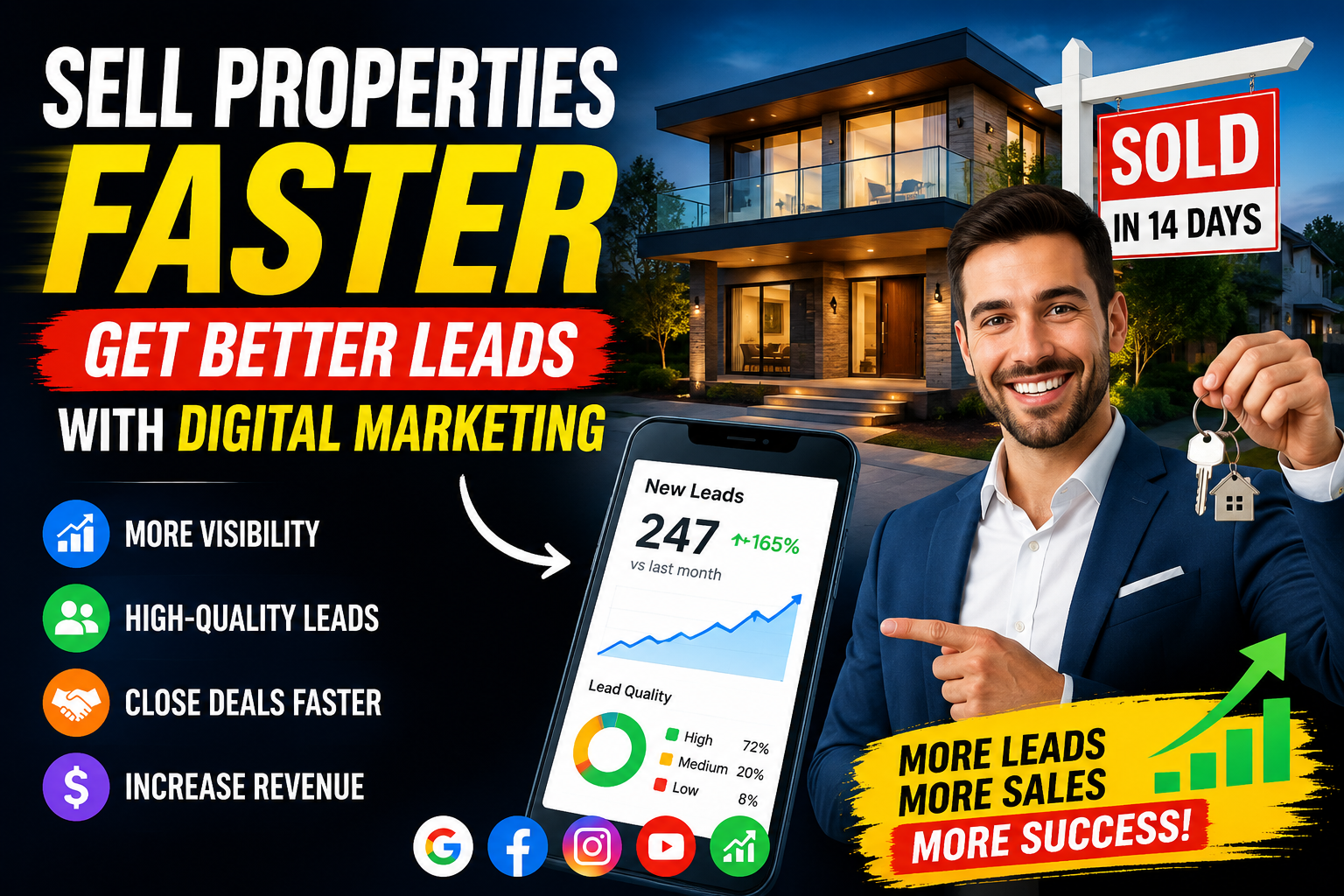
Digital marketing helps realtors sell properties faster by putting listings in front of buyers at the exact moment they’re searching, through SEO, Google Business Profile, PPC, and social media, while high-quality visuals and video cut days on market. It improves lead quality by using intent-based targeting, landing pages, and CRM nurture sequences that filter serious buyers from casual browsers, so agents spend time on prospects who are ready to transact.
Key Takeaways
- Nearly all home buyers search online before contacting an agent, and most still choose to work with one — digital marketing is what gets an agent found first.
- Listings with professional photography sell roughly 32% faster and get far more views than listings with amateur photos; adding video and drone imagery compounds the effect.
- Speed matters more than volume: agents who respond to a new lead within five minutes are dramatically more likely to convert it than those who wait even 30 minutes.
- Organic search (SEO) and referral-driven channels convert at a meaningfully higher rate than most paid channels, but paid search still wins on active buyer intent.
- Lead quality — not just lead count — is the real driver of closed deals; a smaller number of well-nurtured leads consistently outperforms a large pile of unqualified ones.
- The realtors who win in 2026 treat digital marketing as a system: visibility, capture, nurture, and follow-up working together, not isolated tactics.
Why Digital Marketing Now Decides Who Sells Faster
Home buying still runs through real estate agents. In the most recent National Association of Realtors survey of buyers and sellers, 88% of buyers purchased their home through an agent or broker, making agents the most trusted and frequently used information source, and 91% of sellers used an agent as well, with for-sale-by-owner transactions falling to a historic low of just 5%.
That doesn’t mean the internet is optional — it means the internet is where the relationship with an agent starts. Buyers overwhelmingly begin their search online before ever picking up the phone, and mobile devices dominate that search behavior according to NAR’s own consumer data. The realtor who shows up first, with the most credible and helpful digital presence, gets the first conversation. The one who doesn’t show up simply isn’t in the running — no matter how good their in-person service is.
This is the real mechanism behind “selling faster with better lead quality.” Digital marketing doesn’t replace an agent’s relationship-building skill. It determines which agent gets the chance to use that skill, on which buyers, and how quickly.
How Buyer Behavior Has Changed
Three shifts explain why digital marketing has become non-negotiable for realtors rather than a nice-to-have add-on.
1. The search window has stretched, and it starts online. Recent tracking of the NAR Profile of Home Buyers and Sellers shows online search has consistently been the most common first step buyers take, and the typical home search now runs about ten weeks rather than eight, giving agents a longer runway to reach a buyer — but also more competing content to beat.
2. Visual quality is now a filter, not a bonus. Buyers scroll through dozens of listings before ever requesting a showing. A large majority say listing photos are “very important” in deciding which homes to visit in person, and video and drone content are becoming standard rather than premium add-ons.
3. Speed of response has become a competitive advantage in itself. Because buyers frequently contact several agents or inquire on several listings at once, the agent who replies first — not necessarily the one with the best pitch — usually wins the conversation. Response-time data across the industry shows conversion odds drop sharply for every extra minute a lead waits for a reply.
Put together, these shifts mean a realtor’s website, listing photos, ads, and follow-up process are no longer separate from “the sale.” They are the first part of the sale.
The Core Digital Marketing Channels for Realtors
No single channel does everything. A realistic strategy layers a handful of channels, each doing a specific job.
Search Engine Optimization (SEO) and Google Business Profile
SEO is how a realtor gets found by people actively researching a neighborhood, school district, or “homes for sale in [city]” without paying per click. It compounds over time and, once ranking, keeps producing inquiries at close to zero marginal cost. A complete Google Business Profile — reviews, service area, photos, posts — is the local-search equivalent of a storefront sign and is often the first thing a prospective seller sees when they search an agent’s name.
Direct answer: SEO wins long-term, low-cost, high-trust traffic; Google Business Profile wins the “near me” and name-search moments. Why it matters: Organic search consistently shows one of the strongest conversion rates of any digital channel in real estate benchmarking, because the buyer arrived with intent rather than being interrupted by an ad.
Pay-Per-Click and Paid Social Advertising
Google Search ads and Facebook/Instagram ads buy immediate visibility while SEO is still building. Google Ads tend to capture buyers who are actively searching with clear intent, while Facebook and Instagram ads are better for building broad awareness and retargeting people who’ve already visited a listing page. Recent industry benchmarking puts Google Search lead costs in the $50–$70 range per lead nationally and Facebook lead costs somewhat lower but with softer intent, which is why the two are usually paired rather than used alone.
Listing Syndication and IDX Websites
An agent’s own website, connected to an IDX (Internet Data Exchange) feed, is the one digital asset a realtor fully controls — unlike a portal profile on Zillow or Realtor.com, which can disappear if the subscription lapses. A well-built IDX site turns anonymous browsers into named leads by requiring a quick sign-up to save searches or unlock full listing details.
Email and SMS Nurture Campaigns
Most buyers do not convert on the first contact. Email remains one of the highest-return channels in the entire marketing industry when it’s used for structured nurture sequences rather than one-off blasts, because it lets an agent stay useful and visible over the buyer’s multi-week or multi-month search window without being intrusive.
Social Media and Video Content
Instagram, TikTok, YouTube Shorts, and Facebook aren’t just for listing tours — they’re where realtors build the personal trust and local authority that eventually convert into referrals and repeat business. Video-driven listings generate dramatically more inquiries than photo-only listings, and short-form “day in the life of an agent” or neighborhood-guide content builds the kind of familiarity that shortens the sales cycle for future transactions.
Retargeting Ads
Most website visitors leave without submitting a form. Retargeting ads — showing a specific listing or agent’s brand to people who already visited the site — keep a property top of mind and recapture buyers who were interested but not yet ready to act, without spending fresh budget on cold traffic.
Visual Marketing: The Single Biggest Lever on Days-on-Market
If a realtor can only invest in one thing this quarter, the data points squarely at visual media. Multiple independent studies converge on the same conclusion: photo and video quality changes how fast a home sells, not just how many people click.
- Professional photography: Homes marketed with professional photos sell noticeably faster than those photographed on a smartphone, and they typically attract a large jump in online views compared with amateur images.
- Aerial and drone photography: Listings with aerial imagery tend to sell substantially faster than listings without it, and buyers increasingly expect a wide-angle view of the property and surrounding area before they’ll commit to an in-person visit.
- Video tours: Listings that pair photos with a walkthrough video generate far more buyer inquiries than photo-only listings, and a majority of buyers say watching a video made them more likely to book a showing.
- Floor plans: A meaningful share of buyers will skip a listing entirely, or refuse to book a showing, if there’s no floor plan included — a small addition with an outsized effect on qualified showings.
- Virtual staging: For vacant or dated properties, virtual staging is now one of the highest-ROI visual tools available, letting buyers visualize a furnished space without the cost of physical staging.
Despite this, industry surveys of brokers still find that a large share of agents skip professional photography altogether, which means investing properly in visuals is one of the most reliable ways for an individual realtor to out-market the competition in their own market — not because it’s a secret, but because most competitors still under-invest in it.
Lead Quality vs. Lead Quantity
The phrase “more leads” is often the wrong goal. Industry benchmarking shows the average cost per real estate lead has climbed into the hundreds of dollars, and the average website-lead conversion rate across the industry sits below two percent — meaning most of the leads an agent pays for never close. Meanwhile, referral and warm leads convert at rates many multiples higher than cold web leads.
Digital marketing improves lead quality — not just lead volume — in three specific ways:
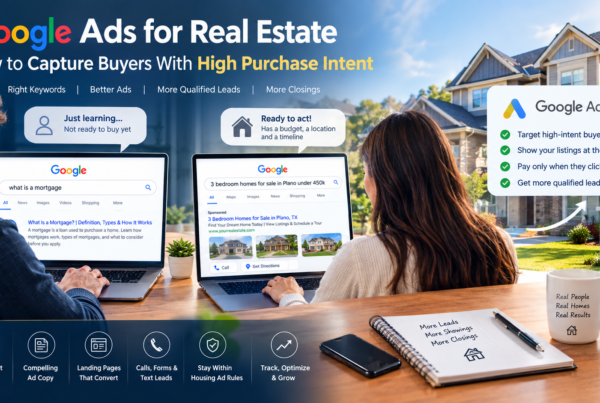
- Intent-based targeting. A Google Search ad triggered by “3 bedroom homes in [neighborhood] under $500k” reaches someone actively shopping, unlike a billboard or a cold call list. That single difference in intent is why paid search consistently outperforms broad social advertising on conversion rate.
- Qualifying content and landing pages. A home-valuation tool, mortgage calculator, or neighborhood guide gathers useful buyer/seller information (timeline, budget, motivation) before the agent ever calls, so the first conversation starts already informed instead of starting from zero.
- Behavioral nurture and lead scoring. A CRM that tracks which listings a lead viewed, how many emails they opened, and how recently they were active lets an agent prioritize the five hot leads in a list of fifty, instead of treating every name the same.
The upshot: a smaller, well-targeted, well-nurtured pipeline routinely outproduces a larger, unfiltered one — and it does so with far less wasted time.
Channel Comparison: Cost, Conversion, and Speed
| Channel | Typical Lead Intent | Relative Conversion Rate | Cost Profile | Best Use |
| Organic SEO | High (active searcher) | Strong — often the highest of any channel | Low ongoing cost, high upfront time investment | Long-term visibility, neighborhood/city pages |
| Google Business Profile | High (local searcher) | Strong for name/near-me searches | Free | Local trust, reviews, direct calls |
| Google Search Ads (PPC) | High | Solid, faster than SEO to activate | Moderate–high per lead | Immediate visibility while SEO builds |
| Facebook/Instagram Ads | Low–medium (interrupt-based) | Lower per click, high volume | Lower cost per lead, more nurture needed | Awareness, retargeting, video reach |
| Email/SMS Nurture | Medium–high (existing contact) | High relative to cost | Very low cost, requires a list | Staying visible over a long search window |
| Referrals / Past Clients | Very high | Highest of any source | Effectively free | Repeat and referral business |
| Retargeting Ads | Medium (warm, prior visitor) | Higher than cold ads | Low–moderate | Recapturing site visitors who didn’t convert |
Figures are directional industry benchmarks that vary by market, price point, and season — use them to guide budget allocation, not as guarantees.
Building a Lead Nurture and Follow-Up System
Generating a lead is the easy part. Converting it is where most agents lose the deal, and the data on this is stark: research on speed-to-lead shows that responding within five minutes rather than thirty minutes can multiply the odds of qualifying a buyer many times over, yet the industry-average response time is measured in hours. Most online leads also require several follow-up touches before they convert, while the typical agent stops after one or two attempts.
A workable nurture system has four parts:
1. Instant acknowledgment. An automated text or email confirming receipt within seconds, even before a human replies, keeps the lead from moving to a competitor’s listing.
2. Fast human follow-up. A phone call or personalized text inside the first five to ten minutes for any lead that shows real intent (form fill, saved search, repeat visits).
3. Scheduled multi-touch sequences. A mix of email, text, and occasional calls spaced over weeks, since most buyers spend well beyond a single day researching before they’re ready to transact.
4. Lead scoring and CRM tracking. Tagging leads by activity level so time goes to the buyers showing real engagement, rather than treating a one-time curious click the same as a repeat visitor requesting three showings.
Step-by-Step: A 90-Day Digital Marketing Plan for a Listing
- Week 1 — Prep the asset. Book professional photography, a video walkthrough, and (for larger or higher-end homes) drone footage and a floor plan before the listing goes live.
- Week 1 — Build the landing page. Create a dedicated page for the property with the full gallery, video, neighborhood details, and a simple inquiry form — not just a syndicated MLS entry.
- Week 1–2 — Launch paid visibility. Run a Google Search campaign targeting buyers searching the neighborhood and price range, plus a Facebook/Instagram campaign using the video and photos for broader reach.
- Week 1–2 — Push organic and social. Post the listing across the agent’s Google Business Profile, Instagram, and any relevant local Facebook groups; send it to the existing email list segmented by buyer criteria.
- Week 2 onward — Retarget. Launch a retargeting campaign for anyone who visited the landing page but didn’t submit an inquiry.
- Ongoing — Nurture every inquiry. Respond within minutes, move engaged leads into a structured follow-up sequence, and track showing requests versus site visits to spot where the funnel is leaking.
- Every 2–3 weeks — Review and adjust. Compare cost per lead and cost per showing across channels; shift budget toward whichever channel is producing qualified showings, not just clicks.
Mistakes That Slow Down Sales and Waste Leads
- Using amateur or smartphone photos to save money. The upfront saving is consistently outweighed by longer days on market and lower buyer engagement.
- Treating every lead the same. A one-time curious clicker and a pre-approved buyer who’s toured three homes need very different follow-up cadences.
- Slow response times. Waiting hours to respond to a new inquiry hands the lead to a faster-moving competitor.
- No dedicated landing page. Sending paid traffic straight to a generic MLS listing or portal page wastes ad spend that could have captured contact information.
- Giving up after one or two follow-up attempts. Most online leads take several touches to convert; stopping early looks like a lost lead but is often just premature follow-up.
- Ignoring Google Business Profile. A thin or unclaimed profile hands local, high-intent “near me” searches straight to competitors.
- Chasing volume over quality. Buying large batches of cold leads without a nurture system in place produces a low-single-digit conversion rate and burns agent time.
Case Scenarios
Scenario 1 — A stalling listing. A mid-range single-family home sits for three weeks with minimal showings and only smartphone photos. After swapping in professional photography, adding a short video walkthrough, and running a one-week local Google and Instagram ad campaign with a dedicated landing page, the agent sees a sharp jump in inquiries and books multiple showings within days — consistent with the broad industry pattern that visual quality and targeted visibility, not price alone, are often what’s holding a listing back.
Scenario 2 — A buyer’s agent drowning in unqualified leads. An agent buying a large batch of cold portal leads each month converts under 1%, matching national averages for unfiltered web leads. Shifting a portion of that budget into SEO-driven content (neighborhood guides, school-district pages) and a structured email nurture sequence produces fewer total leads but a noticeably higher share of serious, pre-informed buyers — reflecting the industry-wide pattern that organic and nurtured leads convert at multiples of cold paid leads.
Scenario 3 — A new agent building local authority. A newly licensed agent with no referral base focuses first on a complete Google Business Profile, consistent local content, and short-form video tours. Within a few months, local search visibility and social engagement begin generating direct inquiries — illustrating how digital-first agents without an existing sphere of influence can still build a lead pipeline from scratch.
These scenarios are illustrative composites based on well-documented industry patterns, not claims about a specific transaction.
Expert Tips
Tip: Treat your Google Business Profile like a second website. Respond to every review, post updates weekly, and keep photos current — it’s free, and it’s often the first thing a prospective seller checks.
Tip: Pair every paid ad with a dedicated landing page, never a generic listing link. A form on a focused page consistently captures more contact information than sending traffic to a crowded portal listing.
Tip: Set a five-minute response standard for new leads and automate the first touch. The data on speed-to-lead is one of the most consistent findings in real estate marketing.
Tip: Budget for video and drone content on every listing over the local median price point — buyer expectations for visual media have moved well past static photos alone.
Tip: Track cost per showing, not just cost per lead. A channel that produces cheap leads but few showings is often more expensive than it looks.
Frequently Asked Questions
1. Does digital marketing actually shorten days on market? Yes, primarily through visual quality and visibility. Listings with professional photography and video consistently show faster sale times and higher inquiry volume than comparable listings marketed with amateur media.
2. What’s the single highest-ROI digital marketing channel for realtors? There isn’t one universal answer, but organic search, email nurture, and referral-driven marketing consistently show the strongest return relative to cost, because they reach people who already have intent or trust in the agent.
3. How much should a realtor budget for digital marketing? Most individual agents spend under $1,000 a month, while top producers often allocate a meaningfully larger share of gross commission income to marketing. Budget should scale with transaction volume and average price point, not be fixed.
4. Is Google Ads or Facebook Ads better for real estate leads? Google Ads generally captures higher-intent, actively searching buyers and converts better per click. Facebook and Instagram ads reach a broader audience earlier in their search and are better suited to brand-building, video reach, and retargeting.
5. How important are professional photos, really? Very. The majority of buyers rate listing photos as a major factor in deciding which homes to visit, and professional photography is associated with materially faster sales and higher view counts compared with amateur images.
6. Do I need video for every listing? It’s not mandatory for every price point, but video meaningfully increases inquiries, and buyer expectations for it are rising quickly, especially above the local median price.
7. What is a “good” lead conversion rate in real estate? Industry averages for unfiltered web leads are well under 2%, while top-performing agents with strong follow-up systems and warmer lead sources (referrals, SEO, past clients) reach conversion rates several times higher.
8. How fast should I respond to a new online lead? As close to immediately as possible. Response-time research shows the odds of qualifying a lead drop sharply for every additional minute of delay, and most leads go with whichever agent responds first.
9. Should I use a real estate CRM? Yes, if you’re running any volume of leads. A CRM lets you track engagement, automate follow-up sequences, and prioritize the leads most likely to convert instead of treating every contact identically.
10. Are Zillow and Realtor.com leads worth buying? They can work, but they’re typically colder and more expensive per closed deal than SEO, referrals, or a well-run email list. They’re best treated as one channel in a mix, not a full strategy.
11. How long does it take for SEO to produce leads for a realtor? SEO is a medium-to-long-term investment, often taking several months to build meaningful rankings for competitive local terms, which is why most agents pair it with paid ads for immediate visibility while organic traffic builds.
12. Does virtual staging actually help sell vacant homes? Yes — it’s currently one of the highest-return visual marketing tools for vacant or dated listings, helping buyers visualize furnished space without the cost of physical staging.
13. What’s the biggest digital marketing mistake new agents make? Buying large volumes of cold leads without a follow-up system in place. Without fast response and structured nurture, even good leads convert at a very low rate.
14. Should social media focus on listings or personal branding? Both, but personal branding — neighborhood expertise, market updates, day-in-the-life content — tends to build the longer-term trust that drives referrals, while listing content drives immediate inquiries.
15. How do I measure whether my digital marketing is working? Track cost per lead, cost per showing, and cost per closed transaction by channel — not just total lead count. The channel producing the most leads isn’t always the one producing the most closings.
Actionable Checklist
- [ ] Claim and fully complete your Google Business Profile
- [ ] Book professional photography for every listing
- [ ] Add video walkthroughs for listings above the local median price
- [ ] Include a floor plan on every listing where possible
- [ ] Build a dedicated landing page for active listings
- [ ] Set up automated instant-response for new leads
- [ ] Create a five-minute response standard for hot inquiries
- [ ] Launch a Google Search ad campaign targeting your service area
- [ ] Set up retargeting ads for landing page visitors
- [ ] Build a segmented email nurture sequence for buyers and sellers
- [ ] Track cost per lead, cost per showing, and cost per closing by channel
- [ ] Review and reallocate marketing budget monthly based on performance
Final Conclusion
Digital marketing doesn’t sell a home by itself — a realtor’s expertise, negotiation, and local knowledge still close the deal. What digital marketing does is control two things that determine everything downstream: how fast a listing gets in front of the right buyers, and how well an agent can tell a serious buyer from a curious click. Realtors who invest properly in visuals, show up in local search, run targeted (not scattershot) ads, and follow up fast consistently see shorter days on market and a pipeline that closes at a higher rate — not because they’re generating more leads, but because they’re generating and converting the right ones.