
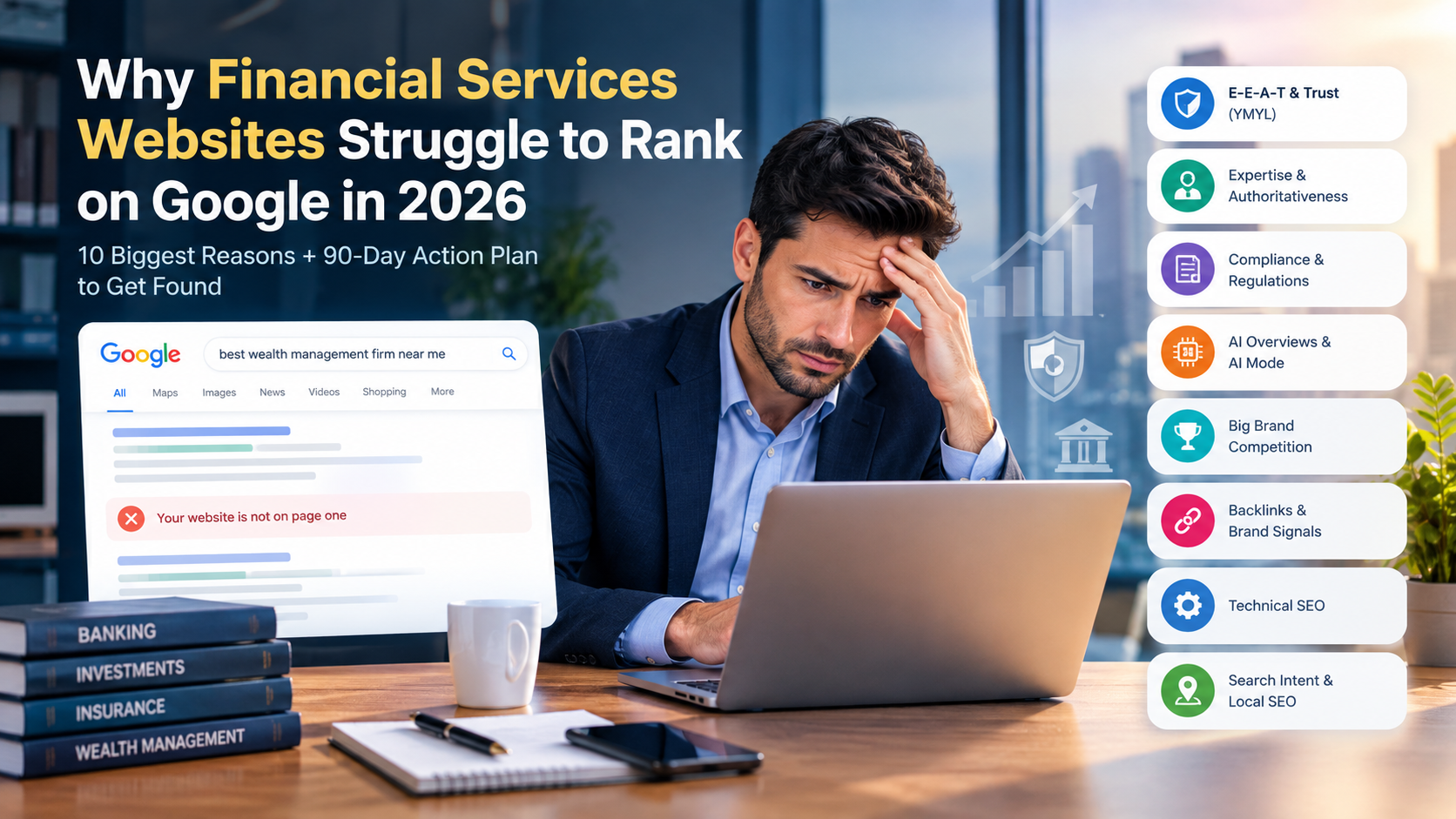
Picture this. Your firm is licensed. Your advisors have years of experience. Your website looks clean and modern. You even publish a blog post every week.
Yet when someone searches “best wealth management firm near me” or “how to choose a business loan,” your site is nowhere on page one.
Sound familiar? You are not alone. Financial services SEO is one of the hardest jobs in search today, and in 2026 it got even harder. Google rolled out major updates. AI Overviews now answer many money questions before anyone clicks a link. And strict industry rules slow down how fast you can publish.
In this guide, you will learn why financial services websites struggle to rank on Google in 2026. You will see the 10 biggest reasons in plain words. Then you will get a simple 90-day plan to fix them. This guide works for banks, lenders, insurance agencies, fintech apps, accounting firms, and wealth management practices.
Let’s start with the short answer.
Why Do Financial Services Websites Struggle to Rank on Google?
Financial services websites struggle to rank on Google in 2026 because Google treats money topics as YMYL (“Your Money or Your Life”) content and holds them to its highest quality standard. To rank, a finance site needs real experts, strong trust signals, accurate and original content, clean technical health, and quality backlinks. Most sites miss several of these. AI Overviews, big-brand competition, and slow compliance reviews make the fight even harder.
Here are the 10 reasons at a glance:
- Google demands a very high level of trust.
- Your content has no real expert behind it.
- Your content is generic and thin.
- Compliance rules slow your content down.
- Google core updates hit YMYL sites hard.
- AI Overviews and AI Mode change how people click.
- Big brands and comparison sites dominate.
- Your backlinks and brand signals are weak.
- Technical problems hold your pages back.
- Your pages do not match search intent, and local SEO is ignored.
Now let’s go through each one.
What Is YMYL and Why Does It Matter for Financial Websites?
YMYL stands for “Your Money or Your Life.” It is the label Google uses for topics that can affect a person’s money, health, safety, or well-being. Banking, loans, credit, investing, insurance, taxes, and retirement planning all fall into this group.
Google’s Search Quality Rater Guidelines explain that pages on these topics need the highest level of care. The logic is simple. If a recipe blog makes a small mistake, dinner tastes a little off. If a finance page makes a small mistake, someone could lose their savings or take a bad loan.
Because the risk is bigger, the bar is higher. That is the root of almost every problem in this article.
This is also why financial sites feel more pain during algorithm changes. According to Scorpion’s analysis of the March 2026 core update, the update hit hardest in YMYL categories. Search expert Glenn Gabe also noted that YMYL topics often see large swings during broad core updates.
In short, if you sell financial products or advice, you play on a tougher field. Let’s see why.
1. Google Demands a Very High Level of Trust
The first reason is the most important one. Google needs to trust your website before it shows it to people who are about to make money decisions.
Google talks about quality using four ideas: Experience, Expertise, Authoritativeness, and Trustworthiness. Together they are called E-E-A-T. Google’s rater guidelines say trust is the most important part of the four.
E-E-A-T is not one score you can check in a tool. It is a way to think about quality. Google’s systems look for signals that match it. For a financial website, those signals include:
- Who owns the business, and is that clear on the site?
- Are licenses and registrations easy to find?
- Is there a real address, phone number, and contact page?
- Is the site secure with HTTPS?
- Do independent websites mention or link to your brand?
- Are there real reviews from real customers?
- Is the advice accurate and up to date?
Here is where many financial websites fail. They hide the “About” page. They list no team members. They bury their license numbers in a tiny footer or leave them out. They have no clear editorial or review policy.
A visitor may never notice these gaps. Google does.
Quick fix: Build a strong “About” page with your story, your leadership team, and your credentials. Show your regulator registrations, such as your SEC or FINRA details in the U.S. or your FCA number in the UK. Add a clear contact page. Add a simple “How we create and review our content” page. These small pages send big trust signals.
2. Your Content Has No Real Expert Behind It
Open ten financial blogs and look at the author line. How many say “Admin,” “Team,” or nothing at all?
That is a big problem in 2026. When a page gives money advice, Google wants to know a real person with real skills stands behind it. Anonymous content is a weak signal in a category where trust matters most.
Google’s own guidance on helpful content asks site owners to think about “Who, How, and Why.” Who created the content? How was it made? Why was it made? Financial sites that cannot answer these questions clearly are at a disadvantage.
Industry writers covering the March 2026 update reported the same pattern. Top-ranking pages in competitive money topics tend to show clear author credentials. Treat that number as an industry observation and not as a Google statement. Still, the direction is clear.
What to do:
- Put a real name on every article.
- Add a short bio with credentials, such as CFP, CPA, CFA, licensed loan officer, or years in the field.
- Link each author name to a full bio page with photo, experience, and social profiles.
- Add a “Reviewed by” line when a licensed expert checks the article.
- Show “Published” and “Last reviewed” dates.
- Use Person and Organization schema so Google can connect the dots.
If your writers are not licensed, that is fine. Have them write the draft, then let a qualified expert review and sign it. Readers and Google will see the difference.
3. Your Content Is Generic and Thin
Ask yourself an honest question. If your competitor’s blog vanished tomorrow, would readers miss anything that only you provide?
Many finance blogs are copies of each other. “What is a mutual fund?” “How does compound interest work?” “5 tips to improve your credit score.” The same points, the same order, the same lines. Google calls this kind of page commodity content, and it is a weak position to be in.
Glenn Gabe reported that a large unconfirmed update in January 2026 heavily hit sites with commodity content, including many that relied on self-serving listicles. Google’s systems are getting better at spotting pages that only rephrase what already ranks.
There is also a spam risk. Google’s spam policies warn against scaled content abuse, which means mass-producing pages mainly to rank, no matter how the pages are made. Publishing hundreds of thin AI-written finance articles is one of the fastest ways to lose trust.
How to stand out:
- Share original data, such as survey results, rate trends, or client questions you hear each week.
- Add real examples with numbers, using compliant, anonymous case studies.
- Build free tools like loan calculators, retirement estimators, or comparison sheets.
- Quote licensed experts by name.
- Answer the follow-up questions that other pages skip.
- Merge weak, overlapping articles into one strong guide.
One deep, useful page beats ten shallow ones. This is the heart of good financial services SEO.
4. Compliance Rules Slow Your Content Down
Here is a problem that outside SEO advice often ignores. Financial marketing is regulated, and rules change how fast you can publish.
In the U.S., broker-dealers follow FINRA rules on public communications. These rules say content must be fair and balanced and must not be misleading, as described in FINRA’s guidance on communications with the public. Investment advisers must think about the SEC’s Marketing Rule, and the SEC keeps a page of Marketing Rule FAQs. In the UK, firms must follow the FCA’s financial promotions rules.
These rules exist to protect people, and they are good. But they create real SEO side effects:
- Every page goes through a long legal review, so you publish only a few articles a year.
- Copy becomes vague and cautious, so it stops answering real questions.
- Disclaimers crowd the page and bury the useful parts.
- Teams publish PDFs instead of web pages, and PDFs are harder to rank and improve.
- Old pages stay live because nobody wants to touch them again.
Meanwhile, faster competitors keep publishing.
A better way: Build compliance into your content workflow instead of adding it at the end.
- Create a library of pre-approved phrases, disclaimers, and claims.
- Split content into two lanes. Educational content (how things work, definitions, guides) can move faster. Promotional content (returns, performance, offers) gets the full review.
- Use standard templates so reviewers see familiar layouts.
- Set a review timeline, such as five business days.
- Keep a change log for every page.
This article is for education only and is not legal advice. Always check your marketing with your compliance team.
5. Google Core Updates Hit YMYL Sites Hard
A core update is a broad change to Google’s ranking systems. Google says these updates are not aimed at any one site. They change how Google judges quality across the web. You can read Google’s own explanation on its core updates page.
In 2026, financial sites felt every wave:
- January 2026: An unconfirmed update reportedly hit commodity content hard.
- March 2026: A core update landed in late March, right after a spam update, and hit YMYL categories especially hard.
- May 2026: Another broad core update rolled out. Google marked it complete on June 2, 2026, according to this recovery playbook, which also says finance is among the most exposed types of sites. Those are practitioner observations, not Google statements.
There is a hard truth here. Many financial sites ranked for years because of old links and old content. New updates now weigh trust, real expertise, and page-level usefulness more heavily. Sites that coasted on past strength can drop quickly.
What to do when traffic drops:
- Check the Google Search Status Dashboard to see whether an update was rolling out.
- Wait until the rollout finishes before you change anything.
- Compare your traffic before and after in Google Search Console.
- Find the pages that lost the most.
- Compare them with the pages that now rank above you. Ask, “Does that page answer the question better?”
- Improve in order of impact. Do not delete content in a panic.
A drop is not always a penalty. Often a competitor simply did a better job.
6. AI Overviews and AI Mode Change How People Click
This is the biggest shift in search behavior. Google now shows AI-written summaries at the top of many results, called AI Overviews. It also offers AI Mode for deeper questions.
Google explains how these work in its guide on AI features and your website. Both may use a “query fan-out” method, which means Google runs many related searches behind the scenes to build one answer. Google also says AI Overviews appear when its systems decide they add value beyond regular search results.
What does this mean for a financial website?
The bad news: Simple, definition-style questions such as “what is APR” or “what is a Roth IRA” often get answered right on the results page. Fewer people click through. If your blog strategy is built only on these easy questions, your traffic will likely shrink.
The good news: Complex questions send people to more sites. And being cited inside an AI answer builds brand trust. People who see your name in an answer may search for you later.
How to become a source AI features pick:
- Put a clear, direct answer of 40 to 60 words right under each question heading.
- Use short paragraphs, lists, and simple tables.
- Support facts with links to strong sources, such as regulators and official data.
- Show author names, credentials, and last-updated dates.
- Cover the follow-up questions in the same article.
- Keep your brand name, address, and details the same everywhere online.
Google says you do not need special markup or a secret trick to appear in these features. The same good SEO basics apply. Be crawlable, be helpful, and be trusted.
A warning: some people try to trick AI search with tricks and tactics. Analysts expect Google to act against sites that try to game AI search. Play the long game.
7. Big Brands and Comparison Sites Dominate the Results
Now look at who you compete against. For most money keywords, page one includes:
- Large banks and insurers
- Government sites, such as tax agencies and consumer finance regulators
- Well-known finance publishers
- Comparison and review sites with huge link profiles
You cannot beat all of them at their own game. And in 2026, Google may prefer different types of sources for different kinds of searches. One analysis of the May 2026 update argues that visibility in YMYL topics depends on source confidence and how well a site fits the query, not on broad authority alone.
This is actually helpful for smaller firms. It means you can win when your page is the best fit for a very specific need.
How to compete:
- Skip the giant head terms such as “personal loan” or “life insurance.”
- Go narrow and specific, such as “business line of credit for restaurants” or “retirement planning for dentists.”
- Add a location where it makes sense, such as “tax planning for small business owners in Austin.”
- Own a niche. Be the go-to source for one audience, one product, or one region.
- Build topic clusters. Write one main guide and 8 to 12 supporting articles that link to each other.
This is called topical authority. When Google sees that you cover a subject deeply, it trusts you more on that subject.
8. Your Backlinks and Brand Signals Are Weak
Links are still one of the strongest ways the web says, “This site is worth trusting.” Financial sites often struggle here for three reasons.
First, promotional content rarely earns links. Nobody links to a page that only says “we are the best lender.”
Second, compliance limits bold claims and creative campaigns.
Third, some firms turn to shortcuts, like buying links or joining link schemes. This is risky. Google’s spam policies list link spam as a violation, and a bad link profile can hurt a YMYL site badly.
How to earn strong links the safe way:
- Original research. Publish a small annual study, such as how small businesses in your state use credit.
- Expert commentary. Offer quotes to journalists and industry blogs.
- Local partnerships. Get listed by chambers of commerce, business groups, and local sponsors.
- Associations. Join trade groups that link to member firms.
- Free tools. A great calculator can earn links for years.
- Podcasts and events. Speak, then ask the host to link to your bio page.
Also build brand demand. When more people search your firm’s name directly, it shows Google that real people know and want your brand. Reviews on trusted platforms, media mentions, and active professional profiles all help.
9. Technical Problems Hold Your Pages Back
Finance websites often run on heavy, complex platforms. They have login portals, rate tables, calculators, chat widgets, cookie banners, tracking tools, and compliance pop-ups. All of these can hurt SEO if built poorly.
Here are the technical issues we see most often:
- Slow pages. Google measures real user experience with Core Web Vitals. According to Google’s Core Web Vitals guide, a good score means the main content loads in 2.5 seconds or less, page responses are under 200 milliseconds, and layout shift stays at or below 0.1. Third-party scripts like chat tools and ad tags are common causes of misses.
- Content Google cannot read. Rates and fees placed inside images, iframes, or heavy JavaScript may never be seen.
- Gated content. Important guides hidden behind forms or logins cannot rank.
- Duplicate pages. Product pages with small changes and many URL versions confuse Google.
- Thin location pages. Fifty city pages with the same text and only the city name changed are a red flag.
- Wrong noindex tags. Staging settings sometimes go live by mistake.
- Weak mobile design. Most people search money questions on their phones.
- Missing structured data. Google’s structured data guide explains how markup helps Google understand your pages. Useful types include Organization, Person, and FinancialProduct.
A note about FAQ schema: Google now limits FAQ rich results to well-known government and health sites. So most finance sites should not expect FAQ dropdowns in search. Q&A formatting still helps readers and AI systems, so keep it, but do not build your plan around rich results.
How to check your site: Run your key pages through PageSpeed Insights and review your reports in Google Search Console. Fix issues at the template level first, because one template fix helps hundreds of pages at once.
10. Your Pages Do Not Match Search Intent, and Local SEO Is Ignored
Search intent means the reason behind a search. People searching money topics usually have one of four goals:
- Learn: “how does a HELOC work”
- Compare: “HELOC vs home equity loan”
- Buy or apply: “HELOC lender near me”
- Find a local pro: “financial advisor in Denver”
Many financial websites only build for one or two of these. Some have beautiful product pages but no helpful guides. Others have a big blog but no clear path to a service page. Both leave money on the table.
Match each page to one main intent. Then connect the journey. A learning article should lead to a comparison page, and the comparison page should lead to a service page with a clear next step.
Local SEO is a big miss. Many people search for a nearby advisor, tax preparer, mortgage broker, or insurance agent. To rank in those local results:
- Claim and complete your Google Business Profile.
- Keep your name, address, and phone number identical across the web.
- Build unique pages for each real office, with staff photos, local details, and local content.
- Earn honest reviews. Be careful here, because client testimonials can fall under industry advertising rules, so check with your compliance team first.
- Get listed in local directories and business groups.
Local signals also tend to be steadier during big core updates, which makes them a safer foundation.
A 90-Day Plan to Fix Your Financial Services SEO
Reading about problems is easy. Fixing them takes a plan. Here is a simple 90-day roadmap.
Days 1 to 14: Audit
- Review Google Search Console for drops, errors, and top pages.
- Crawl your site to find technical issues.
- List every page and label it: keep, improve, merge, or remove.
- Check your trust pages: About, Contact, Team, Licenses, Privacy, Editorial Policy.
- List your top 10 competitors for your main keywords.
Days 15 to 30: Build the Trust Foundation
- Rewrite the About page with real people and credentials.
- Add license and registration details clearly.
- Create author pages and add bylines to all articles.
- Add “Reviewed by” and “Last updated” labels.
- Add Organization and Person schema.
- Fix the major speed and mobile issues.
Days 31 to 60: Improve Your Best Content
- Pick your top 20 pages by traffic or business value.
- Rewrite them with original insight, examples, and expert quotes.
- Add a direct answer of 40 to 60 words under every question heading.
- Add tables, checklists, and simple visuals.
- Link to official sources, such as regulators and government data.
- Merge overlapping articles into stronger guides.
- Set up your compliance fast lane for educational content.
Days 61 to 90: Grow Authority
- Launch one topic cluster around your most valuable service.
- Publish one original study or free tool.
- Start a simple outreach routine: two expert quotes or partner pitches each week.
- Optimize your Google Business Profile and local pages.
- Build a review process that fits your compliance rules.
After Day 90: Measure What Matters
Do not judge success by clicks alone. In the AI era, also track:
- Impressions and average position for target topics
- Branded search growth
- Leads and calls from organic search
- Mentions and citations in AI answers
- Number and quality of new backlinks
SEO for financial services is a slow, steady climb. Expect real movement in six to twelve months for competitive topics. Anyone who promises page one in 30 days is not being honest.
Quick Checklist: What a Strong Financial Website Looks Like in 2026
| Area | What good looks like |
| Trust | Clear About page, licenses, contact details, HTTPS, editorial policy |
| Authors | Named experts with bios, credentials, and reviewer lines |
| Content | Original, accurate, updated, and better than what already ranks |
| Compliance | Pre-approved language and a fast review process |
| AI readiness | Direct answers, clean headings, lists, sources, entity clarity |
| Authority | Earned links, mentions, reviews, and growing branded search |
| Technical | Fast, mobile-friendly, crawlable, clean structured data |
| Local | Complete Google Business Profile and unique location pages |
| Intent | Learn, compare, apply, and local pages linked together |
Common Mistakes to Avoid
Before we wrap up, here are the traps we see most often:
- Publishing lots of AI-written articles without expert review
- Hiding the people behind the business
- Using fake or stuffed reviews
- Buying backlinks
- Chasing only high-volume head terms
- Deleting content in panic after an update
- Treating compliance and SEO as enemies instead of partners
- Measuring only clicks and ignoring leads and brand growth
Frequently Asked Questions
How long does it take for a financial website to rank on Google?
For competitive money topics, most sites need six to twelve months of steady work to see strong gains. Newer sites with few links may need longer. Small wins, like better rankings for long-tail and local searches, often show up sooner. No one can honestly guarantee a specific ranking or date.
Is E-E-A-T a direct ranking factor?
Not exactly. E-E-A-T is a framework Google uses to describe quality, and it is not a single score. Google’s systems look for signals that match it, such as clear authorship, accurate content, and trusted mentions. For financial websites, building these signals is one of the best investments you can make.
Do AI Overviews kill traffic for financial websites?
They can reduce clicks on simple, definition-style questions. But they also give brands a chance to be cited and remembered. The best response is to create deeper, more useful content, answer complex questions well, and track brand visibility along with clicks.
Can I use AI to write financial content?
You can use AI to help with research, outlines, and first drafts. But money content needs human expertise, fact-checking, and compliance review before it goes live. Mass-publishing raw AI content can trigger Google’s spam systems and damage trust.
Should I add FAQ schema to my finance pages?
You can, but do not expect rich results. Google limits FAQ rich results to well-known government and health sites. Still, a clear question-and-answer format helps readers and may help AI systems understand your page.
What is the most important fix for a financial services website?
Start with trust. Show who you are, who writes your content, and why they are qualified. Then improve your content quality and fix technical problems. Trust is the base that every other SEO effort stands on.
Final Thoughts: Win With Trust, Not Tricks
Financial services websites struggle to rank on Google in 2026 because the stakes are high and Google knows it. YMYL pages face tougher checks. Core updates keep raising the bar. AI Overviews change click habits. Compliance slows the pace. And big brands hold the top spots.
But this is not a losing game. Firms that show real expertise, publish original and helpful content, earn trusted links, fix technical gaps, and build a strong local and brand presence can still win. The rules reward the honest, careful, people-first work that good financial firms already do offline. Your website just needs to prove it.
At HT Business Group, we help financial and service brands build fast, secure, search-friendly websites and content that Google and customers can trust. If your rankings have stalled or dropped, we can audit your site, find the real causes, and build a clear plan to grow your organic traffic and leads.
Ready to fix your financial services SEO? Contact HT Business Group today and turn your website into a trusted lead engine.