Introduction: Why This Debate Matters Right Now
By 2026, artificial intelligence has stopped being an “experimental tool” for marketing teams and become core infrastructure. Nearly nine in ten organizations now report regular AI use in at least one business function, and marketers are pouring record budgets into AI-driven campaigns, content, and analytics.
But adoption isn’t the same as advantage. As AI reshapes everything from ad targeting to content creation, marketers face a genuine trade-off: faster, cheaper, more personalized campaigns on one side — and real risks around trust, bias, job displacement, and content quality on the other.
This guide breaks down the real pros and cons of AI in marketing and advertising in 2026, backed by current data, so you can make informed decisions rather than reactive ones.
Quick Answer: The Pros and Cons at a Glance
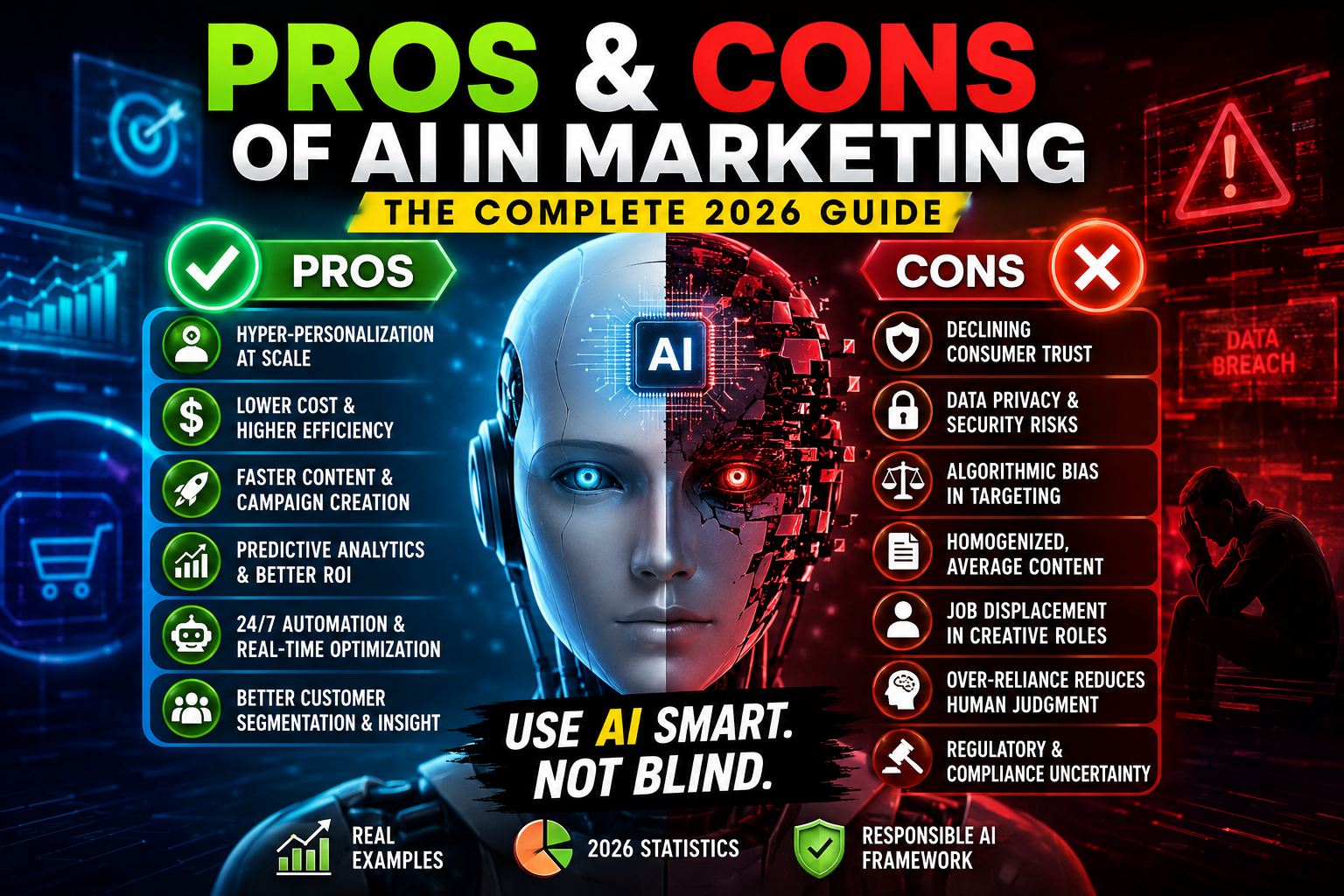
| Pros of AI in Marketing | Cons of AI in Marketing |
| Hyper-personalization at scale | Erosion of consumer trust |
| Lower cost of entry and execution | Data privacy and security risks |
| Faster campaign creation and optimization | Algorithmic bias in targeting |
| Predictive analytics and better ROI | Homogenized, “average” content |
| 24/7 automation (chatbots, ad bidding) | Job displacement in creative roles |
| Real-time performance insights | Over-reliance reduces human judgment |
| Improved customer segmentation | Regulatory and compliance uncertainty |
The Pros of AI in Marketing and Advertising
1. Hyper-Personalization at Scale
AI allows brands to tailor messaging, offers, and product recommendations to individual users rather than broad segments. Machine learning models analyze browsing behavior, purchase history, and engagement patterns in real time, enabling one-to-one personalization that would be impossible manually. A large share of marketers expect AI to keep enabling more personalized experiences, such as curated retail recommendations.
Real-world impact: Recommendation engines (used by retailers, streaming platforms, and e-commerce brands) now drive a meaningful share of total revenue by surfacing the right product to the right shopper at the right moment.
2. Lower Cost of Entry and Higher Efficiency
AI is reducing the cost of running marketing and ad campaigns, making sophisticated tactics accessible to small businesses that previously couldn’t compete with enterprise budgets. Tools that once required dedicated data science teams — audience segmentation, A/B testing, ad copy generation — are now available through affordable, self-serve platforms.
3. Faster Content and Campaign Creation
Generative AI tools compress timelines for research, content production, and optimization. The majority of PPC professionals now use generative AI at least occasionally for writing ad copy, and marketing teams report significantly faster campaign execution when AI handles first drafts, variations, and testing.
4. Predictive Analytics and Smarter Budget Allocation
AI models can forecast customer lifetime value, churn risk, and campaign performance before a dollar is spent. This lets marketing teams shift budgets toward what’s actually working instead of relying on quarterly guesswork — a critical advantage as many CMOs report tighter budgets and turn to AI specifically to close that productivity gap.
5. 24/7 Automation and Real-Time Optimization
AI-powered chatbots, programmatic ad bidding, and email automation operate around the clock, adjusting bids, send times, and creative in real time based on live performance data — something no human team can match at scale.
6. Better Customer Segmentation and Insight
AI can identify patterns in customer data that humans would miss — micro-segments based on behavior rather than just demographics — leading to more relevant campaigns and improved conversion rates across channels.
The Cons of AI in Marketing and Advertising
1. Declining Consumer Trust
This is the most significant headwind. Trust in businesses using AI ethically has fallen sharply — from 58% in 2023 to around 42% today — and a majority of customers say they’re concerned that companies are careless with their data. Overusing AI without transparency can actively damage brand equity rather than build it.
2. Data Privacy and Security Risks
AI marketing runs on data — often large volumes of personal and behavioral data. This raises real concerns around consent, storage, and misuse, especially as regulations (like GDPR and various U.S. state privacy laws) tighten and consumers grow more privacy-conscious.
3. Algorithmic Bias in Targeting and Personalization
AI models learn from historical data, which can embed existing biases into targeting decisions — showing certain job or housing ads disproportionately to specific demographics, for example. Without careful auditing, this creates both ethical problems and legal exposure.
4. Homogenized, “Average” Content
As more brands lean on the same generative AI tools, content across the web is starting to look and sound the same. Industry research now shows that while AI produces more content than ever, much of it is average at best — and audiences are increasingly tuning out generic AI-generated material in favor of authentic, human-created content in spaces like newsletters, podcasts, and video.
5. Job Displacement in Creative and Support Roles
Generative AI is projected to displace a significant number of frontline and support roles at major outsourcing firms in the coming years. Copywriters, junior designers, and customer service reps are among the roles most exposed to automation, raising legitimate workforce and reskilling concerns for marketing organizations.
6. Over-Reliance Reduces Human Judgment
AI is excellent at optimization but poor at strategy, brand voice, and cultural nuance. Teams that hand over too much creative and strategic control risk losing the human insight and distinctiveness that actually builds long-term brand trust and loyalty.
7. SEO and Visibility Disruption
Google’s AI Overviews are now answering many informational queries directly, reducing organic click-through traffic by an estimated 18–47% for affected queries. This is forcing marketers to rethink content strategy entirely — shifting toward Answer Engine Optimization (AEO) and away from traditional keyword-only SEO.
8. Regulatory and Compliance Uncertainty
AI marketing regulation is evolving quickly and unevenly across regions. Brands using AI for ad targeting, dynamic pricing, or automated decision-making face growing compliance risk as new rules around AI transparency and consumer protection continue to emerge.
How to Use AI in Marketing Responsibly: A Balanced Framework
- Keep humans in the loop for brand voice, strategy, and final creative approval — use AI for drafts and speed, not final judgment.
- Be transparent about AI use where it affects the customer (chatbots, personalized offers, AI-generated content).
- Audit AI models regularly for bias in targeting and segmentation.
- Invest in proprietary data and original research — it’s becoming the key differentiator as generic AI content floods the web.
- Prioritize first-party data and clear consent practices to protect trust as privacy regulation tightens.
- Reskill teams rather than simply replacing them — pairing AI efficiency with human strategic oversight consistently outperforms full automation.
Frequently Asked Questions
Is AI good or bad for marketing?
Neither, inherently. AI is a force multiplier — it amplifies whatever strategy and ethics a brand already has. Used well, it improves personalization and efficiency. Used carelessly, it damages trust and produces generic content.
What is the biggest risk of AI in advertising?
Declining consumer trust is currently the biggest measurable risk, driven by concerns about data privacy, algorithmic bias, and a lack of transparency about when and how AI is being used.
Will AI replace marketers?
AI is more likely to reshape marketing roles than eliminate them entirely — automating repetitive tasks (reporting, first-draft copy, bid optimization) while increasing demand for strategists, brand storytellers, and AI oversight specialists.
How can small businesses use AI in marketing without the downsides?
Start with transparent, low-risk use cases — content drafting, customer segmentation, and performance analytics — while keeping brand voice, ethics review, and customer-facing decisions under human control.
Conclusion
AI in marketing and advertising isn’t a binary choice between full automation and rejecting the technology outright. The brands winning in 2026 are the ones treating AI as a productivity and insight engine — not a replacement for human strategy, creativity, and trust-building. Weigh the pros (speed, personalization, cost efficiency) against the cons (trust erosion, bias, content homogenization) for your specific use case, and build in human oversight from day one.