How a Smarter Website, Automated Lead Management, and AI-Powered Communication Helped a Real Estate Business Respond Faster, Improve Lead Management, and Create More Sales Opportunities
Introduction
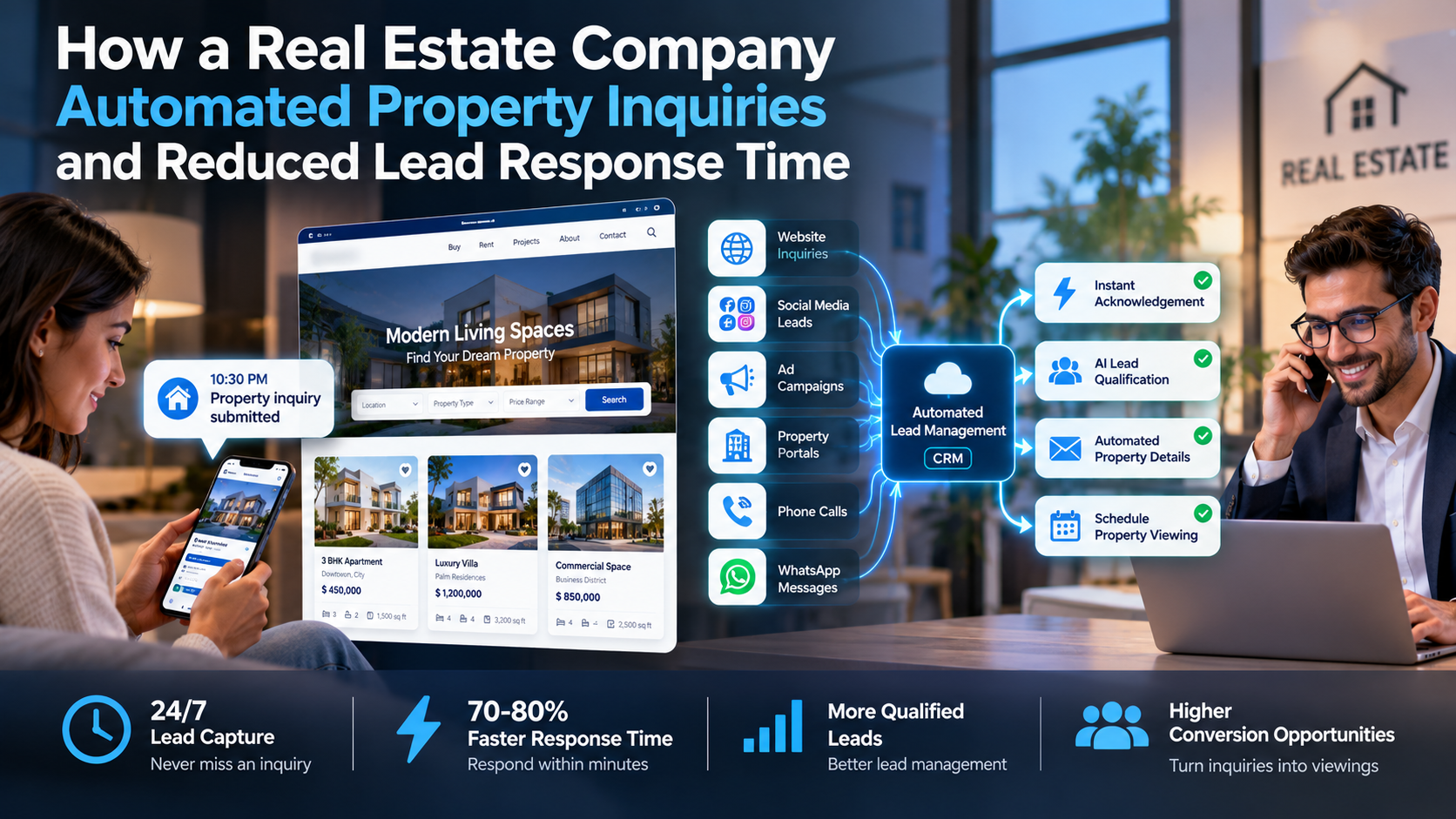
Imagine a potential buyer visits your real estate website at 10:30 PM.
They find a property they like, check its price, view the pictures, and submit an inquiry asking for more information.
They are interested and ready to speak with someone.
But nobody responds.
The next morning, your sales team finally checks the inquiry and calls the prospect. Unfortunately, the buyer has already contacted another real estate company, received property details, and scheduled a viewing.
Your business has lost a potential customer, not because your property was unsuitable, but because your team responded too late.
This is a common problem for real estate companies that receive inquiries through websites, property listing platforms, social media, online advertisements, and phone calls.
As the number of online inquiries increases, managing every potential buyer manually becomes difficult. Sales representatives cannot always monitor every communication channel, answer questions immediately, or remember to follow up with every prospect.
The result is missed opportunities, slow communication, frustrated buyers, and lost revenue.
A better approach is to automate the property inquiry management process.
With the right combination of website development, CRM integration, application development, and AI-powered automation, real estate businesses can capture inquiries, respond automatically, qualify potential buyers, and assign leads to the right sales representatives.
In this illustrative case study, we explore how a real estate company could solve its lead management problems by implementing an automated property inquiry system.
We will cover the business challenges, technology implementation, automation workflow, expected business improvements, and lessons other real estate companies can apply.
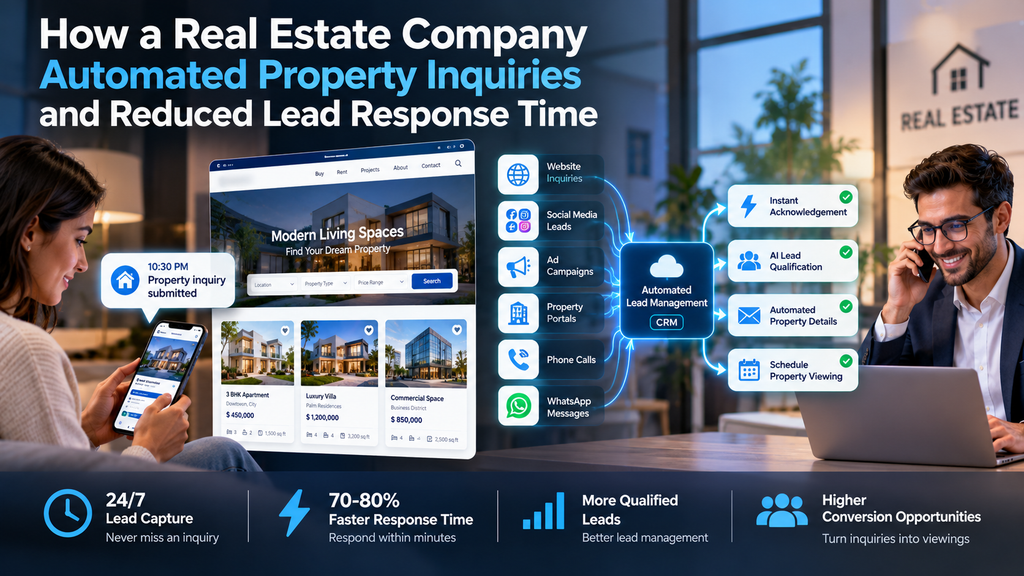
The main objective: Help real estate companies reduce manual work, respond to property inquiries faster, improve customer experience, and convert more inquiries into qualified sales opportunities.
Case study disclosure: This is an illustrative business scenario created to demonstrate a practical technology solution. It does not represent a verified HT Business Group client engagement. Performance improvements and example calculations are illustrative, not measured client results.
1. Understanding the Real Estate Company’s Business Problem
The company in this example was a growing real estate business selling residential properties, apartments, and commercial spaces.
Its marketing team generated inquiries through several channels:
- The company website.
- Google search and organic traffic.
- Facebook and Instagram advertisements.
- Property listing websites.
- Online property campaigns.
- Direct phone calls and WhatsApp messages.
The business was generating interest, but its internal sales process could not handle every inquiry efficiently.
The team was still depending on manual communication, spreadsheets, phone calls, and individual follow-ups.
This created several operational problems.
Problem 1: Property Inquiries Were Not Answered Quickly
When someone submitted a property inquiry, the information was sent to an email inbox.
A sales representative had to check the email, understand the customer’s requirements, collect the property information, and make a phone call.
This process could take several hours, especially during weekends, holidays, and non-working hours.
By that time, the potential buyer might have contacted other agents.
The company needed a system that could acknowledge every inquiry immediately, even when its employees were unavailable.
Problem 2: Leads Were Coming From Different Platforms
The marketing team received inquiries from different sources.
Some leads came from the website, others from Facebook, Instagram, and property portals.
Because these channels were not connected to one central system, employees had to check multiple platforms.
This made it difficult to understand:
- How many inquiries arrived each day?
- Which property generated the most interest?
- Which marketing channel generated qualified buyers?
- Which leads had already received a response?
- Which prospects needed another follow-up?
- Which inquiries were still waiting for an agent?
The company needed one central platform to manage all property inquiries.
Problem 3: Sales Representatives Were Spending Too Much Time on Manual Tasks
Sales representatives were responsible for answering questions, sharing property information, arranging viewings, updating spreadsheets, and following up with prospects.
A significant amount of their working time was spent on repetitive administrative activities.
For example, when someone asked about a two-bedroom apartment, an employee had to:
- Open the inquiry.
- Find the requested property.
- Check its price and availability.
- Prepare a response.
- Send property pictures or a brochure.
- Ask about the customer’s budget.
- Record the conversation.
- Schedule another follow-up.
When the same activities happened dozens of times every day, the process became difficult to manage.
Problem 4: Sales Follow-Ups Were Missed
Not every potential buyer makes a purchase decision immediately.
Some customers want to compare properties, discuss financing, visit different locations, or consult their families.
These prospects need regular communication.
However, without an automated follow-up system, sales representatives may forget to contact interested buyers.
Some leads receive multiple calls, while others receive no follow-up at all.
This creates an inconsistent customer experience.
Problem 5: Management Had Limited Visibility Into Sales Performance
The company’s management team wanted to understand how well its sales process was performing.
However, manually collected data could not provide a clear picture.
Management needed answers to important questions:
- How quickly does the company respond to new inquiries?
- How many inquiries become qualified leads?
- How many prospects schedule property visits?
- Which agents convert the most leads?
- Which properties generate the highest demand?
- Where are potential customers leaving the sales process?
The company needed more than a basic contact form. It needed an integrated lead management system.
2. Why Slow Lead Response Creates a Serious Business Problem
In real estate, timing matters.
People searching for properties often contact multiple companies before choosing an agent or scheduling a viewing.
If another company responds first with useful information, it may gain an advantage.
Research also supports the importance of faster sales responses.
A well-known study published in Harvard Business Review, titled The Short Life of Online Sales Leads, examined how companies responded to online inquiries and highlighted the importance of responding quickly.
The research is older, so its findings should not be treated as a current real estate industry benchmark. However, the underlying business lesson remains relevant: delayed responses can reduce the opportunity to connect with interested prospects.
Real estate companies should therefore measure their response time rather than assume their sales teams are responding quickly enough.
Consider this example:
| Lead response time | Potential customer experience |
|---|---|
| Within 1 minute | Immediate acknowledgment and next steps |
| Within 5 minutes | Faster personal contact from an agent |
| Within 30 minutes | Prospect may already be comparing other options |
| Within 2 hours | Interest may have decreased |
| Next business day | Another agent may have secured the conversation |
These are illustrative response scenarios, not guaranteed conversion outcomes.
The goal should be to acknowledge inquiries immediately and connect qualified buyers with human representatives as quickly as possible.
3. The Technology Solution: Automated Property Inquiry Management
To address these problems, the business needed an integrated technology solution.
Instead of managing inquiries manually, the company could connect its website, CRM, communication channels, and automation workflows.
The proposed system would automatically collect customer information, understand basic property requirements, send an immediate response, and notify the appropriate sales representative.
The solution included five major components:
1. A Lead-Generation Website
The website would become the central point for capturing property inquiries.
Each property listing would include a clear inquiry form with relevant information fields.
For example:
- Customer name.
- Email address.
- Phone number.
- Property type.
- Preferred location.
- Budget range.
- Number of bedrooms.
- Buying or renting preference.
- Preferred viewing date.
Instead of asking visitors to complete a long form, the website would collect only the information needed to begin the conversation.
A mobile-friendly design would also make it easier for people browsing properties on smartphones to submit inquiries.
2. Centralized CRM Integration
All inquiries would automatically enter a central Customer Relationship Management (CRM) system.
The CRM would store:
- Customer contact information.
- Requested property details.
- Inquiry source.
- Communication history.
- Assigned sales representative.
- Current lead status.
- Follow-up date.
- Property viewing status.
This would eliminate the need to transfer information manually between emails and spreadsheets.
3. Automated Email and WhatsApp Communication
Once a visitor submitted an inquiry, the system would automatically send an acknowledgment.
For example:
“Thank you for your interest in our property. We have received your inquiry. Our property team will contact you shortly with the details and available viewing options.”
The customer could also receive relevant property information, depending on their request and communication preferences.
WhatsApp automation could provide another convenient communication channel, subject to applicable platform rules and customer consent.
4. AI-Powered Lead Qualification
The system could use AI to understand basic customer requirements and organize inquiries.
For example, a customer might write:
“I am looking for a three-bedroom apartment in Dallas with a budget of $450,000. I would prefer a property near schools.”
The AI-powered system could identify:
- Property type: Apartment.
- Bedrooms: Three.
- Location: Dallas.
- Budget: Up to $450,000.
- Additional requirement: Near schools.
The information would then be saved in the CRM.
AI would help organize the information, but important decisions such as property availability, pricing, legal eligibility, and final recommendations would remain subject to verified business data and human review.
5. Automated Sales Notifications and Follow-Ups
When a new inquiry arrived, the system would notify the appropriate sales representative.
The assigned employee would receive the customer’s information and requirements.
If the inquiry remained unanswered, the system could send reminders to the sales team.
It could also schedule follow-up messages based on the customer’s preferences and the company’s communication policies.
This would help ensure that interested prospects did not disappear simply because an employee forgot to follow up.
4. How the Automated Property Inquiry System Works
The most important part of the solution was connecting every stage of the inquiry process.
Previously, employees handled each activity separately.
With automation, the system could manage the routine steps automatically.
Step 1: A Customer Visits the Website
A potential buyer visits the real estate company’s website through Google, social media, an advertisement, or a property listing platform.
They browse available properties and select a listing that matches their requirements.
The website displays:
- Property photographs.
- Price information.
- Location.
- Property features.
- Available facilities.
- Property descriptions.
- An inquiry form.
- A viewing request option.
The customer can submit an inquiry without waiting for an employee to become available.
Step 2: The Website Captures the Inquiry
When the customer submits the form, the system collects the information.
The inquiry is automatically sent to the connected CRM.
The system also records the property associated with the inquiry and its original marketing source.
For example:
A customer submits an inquiry about a three-bedroom apartment in Dallas.
The CRM creates a new lead with the property details, customer information, and source.
No employee needs to copy the information manually.
Step 3: The Customer Receives an Instant Response
Immediately after submission, an automated email or approved messaging workflow sends a confirmation.
The customer knows that the company has received the request.
The message can also explain what happens next.
For example:
“Thank you for contacting us about the three-bedroom apartment in Dallas. Your request has been received. A member of our property team will contact you to discuss availability, pricing, and viewing options.”
This improves communication and reduces uncertainty.
Step 4: AI Organizes Customer Requirements
The automation system analyzes the information submitted by the customer.
If the customer provides additional details in a message, AI can extract relevant information and organize it.
For example:
| Customer requirement | Extracted information |
|---|---|
| Property type | Apartment |
| Location | Dallas |
| Budget | $450,000 |
| Bedrooms | 3 |
| Additional requirement | Near schools |
| Purchase timeline | Within 3 months |
This information helps the sales team understand the customer’s needs before making contact.
Step 5: The CRM Assigns the Lead
The system assigns the inquiry to the appropriate sales representative.
Lead assignment can depend on:
- Property location.
- Property category.
- Agent availability.
- Sales territory.
- Existing customer ownership.
- Agent workload.
For example, inquiries about properties in Dallas could go to the Dallas sales team.
Inquiries about commercial properties could go to a specialist handling commercial real estate.
This makes lead distribution more organized.
Step 6: The Sales Representative Receives a Notification
The assigned employee receives an alert through an approved business communication channel.
The notification contains the customer’s contact details, requested property, budget, and inquiry history.
The representative can then contact the prospect with relevant information.
The system should also record when the notification was delivered and when the representative first responded.
Step 7: Automated Follow-Ups Begin
If the customer does not respond immediately, the CRM can schedule appropriate follow-ups.
For example:
- First follow-up: After the initial conversation.
- Second follow-up: After the customer receives property details.
- Third follow-up: After a property comparison or viewing discussion.
The timing should depend on the customer’s preferences and the company’s communication policy.
Customers who request no further communication should be removed from promotional follow-up workflows.
Step 8: Property Viewings Are Scheduled
When a customer expresses interest in visiting a property, the sales representative can share available viewing slots.
The customer selects a suitable time.
The appointment is then recorded in the CRM or connected calendar.
The system can send:
- Booking confirmation.
- Property address.
- Viewing date and time.
- Agent contact information.
- Appointment reminders.
This reduces manual scheduling work and helps prevent missed appointments.
Step 9: Management Tracks the Entire Sales Process
Management can access a central dashboard showing the complete inquiry journey.
For example:
| Metric | What it measures |
|---|---|
| Total inquiries | Number of incoming property leads |
| First response time | Time taken to contact a new prospect |
| Qualified leads | Inquiries matching business criteria |
| Follow-up completion | Percentage of required follow-ups completed |
| Viewing appointments | Number of scheduled property visits |
| Sales conversions | Leads resulting in completed transactions |
| Lead source performance | Which channels generate valuable inquiries |
The management team can use this information to improve marketing campaigns and sales operations.
5. The Complete Property Inquiry Automation Workflow
Here is a simplified view of the proposed system:
Customer visits website
↓
Selects a property
↓
Submits an inquiry form
↓
Inquiry enters the CRM automatically
↓
Customer receives an immediate acknowledgment
↓
AI organizes customer requirements
↓
CRM assigns the inquiry to a suitable agent
↓
Sales representative receives a notification
↓
Agent contacts the customer
↓
Property details and viewing options are shared
↓
Automated follow-ups support the sales process
↓
Management tracks lead performance and conversions
This workflow allows the company to automate repetitive activities while keeping sales representatives involved in important customer conversations.
6. The Technology Behind the Automation
A successful property inquiry automation system does not depend on one tool.
It requires different technologies working together.
The technology stack should be selected based on the company’s existing systems, budget, inquiry volume, security requirements, and future growth plans.
A. Website Development
The website acts as the primary lead-generation platform.
A properly developed real estate website should provide:
- Fast-loading property pages.
- Mobile-friendly inquiry forms.
- Property search and filtering.
- Clear contact information.
- Property viewing requests.
- CRM integration.
- Search engine-friendly page structures.
The website should make it easy for visitors to find a property and contact the business.
Learn more about professional web development services.
B. CRM Integration
A CRM provides a central place to manage customer information.
The system can connect with platforms such as HubSpot, Salesforce, or other CRM solutions.
The right CRM should support:
- Lead capture.
- Lead assignment.
- Sales pipeline management.
- Automated reminders.
- Customer communication history.
- Performance reporting.
The objective is to make customer information available to the entire authorized sales team.
C. Application Development
Some real estate companies need functionality beyond a standard CRM.
For example, a growing property business may want an internal application where employees can manage leads, update property information, track appointments, and monitor sales performance.
A business application could include:
- Admin dashboard.
- Agent login.
- Lead management.
- Property management.
- Appointment scheduling.
- Customer records.
- Automated notifications.
- Sales reports.
This application can be designed around the company’s actual business processes.
Explore application development services to understand how business applications can support operational requirements.
D. AI and Natural Language Processing
AI can help the system understand customer messages and extract useful information.
For example, it can identify whether a customer is interested in buying, renting, or selling a property.
It can also organize location, budget, property type, and other requirements.
AI-powered assistants can answer basic questions using verified property information.
However, AI should not invent property availability, prices, legal information, or financing terms.
When information is unavailable, the system should direct the customer to a human representative.
E. Automation and Integration Tools
Integration tools connect the website, CRM, email platform, calendar, and communication channels.
Depending on the company’s requirements, the solution could use:
- APIs.
- Webhooks.
- CRM automation.
- Email automation.
- WhatsApp Business Platform.
- Calendar integrations.
- Workflow automation platforms.
The purpose is to ensure that information moves between systems without unnecessary manual work.
7. Example: Before and After Automation
To understand the business value, consider how the same inquiry could be handled before and after implementation.
Before Automation
A customer submits an inquiry about a property.
The information enters an email inbox.
An employee checks the email several hours later.
They search for the property information, prepare a response, and call the customer.
If the customer does not answer, the employee must remember to follow up.
The inquiry may also remain outside the company’s main sales tracking system.
The result: Delays, manual work, inconsistent communication, and limited visibility.
After Automation
The customer submits the same inquiry.
The system immediately acknowledges the request.
The CRM stores the customer’s information and property requirements.
AI organizes the inquiry.
The CRM assigns the lead to the appropriate agent and sends a notification.
The sales representative receives the information and contacts the customer.
If another follow-up is needed, the system schedules a reminder.
The result: Faster acknowledgment, better lead organization, reduced administrative work, and a more consistent sales process.
8. Illustrative Business Results: What Could Improve?
The purpose of automation is not simply to send automatic messages.
It is to improve the complete process from the first customer inquiry to the final sales conversation.
For this example, consider a hypothetical real estate company receiving 1,000 inquiries per month.
The following figures demonstrate how a business could measure the potential operational impact.
They are example targets, not verified results.
| Business metric | Before automation | Example target after automation |
|---|---|---|
| Monthly inquiries | 1,000 | 1,000 |
| Average first human response time | 3 hours | Under 10 minutes |
| Inquiries captured in CRM | 65% | 100% |
| Leads with assigned owners | 70% | 100% |
| Follow-up tracking | Mostly manual | Automated |
| Management reporting | Manual spreadsheets | Central dashboard |
| Customer acknowledgment | Employee-dependent | Immediate automation |
The biggest improvement is the company’s ability to handle inquiries consistently.
Improvement 1: Faster Customer Communication
Automatic acknowledgments remove the delay between inquiry submission and initial confirmation.
Sales teams can then focus on contacting qualified prospects.
The company should separately measure automated acknowledgment time and actual human response time.
These are two different metrics.
Improvement 2: Better Lead Management
Centralized CRM integration gives the business a complete record of incoming inquiries.
Employees can identify which leads need attention and which prospects have already received a response.
Improvement 3: Reduced Manual Work
Sales representatives spend less time copying information, checking multiple platforms, and remembering routine follow-ups.
They can spend more time understanding customer requirements and helping buyers make decisions.
Improvement 4: Improved Sales Visibility
Management can identify which marketing channels generate the most qualified leads.
It can also compare agent performance, monitor viewing appointments, and identify problems in the sales pipeline.
Improvement 5: Better Customer Experience
Customers receive clear communication after submitting an inquiry.
They know that their request has been received and understand what will happen next.
This creates a more organized buying experience.
9. How to Calculate the Financial Value of Lead Automation
Real estate companies should evaluate automation based on business outcomes rather than the number of tools installed.
Consider the following hypothetical calculation.
A real estate business receives 1,000 inquiries every month.
Suppose its current sales process converts 2% of inquiries into completed transactions.
That means:
1,000 inquiries × 2% conversion rate = 20 transactions.
Now assume improved response management and follow-up processes increase the conversion rate to 2.5%.
The result would be:
1,000 inquiries × 2.5% conversion rate = 25 transactions.
That represents five additional transactions.
However, these additional transactions are only an illustrative scenario. Automation does not guarantee a higher conversion rate. Results depend on lead quality, property availability, pricing, sales performance, and market conditions.
The business can estimate the financial value using this formula:
Additional monthly contribution = Additional completed transactions × Average contribution per transaction.
For example, if the company’s contribution after variable costs is $3,000 per completed transaction:
5 additional transactions × $3,000 = $15,000 in additional monthly contribution.
This is an illustrative calculation, not a forecast or guaranteed return.
The company should also subtract the costs of software, development, maintenance, and implementation to calculate its actual return on investment.
10. How AI Can Make Real Estate Lead Management Smarter
Traditional automation follows predefined rules.
AI can add another layer of intelligence by helping businesses understand customer requirements and organize information.
Here are some practical applications.
AI-Powered Property Inquiry Assistant
An AI assistant can answer basic property questions using verified company data.
For example:
Customer: “Do you have any two-bedroom apartments in Austin under $350,000?”
The assistant can search an approved property database and show matching listings.
If there are no matching properties, it can explain that and offer to connect the customer with an agent.
Intelligent Lead Qualification
Not every website inquiry represents the same level of buying interest.
Some visitors are researching the market, while others are ready to schedule a property viewing.
AI can organize leads based on information such as:
- Property requirements.
- Purchase timeline.
- Budget.
- Preferred location.
- Viewing interest.
- Previous communication.
Sales teams can use these signals to prioritize conversations.
AI-generated lead scores should be treated as decision-support information, not as guaranteed predictions.
Automated Property Recommendations
When customers share their requirements, the system can compare them with verified property listings.
For example:
A buyer looking for a three-bedroom home in a specific location with a particular budget could receive a list of matching properties.
The recommendation system should only use current, accurate property data.
Automated Customer Communication
AI can help prepare property descriptions, inquiry responses, email drafts, and follow-up messages.
Human representatives should review sensitive or important communications.
This helps maintain a professional tone without making the customer experience feel robotic.
Predictive Sales Analytics
Once the business collects enough reliable historical data, analytics tools can help identify patterns.
For example:
- Which property types receive the most inquiries?
- Which locations generate more qualified leads?
- Which marketing channels produce better customers?
- How long does it take to move from inquiry to viewing?
- Which stages of the sales pipeline experience the most drop-offs?
These insights can help management make better business decisions.
11. Why Real Estate Companies Are Investing in Digital Technology
Real estate businesses are increasingly using digital tools to improve their operations and customer experience.
The National Association of REALTORS® published its 2026 technology findings on September 22, 2026.
According to the report:
- 81% of surveyed REALTORS® said saving time was a primary reason for adopting technology.
- 71% said improving client experience was a motivation.
- 57% said closing more deals was a reason.
- 54% wanted to reduce manual work.
- 46% reported using CRM technology.
The report also highlights the growing use of AI in real estate activities.
These findings show why technology is becoming an important part of modern real estate operations.
Businesses are not adopting technology simply to follow a trend. They want to save time, improve communication, and serve customers more efficiently.
Read the 2026 REALTORS® Technology Report for the latest industry findings.
The National Association of REALTORS®’ 2025 technology survey also provides useful information about technology adoption and the use of AI among real estate professionals.
For real estate businesses, the important lesson is to select technology based on operational problems rather than purchasing tools without a clear purpose.
12. Common Mistakes Real Estate Companies Should Avoid
Automation can improve business operations, but poor implementation can create new problems.
Before investing in a property inquiry management system, companies should understand the following risks.
Mistake 1: Using Too Many Disconnected Tools
Some companies use separate platforms for email, property inquiries, customer records, appointments, and sales reporting.
If these systems do not communicate with one another, employees still need to transfer information manually.
Solution: Build an integrated system where the website, CRM, communication channels, and reporting tools share the necessary information.
Mistake 2: Sending Generic Automated Messages
Customers do not want irrelevant messages.
Someone asking about a luxury apartment should not receive information about unrelated commercial properties.
Solution: Use the customer’s actual inquiry and verified property information to make communication relevant.
Mistake 3: Depending Completely on AI
AI can help organize inquiries and answer routine questions, but it should not replace experienced real estate professionals.
Property purchases involve important financial and legal decisions.
Solution: Use AI for repetitive tasks and information management while keeping human representatives involved in important customer decisions.
Mistake 4: Ignoring Mobile Users
Many customers search for properties using smartphones.
If an inquiry form is difficult to complete on a mobile device, potential buyers may leave without contacting the company.
Solution: Use responsive web development, simple forms, fast-loading pages, and clear contact options.
Mistake 5: Failing to Measure Response Time
Sending an automatic confirmation does not mean a sales representative has contacted the customer.
Companies should not report automated acknowledgments as completed human responses.
Solution: Track both metrics separately.
For example:
- Automated acknowledgment time.
- First human response time.
- Percentage of leads contacted within five minutes.
- Percentage of leads contacted within one hour.
- Average time to property viewing.
Mistake 6: Ignoring Customer Privacy
Real estate companies collect personal information such as names, phone numbers, email addresses, financial preferences, and property requirements.
This information must be handled responsibly.
Solution: Use appropriate access controls, secure data storage, clear privacy notices, consent management, and defined data retention policies.
Companies should also review applicable privacy laws in the markets where they operate.
Mistake 7: Failing to Maintain Property Information
An AI assistant can create serious customer frustration if it shares outdated prices or incorrectly states that an unavailable property is still for sale.
Solution: Connect automated responses to a reliable property database and verify important information before sending it to customers.
13. A Practical Implementation Roadmap for Real Estate Businesses
A real estate company does not need to automate every business activity at once.
A phased implementation approach can reduce complexity and make it easier to measure results.
Phase 1: Business Process Assessment
Start by understanding how the company currently manages property inquiries.
Review:
- Existing website forms.
- Email communication.
- CRM usage.
- Sales team responsibilities.
- Lead sources.
- Customer follow-up processes.
- Reporting requirements.
Identify where delays and manual work occur.
The objective is to understand the actual business problem before selecting technology.
Phase 2: Website and Lead Capture Improvements
Improve the website’s inquiry experience.
Create clear property forms, mobile-friendly layouts, and appropriate contact options.
Ensure that every inquiry is captured with the correct property information and source.
Phase 3: CRM Integration
Connect the website with the CRM.
Set up lead records, assignment rules, customer statuses, and communication history.
Test whether every inquiry reaches the correct destination.
Phase 4: Communication Automation
Configure automated acknowledgments, agent notifications, and follow-up reminders.
Make sure messages are relevant, properly timed, and consistent with customer communication preferences.
Phase 5: AI Integration
Introduce AI features where they provide measurable value.
Start with simple tasks such as extracting customer requirements, organizing inquiries, and drafting responses.
Expand to property recommendations and conversational assistants only after the underlying property data and workflows are reliable.
Phase 6: Testing and Optimization
Test the entire process using different scenarios.
For example:
- A buyer submits an inquiry during business hours.
- A customer submits an inquiry at midnight.
- Two customers request the same property.
- A customer asks about an unavailable listing.
- A lead submits an incomplete form.
- An existing customer submits another inquiry.
- A sales representative does not respond to a new lead.
Check that the system handles each situation correctly.
Phase 7: Performance Monitoring
After launch, review the system regularly.
Track response times, lead assignment accuracy, follow-up completion, viewing appointments, and conversion rates.
Use this data to identify areas for improvement.
14. What Should Real Estate Companies Look for in a Technology Partner?
Selecting the right technology partner is important because property inquiry automation involves several connected systems.
A development partner should understand both the technical requirements and the business processes behind them.
Before choosing a company, consider these factors.
Industry understanding: The technology partner should understand how real estate inquiries, property listings, agent assignments, and viewing appointments work.
Website development capabilities: The team should be able to build a fast, mobile-friendly website that supports lead generation.
CRM integration experience: The partner should understand how to connect websites, CRM platforms, and communication tools.
Application development capabilities: Growing businesses may need internal dashboards and applications to manage operations.
AI implementation knowledge: AI features should solve specific problems rather than exist simply for marketing purposes.
Data security: Customer information should be protected through appropriate security controls.
Scalability: The system should support future growth in property listings, customers, agents, and inquiry volume.
Ongoing support: Businesses need technical assistance, system monitoring, updates, and performance improvements after implementation.
A technology partner should focus on measurable business outcomes, not simply delivering software.
15. How HT Business Group Can Help Real Estate Companies
Real estate companies need more than an attractive website to compete in a digital market.
They need technology that supports lead generation, customer communication, sales operations, and business growth.
HT Business Group helps businesses approach these challenges through technology and digital solutions.
Depending on the company’s requirements, the solution may include the following services.
Web Development for Real Estate Lead Generation
A real estate website should make it easy for potential buyers to discover properties and submit inquiries.
HT Business Group’s web development capabilities can support business websites with:
- Mobile-friendly layouts.
- Property inquiry forms.
- User-friendly navigation.
- Lead capture functionality.
- Third-party integrations.
- Search engine-friendly structures.
- Performance-focused development.
The objective is to turn website visitors into meaningful business inquiries.
Application Development for Property Management
Growing real estate companies may require an internal application to manage daily activities.
A business application can support:
- Property records.
- Customer information.
- Agent management.
- Lead tracking.
- Viewing appointments.
- Sales reporting.
- Internal notifications.
The right application can reduce dependence on spreadsheets and disconnected business tools.
Graphic Designing for Better Property Presentation
Property buyers often make their first impression through online visuals.
Professional graphics can help real estate companies present their listings and services more effectively.
This may include:
- Property marketing creatives.
- Social media graphics.
- Digital advertising designs.
- Brochure layouts.
- Brand identity assets.
- Website graphics.
Digital Marketing for Qualified Property Inquiries
Technology works best when businesses attract the right audience.
Digital marketing can help real estate companies improve online visibility and generate inquiries from people searching for relevant properties.
A business-focused strategy may include SEO, content marketing, social media marketing, and paid advertising.
The goal should be to attract qualified prospects rather than simply increase website traffic.
Integrated Technology for Better Business Operations
The real opportunity comes from connecting these services.
A properly planned system can bring website inquiries, CRM records, customer communication, internal applications, and business reporting together.
This allows the company to manage the complete customer journey more effectively.
Want to improve your real estate company’s lead management process?
HT Business Group can help you identify operational challenges and explore the right technology solution for your business.
Discuss your requirements with our team.
16. Key Lessons From This Real Estate Automation Case Study
The biggest lesson is that generating more inquiries does not always solve a real estate company’s sales problems.
If a business cannot respond to incoming inquiries quickly, organize customer information, and maintain consistent follow-ups, increasing marketing spend may simply increase the workload.
A better approach is to improve the systems that handle existing demand.
Here are the most important lessons:
- Speed matters: Every new inquiry should receive an immediate acknowledgment and a timely human response.
- Centralization improves control: All property inquiries should enter one organized lead management system.
- Automation reduces repetitive work: Sales representatives should spend less time on manual administration.
- AI improves information handling: AI can extract customer requirements and help organize property inquiries.
- CRM integration improves visibility: Management should be able to track every lead from the first inquiry to the final outcome.
- Human communication remains important: Buying a property is a major decision, and customers still need expert guidance.
- Measurement drives improvement: Businesses should track response times, qualified leads, property viewings, and completed transactions.
The objective is not to replace real estate professionals with technology.
It is to give them better tools to serve customers and manage their daily work.
Conclusion: Turn Every Property Inquiry Into a Better Customer Experience
A slow response can cost a real estate company a valuable business opportunity.
When customers are comparing multiple properties and contacting different agents, businesses need a reliable way to manage every inquiry.
Website development, CRM integration, automated communication, AI-powered lead qualification, and application development can work together to create a more efficient property inquiry management system.
Instead of depending on employees to check different platforms throughout the day, companies can capture inquiries automatically, organize customer requirements, notify sales representatives, and track follow-ups from one central system.
The result is a more organized sales process, better customer communication, less manual work, and improved visibility into business performance.
For growing real estate companies, investing in the right technology is not just an operational improvement. It can become an important part of their long-term competitive strategy.
HT Business Group helps businesses explore practical technology solutions that support better operations, stronger digital experiences, and sustainable growth.
Ready to improve your company’s digital operations?
Visit HT Business Group or contact our team to discuss your business requirements.
Frequently Asked Questions
1. How can real estate companies automate property inquiries?
Real estate companies can automate property inquiries by connecting their websites with a CRM, email automation, messaging platforms, and AI-powered workflows. When someone submits an inquiry, the system can automatically save customer details, send an acknowledgment, assign the lead to an agent, and schedule follow-up reminders.
2. How does CRM integration help real estate businesses?
CRM integration brings customer information from different channels into one central platform. It helps real estate companies track inquiries, assign leads, record conversations, manage follow-ups, monitor sales activities, and measure conversion performance.
3. Can AI respond to property inquiries automatically?
Yes. An AI-powered assistant can answer basic questions, identify property requirements, and share information from an approved property database. However, important matters involving property availability, pricing, legal information, and financial decisions should be verified by authorized employees.
4. How can real estate companies reduce lead response time?
Businesses can reduce response time by automating website inquiry capture, connecting communication channels to a CRM, sending immediate acknowledgments, and notifying the right sales representative. They should also track actual human response time to ensure that inquiries receive personal attention.
5. What is the best automation system for a real estate company?
The best system depends on business size, inquiry volume, existing software, and operational requirements. A suitable solution may include a lead-generation website, CRM, email and WhatsApp integrations, appointment scheduling, and AI-powered inquiry management.
6. How much does real estate inquiry automation cost?
The cost depends on the number of integrations, CRM requirements, application features, AI functionality, security requirements, and implementation complexity. Businesses should first identify their operational needs and then compare the total implementation and ongoing maintenance costs.
7. Does real estate automation replace sales representatives?
No. Automation handles repetitive activities such as capturing inquiries, organizing customer details, sending acknowledgments, and scheduling reminders. Sales representatives remain responsible for building relationships, understanding buyer requirements, arranging viewings, negotiating, and supporting transactions.
8. How can HT Business Group help real estate companies?
HT Business Group offers web development, application development, graphic designing, and digital marketing services. These capabilities can help real estate businesses improve their online presence, build business applications, streamline lead management, and support digital growth.