The digital marketing landscape is changing rapidly. For years, businesses have relied on traditional Search Engine Optimization (SEO) to improve Google rankings, attract organic visitors, generate qualified leads, and increase online sales. However, artificial intelligence is transforming how people search for information, discover brands, compare products, and make purchasing decisions.
Today, potential customers are no longer depending exclusively on traditional search engine results. They are increasingly using AI-powered platforms such as ChatGPT, Google AI Overviews, Google AI Mode, Gemini, and Perplexity to find answers, research solutions, and discover businesses.
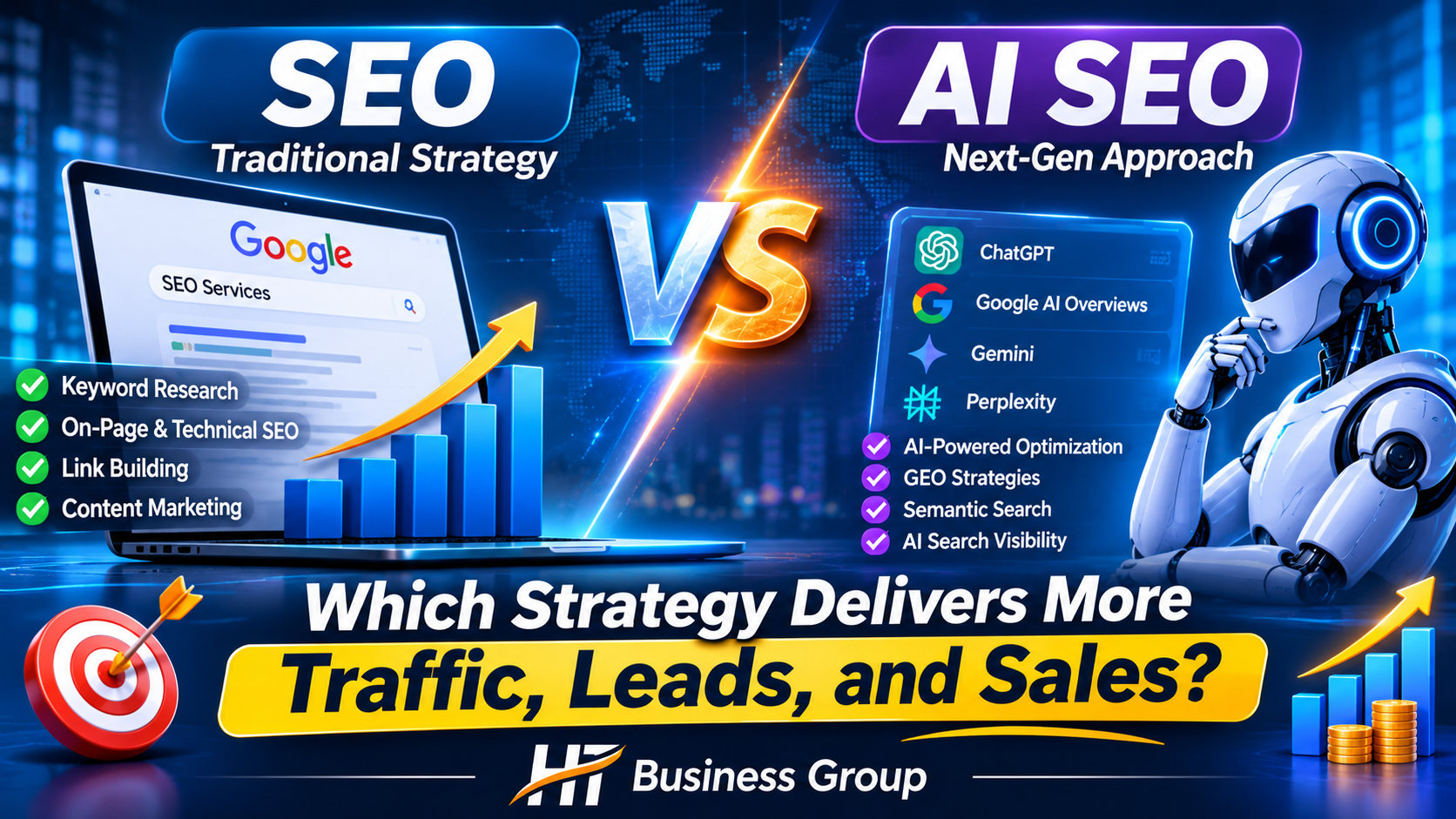
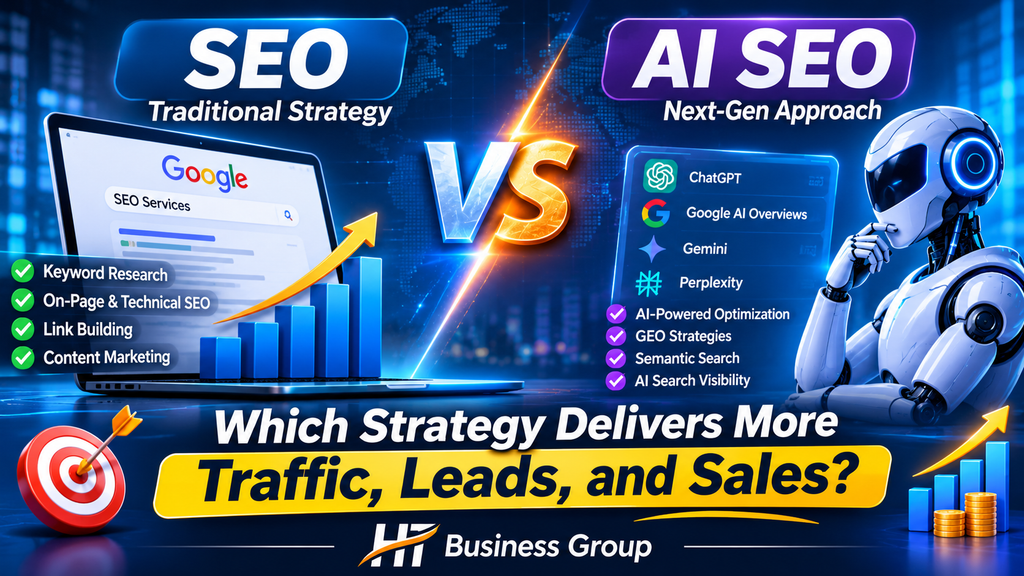
This shift has created an important question for business owners and marketing professionals: SEO vs. AI SEO: Which strategy delivers more traffic, leads, and sales?
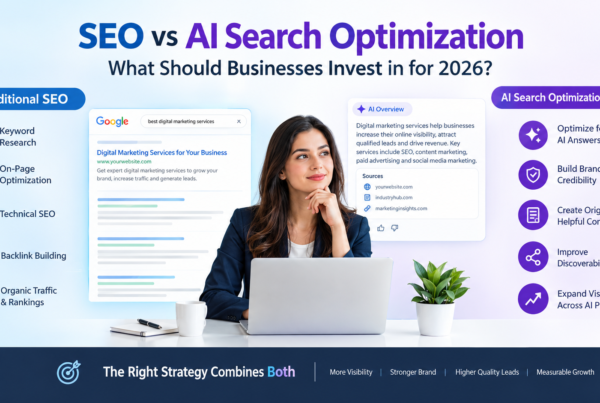
Traditional SEO focuses on improving website visibility in organic search results through keyword research, technical optimization, content marketing, and authority building. AI SEO expands these capabilities by using artificial intelligence to improve SEO workflows and prepare businesses for emerging AI-powered search experiences.
But does AI SEO generate more qualified traffic? Can traditional SEO still deliver better leads? And should businesses invest in both strategies to maximize their digital marketing results?
The answer depends on your business model, target audience, competition, and customer acquisition goals.
In this guide, we will compare traditional SEO and AI SEO across traffic generation, lead acquisition, conversion rates, content optimization, search visibility, and return on investment (ROI). We will also explore practical strategies businesses can use to combine both approaches and achieve sustainable digital growth.
SEO vs. AI SEO: Quick Comparison
Before exploring the details, let’s understand how traditional SEO and AI SEO differ in their ability to support business growth.
| Comparison Factor | Traditional SEO | AI SEO |
|---|---|---|
| Primary Objective | Improve organic search visibility | Enhance SEO workflows and visibility across AI-powered search |
| Traffic Generation | Attract visitors through organic search results | Support organic traffic and discovery through AI-powered experiences |
| Keyword Research | Keyword tools and manual analysis | AI-assisted keyword clustering and intent analysis |
| Content Creation | Human-led research and writing | AI-assisted research, drafting, and optimization |
| Search Visibility | Google, Bing, and other search engines | Traditional search plus AI-generated answers and recommendations |
| Lead Generation | Organic landing pages and service pages | AI-assisted content strategies and broader brand discovery |
| Conversion Optimization | Landing page optimization and user experience | AI-assisted personalization and customer journey analysis |
| Competitor Analysis | Manual research and SEO platforms | AI-assisted competitive intelligence |
| Technical Optimization | Technical audits and implementation | AI-assisted issue analysis and recommendations |
| Performance Tracking | Rankings, clicks, traffic, and conversions | Traditional metrics plus AI visibility and referral analysis |
| Automation | Depends on tools and workflows | Greater opportunities for workflow automation |
| Best Application | Sustainable organic search growth | More efficient optimization and emerging search visibility |
Important: AI SEO does not automatically generate more traffic or sales than traditional SEO. Its value comes from improving optimization processes and helping businesses adapt to changing search behavior.
What Is Traditional SEO?
Traditional Search Engine Optimization is the process of improving a website’s visibility in unpaid search engine results.
When potential customers search for products, services, or information on Google or Bing, search engines evaluate multiple signals to identify relevant and useful pages.
Traditional SEO helps businesses improve their ability to appear for these searches and attract visitors who are actively looking for their offerings.
For example, a company offering website development services may target keywords such as:
- Custom website development services
- Ecommerce website development company
- Professional web development services
- Website development company in the USA
- Custom web application development
When these pages provide relevant information and satisfy user expectations, they can attract visitors who may eventually become customers.
Core Components of Traditional SEO
1. Keyword Research
Keyword research identifies the search queries your potential customers use when looking for your products or services.
SEO professionals evaluate:
- Search volume
- Keyword difficulty
- Search intent
- Commercial search queries
- Transactional keywords
- Long-tail keywords
- Competitor keyword opportunities
The objective is to target relevant keywords that can attract qualified visitors rather than focusing exclusively on high search volumes.
2. On-Page SEO
On-page SEO involves optimizing individual website pages to improve their relevance, structure, and user experience.
Important elements include:
- SEO titles and meta descriptions
- Heading structure
- Keyword placement
- Internal linking
- Image optimization
- Descriptive URLs
- Content relevance
- Calls to action
- Search intent alignment
3. Technical SEO
Technical SEO ensures that search engines can efficiently discover, crawl, render, and index website pages.
It includes:
- XML sitemap optimization
- Robots.txt configuration
- Canonical tags
- Mobile responsiveness
- Website loading speed
- Core Web Vitals
- HTTPS implementation
- Structured data
- Crawl error resolution
- Website architecture optimization
4. Content Marketing
Content marketing helps businesses attract potential customers by publishing useful and relevant information.
Common SEO content formats include:
- Informational blog posts
- Product and service pages
- Industry guides
- Comparison articles
- Case studies
- Buying guides
- Educational resources
- Frequently asked questions
5. Off-Page SEO
Off-page SEO focuses on building a website’s reputation and credibility through relevant external references.
Activities may include digital PR, editorial backlinks, industry publications, expert contributions, and genuine business partnerships.
Together, these SEO activities create a foundation for long-term organic search visibility.
What Is AI SEO?
AI SEO refers to using artificial intelligence, machine learning, and natural language processing to improve search optimization processes and adapt business websites to AI-powered discovery experiences.
Unlike conventional SEO workflows that often involve extensive manual research and analysis, AI-powered SEO tools can process large datasets, identify patterns, analyze search intent, and suggest optimization opportunities more efficiently.
AI SEO has two closely related applications:
- AI-assisted SEO: Using AI to improve keyword research, content development, competitor analysis, technical SEO, and reporting.
- AI search optimization: Improving the discoverability and representation of a business across AI-powered search and answer platforms.
For example, an ecommerce company can use AI tools to identify product-related search queries, organize keywords into topic clusters, analyze competitors, and improve product descriptions.
It can also develop useful content that answers customer questions and provides relevant information for AI-powered discovery experiences.
Core Components of AI SEO
1. AI-Powered Keyword Research
AI tools can identify related keywords, group search queries, analyze search intent, and discover content opportunities.
Instead of targeting only one keyword, businesses can develop content around a broader set of customer questions.
2. AI Content Optimization
AI can help improve content structure, identify missing topics, suggest relevant headings, and analyze whether a page addresses its intended search query.
3. Semantic SEO
Semantic SEO focuses on the meaning and relationships between topics, entities, and concepts.
AI-assisted tools can help identify related subjects and improve topical coverage.
4. Generative Engine Optimization (GEO)
GEO focuses on improving brand visibility in generative AI experiences, where platforms generate conversational answers using information from different sources.
Businesses can support this objective by publishing accurate information, demonstrating expertise, building brand authority, and maintaining technically accessible websites.
5. AI-Powered Technical SEO
AI tools can assist with identifying duplicate content, analyzing website crawls, reviewing internal links, organizing technical audit findings, and prioritizing optimization opportunities.
6. AI Search Visibility Analysis
Businesses can monitor brand mentions, citations, referral traffic, and competitor visibility across available AI search experiences.
These activities help expand the way companies measure their online presence beyond traditional keyword rankings.
SEO vs. AI SEO: Which Strategy Generates More Website Traffic?
Traffic generation is one of the most important considerations when choosing a search optimization strategy.
However, not all website traffic has the same business value.
A website receiving 50,000 visitors from unrelated informational searches may generate fewer sales than a website receiving 5,000 visitors from highly relevant commercial searches.
Therefore, businesses should evaluate traffic quality, search intent, engagement, and conversion potential rather than focusing exclusively on visitor volume.
How Traditional SEO Generates Traffic
Traditional SEO attracts visitors by improving a website’s visibility for relevant search queries.
For example, consider a business offering ecommerce website development services.
Its SEO strategy might target:
- Ecommerce website development company
- Custom ecommerce development services
- Ecommerce website development cost
- Shopify vs. custom ecommerce development
- Best ecommerce development solutions
These searches represent different stages of the customer journey.
Someone searching for an ecommerce development company may be closer to hiring a service provider than someone researching general ecommerce trends.
Traditional SEO helps businesses attract these visitors by creating relevant landing pages, service descriptions, and educational content.
Benefits of Traditional SEO for Traffic Generation
- Captures existing search demand.
- Attracts visitors actively searching for solutions.
- Builds sustainable organic visibility.
- Supports informational and commercial search intent.
- Generates traffic without paying for every individual click.
- Creates long-term opportunities through evergreen content.
How AI SEO Supports Traffic Generation
AI SEO can improve traffic generation by making research, content planning, and optimization more efficient.
For example, AI-powered tools can analyze customer questions, identify related topics, and discover opportunities that may be overlooked during manual research.
Businesses can use these insights to develop:
- More comprehensive blog articles
- Industry-specific landing pages
- Comparison guides
- Product education resources
- Frequently asked questions
- Conversational search content
- Supporting topic clusters
AI SEO also encourages businesses to consider visibility across AI-powered search experiences.
Some users may discover a company through an AI-generated answer and visit its website through a cited source or recommendation.
However, AI-generated answers can satisfy certain informational queries without requiring a website visit. Therefore, AI visibility and website traffic should be measured separately.
Which Strategy Wins for Website Traffic?
Traditional SEO remains essential for capturing established organic search demand.
AI SEO can enhance traffic opportunities through better research, content optimization, and visibility across emerging discovery experiences.
Best approach: Combine traditional SEO with AI-assisted optimization and AI search visibility strategies.
SEO vs. AI SEO: Which Strategy Generates More Qualified Leads?
Traffic becomes valuable when it attracts visitors who are genuinely interested in your products or services.
Lead generation is particularly important for B2B companies, digital marketing agencies, SaaS providers, professional service businesses, and ecommerce companies.
Traditional SEO for Lead Generation
Traditional SEO can generate qualified leads by targeting commercial and transactional keywords.
For example, a potential customer searching for:
“Best SEO company for small businesses”
may be actively evaluating service providers.
A business can attract this visitor through a dedicated SEO services page that includes:
- Service information
- Industry expertise
- Case studies
- Customer testimonials
- Pricing information
- Contact forms
- Clear calls to action
The objective is to connect the visitor’s search intent with a relevant business offering.
Traditional SEO lead generation strategies include:
- Creating optimized service pages.
- Targeting high-intent commercial keywords.
- Publishing industry-specific case studies.
- Developing comparison and solution-focused content.
- Improving landing page conversion rates.
- Adding clear inquiry forms and calls to action.
- Building relevant internal links between blogs and service pages.
AI SEO for Lead Generation
AI SEO can support lead generation by helping businesses understand customer questions and develop content that addresses specific buying concerns.
For example, AI-assisted research may identify queries such as:
- How much does SEO cost for a small business?
- Is AI SEO worth investing in?
- How long does SEO take to generate leads?
- Traditional SEO vs. AI SEO for B2B companies
- How to choose an SEO agency
These questions provide opportunities to create useful educational content that guides potential customers toward relevant services.
AI-powered tools can also support lead qualification and marketing automation when integrated with suitable CRM and analytics platforms.
For example, an AI-enabled website assistant may help visitors find service information, answer common questions, and direct relevant inquiries to the appropriate sales team.
However, these lead-generation capabilities are not exclusive to AI SEO. They are complementary digital marketing technologies.
Which Strategy Wins for Lead Generation?
Traditional SEO is highly effective at capturing existing commercial search demand.
AI SEO can improve research efficiency, support customer education, and expand brand discovery.
For businesses focused on generating qualified leads, the best results generally come from combining search visibility with high-converting service pages, relevant content, and effective lead management.
SEO vs. AI SEO: Which Strategy Generates More Sales?
For most businesses, the ultimate goal of digital marketing is revenue growth.
Traffic and leads are important, but they must contribute to actual purchases, contracts, subscriptions, or other business outcomes.
How Traditional SEO Drives Sales
Traditional SEO can influence purchasing decisions by connecting potential customers with relevant product and service pages.
Consider an ecommerce business selling business software.
Its SEO strategy may target:
- Best CRM software for small businesses
- CRM software pricing
- CRM software comparison
- CRM software for ecommerce
- CRM implementation services
These keywords reflect different levels of purchase intent.
A well-optimized website can guide visitors through the buying journey using informative content, comparison pages, product descriptions, customer reviews, and conversion-focused landing pages.
Traditional SEO supports sales by attracting relevant visitors and helping them make informed decisions.
How AI SEO Supports Sales
AI SEO can contribute to sales by improving how businesses understand customer intent and create relevant buying resources.
AI-assisted tools can help companies:
- Identify product-related search opportunities.
- Analyze customer objections.
- Improve product descriptions.
- Develop comparison content.
- Identify gaps in buying guides.
- Personalize certain customer experiences.
- Analyze customer journeys.
- Support marketing automation.
AI-powered discovery platforms may also introduce customers to brands they were not previously aware of.
For example, a customer asking an AI assistant to compare ecommerce development solutions may discover a company through its website content or an external reference.
However, appearing in AI-generated recommendations does not guarantee a purchase.
The website must still provide relevant information, demonstrate trustworthiness, and offer a compelling customer experience.
Which Strategy Wins for Sales?
Neither traditional SEO nor AI SEO independently guarantees more sales.
Sales depend on factors such as:
- Product or service quality
- Pricing and competitiveness
- Customer demand
- Website usability
- Brand trust
- Landing page experience
- Sales follow-up
- Checkout process
- Customer support
Businesses should evaluate SEO and AI SEO according to their contribution to revenue, not simply their ability to generate impressions or traffic.
SEO vs. AI SEO: 10 Major Differences That Affect Business Growth
Let’s compare both approaches across important marketing and operational factors.
1. Search Visibility and Brand Discovery
Traditional SEO focuses on improving visibility in conventional search engine results.
AI SEO expands the scope to include AI-powered search and answer experiences.
For example, a business may appear in Google’s organic results while also being referenced in an AI-generated response on a different platform.
Business impact: Combining both approaches creates opportunities to reach customers through multiple discovery channels.
2. Keyword Research and Search Intent
Traditional keyword research identifies search terms based on volume, competition, and commercial relevance.
AI-assisted keyword research helps organize large datasets, discover conversational queries, and identify semantic relationships.
Business impact: More comprehensive research can help businesses create content for different stages of the buying journey.
3. Content Creation and Optimization
Traditional SEO relies on high-quality content that satisfies search intent and provides genuine value.
AI SEO introduces tools that can accelerate research, content briefs, drafting, and optimization.
Business impact: Businesses can improve content production efficiency without sacrificing editorial quality.
4. Competitor Analysis
Traditional competitor analysis examines rankings, backlinks, content, landing pages, and market positioning.
AI can help organize competitor information and identify potential content gaps.
Business impact: Businesses can identify opportunities more efficiently and make better-informed content decisions.
5. Technical SEO
Traditional technical SEO addresses crawling, indexing, site architecture, page speed, mobile usability, and structured data.
AI-assisted technical SEO can help analyze reports and prioritize issues.
Business impact: Technical teams can investigate larger datasets and streamline optimization workflows.
6. Authority and Brand Reputation
Traditional SEO emphasizes relevant backlinks, digital PR, and online authority.
AI search optimization also makes brand reputation and consistent information important considerations for broader discovery.
Business impact: A credible brand presence supports customer trust and can create more opportunities for recognition across search platforms.
7. Local Search Visibility
Traditional local SEO focuses on Google Business Profile optimization, local landing pages, customer reviews, and accurate business information.
AI-assisted SEO can help businesses analyze local search demand, customer questions, and content opportunities.
Business impact: Local companies can improve their ability to connect with customers searching for nearby services.
8. Automation and Productivity
Traditional SEO workflows often involve manual research, reporting, auditing, and content analysis.
AI tools can automate or accelerate certain repetitive activities.
Business impact: Marketing teams can spend more time on strategy, customer insights, technical decisions, and conversion optimization.
9. Performance Measurement
Traditional SEO tracks keyword rankings, clicks, impressions, traffic, and conversions.
AI SEO introduces additional indicators such as AI-generated brand mentions, citations, and referral visits.
Business impact: Businesses can develop a more comprehensive understanding of their online discovery channels.
10. Long-Term Business Value
Traditional SEO helps build lasting organic search visibility.
AI SEO helps businesses adapt their workflows and strategies to evolving search behavior.
Business impact: An integrated strategy can create a more resilient digital marketing foundation.
SEO vs. AI SEO: Which Is More Cost-Effective?
Marketing budgets are limited, so businesses need to understand which approach offers better value.
Traditional SEO and AI SEO have different cost structures.
Traditional SEO Costs
Traditional SEO expenses may include:
- SEO strategy and consulting
- Keyword research
- Technical SEO audits
- Content creation
- Website optimization
- Digital PR and outreach
- Link acquisition activities
- Reporting and analytics
- Ongoing maintenance
Costs depend on competition, industry, website size, geographic targeting, and the level of professional support required.
AI SEO Costs
AI SEO may involve additional investments in:
- AI subscriptions
- Keyword research tools
- Content optimization platforms
- AI visibility monitoring
- Automation software
- Technical analysis tools
- Data processing
- Editorial and quality assurance
AI can reduce the time required for some repetitive tasks, but it does not eliminate the need for skilled professionals.
How to Evaluate SEO ROI
Businesses should evaluate the financial contribution of their search marketing activities.
A basic SEO ROI calculation is:
SEO ROI = [(Revenue Attributed to SEO − SEO Investment) ÷ SEO Investment] × 100
For example, assume a company invests $5,000 in SEO and generates $15,000 in attributable revenue during the measurement period.
SEO ROI:
[
\frac{15,000-5,000}{5,000}\times100=200%
]
<text_note> </text_note>
This is a simplified example, not a forecast. Actual attribution should account for measurement periods, customer acquisition costs, margins, assisted conversions, and other marketing influences.
For AI SEO, businesses should separately monitor AI-related costs and attributable results where reliable measurement is available.
Recommendation: Do not choose AI SEO simply because it appears cheaper. Evaluate the cost of acquiring qualified customers and the revenue generated by each marketing channel.
How to Combine Traditional SEO and AI SEO for Better Business Results
The most practical approach is not to choose one strategy and ignore the other.
Businesses should use traditional SEO as the foundation while incorporating AI tools to improve research, optimization, content development, and search visibility.
Here is a practical framework.
Step 1: Build a Strong Technical SEO Foundation
Start by ensuring that your website is technically accessible and search-engine friendly.
Review:
- Website crawling and indexing
- XML sitemap configuration
- Robots.txt
- Canonical tags
- URL structures
- Mobile responsiveness
- Page loading speed
- Core Web Vitals
- Internal linking
- Structured data
Technical SEO should be established before expanding into advanced AI search optimization.
Step 2: Identify High-Intent Keywords
Research keywords based on their potential to generate qualified traffic and business opportunities.
Organize them into:
Informational keywords: Used by people researching a topic.
Example: What is AI SEO?
Commercial keywords: Used by people comparing solutions.
Example: Traditional SEO vs. AI SEO services.
Transactional keywords: Used by people ready to purchase or hire.
Example: Professional SEO agency for businesses.
Prioritize keywords according to business relevance rather than search volume alone.
Step 3: Develop Topic Clusters
Build a structured content strategy around your main products and services.
For example, a digital marketing company can create the following SEO topic cluster.
Pillar Page: Professional SEO Services
Supporting articles:
- SEO vs. AI SEO: Which Strategy Delivers More Traffic, Leads, and Sales?
- Traditional SEO vs. AI SEO: Major Differences
- SEO vs. GEO: What Businesses Need to Know
- How to Rank in Google AI Overviews
- Best AI SEO Tools for Businesses
- Technical SEO Checklist for Business Websites
- How to Improve Organic Lead Generation
- SEO Strategies for Small Businesses
Link relevant supporting articles to the main SEO services page.
Step 4: Use AI to Improve Content Research
AI tools can assist with:
- Search intent classification
- Keyword clustering
- Competitor content analysis
- Content gap identification
- Topic recommendations
- Content brief creation
- FAQ research
- Content improvement suggestions
Verify all important insights using reliable data and industry expertise.
Step 5: Create Useful, Expert-Led Content
Develop content that directly addresses customer problems.
Instead of publishing generic articles, incorporate:
- Original research
- Practical examples
- Industry-specific insights
- Real project experiences
- Expert commentary
- Accurate statistics
- Clear recommendations
AI can assist with content production, but original value should come from research, experience, and expertise.
Step 6: Optimize Landing Pages for Conversions
Generating traffic is only part of the process.
Your landing pages should clearly explain:
- What your business offers
- Who your services are designed for
- What problems you solve
- Why customers should trust you
- How customers can get started
Use relevant calls to action, easy-to-complete forms, and clear service information.
Step 7: Strengthen Brand Authority
Develop a recognizable and trustworthy online presence through:
- Relevant editorial mentions
- Industry publications
- Original case studies
- Genuine customer testimonials
- Expert contributions
- Consistent business information
- Relevant partnerships
Avoid artificial link schemes and fabricated brand references.
Step 8: Monitor Traditional and AI Search Performance
Track conventional search metrics alongside relevant AI discovery indicators.
Review:
- Organic clicks
- Search impressions
- Keyword rankings
- Organic traffic
- Landing page conversions
- Qualified leads
- Revenue attribution
- AI brand mentions
- AI citations
- AI referral traffic
Use the data to identify which channels contribute to business growth.
Best AI SEO Tools to Improve Traffic, Leads, and Sales
AI SEO tools can help businesses improve research, optimize content, analyze competitors, and streamline marketing workflows.
Here are several platforms worth considering.
1. ChatGPT
ChatGPT can assist with keyword brainstorming, content outlines, search intent analysis, competitor research workflows, and SEO reporting.
It can also help develop content briefs and identify questions that potential customers may ask.
2. Semrush
Semrush provides keyword research, competitor analysis, backlink analysis, site auditing, and content marketing capabilities.
It can help businesses discover organic search opportunities and monitor SEO performance.
3. Ahrefs
Ahrefs provides tools for keyword research, backlink analysis, competitor research, and website audits.
It is particularly useful for evaluating search opportunities and understanding competing websites.
4. Surfer
Surfer offers content optimization features that help writers evaluate page structure, topic coverage, and relevant terms.
It can support the optimization of existing articles and the creation of new content briefs.
5. Screaming Frog SEO Spider
Screaming Frog helps identify technical SEO issues, analyze website structures, review metadata, and examine internal linking.
It is useful for technical audits and large-scale website analysis.
6. Google Search Console
Google Search Console provides direct information about search impressions, clicks, indexing, and search queries.
It is essential for measuring organic search performance.
7. Google Analytics 4
Google Analytics 4 helps businesses understand traffic sources, user engagement, conversions, and website performance.
It is useful for evaluating how organic visitors interact with a website and contribute to business goals.
Tool selection tip: Start with Google Search Console and Google Analytics 4, then add specialized AI and SEO tools based on your actual business requirements.
How Different Businesses Can Benefit from SEO and AI SEO
Not every business requires the same search marketing strategy.
The right combination depends on industry competition, customer behavior, sales cycles, and business objectives.
| Business Type | Recommended Strategy | Primary Growth Objective |
|---|---|---|
| Ecommerce Businesses | Traditional SEO + AI SEO | Product discovery and online sales |
| B2B Companies | SEO + GEO + AI Assistance | Qualified leads and brand authority |
| SaaS Businesses | SEO + AI Search Optimization | Product discovery and subscriptions |
| Local Businesses | Local SEO + AI Assistance | Calls, inquiries, and bookings |
| Healthcare Businesses | Expert-Led SEO + AI Assistance | Trust and qualified patient inquiries |
| Real Estate Companies | Local SEO + Content Optimization | Property inquiries and leads |
| Digital Marketing Agencies | Integrated SEO and AI SEO | Client acquisition |
| Startups | AI-Assisted SEO | Cost-efficient brand discovery |
| Enterprise Companies | Integrated Search Strategy | Scalable organic growth |
For example, an ecommerce company may prioritize product and category page optimization, while a B2B software provider may focus more heavily on educational content, comparison pages, and qualified lead generation.
The strategy should reflect how customers actually discover and purchase the company’s offerings.
Common SEO and AI SEO Mistakes That Can Reduce Business Results
Even the best optimization tools cannot compensate for a poor strategy.
Businesses should avoid the following mistakes when implementing traditional and AI-powered SEO.
1. Focusing on Traffic Instead of Qualified Visitors
High traffic does not necessarily translate into business growth.
Target keywords that attract potential customers rather than publishing content solely to increase website visits.
2. Publishing Unedited AI-Generated Content
AI-generated content can contain inaccurate information, repetitive explanations, and unsupported claims.
Review and improve content before publishing it.
3. Ignoring Search Intent
A page targeting a transactional keyword should provide relevant product or service information.
Publishing a general educational article for every keyword can reduce its ability to satisfy search intent.
4. Neglecting Technical SEO
Poor indexing, broken links, incorrect canonical tags, and inaccessible content can affect search visibility.
Maintain a regular technical SEO review process.
5. Overlooking Conversion Optimization
A website may attract substantial organic traffic but generate few leads if its landing pages are confusing or its calls to action are ineffective.
Improve website usability and conversion paths.
6. Relying on AI Search Visibility Alone
AI-generated brand mentions are useful indicators, but they should not replace conventional SEO measurement.
Continue monitoring organic traffic, leads, conversions, and revenue.
7. Expecting Immediate Results
SEO is a long-term marketing investment.
AI tools can accelerate certain workflows, but they cannot guarantee faster rankings, more citations, or immediate revenue growth.
How HT Business Group Helps Businesses Generate More Traffic, Leads, and Sales
Building a successful search presence requires more than publishing blog articles or targeting popular keywords.
Businesses need a comprehensive strategy that connects website optimization, content marketing, technical SEO, brand authority, and conversion optimization.
HT Business Group helps businesses develop digital marketing strategies aligned with their target markets, customer acquisition objectives, and long-term growth plans.
Our approach combines established SEO practices with modern AI-assisted optimization techniques to help businesses improve online visibility and create better opportunities for customer acquisition.
Our SEO and AI Search Optimization Capabilities
1. Comprehensive SEO Services
We help businesses improve organic search visibility through structured SEO strategies.
Our services can include:
- Keyword research
- Competitor analysis
- On-page SEO
- Technical SEO
- Content optimization
- Internal linking
- SEO audits
- Organic performance monitoring
2. AI-Assisted SEO
We use suitable AI-powered workflows to support keyword research, search intent analysis, content planning, semantic optimization, and reporting.
This helps streamline repetitive activities while maintaining professional oversight.
3. GEO and AI Search Visibility
We help businesses prepare for evolving AI-powered search experiences through improved content clarity, topical coverage, brand consistency, and relevant online authority development.
4. SEO Content Marketing
Our content strategy focuses on developing useful resources that address customer questions, support buying decisions, and strengthen topical relevance.
This can include blog articles, service pages, industry guides, comparison content, and case studies.
5. Technical SEO and Website Development
Search performance depends on a technically sound website.
We help businesses align website development with technical SEO requirements, including website architecture, responsive design, performance optimization, crawlability, and indexing.
6. Conversion-Focused Digital Marketing
Attracting website visitors is only the beginning.
We focus on helping businesses create better conversion opportunities through relevant landing pages, clear messaging, effective calls to action, and improved customer journeys.
Our Approach to Sustainable Digital Growth
Our process typically includes:
- Website and SEO Audit: Evaluate technical performance, existing rankings, content quality, and organic visibility.
- Keyword and Market Research: Identify relevant search opportunities and understand customer intent.
- Competitor Analysis: Review competing websites and identify opportunities for differentiation.
- Strategy Development: Build an SEO and AI search optimization roadmap aligned with business objectives.
- Implementation: Improve technical SEO, content, website structure, and relevant landing pages.
- Authority Development: Strengthen brand credibility through useful content and relevant industry contributions.
- Performance Monitoring: Track organic traffic, qualified leads, conversions, and relevant AI search visibility indicators.
Whether you want to increase organic traffic, generate qualified B2B leads, improve ecommerce sales, or strengthen brand visibility across search platforms, HT Business Group can help you identify the right digital marketing strategy.
Ready to turn search visibility into business growth?
Contact HT Business Group to discuss professional SEO, AI SEO, GEO, and digital marketing solutions designed around your business goals.
Frequently Asked Questions (FAQs)
1. What is the difference between SEO and AI SEO?
Traditional SEO focuses on improving website rankings in organic search engine results through keyword research, content optimization, technical SEO, and authority building. AI SEO uses artificial intelligence to improve these activities and can also involve optimizing a brand’s visibility across AI-powered search experiences.
2. Does AI SEO generate more traffic than traditional SEO?
Not necessarily. Traditional SEO can attract substantial organic traffic by targeting established search demand. AI SEO can help businesses discover content opportunities, optimize their websites, and gain visibility across AI-powered platforms. Actual traffic depends on search demand, competition, content quality, and user behavior.
3. Which is better for lead generation: SEO or AI SEO?
Traditional SEO is effective for attracting visitors searching for specific products and services. AI SEO can support lead generation through improved customer research, content optimization, and broader brand discovery. Combining both approaches with conversion-focused landing pages can create better lead-generation opportunities.
4. Can AI SEO increase online sales?
AI SEO can contribute to sales by improving product content, identifying customer questions, optimizing buying guides, and supporting brand discovery. However, actual sales depend on product quality, pricing, customer trust, website experience, and the effectiveness of the purchasing process.
5. Is traditional SEO still important in 2027?
Yes. Traditional SEO remains important for organic search visibility, website discovery, and capturing relevant customer demand. Technical SEO, useful content, internal linking, and authority development continue to provide an important foundation for search performance.
6. What is GEO, and how is it related to AI SEO?
Generative Engine Optimization (GEO) focuses on improving brand visibility in AI-generated answers and conversational search experiences. It is closely related to AI SEO because both involve adapting content and brand information for emerging AI-powered discovery channels.
7. Can AI-generated content rank on Google?
Yes. Google does not automatically penalize content simply because it was created using AI. However, content should provide genuine value, demonstrate accuracy, satisfy user needs, and comply with Google’s spam policies. Publishing large amounts of unoriginal or low-value content can create SEO risks.
8. Which AI SEO tools are best for businesses?
Popular options include ChatGPT, Semrush, Ahrefs, Surfer, Google Search Console, Google Analytics 4, and Screaming Frog. Businesses should select tools based on their requirements, budget, and website complexity.
9. How long does SEO take to generate traffic and leads?
SEO timelines vary depending on website authority, competition, industry, technical condition, content quality, and the effectiveness of the strategy. Some improvements may become visible earlier, while meaningful and consistent organic growth often requires sustained optimization.
10. How can businesses measure AI SEO performance?
Businesses can monitor AI-generated brand mentions, citations, referral traffic, branded search demand, and relevant conversions. They should also continue tracking conventional SEO metrics such as impressions, clicks, rankings, organic sessions, and revenue.
11. Is AI SEO suitable for small businesses?
Yes. Small businesses can use AI-assisted SEO tools to improve keyword research, content planning, competitor analysis, and optimization workflows. They should prioritize essential SEO activities and focus on attracting relevant customers within their target markets.
12. Should businesses invest in traditional SEO and AI SEO together?
Yes, in most cases. Traditional SEO provides the foundation for organic search visibility, while AI SEO helps improve efficiency and prepare businesses for emerging AI-powered discovery experiences. An integrated strategy can support a broader digital marketing approach.
Final Verdict: SEO vs. AI SEO – Which Strategy Delivers More Traffic, Leads, and Sales?
The comparison between traditional SEO and AI SEO is not simply about choosing which technology is newer.
Traditional SEO remains a powerful way to attract relevant visitors, capture existing search demand, and build long-term organic visibility. AI SEO introduces additional opportunities to improve research, optimize content, streamline marketing workflows, and expand brand discovery across AI-powered search experiences.
For traffic generation, traditional SEO remains essential for capturing organic search demand.
For lead generation, combining high-intent SEO content with AI-assisted customer research can help businesses attract and educate potential buyers.
For sales, both approaches need to work alongside effective landing pages, strong brand trust, and a well-designed customer journey.
The winning strategy is an integrated SEO and AI SEO approach.
Businesses that combine proven search optimization practices with responsible AI adoption can build a more adaptable digital presence, improve marketing efficiency, and create more opportunities for sustainable growth.
Do not focus only on ranking higher or generating more visitors. Focus on attracting the right audience, earning customer trust, generating qualified leads, and converting search visibility into measurable business results.
Grow Your Business with Smarter SEO and AI-Powered Digital Marketing.
Partner with HT Business Group to develop a search optimization strategy that connects your business with the right customers across traditional search engines and emerging AI-powered discovery platforms.