Quick Answer
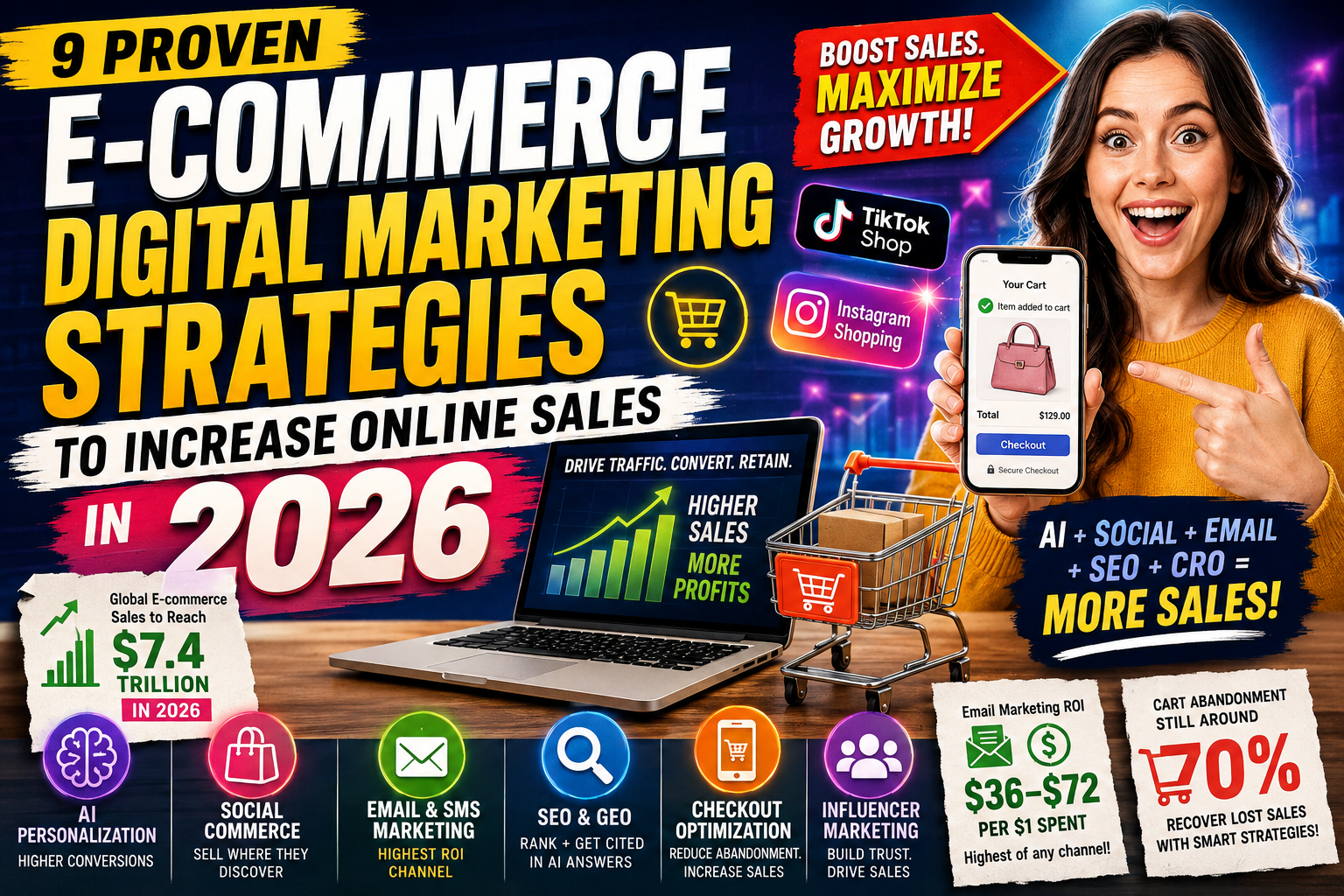
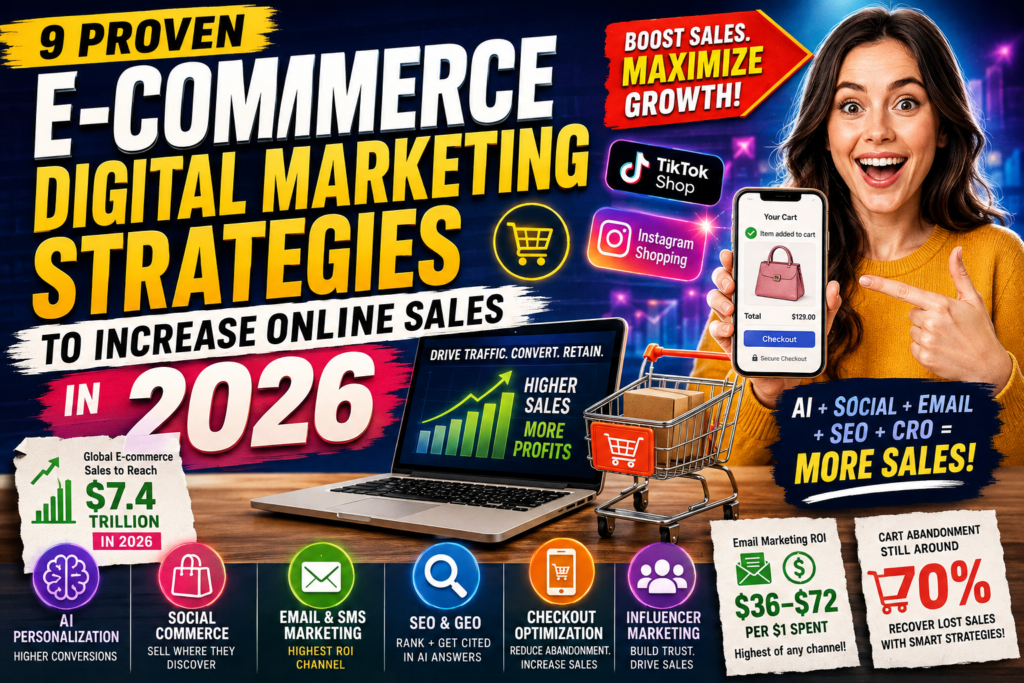
To increase online sales in 2026, e-commerce brands need to combine AI-driven personalization, social commerce (especially TikTok Shop and Instagram Shopping), retention-focused email/SMS marketing, checkout optimization, and content built for AI search — not just traditional Google rankings. The brands winning in 2026 treat channels as one connected system, not separate campaigns.
Key Takeaways
- Global online retail sales are on pace to cross $6.9–7.4 trillion in 2025–2026, but growth is shifting toward mobile, social, and AI-assisted discovery (Grazitti, Web & Crafts).
- Email marketing still delivers the highest ROI of any channel — $36–$45 per dollar spent on average, and up to $72–$79 for optimized U.S. e-commerce programs (Omnisend).
- Social commerce is now a core revenue channel, not an experiment. U.S. social commerce crossed $100 billion in 2026, with TikTok Shop alone generating an estimated $23–38 billion in U.S. sales (eMarketer).
- Google AI Overviews are reshaping SEO. They now appear on roughly 15–20% of all searches (higher for informational queries) and can cut organic click-through rates by 30–65% on affected queries (SeoProfy).
- Cart abandonment remains stuck around 70%, with mobile abandonment running even higher — meaning checkout optimization is one of the fastest ways to recover lost revenue (Baymard Institute).
- Winning in 2026 means optimizing for both traditional search and AI-generated answers (Generative Engine Optimization, or GEO), since AI-referred shoppers convert at a measurably higher rate than average organic visitors.
Why E-Commerce Marketing Is Different in 2026
For years, the e-commerce marketing playbook was simple: rank on Google, run some Facebook ads, send a newsletter. That playbook is breaking down.
Three shifts define 2026:
1. Discovery has moved off the website. Over 60% of product discovery now happens directly inside TikTok, Instagram, and YouTube — shoppers are evaluating and buying products without ever visiting a brand’s site first (GenAIEmbed / EMARKETER).
2. Search results answer questions before you get the click. Google’s AI Overviews now appear on a meaningful share of searches and can reduce organic click-through rates by roughly a third to two-thirds on affected queries (SeoProfy, eSEOspace). Brands that get cited inside AI answers are seeing higher-converting traffic; brands that don’t are losing visibility even while “ranking” well.
3. Retention is more profitable than acquisition. With paid acquisition costs rising, owned channels like email and SMS — where a brand isn’t paying a platform for every impression — are pulling further ahead on ROI (Sender.net).
The strategies below are organized around these three realities: be discoverable on social platforms, be citable in AI search, and retain the customers you already have.
Strategy 1: AI-Powered Personalization
Direct answer: AI personalization means using purchase history, browsing behavior, and predictive models to show each shopper different products, prices, or messaging — automatically, at scale.
Why it matters: The global AI-in-e-commerce market is projected to reach roughly $64 billion by 2034, growing at a 24%+ annual rate, driven largely by smarter product recommendations and marketing automation (Web & Crafts). Amazon’s recommendation engine — which anticipates what a shopper is likely to buy next — is the most visible proof that predictive personalization drives repeat purchases (LSEO).
Real example: An online skincare brand can use AI to detect that a customer who bought a moisturizer 45 days ago is statistically likely to need a refill now, and trigger a personalized “running low?” email with a one-click reorder — instead of sending the same generic promo to every subscriber.
How to apply it:
- Use your e-commerce platform’s native recommendation engine (Shopify, BigCommerce, or a dedicated tool) to power “customers also bought” and “recommended for you” modules.
- Segment email and SMS flows by predicted purchase intent, not just past purchases.
- Layer AI chat-based shopping assistants into your site or WhatsApp for real-time, personalized product guidance.
Bullet summary: AI personalization increases relevance, and relevance increases conversion — but it depends on clean first-party data, so pair it with strong zero-party data collection (quizzes, preference centers).
Strategy 2: Social Commerce (TikTok Shop, Instagram, Live Shopping)
Direct answer: Social commerce lets customers discover and buy products inside a social app, without redirecting to an external website — and in 2026 it’s one of the fastest-growing sales channels in e-commerce.
Why it matters: The global social commerce market is estimated at roughly $2.1–2.6 trillion in 2026, growing at over 26% annually (AutoFaceless, SellersCommerce). In the U.S. alone, social commerce sales crossed $100 billion for the first time in 2026, up roughly 18% year-over-year (eMarketer). TikTok Shop is the standout performer, converting at around 4.7% — more than double Instagram Shopping’s 2.1% and nearly triple Facebook Shops’ 1.8% (ShortFormNation).
Real example: A supplements or beauty brand running a livestream shopping event can see conversion rates 3–5x higher than a standard product page, since livestreams combine entertainment, real-time Q&A, and instant checkout in one experience (Web Tonic).
Platform-by-Platform Snapshot
| Platform | Est. Conversion Rate | Best For |
| TikTok Shop | ~4.7% | Daily-use, consumable products; beauty, health, home |
| Pinterest Shopping | ~3.2% | High-intent planners; fashion, home decor, gifting |
| Instagram Shopping | ~2.1% | Visual product discovery; fashion, lifestyle |
| Facebook Shops | ~1.8% | Broad reach, retargeting-driven purchases |
(Conversion benchmarks compiled from ShortFormNation and Ringly.io; actual results vary by category.)
How to apply it:
- Set up native checkout (TikTok Shop, Instagram Checkout) instead of redirecting off-platform — native checkout flows see 30–50% higher completion rates (Web Tonic).
- Run at least one livestream shopping event per month in high-consideration categories.
- Prioritize UGC and photo reviews on product pages — UGC can lift conversion by over 350% compared to pages with none (Web Tonic).
Bullet summary: If your category sells well on video (beauty, fashion, home, food), TikTok Shop and Instagram Shopping should now be treated as primary sales channels, not just brand-awareness tools.
Strategy 3: Email and SMS Marketing for Retention
Direct answer: Email marketing remains the single highest-ROI channel in e-commerce, returning an estimated $36–$45 for every $1 spent on average, and up to $72–$79 for optimized U.S. e-commerce programs (Omnisend).
Why it matters: Automated flows (welcome series, abandoned cart, post-purchase) make up only about 2% of total email sends but drive roughly 30–37% of all email-generated revenue (Ringly.io). Welcome emails alone average an 83.6% open rate — the highest of any automated email type.
Real example: A DTC apparel brand that builds a 4-email abandoned-cart sequence (reminder → social proof → limited-time discount → final notice) typically recovers a meaningfully higher share of abandoned revenue than a single reminder email, because each message targets a different objection (forgot, price hesitation, urgency).
How to apply it:
- Build these five core flows first: welcome series, abandoned cart, browse abandonment, post-purchase, and win-back.
- Segment your list by purchase recency, frequency, and predicted intent — segmented campaigns generate roughly 760% more revenue than unsegmented blasts (SellersCommerce / industry benchmarks).
- Add SMS as a secondary, higher-urgency channel — SMS open rates run close to 98%, well above email.
Bullet summary: Because email is an owned channel with no per-impression platform cost, it should be the retention backbone of every e-commerce marketing budget, even as acquisition channels shift.
Strategy 4: SEO and Generative Engine Optimization (GEO)
Direct answer: SEO in 2026 means optimizing for two audiences at once — Google’s traditional ranking algorithm and Google’s AI Overviews (plus tools like ChatGPT and Perplexity) — because both now shape whether shoppers ever see your brand.
Why it matters: AI Overviews now appear on roughly 15–20% of all Google searches, and can reach 47–64% of queries in some categories (eSEOspace). When an AI Overview appears, organic click-through rates for the #1 ranking result can drop by 34–65% (SeoProfy). At the same time, AI-referral traffic to U.S. retail sites grew 393% year-over-year in early 2026 — still a small slice of total traffic, but growing fast (SEOSherpa).
Real example: Rakuten24 improved Core Web Vitals (page speed and stability) and saw a 33.13% increase in conversion rate — a reminder that technical SEO directly affects revenue, not just rankings (SEOSherpa).
How to apply it:
- Write clear, direct answers near the top of product and category content — the format AI Overviews are most likely to cite.
- Invest in structured data (Product, Review, FAQ, Breadcrumb schema) so search engines and AI systems can parse your pages accurately.
- Build topical depth around your core categories instead of isolated blog posts — interconnected content clusters are outperforming one-off pages for AI citation (TheeDigital).
- Track brand mentions and citations inside AI answers, not just click-through traffic, since visibility and traffic are no longer the same metric.
Bullet summary: SEO isn’t dying — it’s splitting into two disciplines. Keep optimizing for rankings, but also optimize specifically to be the source an AI Overview quotes.
Strategy 5: Paid Search, Shopping Ads, and Retargeting
Direct answer: Paid search and Shopping ads remain essential for capturing high-intent, ready-to-buy shoppers, especially since Google Shopping ads now account for more than 75% of U.S. retail paid-search spend (SEOSherpa).
Why it matters: Paid search delivers strong, measurable ROI for bottom-funnel intent, though it’s generally lower than email — commonly benchmarked around $8 back for every $1 spent (Sender.net). Paid CTR is also being squeezed by AI Overviews, which have shown CTR drops as steep as 68% on affected queries (Triangle Direct Media) — making precise targeting and creative testing more important than ever.
How to apply it:
- Prioritize Shopping and Performance Max campaigns for product-level intent.
- Layer dynamic retargeting for cart abandoners and product-page visitors who didn’t buy.
- Test creative variations continuously using tools built for rapid ad experimentation (Meta Experiments, dedicated creative-testing platforms).
Bullet summary: Paid search should complement — not replace — organic and retention channels, since it’s the fastest lever for volume but the most expensive per acquisition.
Strategy 6: Influencer and Creator Marketing
Direct answer: Influencer marketing in 2026 is shifting from big-name endorsements to niche and micro-creators with smaller, more engaged, higher-trust audiences (LSEO).
Why it matters: About 58% of consumers over 18 say they’ve purchased a product because of an influencer endorsement (eMarketer), and the broader creator economy is projected to grow more than 16% in 2026, reaching roughly $20.6 billion in creator revenue.
How to apply it:
- Prioritize creators with genuine engagement and category relevance over raw follower count.
- Combine influencer content with native social commerce checkout so viewers can buy without leaving the app.
- Repurpose top-performing creator content as paid social ads (whitelisting/spark ads) — it typically outperforms brand-made creative.
Bullet summary: Creator content works best when it feeds directly into a shoppable moment — a TikTok Shop link, an Instagram tag, a livestream — rather than ending in a generic “link in bio.”
Strategy 7: Checkout and Cart Abandonment Recovery
Direct answer: The average cart abandonment rate has held steady at roughly 70% for over a decade, meaning checkout optimization is one of the highest-leverage, lowest-cost ways to increase sales without spending more on traffic (Baymard Institute).
Why it matters: Baymard Institute estimates that better checkout design alone could recover around $260 billion in lost orders across the U.S. and EU. The top causes of abandonment are unexpected extra costs (about 48% of cases), forced account creation, and checkout flows that feel too complicated (Growth Suite).
Real example: Mobile cart abandonment runs notably higher than desktop (roughly 73–85% vs. 66–73%, depending on the study), largely due to form-input friction and slower load times on mobile networks (Digital Applied). A brand that shortens its mobile checkout form and adds one-tap payment options directly targets this gap.
How to apply it:
- Show total cost (shipping, tax) as early as possible — don’t surprise shoppers at the final step.
- Offer guest checkout by default; never force account creation before purchase.
- Add digital wallets and Buy Now, Pay Later (BNPL) options — payment flexibility is now one of the top checkout-optimization factors.
- Layer in SMS-based cart recovery alongside email; SMS converts recovery messages faster due to near-instant open rates.
Bullet summary: A handful of checkout fixes — transparent pricing, guest checkout, one-tap payment — typically deliver a faster ROI than any new acquisition channel.
Strategy 8: Mobile Commerce Optimization
Direct answer: Mobile now accounts for roughly 70–73% of e-commerce traffic, but converts at a lower rate than desktop — meaning mobile UX is both the biggest opportunity and the biggest leak in most e-commerce funnels (Searchlab).
Why it matters: Desktop conversion rates can run more than twice as high as mobile in some benchmarks, and 45% of mobile shoppers cite “forms too difficult to fill out” as a reason for abandoning (Searchlab). Stores with a mobile-first (not just responsive) checkout see meaningfully lower abandonment.
How to apply it:
- Audit your checkout specifically on mobile — not just your homepage — since that’s where most friction happens.
- Enable autofill and digital wallet payments (Apple Pay, Google Pay) to cut form-fill steps.
- Compress images and lazy-load non-critical content to protect mobile page speed, which directly affects both SEO and conversion.
Bullet summary: Treat mobile as the primary experience to design for, with desktop as the secondary — most of your traffic, and most of your abandonment, is happening on a phone.
Strategy 9: Content Marketing and Blogging
Direct answer: Blogging and educational content still drive qualified, lower-cost traffic — through how-to guides, buying guides, and product comparison content — and now double as raw material for AI Overview citations (Web & Crafts).
Why it matters: Organic search still accounts for roughly 23.6% of e-commerce website traffic (SEOSherpa), and non-branded organic search can generate dramatically more revenue than early-stage AI chatbot referral traffic — meaning content investment still pays off, even as the format of “winning” shifts toward being cited rather than just ranked.
How to apply it:
- Build content around real buyer questions (“how to choose,” “vs.,” “sizing guide”) rather than generic top-of-funnel topics.
- Structure each article with a direct answer up top, followed by supporting detail — the format both readers and AI systems parse fastest.
- Interlink blog content to relevant product and category pages to pass authority and guide shoppers toward purchase.
Bullet summary: Content marketing’s job in 2026 isn’t just to rank — it’s to become the source that both shoppers and AI systems trust enough to cite.
Channel Comparison: Where to Invest First
| Channel | Typical ROI / Benchmark | Speed to Results | Best Fit |
| Email marketing | $36–$72+ per $1 spent | Fast (weeks) | Retention, repeat purchases |
| SEO / GEO content | Compounding, slower start | Slow (months) | Long-term organic growth |
| Paid search / Shopping ads | ~$8 per $1 spent (varies) | Fast (days) | High-intent, bottom-funnel |
| Social commerce (TikTok Shop, etc.) | 2–4.7% conversion by platform | Fast–Medium | Discovery + direct sales, visual categories |
| Influencer/creator marketing | Varies widely by niche fit | Medium | Trust-building, category credibility |
| Checkout/CRO improvements | No ad spend; recovers existing traffic | Fast (weeks) | Immediate revenue recovery |
Benchmarks are directional industry averages compiled from the sources cited throughout this article; actual performance varies by category, price point, and audience.
Pros and Cons of Each Major Channel
Email & SMS Marketing
- ✅ Highest ROI of any channel; you own the audience; highly automatable
- ❌ Requires an existing list; deliverability and list quality take ongoing work
Social Commerce
- ✅ Meets shoppers where they already are; strong for visual/impulse categories
- ❌ Platform-dependent; algorithm and policy changes can shift performance quickly
SEO / GEO
- ✅ Compounding, durable traffic; builds long-term brand authority
- ❌ Slow to show results; AI Overviews are reducing click-through even for top rankings
Paid Search & Shopping Ads
- ✅ Immediate, controllable, highly measurable
- ❌ Costs scale with competition; stops working the moment you stop paying
Influencer/Creator Marketing
- ✅ Builds trust faster than brand-made ads; strong for new-audience reach
- ❌ Harder to forecast ROI; quality varies widely by creator
Step-by-Step: Building Your 2026 E-Commerce Marketing Plan
- Audit your current funnel. Identify where you’re losing the most shoppers — traffic, conversion, or retention — using Google Analytics and your checkout data.
- Fix checkout friction first. This is the fastest, lowest-cost win: transparent pricing, guest checkout, and mobile-optimized forms.
- Build your five core email/SMS flows. Welcome, abandoned cart, browse abandonment, post-purchase, and win-back.
- Choose one or two social commerce platforms to go deep on, based on where your category already gets engagement (e.g., TikTok Shop for beauty, Pinterest for home decor).
- Restructure top content for AI citation. Add direct answers, FAQs, and structured data to your highest-traffic product and guide pages.
- Layer in paid search/Shopping ads to capture the highest-intent searches your organic content hasn’t yet won.
- Test one creator partnership in a category-relevant niche and track it through to attributed sales, not just impressions.
- Review and reallocate budget quarterly based on actual channel ROI, not assumptions carried over from the previous year.
Common Mistakes to Avoid
- Treating social media as awareness-only. In 2026, TikTok and Instagram are direct sales channels — not activating native checkout leaves revenue on the table.
- Ignoring mobile checkout specifically. A “responsive” site is not the same as a mobile-first checkout experience.
- Sending unsegmented email blasts. Generic campaigns underperform segmented flows dramatically.
- Writing content only for rankings, not for AI citation. Pages without clear, direct answers and structured data are less likely to be cited in AI Overviews.
- Under-investing in retention. Chasing new customers while ignoring win-back and loyalty flows is one of the most common (and most expensive) mistakes in e-commerce marketing.
- Hiding shipping costs until the final checkout step. This is still the single biggest driver of cart abandonment.
Expert Tips
- Prioritize owned channels (email, SMS, app) as your foundation, since they’re insulated from platform algorithm changes and AI-search disruption.
- Measure “citation share” in AI Overviews, not just organic rankings, as a new core SEO KPI going into 2026.
- Pair every paid social campaign with a native checkout flow — redirecting off-platform measurably lowers completion rates.
- Treat your top 10% of content pages as strategic assets and rebuild them for clarity and citability rather than publishing new, thinner pages.
Frequently Asked Questions
1. What is the most effective digital marketing strategy for e-commerce in 2026?
No single channel wins alone — the most effective approach combines high-ROI retention marketing (email/SMS), social commerce for discovery, and checkout optimization to capture the demand you already have.
2. How much should an e-commerce brand spend on digital marketing?
This varies widely by category and margin, but many brands allocate a growing share toward retention (email/SMS) and checkout optimization first, since these typically deliver faster, more measurable returns than new acquisition spend.
3. Is SEO still worth it with AI Overviews taking over search results?
Yes. Organic search still drives a meaningful share of e-commerce traffic, and content built for AI citation is starting to convert at a higher rate than average organic traffic, even as click-through rates shift.
4. What is Generative Engine Optimization (GEO)?
GEO is the practice of structuring content so AI systems (Google AI Overviews, ChatGPT, Perplexity) are more likely to cite it directly in an AI-generated answer — using clear direct answers, structured data, and topical depth.
5. Which social platform converts best for e-commerce?
Based on current benchmarks, TikTok Shop generally shows the highest conversion rate among major social platforms, though the “best” platform depends heavily on product category and target audience.
6. How do I reduce cart abandonment?
Show all costs upfront, offer guest checkout, add digital wallets, and follow up with a multi-step email and SMS recovery sequence rather than a single reminder.
7. Is email marketing still relevant in 2026?
Yes — it remains the highest-ROI digital marketing channel available to e-commerce brands, particularly for retention and repeat purchases.
8. Should small e-commerce brands invest in influencer marketing?
Micro and niche creators often deliver better ROI than large influencers for smaller brands, since their audiences tend to be more engaged and closely aligned with a specific category.
9. What’s the biggest mistake e-commerce brands make with mobile shopping?
Treating mobile as a scaled-down desktop experience instead of redesigning checkout specifically for mobile friction points like form length and load speed.
10. How important is livestream shopping in 2026?
It’s becoming a meaningful revenue channel, especially in beauty, fashion, and home categories, where live formats can convert significantly higher than standard product pages.
11. Do I need structured data (schema markup) for e-commerce SEO?
Yes — Product, Review, FAQ, and Breadcrumb schema help both traditional search engines and AI systems understand and accurately cite your pages.
12. How often should I review my digital marketing channel mix?
At least quarterly, reallocating budget based on actual ROI data rather than the previous year’s assumptions, since channel performance (especially social and AI search) is shifting quickly in 2026.
Conclusion
E-commerce marketing in 2026 isn’t about picking one winning channel — it’s about building a system where retention, social discovery, checkout experience, and AI-era search work together. The brands seeing the strongest growth aren’t necessarily spending the most; they’re the ones fixing checkout friction, doubling down on the highest-ROI retention channels, and rebuilding content to be citable in an AI-driven search landscape. Start with the fastest wins — checkout optimization and email/SMS flows — and build outward from there.