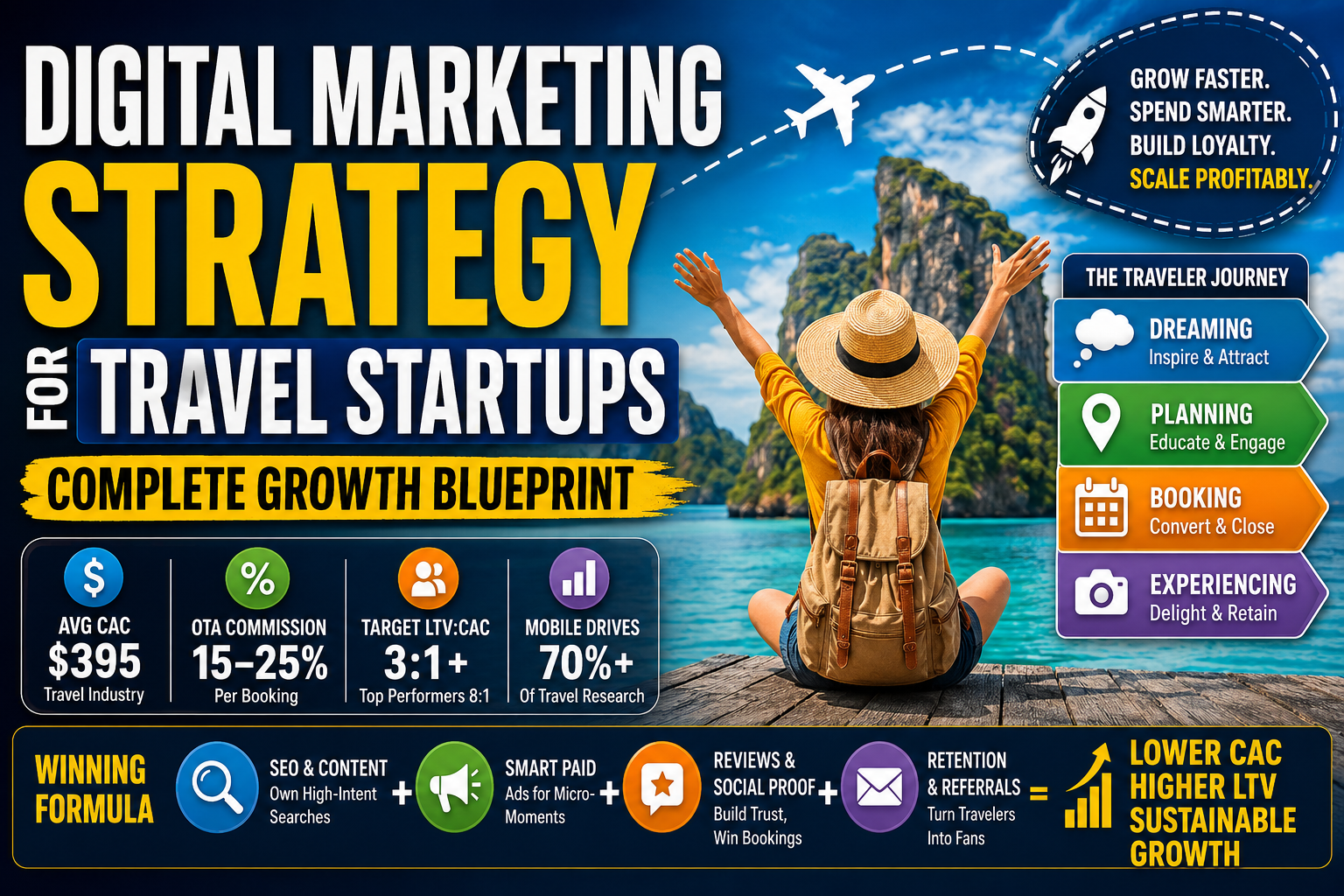
A winning digital marketing strategy for a travel startup combines SEO-driven content for high-intent searches, paid search and social ads targeted at “micro-moments” in the booking journey, a review and social-proof engine, and a retention program that raises repeat-booking rate — because in travel, acquisition is expensive but loyal travelers are highly profitable.
Key Takeaways
- Travel and hospitality companies report an average customer acquisition cost (CAC) around $395, roughly in line with the cross-industry average — so travel startups can’t out-CAC the big OTAs on paid media alone.
- Online travel agencies (OTAs) commonly charge 15–25% commission per booking, which is effectively a paid acquisition cost even when a startup isn’t running ads.
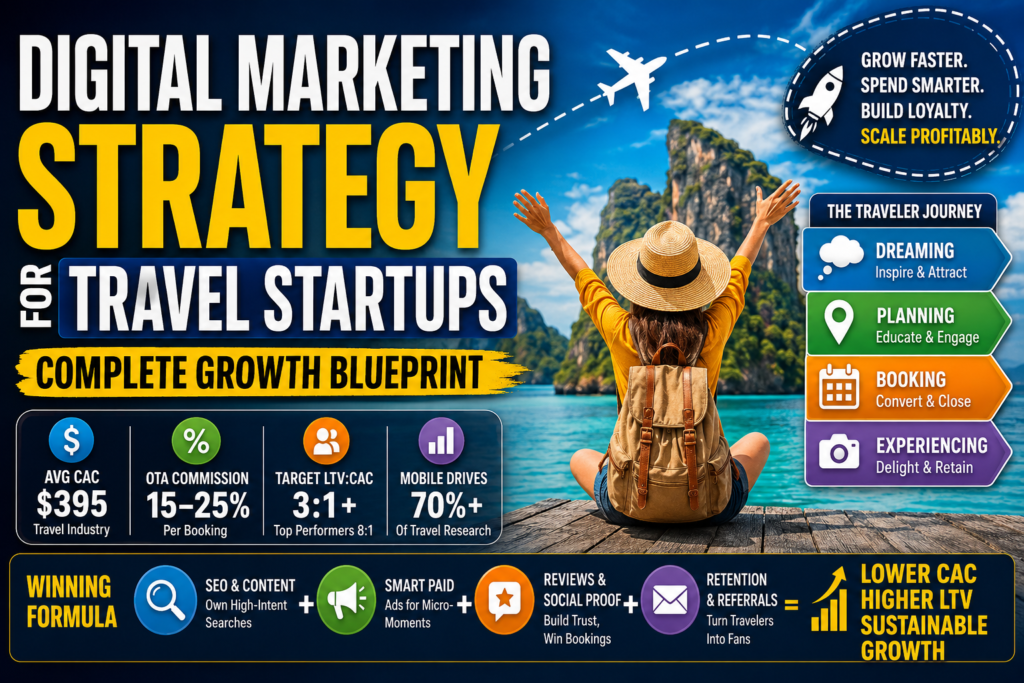
- Google’s own travel research shows bookings are shaped by “micro-moments” — dreaming, planning, booking, and experiencing — and content that matches each stage converts better than generic brand content.
- A sustainable growth model targets a 3:1 LTV-to-CAC ratio as a baseline, with top performers reaching 8:1 by investing in retention and referrals, not just new-customer ads.
- Mobile now drives the majority of travel research and a large share of bookings, so mobile page speed and mobile checkout are non-negotiable ranking and conversion factors.
Why Travel Startup Marketing Is Different
Travel is a high-consideration, high-emotion purchase. People don’t buy a flight the way they buy a phone charger — they research for days or weeks, compare across multiple sites, and often abandon a booking to “sleep on it.” That behavior changes what “good marketing” looks like.
Three industry realities shape the strategy:
1. Acquisition costs are already high, and OTAs set the floor. Because Booking.com, Expedia, and Airbnb dominate paid search and app-store real estate, independent travel brands are bidding against companies with enormous budgets. Travel and hospitality CAC benchmarks average around $395 per customer — similar to cross-industry norms, but travel margins per booking are often thinner than in SaaS or e-commerce, so that CAC has to work harder.
2. The booking journey is not linear. Google’s travel research identified four recurring “micro-moments” travelers move through: dreaming about a trip, planning it, booking it, and experiencing it. A startup that only markets to the “booking” moment (bottom-of-funnel ads) misses the much larger audience still in the “dreaming” and “planning” stages, where brand preference actually gets formed.
3. Trust is the product. Travelers are handing over money for something intangible and non-refundable in most cases. Reviews, security signals, and social proof matter more in travel than in almost any other e-commerce category — nearly seven in ten travelers say they find OTAs more secure and convenient specifically because of trust signals like reviews and buyer protection.
What this means for a startup: you cannot win by copying OTA playbooks with 1% of their budget. You win by owning a narrow niche (a destination, traveler type, or trip style) end-to-end — content, community, and retention — where the giants are generic.
Step 1: Build a Foundation Before You Spend a Dollar
Define your Ideal Customer Profile (ICP)
Skip “everyone who travels.” Pick a niche you can dominate: solo female backpackers, remote-work “digital nomads,” multigenerational family trips, adventure/eco-tourism, or luxury weekend escapes. A narrow ICP lets you write content and run ads that speak directly to one traveler’s fears and desires instead of generic copy that speaks to no one.
Map the micro-moments for your niche
For each ICP, write down the actual questions they type into Google at each stage:
- Dreaming: “best places to visit in [region] for solo travelers”
- Planning: “[destination] itinerary 7 days,” “is [destination] safe for solo women”
- Booking: “[destination] tour operator reviews,” “[company] vs [competitor]”
- Experiencing: “things to do near me in [destination],” “[destination] wifi/data tips”
This map becomes your entire content and campaign calendar. It also reveals a competitive edge: most travel startups only build content for the “booking” stage because that’s where conversions are obvious. The dreaming and planning stages have far less competition and are where trust and brand recall get built.
Set a real unit-economics baseline
Before building campaigns, calculate:
- Average booking value (ABV)
- Gross margin per booking
- Target CAC (should stay meaningfully below margin per booking, adjusted for repeat-purchase rate)
- Target LTV:CAC ratio — aim for at least 3:1
If you don’t know these numbers, every channel decision below is a guess.
Step 2: SEO and Content Strategy for Travel Startups
SEO is the highest-leverage channel for travel startups because organic search compounds — a well-ranked destination guide keeps bringing bookings long after a paid ad budget runs out.
Direct answer
Travel SEO works by building destination and trip-specific content that matches each micro-moment, backed by technical SEO (page speed, mobile usability, structured data) and authoritative backlinks from tourism boards, travel media, and local partners.
Core content pillars
- Destination guides — comprehensive, first-hand guides for each place you operate (not rewrites of Wikipedia).
- Comparison and “vs” pages — “[Your brand] vs [Competitor],” “[Trip type] vs [alternative trip type].” These capture high-intent, late-funnel searches.
- Itinerary content — “X days in [destination]” pages target planning-stage searchers and are highly linkable.
- Practical/utility content — visa requirements, packing lists, safety tips, budget breakdowns. Low competition, high trust-building value.
- Reviews and social proof pages — aggregate traveler reviews and UGC photos on-site, not just on third-party platforms.
On-page and technical essentials
- Page speed: mobile page speed directly affects both rankings and booking conversion, since a large share of travel research now happens on mobile devices.
- Structured data: use TouristTrip, Product, Review, and FAQPage schema so Google can generate rich results and AI Overview citations.
- Internal linking: link destination guides → itineraries → booking pages in a clear funnel, so search engines and users both understand the path to conversion.
- E-E-A-T signals: author bios with real travel experience, first-hand photos (not stock images), and transparent pricing build the trust signals Google’s Helpful Content guidance rewards.
AI Overview and featured snippet optimization
Structure key pages so each major section answers a question in the first two sentences, followed by supporting detail. For example, open a “Is [destination] safe for solo travelers?” section with a direct yes/no-style answer, then explain nuance, then give a bullet-point summary. This format is what search engines pull into AI Overviews and featured snippets.
Featured snippet formats to build deliberately:
| Snippet Type | Best Content Match |
| Definition box | “What is [travel concept]?” pages |
| Numbered list | Step-by-step booking or visa guides |
| Table | Price/cost comparisons, packing checklists |
| FAQ accordion | Destination FAQ sections |
Step 3: Paid Acquisition Channels
Direct answer
Paid acquisition for travel startups works best as a supporting channel for high-intent bottom-of-funnel keywords and retargeting, not as the primary growth engine, because blended CAC on cold paid traffic often exceeds what an early-stage travel margin can sustain.
Google Search and Performance Max
Reserve search ads for terms with clear booking intent (“book [trip type] [destination],” “[your brand name]”). Broad awareness terms are usually too expensive to win against OTA budgets. Performance Max can work well once you have enough conversion data (typically 30+ conversions/month) to let the algorithm optimize properly.
Metasearch (Google Hotel Ads, Tripadvisor, Kayak)
For accommodation or package-based travel startups, metasearch listings put you directly next to OTA prices at the exact “booking” micro-moment. Commission or cost-per-click structures vary, but metasearch typically converts at a higher rate than generic display ads because intent is already high.
Paid social (Meta, TikTok, Pinterest)
Paid social is most effective at the “dreaming” stage — visually rich ads that plant the idea of a trip. Retarget engaged viewers with planning-stage content, then convert with a final retargeting push offering a limited-time incentive.
OTA and marketplace listings
Listing on an established OTA is itself a paid acquisition channel: the 15–25% commission functions as a CAC. It’s often rational for a new travel startup to accept this cost in year one to build review volume and brand awareness, while simultaneously building the owned channels (SEO, email) that reduce OTA dependency over time.
Step 4: Social Media and Influencer Marketing
Direct answer
Social media drives travel discovery rather than direct bookings for most startups, so its ROI should be measured through assisted conversions, branded search lift, and follower-to-email conversion — not last-click sales alone.
Platform strategy
- Instagram/TikTok: short-form destination content, behind-the-scenes trip footage, and user-generated content reposts. This is where “dreaming moment” demand gets created.
- Pinterest: long shelf-life for itinerary and packing-list pins; strong for planning-stage searchers who are actively saving ideas.
- YouTube: long-form trip vlogs and “what to expect” videos build trust before booking and rank well in Google’s video results.
Micro-influencer partnerships
Micro-influencers (10k–100k followers) in a travel niche typically deliver more engaged, lower-cost reach than large-name creators, and their audiences trust destination-specific recommendations more. Structure partnerships around usable content rights (so you can repost footage) rather than one-off posts alone.
Real example
A niche adventure-travel startup targeting a single region (say, hiking trips in Patagonia) can realistically out-market a giant OTA on Instagram and Pinterest simply by publishing more specific, higher-quality content about that one region than a generalist competitor ever will — the same “narrow niche” advantage described in Step 1 applies to social content, not just SEO.
Step 5: Conversion Rate Optimization
Direct answer
Conversion rate optimization (CRO) for travel sites means removing friction from a booking flow that’s inherently high-stakes: clear pricing, visible trust signals, fast mobile checkout, and flexible cancellation terms shown before the payment step, not after.
High-impact CRO levers
- Show total price early. Hidden fees revealed at checkout are one of the most common reasons travelers abandon bookings.
- Display reviews near the “Book Now” button, not buried on a separate page.
- Offer guest checkout. Forcing account creation before booking adds friction at the exact moment intent is highest.
- Make cancellation policy visible before payment. Uncertainty about refunds is a major trust barrier in travel.
- Optimize for mobile checkout specifically — test the mobile flow separately from desktop, since a large share of travel research and a fast-growing share of bookings now happen on mobile devices.
- Add urgency honestly — “3 spots left” only if true. Fabricated scarcity damages trust and violates several ad platforms’ policies.
Pros and cons of common CRO tactics
| Tactic | Pros | Cons |
| Exit-intent discount popups | Recovers some abandoners | Trains users to wait for discounts |
| Live chat / chatbot | Answers objections in real time | Needs real staffing or a well-trained bot to avoid frustrating users |
| Guest checkout | Lowers friction, raises conversion | Loses some first-party data for retargeting |
| Price-match guarantee | Builds trust vs. OTAs | Can compress margins if overused |
Step 6: Email, Lifecycle, and Retention Marketing
Direct answer
Retention marketing is the highest-ROI lever available to a travel startup because repeat travelers and referrals cost far less to reach than new cold traffic, and a modest lift in retention has an outsized effect on lifetime profit.
Lifecycle stages to automate
- Pre-trip: booking confirmation, packing reminders, destination tips — builds trust and reduces support tickets.
- During trip: check-in emails or app notifications with local tips — creates goodwill and repeat-brand recall.
- Post-trip: review request, photo-sharing prompt, personalized offer for the next trip based on where they just went.
- Win-back: re-engagement email sequence for travelers who haven’t booked in 12+ months, timed around seasonal travel windows.
Referral programs
Travel is inherently social — people travel with friends and talk about trips afterward. A referral program (both the giver and receiver get a credit) taps into that behavior directly and typically produces some of the lowest-cost bookings a startup can generate, because the “ad” is a trusted personal recommendation rather than a paid placement.
Metrics That Actually Matter
Vanity metrics (followers, impressions, raw traffic) don’t fund payroll. Track these instead:
- CAC by channel — not just blended CAC. Organic and referral CAC are often dramatically lower than paid CAC, and blending them hides which channels are actually efficient.
- LTV:CAC ratio — target 3:1 minimum; treat anything below 1:1 as unsustainable.
- Repeat booking rate — the single best predictor of long-term profitability in travel.
- Booking abandonment rate — measured specifically at the payment step, since travel checkout abandonment tends to spike there due to price or trust concerns.
- Organic share of bookings — track this quarterly as a proxy for reduced dependency on paid channels and OTA commissions.
- Review velocity and rating — leading indicator of both SEO performance (via review schema) and paid ad Quality Score.
Comparison: Channel-by-Channel Cost and Payoff
| Channel | Typical Cost Model | Best Funnel Stage | Time to Results |
| SEO/content | Time + writer/dev cost | Dreaming → Planning | 6–12 months |
| Google Search Ads | CPC, high for travel terms | Booking | Immediate |
| Metasearch (Hotel Ads, Kayak) | CPC or commission | Booking | Immediate |
| Paid social | CPM/CPC | Dreaming | Weeks |
| Influencer partnerships | Flat fee or commission | Dreaming → Planning | Weeks–months |
| Email/lifecycle | Low fixed platform cost | Repeat booking | Ongoing |
| Referral program | Cost only on conversion | Booking (via trust) | Ongoing |
| OTA listing | 15–25% commission | Booking | Immediate |
Mistakes to Avoid
- Competing on price alone against OTAs. You will lose that fight; compete on niche expertise and experience instead.
- Ignoring mobile checkout speed. A slow mobile flow quietly kills conversion even when traffic volume looks healthy.
- Running paid ads before fixing conversion rate. Paying to send traffic to a leaky booking flow wastes budget that could fund SEO or retention instead.
- Treating reviews as an afterthought. In travel, review volume and recency directly affect both conversion and rankings.
- No cancellation/refund clarity. Ambiguous policies are a leading cause of cart abandonment and chargebacks in travel bookings.
- Overlooking the “dreaming” stage. Startups that only market to people ready to book miss the much larger top-of-funnel audience where brand preference actually forms.
Expert Tips
Tip: Build one exceptional, deeply researched destination guide before writing ten shallow ones. Google’s Helpful Content guidance rewards depth and first-hand experience over volume, and one authoritative page can outrank a dozen thin ones.
Tip: Use post-trip review requests to also collect user-generated photos — real traveler photos consistently outperform stock imagery in both ad creative and on-page conversion.
Tip: Track CAC and LTV by acquisition channel monthly, not quarterly. Travel demand is seasonal, and a channel that looks efficient in one season can flip in another.
90-Day Growth Roadmap
- Days 1–15: Define ICP, map micro-moments, set unit-economics targets, audit current site speed and mobile UX.
- Days 16–30: Fix core CRO issues (pricing clarity, guest checkout, review placement); implement review-collection automation.
- Days 31–60: Publish 8–12 cornerstone SEO pages (destination guides, itineraries, comparison pages) with schema markup; launch retargeting and metasearch listings.
- Days 61–75: Launch micro-influencer partnerships and paid social tests targeting the dreaming stage; start lifecycle email sequences.
- Days 76–90: Launch referral program; review CAC/LTV by channel; double down on the two or three channels with the strongest LTV:CAC ratio.
Frequently Asked Questions
1. What is the average customer acquisition cost for a travel startup?
Travel and hospitality companies average roughly $395 CAC, though this varies widely by niche, booking value, and channel mix.
2. Should a travel startup list on OTAs like Booking.com or Expedia?
Often yes, especially early on — the 15–25% commission functions as a paid acquisition cost that buys instant visibility and review volume while owned channels like SEO and email are still being built.
3. Is SEO worth it for a small travel startup?
Yes. Because SEO compounds over time and doesn’t require ongoing ad spend per click, it’s typically the most sustainable channel for a resource-constrained startup, even though results take months to build.
4. What’s the biggest mistake travel startups make in marketing?
Trying to compete with large OTAs on price and paid ad volume instead of owning a specific niche, destination, or traveler type where they can be the clear expert.
5. How important is mobile optimization for travel marketing?
Very. Mobile devices account for the majority of travel research and a substantial share of bookings, and page speed on mobile affects both search rankings and conversion rate directly.
6. What LTV:CAC ratio should a travel startup target?
A common baseline is 3:1 (lifetime value at least three times acquisition cost), with top-performing companies reaching closer to 8:1 through strong retention and referral programs.
7. How can a travel startup reduce CAC over time?
By shifting spend toward organic search, email/lifecycle marketing, and referrals — channels with near-zero marginal cost per booking compared to paid ads.
8. Do influencer partnerships work for early-stage travel brands?
Micro-influencers in a specific travel niche often outperform large-name creators for early-stage brands because their audiences are smaller but more trusting and destination-specific.
9. What content should a travel startup prioritize first?
Cornerstone destination and itinerary guides for the niche the startup serves, since these target both “dreaming” and “planning” stage searches with relatively lower competition than generic travel terms.
10. How do reviews affect travel SEO and conversion?
Reviews function as both a trust signal for conversion and a ranking input via structured data (review schema), making review collection a dual-purpose growth lever.
11. What’s the role of email marketing in travel?
Email drives repeat bookings and referrals from past travelers, which are typically far cheaper to generate than new cold-traffic bookings.
12. Should paid ads or SEO come first for a new travel startup?
Fix conversion rate first, then build SEO content in parallel with a small, tightly targeted paid budget on bottom-of-funnel, high-intent keywords — avoid broad paid spend before the booking flow converts well.
Final Conclusion and Checklist
Travel startups can’t out-spend Booking.com or Expedia on paid acquisition, and trying to is the most common reason travel marketing budgets fail to produce sustainable growth. The strategy that works is narrower and more patient: pick a specific niche, build content and campaigns around every stage of the traveler’s decision journey (not just the booking moment), fix conversion friction before scaling ad spend, and invest early in retention and referrals — the channels with the best long-term economics in an industry defined by high acquisition costs and thin margins.