Search behavior is evolving. People no longer rely exclusively on traditional search engines to discover businesses, compare products, or find answers to their questions. They also use AI-powered tools, conversational search platforms, and answer engines to access information and make decisions.
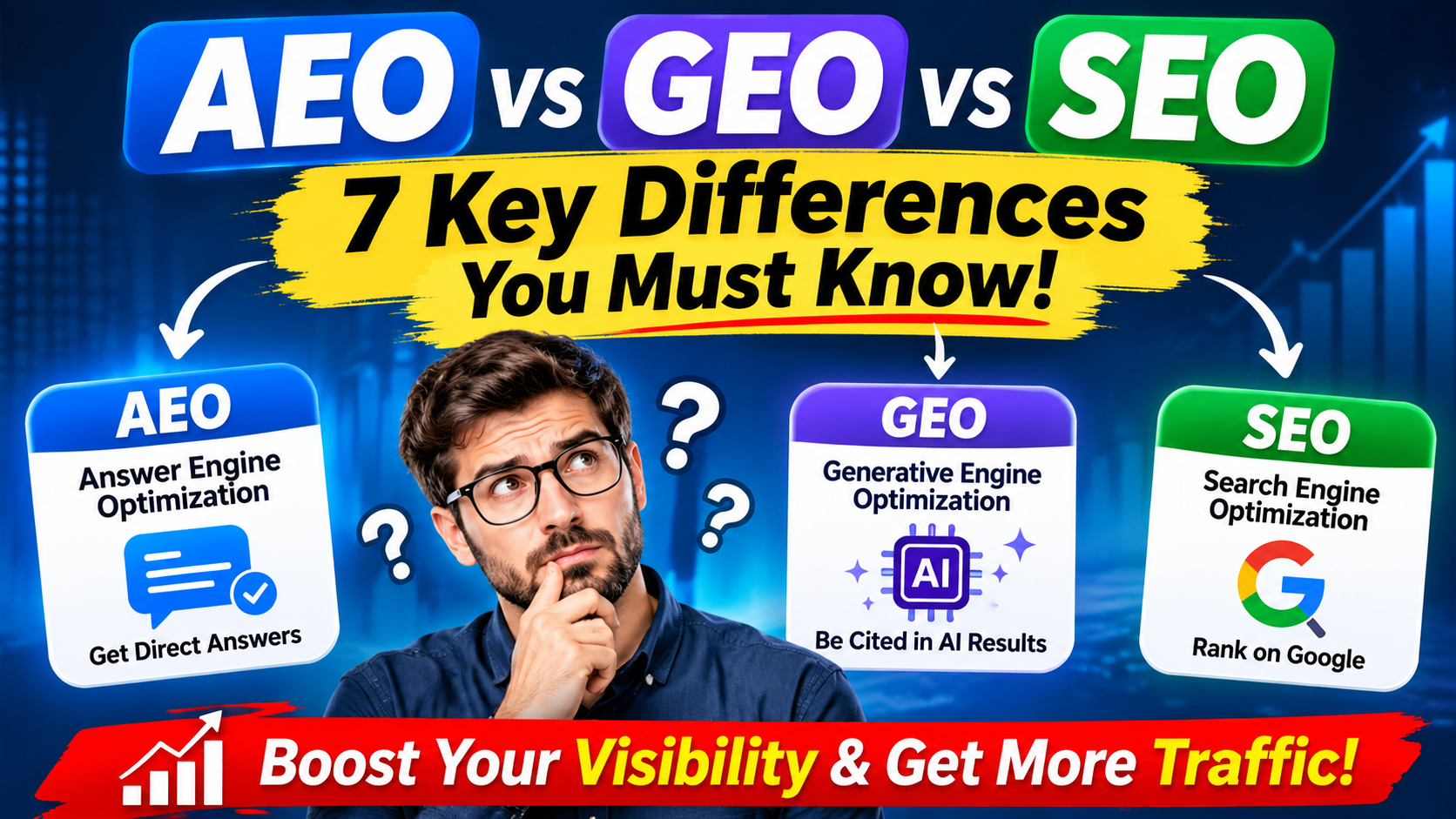
This shift has introduced three important digital marketing concepts: Search Engine Optimization (SEO), Answer Engine Optimization (AEO), and Generative Engine Optimization (GEO).
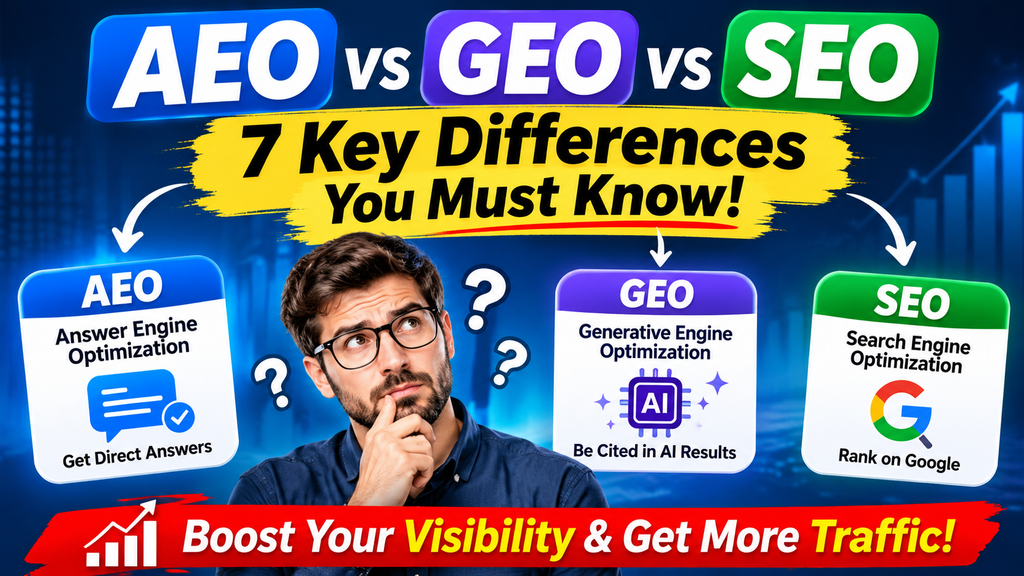
Although these strategies share the goal of improving online visibility, each serves a different purpose. SEO helps websites rank in traditional search engine results, AEO helps content appear as direct answers to users’ questions, and GEO focuses on improving the likelihood that AI-powered platforms will reference, summarize, or cite a brand’s content in generated responses.
For businesses looking to strengthen their digital presence, understanding these differences is essential. Rather than treating SEO, AEO, and GEO as competing strategies, companies should consider how they work together to create a comprehensive search visibility strategy.
In this guide, we will explore what SEO, AEO, and GEO mean, how they work, their key differences, and how businesses can use all three to build authority, reach potential customers, and generate sustainable growth.
What Is SEO (Search Engine Optimization)?
Search Engine Optimization (SEO) is the process of improving a website’s visibility in organic search engine results. It involves optimizing website content, technical performance, site structure, and authority to help search engines understand its relevance and quality for specific search queries.
When someone searches for a product, service, or topic on Google or Bing, search engines evaluate numerous factors to determine which pages should appear in the results. SEO helps businesses make their websites more accessible, relevant, and useful for both search engines and visitors.
How Does SEO Work?
SEO focuses on helping search engines discover, crawl, understand, index, and rank website content. A successful SEO strategy typically includes three major areas:
1. On-Page SEO
On-page SEO involves optimizing individual website pages to improve their relevance and usefulness for specific search queries.
Key activities include:
- Conducting keyword research and identifying relevant search terms.
- Creating informative, original, and search-intent-focused content.
- Optimizing title tags, meta descriptions, and heading structures.
- Using relevant keywords naturally throughout the content.
- Adding descriptive image alt text and optimizing images.
- Creating internal links between relevant website pages.
- Structuring URLs to make them clear and descriptive.
2. Technical SEO
Technical SEO focuses on improving the technical foundation of a website so search engines can access and understand its content efficiently.
Important technical SEO activities include:
- Improving website loading speed and performance.
- Ensuring mobile responsiveness and usability.
- Implementing HTTPS and secure browsing.
- Creating and maintaining XML sitemaps.
- Configuring robots.txt correctly.
- Fixing broken links, redirects, and crawl errors.
- Resolving duplicate content and indexing issues.
- Implementing structured data where appropriate.
- Improving Core Web Vitals and overall page experience.
3. Off-Page SEO
Off-page SEO includes activities performed outside a website to strengthen its reputation, authority, and credibility.
Common off-page SEO activities include:
- Earning relevant, high-quality backlinks.
- Building brand mentions across trusted websites.
- Publishing expert contributions and guest articles.
- Developing industry relationships and digital PR opportunities.
- Encouraging genuine customer reviews and testimonials.
- Building a consistent brand presence across relevant platforms.
Benefits of SEO for Businesses
SEO helps businesses establish a strong foundation for long-term organic visibility.
Key benefits include:
- Increased Organic Traffic: Reach people actively searching for your products, services, or expertise.
- Improved Search Visibility: Increase opportunities for relevant pages to appear in search results.
- Higher Brand Credibility: Build trust by providing useful content and demonstrating industry expertise.
- Better User Experience: Improve navigation, mobile usability, website performance, and content accessibility.
- Qualified Lead Generation: Attract visitors whose search intent aligns with your business offerings.
- Long-Term Marketing Value: Build an organic presence that can continue attracting visitors beyond individual advertising campaigns.
SEO remains an essential digital marketing strategy because traditional search engines continue to play a significant role in online discovery and purchasing decisions.
What Is AEO (Answer Engine Optimization)?
Answer Engine Optimization (AEO) is the process of structuring and optimizing website content so that answer-focused platforms can easily identify, understand, and present it in response to users’ questions.
Unlike traditional SEO, which often focuses on improving rankings for search queries, AEO places greater emphasis on providing clear, accurate, and direct answers.
People increasingly search using conversational questions such as:
- What is the cost of developing an ecommerce website?
- How does AI automation help small businesses?
- Which CRM platform is best for a growing company?
- How long does it take to develop a mobile application?
- What are the benefits of cloud-based software?
Answer engines aim to provide relevant responses without requiring users to visit multiple websites. Depending on the platform and query, these responses may appear as featured snippets, answer boxes, voice search responses, or other direct-answer experiences.
How Does AEO Work?
AEO focuses on making information easy for search and answer systems to identify, interpret, and use.
A well-planned AEO strategy includes the following activities:
1. Targeting Question-Based Keywords
Identify the questions your potential customers ask when researching products, services, or solutions.
Useful research methods include:
- Google autocomplete suggestions.
- People Also Ask results.
- Related searches.
- Customer support questions.
- Industry forums and community discussions.
- Keyword research tools.
Organize these questions according to search intent and create content that addresses each topic accurately.
2. Providing Clear and Direct Answers
Answer the primary question near the beginning of the relevant section instead of making readers search through several paragraphs.
For example:
Question: What is custom software development?
Answer: Custom software development is the process of designing, building, testing, and maintaining software applications specifically tailored to an organization’s business requirements, workflows, and operational goals.
After providing a direct answer, expand the topic with relevant explanations, examples, and practical insights.
3. Creating Structured and Readable Content
Organize content so that users and search systems can easily understand the relationship between questions and answers.
Recommended content formats include:
- Clearly defined H1, H2, and H3 headings.
- Question-based headings.
- Short explanatory paragraphs.
- Numbered instructions and bullet points.
- Comparison tables.
- Step-by-step guides.
- Relevant FAQ sections.
4. Implementing Relevant Structured Data
Structured data helps search engines understand specific information on a webpage.
Depending on the content, businesses may use appropriate schema types such as:
- Article schema.
- Organization schema.
- Product schema.
- Service-related structured data where applicable.
- BreadcrumbList schema.
- SoftwareApplication schema for relevant software products.
Structured data must accurately represent visible page content. Adding schema does not guarantee featured snippets, rich results, or AI-generated answers.
5. Demonstrating Expertise and Credibility
Answer engines need useful, reliable information. Businesses should publish content that demonstrates practical knowledge and provides meaningful answers.
This includes:
- Explaining concepts with real-world examples.
- Providing accurate and updated information.
- Identifying credible sources when making factual claims.
- Including relevant expert insights.
- Maintaining consistent business information.
- Avoiding unsupported claims and unnecessary keyword repetition.
Benefits of AEO for Businesses
AEO helps businesses make their expertise more accessible through answer-focused search experiences.
Its key benefits include:
- Greater Answer Visibility: Improve the structure and clarity of content for answer-oriented search experiences.
- Voice Search Readiness: Make information easier to interpret for conversational and voice-based queries.
- Featured Snippet Opportunities: Create concise, relevant answers that may qualify for featured snippets.
- Improved Content Accessibility: Help visitors find important information quickly.
- Stronger Topical Authority: Cover customer questions comprehensively and demonstrate subject expertise.
- Better Customer Engagement: Address common concerns during different stages of the buying journey.
AEO is particularly useful for service-based businesses, SaaS companies, educational websites, healthcare organizations, and businesses that receive recurring customer questions.
What Is GEO (Generative Engine Optimization)?
Generative Engine Optimization (GEO) is the practice of improving a brand’s content, information, and online presence so that generative AI platforms can more effectively discover, understand, evaluate, and potentially reference the brand in AI-generated responses.
Generative AI platforms can synthesize information from multiple sources to provide conversational answers. Examples include ChatGPT, Google AI experiences, Perplexity, and Microsoft Copilot.
For instance, a business owner might ask an AI platform:
“Which companies provide reliable AI automation solutions for ecommerce businesses?”
Instead of displaying only a traditional list of search results, a generative platform may produce a summarized response containing explanations, recommendations, and references to relevant sources.
GEO focuses on increasing the likelihood that a business’s information will be considered relevant and useful in these generative search experiences.
However, no GEO strategy can guarantee that a particular AI platform will mention, recommend, or cite a business.
How Does GEO Work?
GEO focuses on improving content quality, brand understanding, factual consistency, and information accessibility across the digital ecosystem.
A comprehensive GEO strategy generally includes the following activities:
1. Publishing Original and Information-Rich Content
Generative systems benefit from content that provides meaningful information rather than simply repeating existing material.
Businesses should create:
- Detailed industry guides.
- Original research and surveys.
- Data-driven articles.
- Technical explanations.
- Practical case studies.
- Expert commentary.
- Product and service comparisons.
- Industry-specific solution pages.
Original insights, meaningful statistics, and clearly explained processes can make content more informative and useful.
2. Strengthening Brand Entity Recognition
A brand should have a consistent and identifiable presence across its website and other trusted online sources.
Important activities include:
- Maintaining consistent business names and descriptions.
- Publishing detailed About Us and service pages.
- Using Organization schema where appropriate.
- Maintaining accurate business profiles.
- Building credible industry-related brand mentions.
- Keeping company information consistent across relevant platforms.
- Associating the brand with clearly defined products, services, and areas of expertise.
The objective is to make it easier for information systems and potential customers to understand what a business does and what makes it relevant.
3. Building Topical Authority
Generative engines need context to understand which businesses and sources are relevant to particular subjects.
Businesses can strengthen their topical coverage by creating interconnected content around their primary areas of expertise.
For example, an AI development company could publish related resources about:
- AI agent development.
- Machine learning applications.
- AI-powered customer support.
- Business process automation.
- Predictive analytics.
- AI integration and implementation.
- Industry-specific AI solutions.
A well-organized content ecosystem helps communicate the depth and scope of a company’s expertise.
4. Improving Content Clarity and Extractability
Content should be easy to interpret, summarize, and reference.
Recommended practices include:
- Using descriptive headings.
- Providing concise definitions.
- Explaining technical terminology.
- Including relevant statistics with sources.
- Using comparison tables where appropriate.
- Separating individual ideas into clear sections.
- Adding specific examples and practical explanations.
- Identifying the author or organization responsible for the content.
5. Earning Relevant Third-Party Mentions
A brand’s reputation extends beyond its own website.
Relevant references from industry publications, professional communities, reputable directories, business partners, and trusted websites can help establish its broader digital presence.
Focus on earning genuine mentions through:
- Digital PR campaigns.
- Industry contributions.
- Expert interviews.
- Original research publications.
- Relevant partnerships.
- Professional community participation.
- High-quality editorial coverage.
Third-party mentions should be authentic and relevant rather than generated through artificial mention-building schemes.
6. Making Website Content Accessible
Technical accessibility remains important for GEO.
Businesses should ensure that:
- Important content is available in crawlable HTML.
- Pages are not unintentionally blocked from relevant crawlers.
- Website navigation is logically structured.
- Content is accessible without unnecessary technical barriers.
- Canonical tags and redirects are configured correctly.
- Key information is not available exclusively inside inaccessible scripts or embedded elements.
- Website content is regularly reviewed and updated.
Different AI platforms use different retrieval, indexing, crawling, and source-selection systems. Their access requirements and policies should be reviewed individually.
Benefits of GEO for Businesses
GEO helps businesses prepare their digital presence for the growing use of generative AI in information discovery.
Key benefits include:
- AI Search Visibility: Improve the possibility of being referenced in relevant AI-generated responses.
- Brand Discovery: Create additional opportunities for potential customers to encounter your business through conversational AI platforms.
- Brand Authority: Strengthen your reputation through original content and credible third-party references.
- Competitive Differentiation: Present specialized expertise and business solutions in a clear, informative way.
- Decision-Making Support: Help prospective customers understand your services, capabilities, and industry knowledge.
- Future-Ready Digital Presence: Adapt your content strategy to evolving search and discovery experiences.
GEO is especially relevant for B2B companies, technology providers, SaaS businesses, professional service firms, and organizations targeting customers who use AI tools for research and vendor evaluation.
AEO vs. GEO vs. SEO: Key Differences
SEO, AEO, and GEO are closely related but have different optimization priorities. Understanding these differences helps businesses allocate resources and develop a more effective digital marketing strategy.
| Comparison Factor | SEO | AEO | GEO |
|---|---|---|---|
| Full Form | Search Engine Optimization | Answer Engine Optimization | Generative Engine Optimization |
| Primary Goal | Improve organic search visibility | Improve visibility in direct-answer experiences | Improve visibility in AI-generated responses |
| Main Focus | Rankings, relevance, technical health, and authority | Clear and accurate answers to user questions | Brand understanding, content quality, and AI discoverability |
| Common Platforms | Google, Bing | Featured snippets, voice assistants, answer-focused search | ChatGPT, Google AI experiences, Perplexity, Microsoft Copilot |
| Content Approach | Search-intent-focused pages and articles | Question-based content and concise answers | Original insights, authoritative resources, and contextual information |
| Keyword Strategy | Primary, secondary, and long-tail keywords | Conversational and question-based queries | Natural-language topics, entities, and contextual search intent |
| Technical Priorities | Crawling, indexing, site speed, mobile usability | Structured content and relevant schema | Content accessibility, crawlability, and clear entity information |
| Authority Signals | Relevant backlinks, brand reputation, and expertise | Credible information and demonstrated expertise | Trusted references, original research, and consistent brand information |
| Measurement | Rankings, organic traffic, impressions, conversions | Answer visibility, featured snippets, and relevant traffic | AI citations, brand mentions, referral traffic, and assisted conversions |
| Business Outcome | Sustainable organic discovery | Greater opportunities to provide direct answers | Greater opportunities for AI-driven brand discovery |
The most important distinction is that SEO focuses on search visibility, AEO focuses on answer visibility, and GEO focuses on visibility within generative AI experiences.
These strategies overlap significantly. High-quality content, technical accessibility, factual accuracy, and a strong reputation can support all three.
SEO vs. AEO vs. GEO: Practical Examples
Understanding these strategies becomes easier when we look at how a single business topic can be optimized for different search experiences.
Consider a company that provides custom web development services.
Example 1: Traditional SEO
Target keyword: Custom Web Development Services
The company creates a dedicated service page optimized around the keyword.
The page includes:
- Custom web development capabilities.
- Technologies and frameworks.
- Development process.
- Industry-specific solutions.
- Project examples.
- Relevant FAQs.
- Clear contact and consultation options.
The primary objective is to improve the page’s visibility in traditional organic search results.
Example 2: Answer Engine Optimization
Target question: How much does custom web development cost?
The company publishes a detailed article answering this question.
The content explains:
- Factors that influence development costs.
- Differences between simple and complex projects.
- Technology requirements.
- Design and integration considerations.
- Maintenance and ongoing support.
- Questions businesses should ask before hiring a development partner.
The article provides a direct introductory answer and then expands on the subject.
The objective is to make the information useful for question-based searches and answer-focused experiences.
Example 3: Generative Engine Optimization
Target topic: Best custom web development solutions for growing businesses
The company publishes a comprehensive resource containing:
- Original insights into website development.
- Comparisons of different development approaches.
- Industry-specific use cases.
- Technical recommendations.
- Relevant case studies.
- Expert commentary.
- Credible references.
- Clear information about its development expertise.
The objective is to build a credible, informative digital presence that generative AI platforms may discover and reference when responding to relevant queries.
These three examples demonstrate how one subject can support different optimization objectives without requiring completely separate content strategies.
Can SEO, AEO, and GEO Work Together?
Yes. SEO, AEO, and GEO are most effective when integrated into a unified digital visibility strategy.
Businesses do not need to abandon traditional SEO to adopt AEO or GEO. Instead, they can build on their existing SEO foundation and expand their content strategy to accommodate changing search behavior.
Consider the following integrated approach:
Step 1: Build a Strong SEO Foundation
Start with technical SEO, keyword research, website architecture, search-intent analysis, and high-quality content.
Ensure that important website pages can be crawled and indexed correctly.
Step 2: Optimize Content for Direct Answers
Identify common customer questions and incorporate relevant answers into service pages, blog articles, and dedicated FAQ resources.
Use descriptive headings and concise explanations to improve content clarity.
Step 3: Develop a GEO-Focused Content Strategy
Create authoritative resources that demonstrate practical expertise.
Include original research, relevant data, case studies, industry insights, and meaningful third-party references.
Step 4: Strengthen Brand Authority
Maintain accurate business information and build a credible online presence through relevant publications, partnerships, professional communities, and industry contributions.
Step 5: Measure and Improve Performance
Monitor traditional organic search performance, answer-focused visibility, AI references, referral traffic, and business conversions.
Use these insights to identify opportunities and improve content over time.
An integrated approach allows businesses to build visibility across multiple discovery channels while maintaining a consistent brand message.
How to Measure SEO, AEO, and GEO Performance
Measuring performance is essential to understanding whether your optimization efforts are generating meaningful business results.
However, each strategy requires different measurement methods.
SEO Performance Metrics
Businesses can evaluate SEO performance using:
- Organic clicks and impressions.
- Keyword rankings.
- Organic website sessions.
- Click-through rates (CTR).
- Indexed pages.
- Organic conversion rates.
- Qualified leads from organic search.
- Backlink quality and referring domains.
- Core Web Vitals and technical health.
Tools such as Google Search Console, Google Analytics 4, and professional SEO platforms can help monitor these metrics.
AEO Performance Metrics
AEO measurement can focus on:
- Featured snippet visibility.
- Performance for question-based queries.
- Search impressions and clicks for conversational queries.
- Voice search performance where measurable.
- Visibility in answer-focused search experiences.
- Engagement with FAQ and informational content.
- Conversions from relevant answer-driven traffic.
Not all answer appearances are independently measurable, so businesses should combine available search data with content performance and conversion analysis.
GEO Performance Metrics
GEO measurement is still developing, and there is no universal reporting standard across AI platforms.
Useful indicators include:
- Brand mentions in AI-generated responses.
- AI-generated citations and source references.
- Referral traffic from AI platforms.
- Relevant branded search growth.
- Visibility across a consistent set of industry-related prompts.
- Accuracy of brand information in AI responses.
- Leads and conversions influenced by AI-driven discovery.
Businesses can periodically test relevant customer questions across selected AI platforms and record whether their brand or website appears.
Because generative responses can change depending on context, location, personalization, and platform updates, these checks should be treated as directional indicators rather than definitive rankings.
Common Mistakes Businesses Should Avoid
While implementing SEO, AEO, and GEO, businesses should avoid practices that create unnecessary complexity or reduce content quality.
1. Treating GEO as a Replacement for SEO
Traditional search engines remain important discovery channels. Ignoring technical SEO, indexing, and organic search performance can weaken the overall digital strategy.
2. Writing Content Only for AI Platforms
Content should serve real people first. Articles filled with repetitive phrases, artificial questions, or unnecessary summaries are unlikely to provide meaningful value.
3. Overusing Keywords
Repeating keywords unnaturally does not make content more authoritative. Focus on relevance, completeness, and natural language.
4. Publishing Unsupported Claims
Avoid fabricated statistics, exaggerated business results, and unverified industry statements. Use credible sources and clearly explain the context behind data.
5. Ignoring Brand Consistency
Inconsistent business names, descriptions, services, and company information can create confusion for potential customers and information systems.
6. Relying on Schema Alone
Structured data can help search engines interpret page content, but it does not guarantee rankings, featured snippets, or AI citations.
7. Ignoring Website Technical Health
Slow pages, broken links, inaccessible content, and indexing problems can undermine visibility across multiple discovery channels.
8. Measuring Only Rankings
Rankings are important, but they do not represent the entire customer journey. Businesses should also measure qualified traffic, brand discovery, engagement, and conversions.
Which Strategy Should Your Business Prioritize?
The right approach depends on your business model, target audience, industry, and current digital marketing performance.
| Business Type | Recommended Focus |
|---|---|
| Ecommerce Businesses | SEO + AEO + GEO |
| SaaS Companies | SEO + GEO + AEO |
| B2B Service Providers | SEO + GEO + AEO |
| Local Businesses | Local SEO + AEO + GEO |
| Educational Websites | SEO + AEO + GEO |
| Technology Companies | SEO + GEO + AEO |
| Professional Service Firms | SEO + AEO + GEO |
| New Business Websites | SEO Foundation + AEO + GEO |
For most businesses, SEO should provide the technical and content foundation. AEO can help address customer questions more effectively, while GEO can expand the strategy toward generative AI discovery.
The priority should be based on actual business opportunities rather than following every emerging marketing trend.
How HT Business Group Helps Businesses Improve Digital Visibility
Building a strong digital presence requires more than publishing blog posts or adding keywords to website pages. Businesses need a coordinated approach that connects website development, search optimization, content strategy, and technology.
HT Business Group helps businesses strengthen their digital presence through technology-driven solutions and digital services designed to support their business objectives.
Our capabilities include:
Search Engine Optimization (SEO)
We help businesses improve their organic search foundations through keyword research, technical website optimization, on-page improvements, content strategy, and authority-building initiatives.
Website Design and Development
We create business websites focused on usability, performance, responsive design, and scalable functionality. A well-developed website provides the technical foundation needed to support long-term digital marketing activities.
Content Strategy and Optimization
We help businesses develop relevant website content, service pages, and informative resources that address customer search intent and communicate their expertise.
AI and Business Automation Solutions
We help organizations explore AI-driven technologies and automation opportunities that support operational efficiency, customer experiences, and business growth.
Digital Marketing Solutions
Our digital marketing capabilities help businesses strengthen their online presence, connect with relevant audiences, and create opportunities for sustainable lead generation.
Whether you want to improve your website’s organic search performance, create more answer-focused content, or prepare your digital presence for AI-driven discovery, HT Business Group can help you develop a strategy aligned with your business goals.
Frequently Asked Questions (FAQs)
1. What is the main difference between SEO, AEO, and GEO?
SEO focuses on improving a website’s visibility in traditional organic search results. AEO focuses on optimizing content to provide direct answers to user questions, while GEO focuses on improving the likelihood of a brand’s content being discovered, referenced, or cited in AI-generated responses.
2. Is GEO replacing traditional SEO?
No. GEO is not a replacement for SEO. Traditional search engines remain important sources of website traffic and customer discovery. GEO extends optimization efforts to generative AI platforms, making an integrated approach more valuable for businesses.
3. Is AEO a part of SEO?
AEO is closely related to SEO and shares several optimization principles, including content quality, search intent, technical accessibility, and structured information. However, AEO places greater emphasis on direct answers and answer-focused search experiences.
4. How can I optimize my website for AI search?
Start by publishing accurate, useful, and original content. Organize information with descriptive headings, explain your products and services clearly, maintain consistent brand information, implement relevant structured data, and make important website content accessible to search systems.
5. Does GEO require a separate website or content strategy?
No. Businesses can build GEO into their existing SEO and content strategies. Improving content quality, demonstrating expertise, publishing original insights, and maintaining a consistent digital presence can support both traditional and generative search visibility.
6. How long does it take to see results from SEO, AEO, and GEO?
There is no fixed timeline. Results depend on factors such as website history, competition, content quality, technical health, brand authority, and platform-specific discovery processes. SEO improvements may take time to translate into measurable organic performance, while AEO and GEO visibility can vary across queries and platforms.
7. Which tools can help measure SEO, AEO, and GEO?
Google Search Console and Google Analytics 4 are useful for monitoring organic search and website performance. Professional SEO tools can support keyword and competitor analysis. For GEO, businesses can use consistent AI prompt testing, citation monitoring, referral analytics, and brand mention tracking.
8. Can small businesses benefit from AEO and GEO?
Yes. Small businesses can use AEO to answer customer questions and GEO to communicate their expertise through informative content and a consistent online presence. These strategies can complement a well-planned SEO foundation.
9. Does structured data guarantee AI search visibility?
No. Structured data helps eligible search systems interpret information, but it does not guarantee that a website will appear in featured snippets or AI-generated responses. Content relevance, accuracy, accessibility, and platform-specific systems also influence visibility.
10. Should businesses invest in SEO, AEO, and GEO together?
For most businesses, an integrated strategy is a sensible long-term approach. SEO establishes organic search foundations, AEO improves the presentation of useful answers, and GEO extends the focus to generative AI discovery. The investment and implementation priorities should reflect business goals, resources, and audience behavior.
Final Thoughts: Build a Search Strategy for the Future
The way people discover businesses and evaluate information is changing. Traditional search engines, answer-focused experiences, and generative AI platforms are becoming important parts of the digital discovery journey.
SEO, AEO, and GEO are not competing approaches. They address different aspects of online visibility and can work together to help businesses reach customers across multiple search experiences.
By investing in technically sound websites, useful content, clear answers, original insights, and a credible brand presence, businesses can build a stronger foundation for long-term digital growth.
Ready to strengthen your online presence?
Connect with HT Business Group to explore website development, SEO, digital marketing, and AI-powered business solutions that align with your growth objectives.