
Quick Answer
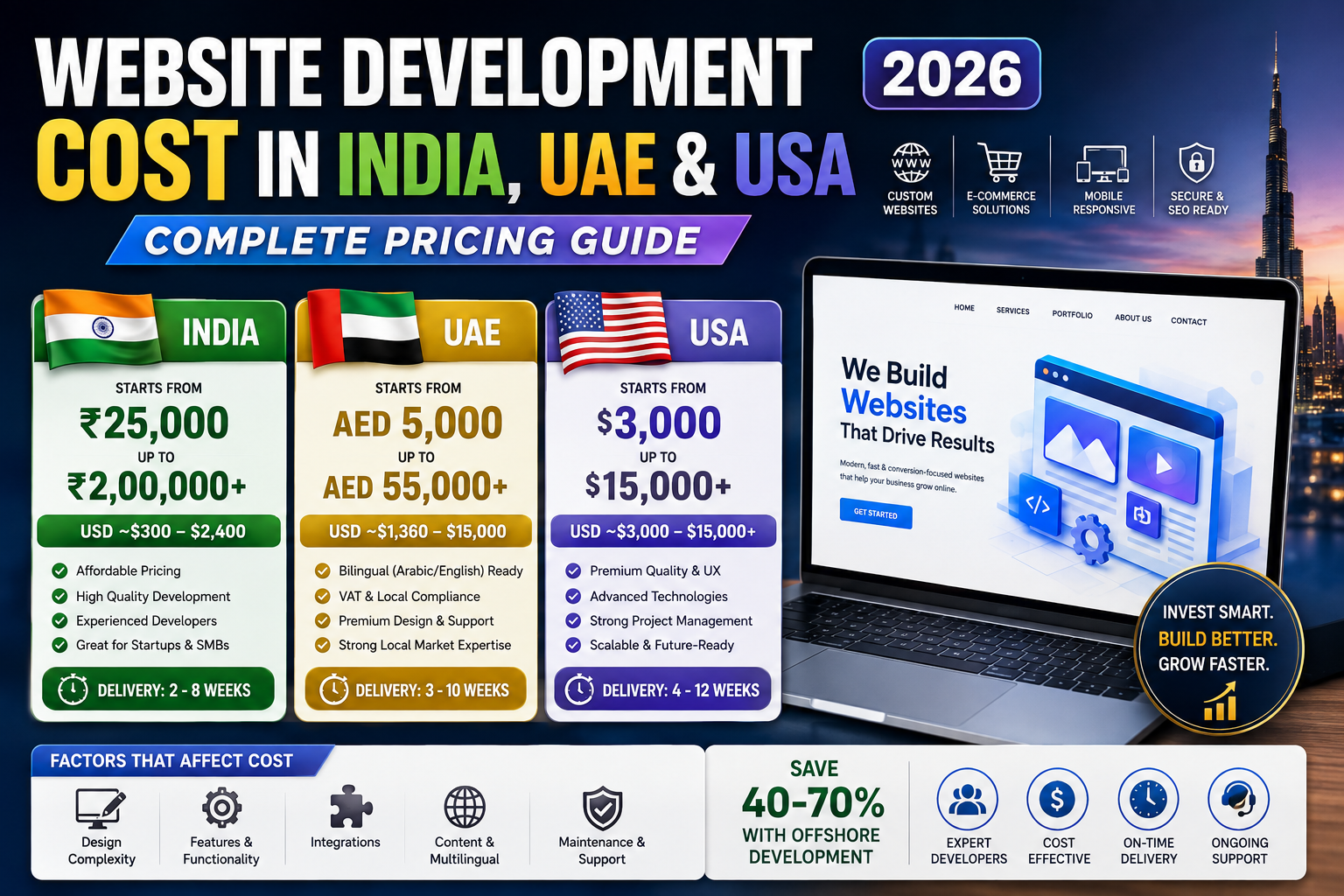
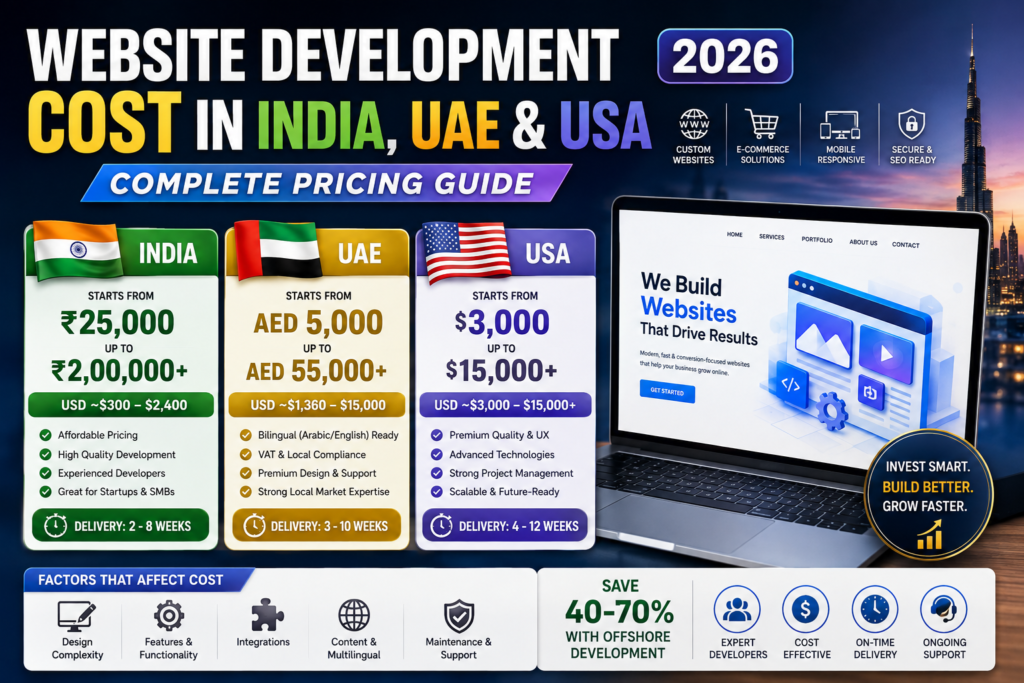
In 2026, a professional business website costs ₹25,000–₹2,00,000 (~$300–$2,400) in India, AED 5,000–55,000 (~$1,360–$15,000) in the UAE, and $3,000–$15,000 in the USA. Basic sites start lower and custom e-commerce or enterprise platforms run far higher in all three markets. India offers the lowest cost per feature, the UAE sits in the middle with strong bilingual requirements, and the USA has the highest rates but often the most mature project management and support.
Key Takeaways
- India: ₹10,000–₹2,50,000 for most business sites; ₹50,000–₹8,00,000+ for e-commerce; hourly rates of $15–$60.
- UAE: AED 3,500–55,000 for most business sites; AED 15,000–150,000+ for e-commerce and custom platforms; hourly rates of AED 50–350.
- USA: $2,000–$15,000 for most business sites; $8,000–$50,000+ for e-commerce; hourly rates of $50–$250.
- Platform choice (WordPress, Shopify, Webflow, or custom code) moves the price more than almost any other single factor.
- Offshore and hybrid teams (e.g., an Indian development team serving a UAE or US client) can cut costs by 40–70% versus fully local agencies, provided time zone and communication overlap are managed well.
- Ongoing costs — hosting, maintenance, SSL, and plugin licenses — typically add 10–20% of the build cost every year and are the most commonly underestimated line item.
Why Website Costs Vary So Much
A website is not one product — it is a bundle of design work, engineering hours, third-party tools, and ongoing support. Two businesses asking for “a website” can get quotes that differ tenfold, and both quotes can be fair, because they describe different scopes.
Four variables explain almost all of the price difference between a $500 site and a $50,000 site:
- Where the team is based. Labor cost is the single biggest driver of the final invoice. A developer’s hourly rate in Mumbai, Dubai, and San Francisco can differ by 5–10x for comparable skill levels.
- What the site needs to do. A five-page brochure site and a 500-product online store with inventory sync are not the same engineering problem.
- Custom design vs template. A purchased theme with color changes costs a fraction of a from-scratch Figma design system.
- Who builds it. Freelancers, boutique agencies, full-service agencies, and in-house teams all price differently because they carry different overhead and offer different levels of accountability.
Understanding these four levers lets you read any quote — Indian, Emirati, or American — and know whether it’s fair for the scope described.
Website Development Cost in India (2026)
India remains one of the most cost-efficient markets globally for website development, which is why many UAE and US businesses outsource part or all of their build to Indian teams.
Typical 2026 ranges:
| Website Type | Cost Range (INR) | Approx. USD |
| Basic landing page / portfolio | ₹5,000 – ₹20,000 | $60 – $240 |
| Small business / brochure website | ₹25,000 – ₹1,50,000 | $300 – $1,800 |
| Corporate website with CMS | ₹80,000 – ₹2,50,000 | $960 – $3,000 |
| E-commerce website | ₹50,000 – ₹8,00,000+ | $600 – $9,600+ |
| Custom web application / SaaS | ₹3,00,000 – ₹10,00,000+ | $3,600 – $12,000+ |
Hourly rates: Indian developers and agencies typically bill $15–$60 per hour (₹1,200–₹5,000), compared with $80–$250 per hour in the US. This gap is the main reason global businesses treat India as a primary outsourcing destination for web projects.
Why India is cheap without necessarily being low quality: Cost of living and average developer salaries are lower than in the US, UK, or UAE, so the same skill level costs less to hire. WordPress remains the dominant platform choice for Indian SMB projects because it minimizes custom development hours while still giving the client a manageable CMS.
Where costs climb in India: Multilingual sites, payment gateway integrations (Razorpay, PayU, Cashfree), inventory-heavy e-commerce, and government or BFSI (banking, financial services, insurance) compliance requirements all push Indian project costs toward the higher end of the range.
Website Development Cost in the UAE (2026)
The UAE market sits between India and the USA on price, shaped by high commercial rents, a competitive digital economy, and near-universal bilingual (Arabic/English) requirements.
Typical 2026 ranges (Dubai, Abu Dhabi, Sharjah are broadly similar):
| Website Type | Cost Range (AED) | Approx. USD |
| Basic business website | AED 3,500 – 8,000 | $950 – $2,180 |
| Corporate website with CMS | AED 12,000 – 55,000 | $3,270 – $15,000 |
| E-commerce website | AED 15,000 – 110,000+ | $4,080 – $30,000+ |
| Custom enterprise platform | AED 50,000 – 275,000+ | $13,600 – $75,000+ |
Hourly rates: UAE freelancers start around AED 50 per hour, while specialist local agencies bill AED 150–350 per hour. Many UAE businesses now hire hybrid teams — a Dubai-based project manager paired with an offshore (often Indian) development team — to control cost while keeping local accountability.
What makes UAE projects more expensive than India for similar scope:
- Bilingual/RTL (right-to-left) Arabic support typically adds AED 3,000–8,000 to a project, since it is not a simple translation layer but a full layout and typography adjustment.
- VAT compliance and local payment gateways (Telr, Tabby, Network International) require integration work not needed in other markets.
- Higher commercial overhead for Dubai- and Abu Dhabi-based agencies is passed through in hourly rates.
Offshore savings: UAE businesses that hire offshore teams for development, while keeping a local point of contact, commonly report 40–60% savings versus a fully local Dubai agency for comparable scope and quality.
Website Development Cost in the USA (2026)
The USA has the highest average website costs of the three markets, driven by developer salaries, agency overhead, and higher client expectations around UX research, accessibility, and post-launch support.
Typical 2026 ranges:
| Website Type | Cost Range (USD) |
| Landing page / simple site | $300 – $2,000 |
| Small business website | $2,000 – $10,000 |
| Custom professional website | $3,000 – $15,000 |
| E-commerce website | $5,000 – $50,000 |
| Custom web application / SaaS MVP | $50,000 – $500,000+ |
Hourly rates: US agencies average $100–$250 per hour; freelancers typically charge $50–$150 per hour. According to Clutch’s aggregated client-review pricing data, most web development companies globally charge $25–$49 per hour, meaning US agency rates sit well above the global median — a premium clients are often paying for stronger project management, native-language communication, and faster iteration cycles.
Why the US costs more for comparable scope:
- Developer salaries and cost of living are the highest of the three markets.
- Buyers increasingly demand custom, conversion-focused design rather than template installs — Clutch’s 2026 survey found that the share of small-business buyers spending under $10,000 has fallen from prior years as expectations rise.
- Compliance needs — ADA/WCAG accessibility, state-level privacy law (e.g., CCPA), and payment security (PCI-DSS) — add engineering and QA hours not always priced into offshore quotes.
Side-by-Side Comparison Table
| Factor | India | UAE | USA |
| Basic website | ₹10,000–25,000 (~$120–$300) | AED 3,500–8,000 (~$950–$2,180) | $300–$2,000 |
| Small business site | ₹25,000–1,50,000 (~$300–$1,800) | AED 12,000–30,000 (~$3,270–$8,170) | $2,000–$10,000 |
| E-commerce site | ₹50,000–8,00,000 (~$600–$9,600) | AED 15,000–110,000 (~$4,080–$30,000) | $5,000–$50,000 |
| Hourly rate | $15–$60 | $60–$95 (AED 50–350) | $50–$250 |
| Typical build time | 2–8 weeks | 3–10 weeks | 4–12 weeks |
| Dominant platform | WordPress | WordPress / Shopify / Next.js | WordPress / Shopify / custom |
| Key added cost | Payment gateway, multilingual | Arabic RTL, VAT compliance | Accessibility, privacy compliance |
| Typical savings via offshoring | N/A (often the offshore destination) | 40–60% | 50–70% |
How to read this table: If you are comparing a quote from each region for the same scope of work — say, a 10-page corporate site with a contact form and blog — expect the US quote to be roughly 5–8x the Indian quote and roughly 2–3x the UAE quote. That gap narrows for highly custom or compliance-heavy work, where engineering hours (not geography) start to dominate the price.
Cost by Website Type
Basic / Landing Page Website
A single-page or few-page site built to establish credibility or capture leads. Usually template-based with minor customization.
- India: ₹5,000–₹25,000
- UAE: AED 3,500–8,000
- USA: $300–$2,000
Small Business / Brochure Website
5–15 pages, CMS-backed (usually WordPress), mobile-responsive, basic on-page SEO.
- India: ₹25,000–₹1,50,000
- UAE: AED 12,000–30,000
- USA: $2,000–$10,000
E-commerce Website
Product catalog, cart, checkout, payment gateway, and often inventory management. Cost scales sharply with product count and integration complexity.
- India: ₹50,000–₹8,00,000+
- UAE: AED 15,000–110,000+
- USA: $5,000–$50,000+
Custom Web Application / SaaS Platform
Bespoke functionality, user accounts, dashboards, and often API integrations. This is software engineering, not website design, and is priced accordingly.
- India: ₹3,00,000–₹10,00,000+
- UAE: AED 50,000–275,000+
- USA: $50,000–$500,000+
What Actually Drives the Price
| Factor | Impact on Cost |
| Number of pages | More pages mean more design, content, and QA hours. |
| Custom design vs template | Custom Figma design with animations can cost 40–80% more than a themed build. |
| Platform choice | WordPress/Shopify keep costs down; fully custom code (React, Next.js, Laravel) raises them. |
| Integrations | Payment gateways, CRMs, WhatsApp/API connections typically add a fixed fee per integration. |
| Multilingual / RTL support | Common in the UAE; adds both design and QA time. |
| Compliance needs | Accessibility (US), VAT invoicing (UAE), data localization (India) all add engineering hours. |
| Content creation | Copywriting and original photography are often quoted separately and skipped in “cheap” quotes. |
| Team seniority | A senior developer at a higher hourly rate can be cheaper overall if they finish the same feature in far fewer hours. |
Expert tip: When comparing quotes, always ask what is excluded — content writing, stock photography, third-party software licenses, and post-launch support are the most common items left off a low quote to make it look cheaper than a competitor’s.
Freelancer vs Agency vs In-House vs Offshore
| Model | Best For | Typical Cost Position | Trade-off |
| Freelancer | Simple sites, tight budgets | Lowest | Limited bandwidth, single point of failure |
| Boutique/local agency | Mid-complexity business sites | Mid | Better process, still limited scale |
| Full-service agency | E-commerce, enterprise, ongoing marketing | High | Strong accountability, higher overhead |
| In-house team | Ongoing product development | Highest fixed cost, lowest marginal cost over time | Best for long-term, complex platforms |
| Offshore/hybrid team | Cost-sensitive UAE/US businesses | Low-to-mid | Requires strong communication and time-zone planning |
Pros and Cons Summary
- Freelancers — Pros: cheapest, flexible, direct communication. Cons: no backup if unavailable, variable quality control.
- Agencies — Pros: project management, QA process, accountability, easier to scale scope. Cons: higher hourly rates, sometimes slower due to process overhead.
- Offshore/hybrid teams — Pros: 40–70% cost savings, access to specialized skill at lower rates. Cons: time-zone coordination, potential communication gaps, need for a clear written spec.
Hidden and Ongoing Costs
Every market has recurring costs that are easy to miss when comparing only the “build” quote.
- Domain registration: $10–$20/year (~₹800–₹1,700 / AED 40–75) regardless of region.
- Hosting: $2–$120/month depending on traffic and platform; managed WordPress or Shopify plans sit at the higher end.
- SSL certificate: Often free via the host, but premium/EV certificates run $50–$300/year.
- Maintenance: $30–$500/month (₹2,500–₹40,000 / AED 100–1,800) covering updates, security patching, backups, and small content edits.
- Plugin/app licenses: $100–$500/year for e-commerce extensions (shipping, inventory, marketing add-ons).
- Payment gateway fees: Typically 2–3% per transaction across all three markets, on top of any setup fee.
Rule of thumb: Budget 10–20% of your original build cost every year for hosting, maintenance, and software renewals. Skipping this is the most common way businesses end up with an outdated, insecure, or broken site within 18 months.
Case Study Scenarios
Scenario 1 — Indian D2C skincare brand, WordPress + WooCommerce A 40-product WooCommerce store with a custom-designed homepage, Razorpay integration, and basic SEO landed at ₹1,40,000 (~$1,680) built by a 4-person boutique agency in 6 weeks. Ongoing hosting and maintenance runs ₹3,000/month.
Scenario 2 — Dubai-based consulting firm, bilingual corporate site A 12-page bilingual (Arabic/English) corporate site with a CMS, team bios, and a booking form was quoted at AED 28,000 (~$7,620) by a local agency, versus AED 14,500 (~$3,950) from a hybrid offshore team with a Dubai-based project manager — a 48% saving for functionally equivalent scope.
Scenario 3 — US-based B2B SaaS startup, custom web app An MVP with user authentication, a billing dashboard, and Stripe integration was quoted at $62,000 by a US development shop, with a 10-week timeline including UX research and QA — reflecting the higher engineering complexity of a web application rather than a marketing website.
Step-by-Step: How to Budget Your Website
- Define the website type first. Brochure site, e-commerce store, or custom application — this alone narrows your budget range by 5–10x.
- List required integrations. Payment gateways, CRMs, booking systems, and third-party APIs each carry a separate cost.
- Decide on design approach. Template-based keeps cost low; fully custom design raises it 40–80%.
- Choose your team model. Match freelancer, agency, or offshore hybrid to your budget and how mission-critical the site is.
- Get 3 quotes with identical scope documents. Send the same written specification to every vendor so quotes are comparable.
- Ask what’s excluded. Confirm whether content, photography, and post-launch support are included.
- Budget for year one running costs, not just the build — add 10–20% of build cost for hosting and maintenance.
- Set a contingency of 15–20% for scope changes, which occur on the majority of custom projects.
Mistakes to Avoid
- Choosing purely on lowest price. The cheapest quote often excludes content, revisions, or post-launch support, leading to costly change orders later.
- Skipping a written scope document. Verbal agreements are the top cause of budget overruns and disputes.
- Ignoring hosting and maintenance costs. A site with no maintenance plan is the most common target for security breaches.
- Underestimating multilingual/compliance needs. In the UAE, skipping Arabic RTL planning upfront can mean a costly redesign later. In the US, ignoring ADA/WCAG accessibility can create legal risk.
- Comparing hourly rate alone. A lower hourly rate with more hours can cost more than a higher rate with fewer, more efficient hours.
- No plan for content. Many delays happen not because of development, but because copy and images were never finalized.
Expert Tips
- Get itemized quotes, not lump-sum numbers. This makes it possible to negotiate individual line items rather than the whole project.
- Ask for a maintenance SLA (service level agreement) before signing, not after launch.
- For UAE projects, budget Arabic content translation and RTL QA as a separate line item — it is rarely a simple “add-on.”
- For US e-commerce, price in PCI-DSS and ADA compliance review as part of the initial quote, not an afterthought.
- For India-based outsourcing serving UAE/US clients, insist on daily async updates to bridge the time-zone gap and avoid costly miscommunication.
Frequently Asked Questions
1. What is the average website development cost in India in 2026?
Most Indian small business websites cost between ₹25,000 and ₹1,50,000, with e-commerce sites ranging from ₹50,000 to ₹8,00,000 depending on complexity.
2. What is the average website development cost in Dubai/UAE in 2026?
Basic business websites in the UAE range from AED 3,500 to AED 8,000, while corporate and e-commerce sites typically fall between AED 12,000 and AED 110,000.
3. What is the average website development cost in the USA in 2026?
Most US small business websites cost $2,000 to $10,000, while custom e-commerce builds range from $5,000 to $50,000 or more.
4. Why is website development so much cheaper in India than in the USA?
The gap comes primarily from developer salary differences, not quality differences. Hourly rates in India ($15–$60) are a fraction of US rates ($100–$250), driven by lower cost of living and operating overhead.
5. Is it safe to outsource website development from the UAE or USA to India?
Yes, provided you use a written scope document, verify past client references, and set clear communication cadences. Many UAE and US businesses run hybrid models with a local project manager and an offshore Indian development team.
6. How much does e-commerce website development cost compared to a regular website?
E-commerce typically costs 2–5x more than an equivalent brochure site due to payment gateway integration, product catalog management, and security requirements.
7. Does WordPress reduce website development cost?
Yes. WordPress powers a large share of websites globally and reduces custom development time significantly compared with building from scratch, which is why it dominates budget-conscious projects in all three markets.
8. What ongoing costs should I budget for after launch?
Plan for domain renewal, hosting, SSL, plugin/app licenses, and maintenance — typically 10–20% of your original build cost annually.
9. How long does it take to build a website in 2026?
A basic site typically takes 2–4 weeks; a small business site 4–8 weeks; and a custom e-commerce or web application 8–20+ weeks depending on integration complexity.
10. Is a freelancer or an agency better for a small business website?
Freelancers suit simple, budget-conscious projects with a single decision-maker. Agencies suit projects needing project management, QA processes, and long-term scalability.
11. Why does a bilingual (Arabic/English) website cost more in the UAE?
RTL (right-to-left) layout support is a structural design and QA requirement, not a simple translation, typically adding AED 3,000–8,000 to a project.
12. What is the biggest hidden cost businesses forget to budget for?
Ongoing maintenance and content updates. Many businesses budget only for the initial build and are surprised by hosting, security, and update costs in year one.
13. Does a higher hourly rate always mean a more expensive project? Not necessarily. A senior developer at a higher hourly rate can complete the same feature in far fewer hours than a junior developer at a lower rate, sometimes resulting in a lower total cost.
14. How much should a small business budget for their first website?
Realistic first-website budgets are roughly ₹25,000–₹1,50,000 in India, AED 12,000–30,000 in the UAE, and $2,000–$10,000 in the USA for a professional, mobile-responsive, SEO-ready site.
15. Are there truly free ways to get a website?
DIY builders (e.g., free-tier website platforms) can get a basic site live at $0 upfront, but they typically carry monthly subscription fees, limited customization, and weaker SEO control compared with a professionally built site.