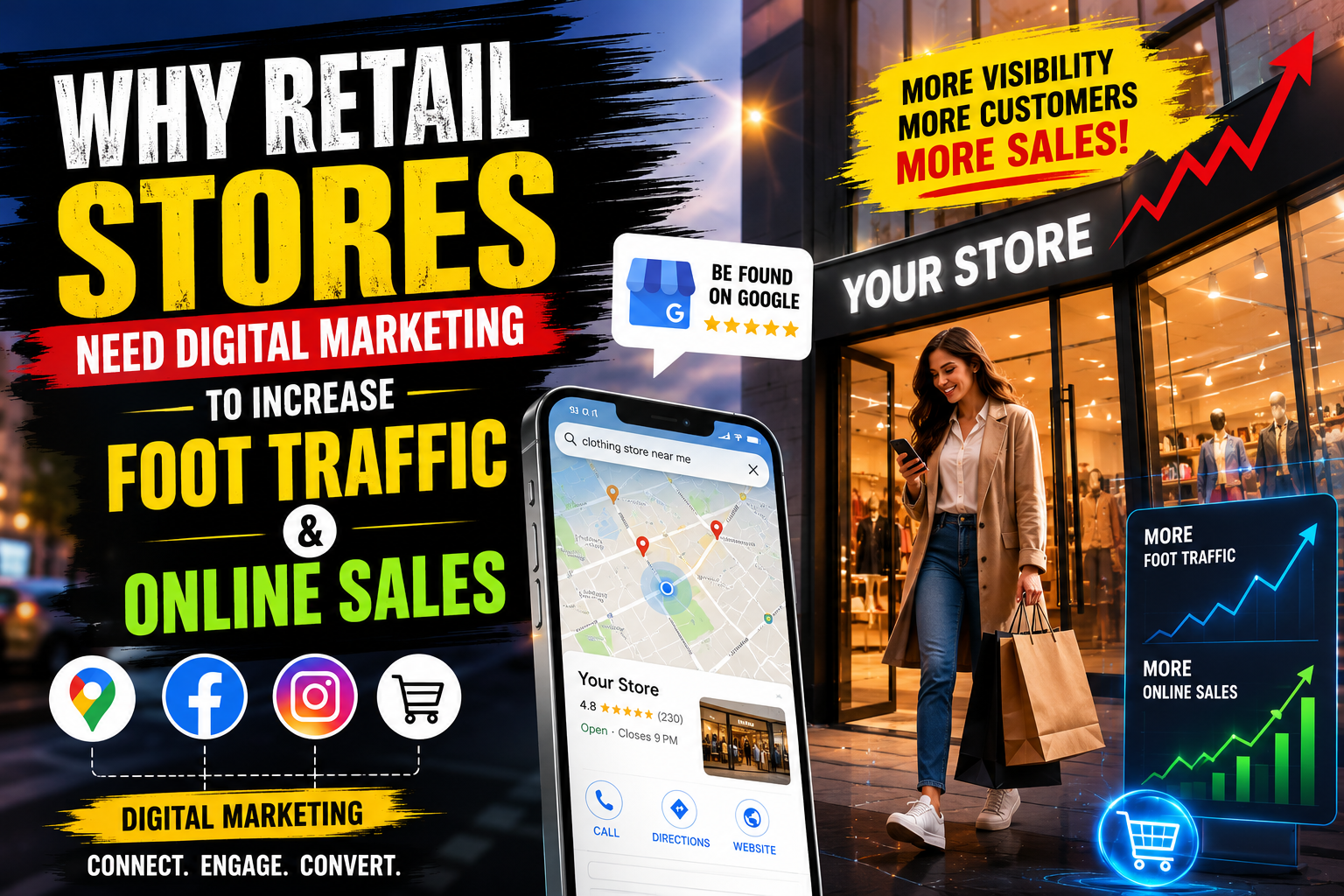
Retail success used to depend on location, window displays, and word of mouth. That model is gone. Today, almost every shopping trip — even one that ends in a physical store — starts with a phone.
Quick Answer
Retail stores need digital marketing because most shoppers now research, compare, and decide online before they ever walk through a door or click “buy.” Local SEO, Google Business Profile optimization, social media, and paid local ads put a store in front of nearby, high-intent buyers at the exact moment they’re deciding where to go and what to buy — driving both in-store visits and online sales.
Key Takeaways
- Nearly half of all Google searches carry local intent, and most “near me” searches lead to a store visit within a day.
- Digital research now precedes most in-store purchases — shoppers check hours, stock, reviews, and prices online before they ever leave home.
- Retailers with a strong store footprint see better online performance too; digital and physical channels reinforce each other rather than compete.
- Omnichannel retailers retain customers at roughly triple the rate of single-channel retailers and see meaningfully higher order values.
- Social commerce is now a real sales channel, not an experiment — it’s on track to top $100 billion in US sales this year.
- Retailers that skip digital marketing are invisible at the exact moment modern shoppers are deciding where to spend money.
Why This Matters Right Now
Direct answer: Retail stores need digital marketing because it is now the primary way shoppers discover, evaluate, and choose where to spend money — both online and in person.
Explanation: A decade ago, a retail store’s visibility depended on foot traffic patterns, signage, and local advertising. Now, a search engine result, a Google Business Profile, or a TikTok Shop listing often decides whether a customer ever considers a store at all. Retail traffic data through 2026 shows modest but real overall growth in physical visits — around 2–3% year-over-year in several major analyses — but that growth is not evenly distributed. Stores that show up clearly online capture a disproportionate share of it, while stores with weak or absent digital presence are losing ground even in a growing market.
Example: A neighborhood hardware store with an outdated Google listing (wrong hours, no photos, no reviews) can lose a customer to a competitor three miles away simply because the competitor’s listing loaded faster with better information — even if the hardware store was actually closer.
Bullet summary:
- Physical retail traffic is growing modestly overall, but digital visibility determines who captures that growth.
- Discovery now happens on search engines, maps, and social platforms before it happens on the sidewalk.
- Retailers who ignore digital marketing are competing with one hand tied behind their back, regardless of how good their store actually is.
How Shoppers Actually Find Retail Stores Today
Direct answer: Most shoppers use local search, maps, and social platforms to decide which physical store to visit, and a large share of those searches convert into a same-day store visit or purchase.
Explanation: Local intent is baked into how people search. Industry compilations drawing on Google, BrightLocal, and Semrush data consistently show that roughly 46% of all Google searches have local intent, and that the volume of “near me” searches in the US now runs into the hundreds of millions per month. What happens after that search matters even more than the search itself.
Real example: Someone searches “running shoes near me” on their phone. Google surfaces a local map pack with three stores. The shopper picks one based on star rating, photos, and whether the listing says “open now.” That decision happens in under 30 seconds, long before the shopper ever sees the inside of any of the three stores.
Bullet summary of the core behavioral stats:
- About 76% of people who perform a local search visit a business within 24 hours.
- Around 28% of “near me” searches result in a purchase within a day.
- Roughly 72% of consumers who do a local search visit a store within five miles of their location.
- About 42% of local searches result in a click on a result within the Google Local 3-Pack — meaning ranking outside the top three effectively means being skipped.
- 86% of shoppers research products online even when they intend to buy in-store, underscoring that “online research, offline purchase” is now the default path, not the exception.
Why This Changes the Marketing Calculation for Retailers
If nearly half of local searchers act within a day, a retailer’s digital presence isn’t a long-term branding project — it’s closer to a live storefront that needs to be staffed, stocked, and kept current every single day. An out-of-date Google Business Profile isn’t a cosmetic issue; it’s a direct leak in the sales funnel.
How Digital Marketing Increases Foot Traffic
Direct answer: Digital marketing increases foot traffic by making a store visible, trustworthy, and easy to choose at the exact moment nearby shoppers are searching, browsing, or comparing options.
1. Local SEO and Google Business Profile
Explanation: A complete, accurate, review-rich Google Business Profile is the single highest-leverage local marketing asset most retailers have, because it appears directly in Google Search and Google Maps without requiring the shopper to visit a website first.
Example: A boutique clothing store that adds current photos, responds to every review, and keeps hours accurate typically shows up more often in the map pack and gets more direction requests and calls than a competitor with a bare-bones, unclaimed listing.
Bullet summary:
- A complete profile makes a business roughly 2.7 times more likely to be seen as reputable and meaningfully more likely to be visited.
- Listings with ratings above 4.2 stars tend to attract more clicks and calls than lower-rated competitors.
- Adding photos has been associated with a notable increase in direction requests.
2. Social Media Marketing
Explanation: Platforms like Instagram, TikTok, and Facebook now function as discovery engines for local retail, not just brand-awareness tools. Location tags, local hashtags, and geo-targeted ads put a store in front of nearby users who weren’t actively searching but are open to a nearby recommendation.
Example: A boutique posting short video content showing new arrivals, tagged with its neighborhood, can drive walk-in traffic from people scrolling nearby — a channel that didn’t exist for local retail a decade ago.
Bullet summary:
- Social media campaigns have been linked to meaningful boosts in physical store visits in recent industry tracking.
- Mobile app promotions and location-based coupons are strongly associated with increased map views and visits for retail businesses.
3. Paid Local Advertising
Explanation: Google Local Services ads, geo-targeted Google Ads, and Meta local awareness campaigns let a retailer pay specifically to reach people within a defined radius who are actively shopping — a far more efficient use of a limited ad budget than broad, non-local advertising.
Bullet summary:
- Location-based mobile promotions can significantly increase map views for a retail business.
- Radius targeting means budget isn’t wasted reaching shoppers who could never realistically visit the store.
4. Digital Signage and In-Store Tech Integration
Explanation: Digital marketing doesn’t stop at the door. Retailers that connect outdoor digital signage, QR-code promotions, and mobile app integration to their online marketing create a continuous experience from search result to storefront to checkout.
Bullet summary:
- Retailers using digital signage have reported meaningfully higher store visit rates than those without it.
- Curbside pickup and BOPIS (buy online, pick up in-store) options have been associated with higher visit volumes, since they give online browsers a reason to physically show up.
How Digital Marketing Increases Online Sales
Direct answer: Digital marketing increases online sales by putting products in front of ready-to-buy audiences on search engines, social platforms, and email at the moment of highest purchase intent, and by removing friction between discovery and checkout.
1. E-Commerce SEO and Content
Explanation: Ranking for product and category searches means capturing demand that already exists, rather than paying to create it. Retailers that publish clear product information, comparison content, and buying guides tend to rank better and convert better, because they match what shoppers are actually trying to figure out.
Bullet summary:
- Local mobile searches convert to same-day purchases at roughly 2.6 times the rate of non-local searches.
- Clear, well-structured product content reduces the research shoppers have to do elsewhere, keeping them in the retailer’s own funnel.
2. Social Commerce
Explanation: Shopping has moved directly into social apps. Shoppable posts, livestream shopping, and in-app checkout remove the extra step of leaving a platform to buy, which measurably increases conversion.
Example: A retailer running a livestream product demo with an in-app “buy now” button converts viewers at rates far above a standard product page, because the purchase decision and the purchase action happen in the same moment.
Bullet summary:
- US social commerce sales are projected to surpass $100 billion in 2026, growing around 18% year-over-year.
- TikTok Shop’s native conversion rate has been reported at roughly 4.7%, compared with a global average e-commerce conversion rate closer to 1.9%.
- Shoppable livestreams have been reported converting at rates as high as 30% in some markets, versus 2–3% for standard e-commerce pages.
3. Email and SMS Marketing
Explanation: Direct channels remain some of the highest-ROI tools available because the retailer owns the relationship rather than renting attention from a platform algorithm.
Bullet summary:
- Cart-recovery email sequences have been shown to recover meaningful shares of abandoned carts, with multi-email sequences outperforming single emails.
- Adding SMS to an email sequence has been associated with further increases in recovered sales.
4. Retargeting and Paid Search
Explanation: Most shoppers don’t buy on the first visit. Retargeting ads on Google and social platforms bring browsers back at the point they’re ready to convert, while paid search captures shoppers actively typing in purchase-intent keywords.
The Halo Effect: Why Online and In-Store Growth Are Linked
Direct answer: Physical stores and digital marketing reinforce each other — a strong local presence improves online discoverability, and strong online visibility drives more store visits. This is often called the “halo effect.”
Explanation: Industry research from commercial real estate analysts has found that a strong physical store footprint lifts digital performance, while store closures can hurt online discoverability and sales in the surrounding area. The relationship runs both directions: online research drives offline visits, and offline visibility (signage, foot traffic, local familiarity) drives online searches for the brand.
Real example: A regional apparel chain that expanded its store count in 2025 using data-driven site selection opened dramatically more new locations than the year before, treating each new store partly as a driver of local digital demand, not just a standalone retail unit.
Bullet summary:
- Omnichannel shoppers show meaningfully higher lifetime value and higher order values than single-channel shoppers.
- Companies with strong omnichannel engagement have reported customer retention around 89%, compared to roughly 33% for weak channel integration.
- 41% of online shoppers say the quality of a retailer’s app influences which physical stores they choose to shop at.
Digital Marketing vs. Traditional Marketing for Retail
| Factor | Traditional Marketing (print, radio, generic signage) | Digital Marketing (local SEO, social, paid search) |
| Targeting precision | Broad geographic or demographic targeting only | Precise targeting by location, behavior, and intent |
| Cost per qualified lead | Typically higher, harder to isolate | Generally lower and more measurable |
| Measurability | Difficult to track direct ROI | Clicks, calls, visits, and sales trackable in near real time |
| Speed to results | Slow (print cycles, ad buys) | Fast (campaigns can launch and adjust same-day) |
| Reach at moment of intent | Passive, hopes to catch attention | Active, appears when shopper is already searching |
| Ability to build reviews/trust | Minimal | Strong (reviews, ratings, social proof visible instantly) |
| Best use case today | Brand awareness, local sponsorships | Discovery, conversion, and retention |
Important note: Traditional marketing isn’t obsolete — a well-placed local sponsorship or radio spot still builds brand recognition. But it can no longer replace digital marketing, because it doesn’t intercept the moment when a shopper is actively deciding where to go.
Pros and Cons of Investing in Retail Digital Marketing
Pros:
- Reaches shoppers at the exact moment of purchase intent
- Measurable ROI down to individual campaigns and keywords
- Levels the playing field between small independent retailers and large chains in local search
- Builds a compounding asset (reviews, rankings, content) that keeps working after the initial spend
- Supports both foot traffic and online sales from the same core investment
Cons:
- Requires ongoing maintenance (reviews, content, ad management) — it isn’t a one-time setup
- Results in organic channels like SEO take weeks to months to build
- Paid channels require budget discipline; poorly managed ad spend can be wasted quickly
- Success requires accurate, real-time business data (hours, inventory, pricing) — inaccurate data actively hurts trust
- Platform algorithm changes (Google, Meta, TikTok) can shift results without warning
Step-by-Step Guide: Building a Retail Digital Marketing Plan
- Claim and fully complete your Google Business Profile. Verify the listing, add accurate hours, a local phone number, current photos, and your product categories.
- Audit and respond to reviews weekly. Reply to both positive and negative reviews professionally; review responsiveness affects both trust and ranking.
- Build local SEO content on your website. Include location-specific landing pages, local keywords, and clear store information (hours, parking, accessibility).
- Launch geo-targeted paid ads. Start with a modest radius-based budget on Google Ads and Meta, targeting high-intent local keywords and lookalike local audiences.
- Set up social commerce channels. Enable shopping tags on Instagram and Facebook, and evaluate TikTok Shop if your product category fits a younger, visually driven audience.
- Connect online and offline offers. Use BOPIS, curbside pickup, or app-exclusive coupons to give online browsers a reason to visit the physical store.
- Build an email/SMS list and automate cart recovery. Even a simple three-email abandoned-cart sequence recovers meaningful revenue.
- Track the right metrics. Monitor direction requests, phone calls, website clicks, in-store redemption of digital coupons, and online conversion rate — not just impressions.
- Review and adjust monthly. Local search, social algorithms, and consumer behavior shift quickly; a quarterly “set and forget” approach underperforms an actively managed one.
Common Mistakes Retailers Make
- Leaving the Google Business Profile unclaimed or outdated. A large share of local retailers still haven’t claimed their listing, despite it being one of the highest-converting free assets available.
- Ignoring reviews. Consumers frequently say they’d avoid a business with mostly negative or unanswered reviews.
- Treating online and in-store as separate businesses. Siloed data prevents retailers from understanding how a Facebook ad actually drove a walk-in sale.
- Inconsistent business information across platforms. Wrong hours or addresses on even one directory can cost a visit.
- Over-investing in awareness, under-investing in local intent capture. Broad brand campaigns feel impressive but often convert worse than a well-optimized local listing.
- No mobile optimization. With the majority of local searches happening on smartphones, a slow or clunky mobile site directly costs sales.
Expert Tips for Faster Results
- Prioritize the map pack, not just organic rank. For local retail, appearing in the top three Google Maps results usually matters more than a page-one organic ranking.
- Use real, recent photos — not stock images. Recency and authenticity in Google Business Profile photos correlate with stronger engagement.
- Match content format to platform behavior. Short-form video performs disproportionately well on TikTok and Instagram Reels compared with static posts.
- Treat SMS as a retention tool, not just a discount blaster. Overusing SMS for promotions erodes its effectiveness; reserve it for high-value updates like restocks or order-ready notices.
- Audit your competitors’ listings quarterly. Local rankings are relative — you don’t need to be perfect, just better optimized than the businesses ranking above you.
Business Scenarios: Putting It Into Practice
Scenario 1 — Independent Retailer: A single-location home goods store invests primarily in Google Business Profile optimization and a modest local Meta ad budget. Within a few months, the store typically sees improved map-pack visibility and more phone/direction-request activity, since these channels directly target existing local demand rather than trying to create new demand from scratch.
Scenario 2 — Regional Multi-Location Chain: A chain with several locations layers in location-based site-selection data and syncs in-store promotions with app-based offers, so a customer who sees a promotion online can redeem it in any nearby branch. This kind of connective tissue between digital and physical channels is precisely what recent commercial real estate research points to as a driver of the “halo effect” between store presence and online performance.
Scenario 3 — Category Specialist Going Social-First: A specialty retailer in a visually driven category (fashion, home décor, beauty) builds a livestream shopping cadence on a platform like TikTok Shop, using the visual, entertainment-driven format that has shown conversion rates well above standard e-commerce averages in current market data.
Each scenario emphasizes the same principle: digital marketing isn’t one tactic. It’s matching the right channel to the retailer’s size, category, and customer behavior.
Frequently Asked Questions
1. Does digital marketing actually increase foot traffic, or only online sales? Both. Local search, social media, and paid local ads are consistently linked to increased physical store visits, not just website traffic, because most local searches are made with the explicit intent to visit somewhere nearby.
2. What’s the single highest-priority digital marketing step for a small retail store? Claiming and fully optimizing the Google Business Profile — it’s free, appears directly in Google Search and Maps, and has one of the strongest documented links to same-day store visits.
3. How quickly can a retail store see results from digital marketing? Paid local ads and Google Business Profile updates can show engagement changes within days to weeks. Organic SEO content typically takes one to three months to gain meaningful traction.
4. Is social media marketing worth it for a small retail business? Yes, particularly platforms with strong local discovery features and shopping integrations. Short-form video and location tagging have been linked to real increases in physical store visits.
5. Do online reviews really affect whether someone visits a physical store? Yes. Consumers consistently report avoiding businesses with low ratings or unanswered negative reviews, and higher-rated listings tend to receive more clicks, calls, and visits.
6. What is the “halo effect” in retail marketing? It’s the documented relationship where a strong physical store presence improves a brand’s online visibility and performance, while store closures tend to reduce local online discoverability — meaning physical and digital channels support each other rather than compete.
7. Should a retail store prioritize foot traffic or online sales? Neither should be prioritized exclusively. Omnichannel retailers — those investing in both — show meaningfully higher customer retention and order values than single-channel retailers.
8. How does social commerce differ from a regular online store? Social commerce allows customers to discover and purchase products directly inside a social app (like TikTok or Instagram), removing the extra step of visiting a separate website, which has been linked to notably higher conversion rates in current platform data.
9. What role does mobile play in retail digital marketing? A dominant role. Most local searches happen on smartphones, and mobile-driven local searches convert to purchases at a meaningfully higher rate than non-local searches.
10. Are BOPIS and curbside pickup considered digital marketing? They’re a digital-to-physical bridge. While the fulfillment happens in-store, the discovery and ordering typically start online, and offering these options has been associated with higher store visit volumes.
11. How much should a small retail store budget for digital marketing? Budgets vary widely by market and competition, but many small businesses start with a modest monthly local ad budget alongside free organic efforts (Google Business Profile, social posting) and scale spend based on measured ROI rather than a fixed industry rule.
12. What metrics should a retailer track to measure digital marketing success? Direction requests, phone calls, website clicks from the Google Business Profile, in-store redemption of digital coupons, online conversion rate, and repeat purchase rate — not just impressions or follower counts.
13. Can digital marketing help a retail store compete with larger chains? Yes, particularly in local search. Local map-pack rankings are based on proximity, relevance, and profile completeness — factors an independent retailer can often optimize as well as, or better than, a large chain with a less-maintained listing.
14. Is email marketing still effective for retail in 2026? Yes. Cart-recovery sequences and loyalty communications remain among the higher-ROI digital channels available, particularly when combined with SMS for time-sensitive updates.
15. What’s the biggest risk of not investing in digital marketing as a retailer? Becoming invisible at the exact moment shoppers are deciding where to go or what to buy — since the majority of that decision-making now happens through search engines, maps, and social platforms before a customer ever reaches the store.
Conclusion
Retail success no longer starts at the front door — it starts with a search bar, a map pin, or a social feed. The data is consistent across every major study: local search drives real, fast, high-intent store visits, and digital channels like social commerce are becoming a primary revenue stream in their own right. Retailers who treat digital marketing as optional are competing with an invisible handicap, while those who invest in local SEO, accurate business profiles, social commerce, and connected online-to-offline experiences are capturing both the foot traffic and the online sales that used to be treated as separate goals. In 2026’s retail environment, they aren’t separate anymore — they’re the same growth engine.