
![SEO for Real Estate Websites: How to Rank for “Homes for Sale in [City]”](https://htbusinessgroup.com/wp-content/uploads/2026/08/SEO-for-Real-Estate-Websites.png)
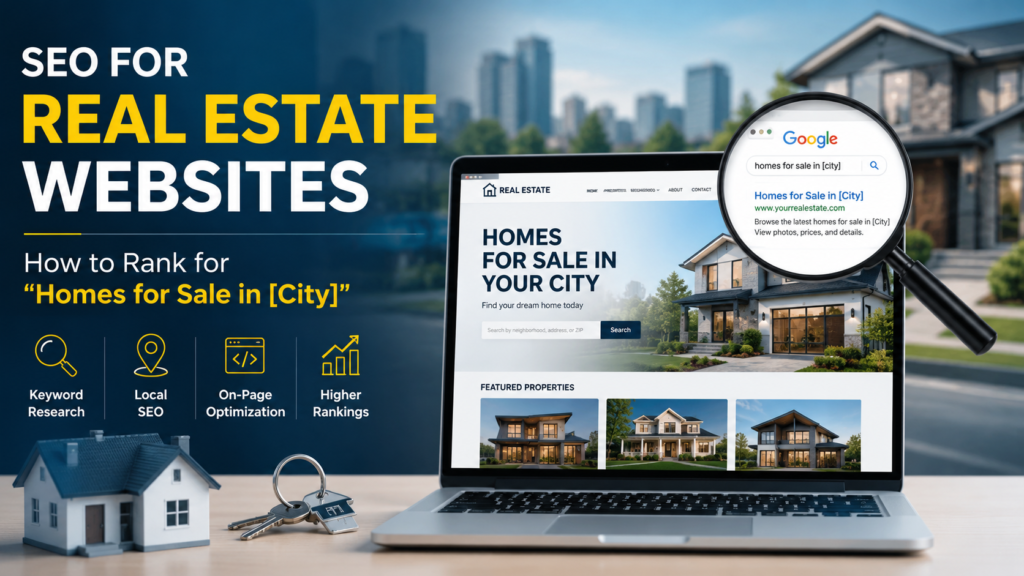
To rank for “homes for sale in [City]”, create a dedicated city landing page that matches local search intent with current property listings, neighbourhood insights, pricing trends, and useful buyer information. Optimise the title, H1, headings, URLs, internal links, and on-page copy around the city and related real-estate queries without keyword stuffing. Strengthen local relevance with accurate business information, location-specific content, authoritative backlinks, and appropriate structured data; Google recommends structured data as a way to help Search understand page content. For AI Overviews and featured-snippet opportunities, answer common buyer questions directly in concise, factual sections while demonstrating genuine local expertise and keeping listings and market information fresh.
Key Takeaways
- Online search is the most common starting point for home buyers, and roughly half now find the home they buy online — but agents still close the deal, so your website’s job is to get you the lead, not replace the agent.
- Google treats “homes for sale in [city]” as a hybrid query: it blends the Local Pack (map results), organic listing pages, and increasingly AI Overviews that summarize market data.
- Static “About Us” pages don’t rank for these terms. You need dedicated, regularly updated pages for each city, neighborhood, and property type you serve.
- RealEstateListing, RealEstateAgent, and LocalBusiness schema markup are table stakes, not optional extras — most competing sites still don’t implement them correctly.
- Thin, duplicate IDX feed pages are a leading cause of real estate sites getting filtered out of Google’s index entirely.
- Core Web Vitals and mobile performance matter more in real estate than almost any other vertical, since the majority of home searches happen on a phone.
Why “Homes for Sale in [City]” Is a High-Value, High-Competition Query
“Homes for sale in [city]” is what SEOs call a money keyword — the searcher has clear commercial intent and is often within weeks of taking action. That’s exactly why it’s so competitive: Zillow, Realtor.com, Redfin, and your local MLS portal are already ranking on page one in almost every US and Canadian market, and Property Finder and Bayut dominate the same query type in Dubai.
The data backs up why this keyword is worth fighting for. According to the National Association of REALTORS® 2025 Profile of Home Buyers and Sellers, searching online has remained the most common first step in the home-buying process for years, and 52% of recent buyers said they found the home they eventually purchased online. Nearly every buyer used the internet at some point in their search, and 70% relied primarily on a mobile or tablet device to do it. At the same time, 88% of buyers still closed their purchase through an agent — which means the website’s real job isn’t to replace the agent, it’s to be the first touchpoint that earns the inquiry.
That combination — high search volume, high commercial intent, and a buyer who still wants a human — is exactly why a well-optimized local real estate website converts so much better than generic lead-gen ads. It’s also why big portals with deeper data feeds and higher domain authority tend to outrank individual agent and brokerage sites unless those sites invest deliberately in the fundamentals below.
Regional nuance:
- USA: “Homes for sale in [city]” competes directly with Zillow, Redfin, and Realtor.com, plus every other local brokerage. Winning usually means going hyperlocal — targeting specific neighborhoods, zip codes, and school districts the portals cover less precisely.
- Canada: Realtor.ca (powered by CREA) tends to dominate national queries. Local brokerage sites do better competing on bilingual content (especially in Quebec and Ottawa), neighborhood guides, and long-tail terms.
- Dubai/UAE: Property Finder and Bayut own most head-term queries. Independent agencies typically win by targeting specific developments (e.g., “apartments for sale in Dubai Marina”), off-plan projects, and investor-focused long-tail searches like “best areas for rental yield in Dubai.”
How Google Evaluates Real Estate Websites
Google’s Search Essentials and Helpful Content guidance apply to real estate sites the same way they apply to any other site, but a few factors carry extra weight in this vertical because listing content is commercial, time-sensitive, and often thin by nature.
Experience. Does the content reflect actual market knowledge? A page that says “beautiful 3-bedroom home in a great neighborhood” for every listing signals template content, not experience. Pages that reference specific streets, school catchments, commute times, or HOA details read as written by someone who actually knows the market.
Expertise. Agent bios, credentials (license numbers, brokerage affiliation, years active in the specific market), and accurate, current data all support expertise signals.
Authoritativeness. Backlinks from local news outlets, chambers of commerce, relocation guides, and industry directories tell Google this site is a recognized source in its market — not just another listing aggregator clone.
Trustworthiness. Accurate pricing, honest “sold” or “off-market” status, clear contact information, and no misleading claims about school ratings or neighborhood safety. Real estate is a high-stakes purchase, so Google’s quality systems are less forgiving of inaccurate or stale listing data here than in lower-stakes verticals.
Expert tip: Google’s helpful content systems specifically look for whether content was created primarily to attract search traffic (thin, duplicated MLS descriptions) or to genuinely help a person searching. Rewriting MLS-supplied listing descriptions in your own words — even briefly — is one of the highest-leverage fixes most agent sites never make.
Keyword Research for Local Real Estate SEO
Effective real estate keyword research goes several layers deeper than the head term.
Primary keyword pattern:
- Homes for sale in [city]
Secondary keyword patterns:
- [Property type] for sale in [city] (condos, townhomes, single-family homes)
- Real estate agent in [city]
- [Neighborhood] homes for sale
- New listings in [city]
Long-tail keyword patterns:
- Homes for sale in [city] under $[price]
- [City] homes for sale with a pool / basement / acreage
- Best neighborhoods to buy a home in [city] for families
- New construction homes in [city] 2026
Semantic and NLP-related terms to weave in naturally: listing price, square footage, days on market, price per square foot, HOA fees, school district, walkability, comparable sales, closing costs, pre-approval, buyer’s market vs. seller’s market.
People Also Ask-style questions to answer directly on-page:
- What is the average home price in [city] right now?
- Is [city] a buyer’s or seller’s market?
- How long do homes stay on the market in [city]?
- What are the best neighborhoods in [city] for [families / first-time buyers / investors]?
Dubai-specific terms worth targeting: off-plan vs. ready properties, freehold areas, Golden Visa eligibility by investment amount, RERA-registered agent, service charges, ROI/rental yield by area.
Building content around these questions does double duty: it targets long-tail organic traffic and positions your page well for AI Overviews, which favor pages that answer a specific question clearly near the top of the content.
On-Page SEO for City and Neighborhood Pages
The single biggest structural mistake in real estate SEO is relying on one generic “listings” page (usually just an embedded IDX widget) to rank for every city and neighborhood a brokerage serves. Google needs a dedicated, unique page per meaningful geography.
What each city/neighborhood page needs:
- A unique H1 that matches real search intent — “Homes for Sale in [City], [State/Province/Emirate]” rather than a generic “Property Search.”
- 200–400 words of original, locally specific intro content above the listing feed: market snapshot, average price trends, what makes the area distinct, and who it tends to suit (families, retirees, investors).
- A live or near-live listings feed pulling from the MLS/IDX or local portal API, clearly labeled with last-updated timestamps.
- Internal links to related neighborhood pages, a buyer’s guide, and the agent’s bio/contact page.
- A short, specific meta title and description — not an auto-generated template repeated across every city page with only the city name swapped.
- Local FAQs answering 3–5 of the “People Also Ask”-style questions above, specific to that city.
Featured snippet opportunities to build in:
- A short numbered list: “Steps to Buy a Home in [City]”
- A definition box: “What Counts as a ‘Starter Home’ in [City]?”
- A comparison table of nearby neighborhoods by price range and commute time
Technical SEO: Site Structure, IDX, and Core Web Vitals
Site architecture. Use a logical URL and folder hierarchy: /homes-for-sale/[city]/, /homes-for-sale/[city]/[neighborhood]/. This helps both crawlers and users understand geographic hierarchy and supports internal linking between related pages.
IDX/MLS feed handling. IDX-powered listing pages are one of the most common technical SEO failure points in real estate:
- Duplicate content across brokerage sites. Every brokerage using the same IDX provider often displays identical listing descriptions. Add a unique summary paragraph above the syndicated data.
- Thin or empty pages. A search results page with zero matching listings (common in smaller markets or narrow filters) should be handled with noindex or a helpful “no results” experience with related suggestions — not left to return an empty, indexable page.
- Crawl budget waste. Faceted search filters (price, beds, baths) can generate thousands of near-duplicate URLs. Use canonical tags and parameter handling to prevent this from diluting crawl budget and diluting ranking signals across near-identical pages.
Core Web Vitals. Since the majority of home searches happen on mobile, Largest Contentful Paint (LCP), Interaction to Next Paint (INP), and Cumulative Layout Shift (CLS) directly affect both rankings and lead conversion. Property photo galleries and IDX widgets are frequent offenders — compress and lazy-load images, and avoid IDX iframes that block rendering.
Mobile-first design. Map-based search, tap-to-call buttons, and single-thumb-friendly filters aren’t nice-to-haves; they’re baseline expectations for a majority-mobile audience.
Schema Markup for Real Estate Listings
Structured data is one of the highest-leverage, most commonly skipped technical fixes in real estate SEO. Schema.org maintains listing-specific vocabulary purpose-built for this industry:
- RealEstateListing — describes the overall listing page: property type, price, and links to the underlying Offer.
- Offer (nested within the listing) — price, availability, and business function (sale or lease).
- RealEstateAgent — a subtype of LocalBusiness for the agent or brokerage: name, address, phone, service area, and reviews.
- Organization / LocalBusiness — brokerage-level details that support your Google Business Profile connection and knowledge panel eligibility.
- BreadcrumbList — supports breadcrumb rich results and reinforces your site’s geographic hierarchy to crawlers.
- FAQPage — for the local FAQ blocks recommended above, when questions and answers are visible on the page.
It’s worth being precise here: having a valid schema type doesn’t guarantee Google will render a special rich result for it. Google supports a specific, evolving set of structured-data features, and eligibility depends on meeting Google’s current documentation for each feature, not just implementing the schema.org vocabulary correctly. Treat schema as a clarity signal for search engines and AI systems first, and a rich-result opportunity second.
JSON-LD is Google’s recommended format over microdata because it lives in a script tag separate from your visible HTML, which means you can update it without risking your page layout.
Expert tip: Apply RealEstateListing schema to every active listing page, not just featured ones. Re-validate quarterly — CMS updates and plugin conflicts are a common cause of schema silently breaking.
Local SEO: Google Business Profile and Citations
For queries with local intent, the Local Pack (map results) often outranks organic listings entirely. To compete there:
- Fully complete and verify your Google Business Profile, with accurate categories (Real Estate Agent, Real Estate Agency), service areas, and hours.
- Collect and respond to reviews consistently — review volume and recency are among the strongest local ranking signals.
- Keep NAP (Name, Address, Phone) consistent across your website, GBP, and every directory listing (Zillow agent profile, Realtor.com, local chamber of commerce, Bayut/Property Finder agent pages in the UAE).
- Post market updates and new listings to your Google Business Profile regularly; an inactive profile signals lower relevance over time.
Content Strategy Beyond the MLS Feed
Listings alone rarely earn backlinks or rank for informational queries that feed the top of your funnel. A supporting content layer does the heavy lifting:
- Neighborhood guides — schools, commute times, walkability, local amenities.
- Market reports — quarterly or monthly local price trends, inventory levels, days-on-market data.
- Buyer/seller guides — localized to your market’s specific process, closing costs, and timelines.
- Relocation content — especially valuable in Dubai and other markets with large expat populations relocating for work.
This content earns links, builds topical authority around your city and neighborhood pages, and gives you material to answer the “People Also Ask” questions Google surfaces for these searches.
Link Building and Authority Signals
Real estate backlinks that move the needle tend to come from sources with genuine local or industry relevance:
- Local news and lifestyle publications covering market trends (often earned by contributing data or commentary)
- Chamber of commerce and local business association directories
- Relocation and corporate housing resource pages
- Guest contributions to real estate industry publications
- Sponsorships or partnerships with local community organizations, each linking back to your site
Avoid generic, high-volume directory submissions with no topical or geographic relevance — they add little authority and can look manipulative in aggregate.
IDX vs. Custom Listing Pages: A Comparison
| Factor | IDX Plugin/Widget | Custom-Built Listing Pages |
| Setup speed | Fast — days | Slower — weeks to months |
| Upfront cost | Lower | Higher |
| Content uniqueness | Often duplicated across brokerages using the same provider | Fully unique, controllable |
| SEO control | Limited by the provider’s URL structure and rendering | Full control over URLs, schema, and page speed |
| Page speed | Varies; iframes can hurt Core Web Vitals | Optimizable from the ground up |
| Best fit | Small teams needing to launch quickly | Brokerages investing seriously in organic search as a lead channel |
Many high-performing sites use a hybrid: IDX for live inventory data, layered with a custom-built page shell, unique content, and proper schema around it.
Common Mistakes That Keep Real Estate Sites Out of Rankings
- Using one generic “search homes” page instead of dedicated city/neighborhood pages
- Copying MLS listing descriptions verbatim across every listing and every competing brokerage site
- No schema markup, or schema that hasn’t been validated since a CMS update
- Ignoring mobile page speed while the majority of traffic is mobile
- Letting old, sold, or off-market listings stay indexed and live on the site
- No local content layer — nothing but listings, with zero neighborhood guides or market data to earn links
- Inconsistent NAP data across directories, which weakens local ranking signals
- Treating SEO as a launch task instead of an ongoing content and technical practice
Step-by-Step Implementation Checklist
- [ ] Audit current site structure; map out dedicated URLs for every city and neighborhood served
- [ ] Rewrite or supplement MLS-supplied listing descriptions with unique summaries
- [ ] Add 200–400 words of original local market content to each city/neighborhood page
- [ ] Implement RealEstateListing, RealEstateAgent, Organization, and BreadcrumbList schema
- [ ] Validate schema with Google’s Rich Results Test and Schema.org validator
- [ ] Set up noindex handling for empty/thin search-filter result pages
- [ ] Run a Core Web Vitals audit and fix top mobile speed issues (image compression, lazy loading)
- [ ] Fully complete and verify Google Business Profile; align NAP across all directories
- [ ] Publish at least one local market report or neighborhood guide per target city
- [ ] Set a quarterly cadence to update stale listings, refresh market data, and re-check schema
Frequently Asked Questions
How long does it take to rank for “homes for sale in [city]”?
Ranking for “homes for sale in [city]” typically takes three to six months of consistent technical SEO, local content, authority building, and optimisation, although highly competitive markets can take longer. Major portals such as Zillow and Realtor.com can make broad city terms particularly difficult. Neighbourhood, property-type, and long-tail keywords often deliver faster ranking opportunities while the main city page builds authority.
Do I need a separate page for every neighborhood I serve?
Create dedicated neighbourhood pages when an area has meaningful search demand, property inventory, or genuine buyer and seller interest. Each page should provide unique information such as local amenities, housing trends, property types, pricing, schools, transportation, and nearby attractions. Avoid creating thin pages that simply replace the neighbourhood name, as they offer little additional value to users.
Is IDX bad for SEO?
IDX is not inherently bad for SEO, but simply embedding an IDX listing feed rarely creates enough unique content to rank competitively. The same property information may appear across numerous real estate websites, creating limited differentiation. Strengthen IDX pages with original neighbourhood insights, market analysis, buyer guidance, internal links, and useful information surrounding the listings.
Does schema markup guarantee a rich snippet in Google?
No, schema markup does not guarantee a rich result or featured snippet. Structured data helps Google understand the meaning and context of a page, but Google independently determines whether a search feature appears. Use accurate, relevant schema that matches visible page content and combine it with strong content, technical SEO, and search-intent optimisation.
How important is Google Business Profile for a real estate agent?
Google Business Profile is highly important for local real estate SEO, particularly when users search for agents, brokerages, or property services in a specific location. A complete and accurate profile can strengthen local visibility and help a business appear in Google Maps and the Local Pack. Keep business details, categories, service areas, reviews, photos, and updates accurate and consistent.
What’s the biggest ranking difference between the US, Canada, and Dubai markets?
The main difference is how competitive local search results are and which property portals dominate each market. In the US and Canada, large portals and established brokerages make broad property searches highly competitive, so hyperlocal and neighbourhood-focused SEO is often more effective. In Dubai, targeting specific developments, off-plan projects, communities, property types, and investor-focused searches can create stronger opportunities for independent real estate websites.
Should listing pages be indexed once a property sells?
A sold property page should not automatically remain indexed as an active listing. If the page has valuable search visibility or backlinks, consider keeping it accessible with a clear “Sold” status and updated information; otherwise, redirect it to a highly relevant current property or neighbourhood page when appropriate. Avoid mass redirects to unrelated pages or leaving outdated listings that misleadingly appear available.
Do I need bilingual pages for the Canadian market?
Bilingual SEO depends on the location, audience, and language demand of the market you serve. French-language content can be particularly valuable in Quebec and other areas with significant French-speaking audiences, while it may be unnecessary for some predominantly English-speaking markets. When creating bilingual pages, use genuinely translated, locally relevant content rather than automatically translating and publishing duplicate pages.
What content earns backlinks in real estate?
Real estate content earns backlinks most effectively when it provides original local data, research, or genuinely useful resources. Examples include city housing-market reports, neighbourhood guides, home-price trends, relocation guides, development research, and local property statistics. These resources can attract links from journalists, local organisations, community websites, businesses, and industry publications more naturally than individual listing pages.
How often should market data on a city page be updated?
Update real estate market data at least quarterly, with monthly updates preferable in rapidly changing markets. Refresh property prices, inventory, days on market, mortgage conditions, and other statistics whenever reliable new data becomes available. Clearly displaying the “Last Updated” date also helps users understand how current the information is and strengthens the page’s credibility.
Can AI Overviews replace organic listing traffic?
AI Overviews can reduce clicks for some informational real estate searches by answering questions directly within Google, but they do not eliminate the need for strong organic visibility. Pages that provide clear, original, authoritative answers to questions about local markets, neighbourhoods, prices, and buying conditions can become useful sources for AI-generated answers. Optimising for concise answers while providing deeper supporting information can help maintain visibility across traditional and AI-powered search.
Conclusion
Ranking for “homes for sale in [city]” isn’t a single fix — it’s the compounding result of unique local content, clean technical execution, correct schema, and consistent local authority signals. Brokerage and agent sites that treat this as an ongoing practice, updating listings, market data, and content on a regular cadence, consistently outperform sites that launch once and stop. The portals will likely keep dominating the broadest head terms, but neighborhood-level and long-tail searches are genuinely winnable — and those are often the higher-intent leads anyway.