Executive Summary
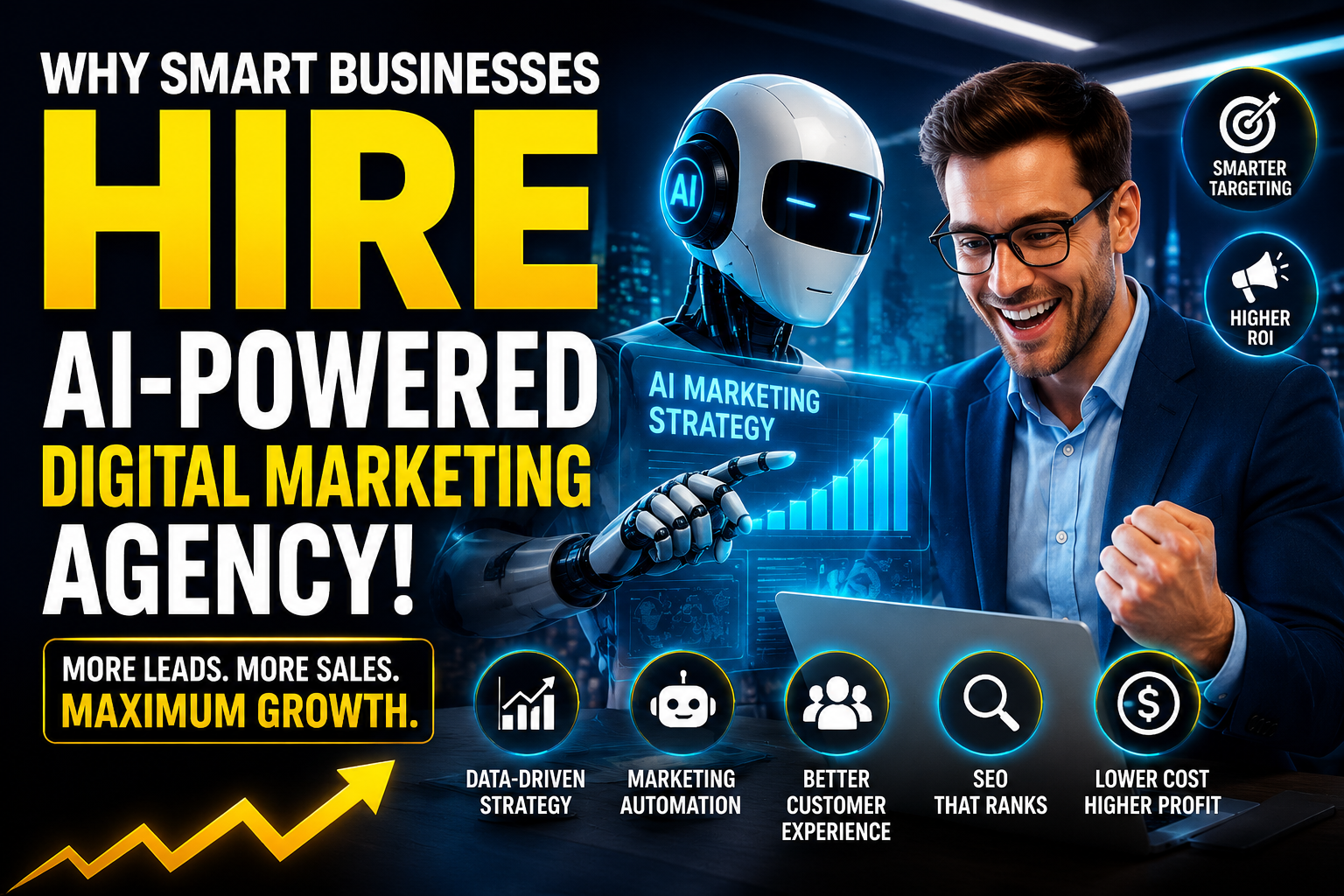
An AI-based digital marketing agency combines advanced AI tools with human expertise to deliver smarter, faster campaigns and higher ROI. Such agencies use machine learning, predictive analytics, and automation to analyze large data sets, optimize ad spend, personalize content, and continuously improve performance – tasks that exceed human-scale capability. Research shows this approach pays off: AI-powered ad campaigns can boost conversion rates by up to 30% and deliver ~26% more conversions per dollar spent, and 74–75% of organizations using generative AI report positive ROI from marketing. In short, hiring an AI-driven agency gives businesses data-driven insight, time savings, personalization at scale, and competitive advantage – translating into measurable sales growth and cost efficiency.
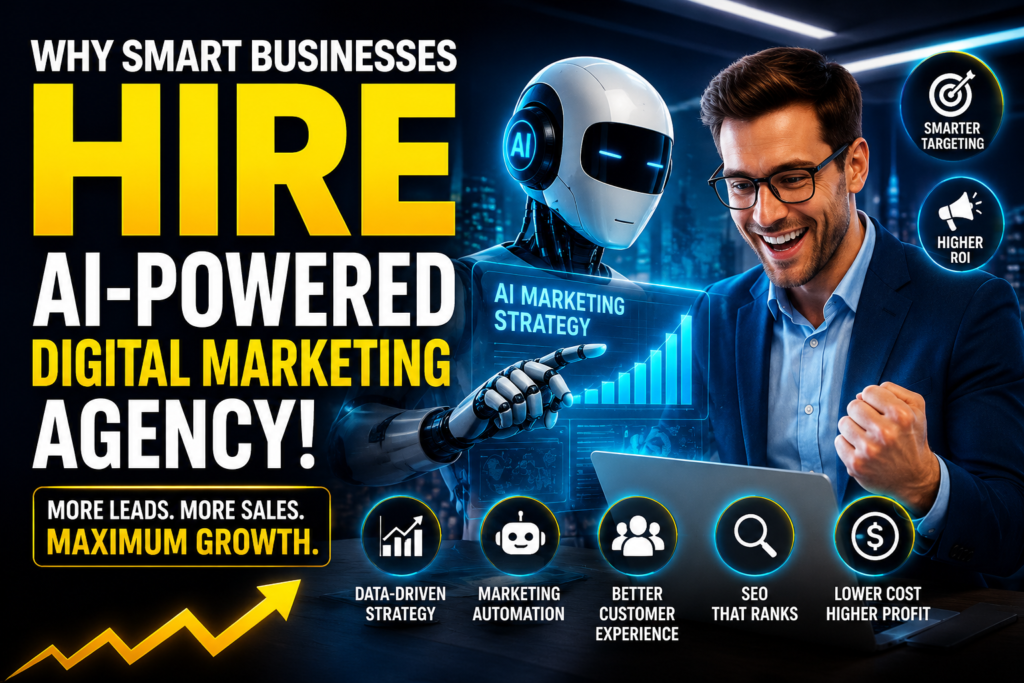
What Is an AI-Based Digital Marketing Agency?
An AI-based digital marketing agency is a full-service marketing partner that systematically incorporates AI and machine learning into its services. In practice, this means using tools like predictive analytics, natural language generation, smart bidding algorithms, and chatbots to supplement traditional marketing skills. According to Deloitte, AI is applied “across the entire marketing process – from strategic planning, campaign planning, creative concept creation and production, activation, up until measurement,” enabling companies to “tap into unrealized opportunities, drive innovation, and ultimately stay ahead of competition.” In other words, such an agency doesn’t just handle ads or SEO; it uses AI to automate tasks (like data analysis and content generation) and then uses human insight to guide strategy.
For example, generative AI can write initial ad copy or design social posts, machine learning can uncover micro-segments of high-value customers, and automated bid tools adjust spending minute-by-minute for best performance. The agency’s experts then review AI outputs, align them with brand goals, and optimize continually. This combined “human + AI” model ensures fast, scalable marketing processes with the oversight needed to keep messaging on-brand and accurate.
Top 10 Business Benefits
- Faster Data-Driven Decisions – AI can process and analyze vast marketing datasets in seconds. Surveys show 53% of marketers use AI for data analysis to predict trends and consumer behavior. Google reports that better data activation through AI tools (e.g., tag management) yields an average 14% lift in conversions.
- Automated Efficiency – Automating repetitive tasks frees staff for strategy. HubSpot research finds 78% of marketers agree AI reduces time on manual tasks like data entry and scheduling. AI-driven workflows can auto-generate ad variations or segment email lists instantly, speeding campaign launches and cutting overhead.
- Higher ROI & Performance – Companies using AI report a 35% average improvement in marketing ROI, with roughly a 5.2x return on AI tool investment. Google’s Demand Gen (AI-driven ad campaigns) saw a 26% increase in conversions per dollar after AI enhancements. AI lets agencies allocate budget more effectively, steadily raising sales and lowering acquisition costs.
- Advanced Personalization – AI excels at tailoring messaging by analyzing behavior and context in real time. McKinsey notes personalization usually drives a 10–15% revenue lift, and 60% of marketers say AI helps personalize the customer experience. AI agencies use tools that learn individual preferences to serve the right offer or email to each user, boosting engagement and loyalty.
- Predictive Analytics & Targeting – AI identifies which prospects are most likely to convert. Machine learning models can score leads, predict customer lifetime value, and anticipate demand, allowing agencies to focus resources on high-value segments rather than generic demographics.
- Better Content and Creatives at Scale – AI tools help generate ideas and assets quickly, from ad copy to image and video variants. Deloitte highlights use cases like “content automation production” and converting 2D assets into 3D. This means more creative variations for A/B testing, combined with human creative guidance to ensure quality.
- Improved SEO and Discovery – AI agencies use smart SEO tools that analyze search trends, optimize for voice/AI queries, and restructure content for AI-driven search engines (Generative/Geo search). They use NLP techniques to help brands appear in AI-generated answers, improving click-through in ways traditional SEO might miss.
- Continuous Optimization – Unlike static campaigns, AI-driven marketing is iterative. AI systems test countless variations (ads, keywords, audiences) and reallocate resources on the fly. Brands that use AI optimization tools are 16% more likely to see measurable improvements, running ongoing experiments that train the model and quickly adjust strategy.
- Cost Efficiency & Scalability – Because AI automates labor, agencies can serve more clients or larger campaigns without proportionally growing staff, often lowering client cost compared to an in-house team (see Cost vs. ROI section below). Agencies can rapidly scale client campaigns without new hires, enabling faster growth without HR delays.
- Competitive Advantage – Having expert guidance in AI marketing keeps companies ahead of peers. Clients of AI agencies often launch initiatives like AI-driven chatbots, personalized product recommendations, or predictive churn prevention long before they would on their own — a first-mover edge that often translates into higher market share and brand value.
Services Offered by AI-Based Agencies
AI-driven agencies typically provide the full suite of digital marketing services—but powered by AI capabilities:
- AI-Enhanced SEO & Content Marketing – Automated keyword research, AI-driven content generation (blogs, landing pages), and real-time SEO recommendations.
- Programmatic Advertising & PPC – AI optimization of bids, budgets, and placements across Google, Facebook, and other networks, with predictive algorithms adjusting targeting continuously.
- Social Media & Display Ads – Automated ad creation (image/video/text) and hyper-targeting, plus analytics that micro-segment audiences.
- Email Marketing & Automation – AI-based list segmentation, send-time optimization, and personalized email content.
- Chatbots & Conversational AI – AI chat interfaces for lead qualification and customer service, trained on a business’s data.
- Analytics & Dashboards – Integrated AI dashboards that ingest data from all channels and deliver predictive insights.
- Predictive Lead Scoring – Using ML models to rank prospects by likelihood to convert.
- Creative Design (Assisted) – Generative design or AI video editing to speed up creative asset production.
- Strategic Consulting – Advice on AI adoption strategy, data infrastructure, and integrating AI insights into broader marketing plans.
These services reflect Deloitte’s AI use cases – from “content automation” and “predict patterns for segmentation” to “automate insights into KPIs.” In each area, the agency’s team manages the AI tools, interprets results, and ensures the work aligns with business goals.
Ideal Client Profiles
AI-based marketing agencies can serve a wide range of businesses, but they’re especially valuable for:
- Growth-Oriented SMEs and Startups – Need big results with limited budgets; AI agencies give small teams access to enterprise-grade analytics and automation without the cost of in-house specialists.
- E-Commerce & Retail Brands – Benefit hugely from AI personalization and recommendation engines that turn product feeds and web analytics into dynamic ads and offers.
- B2B Companies – Complex sales cycles or lead-gen needs benefit from lead scoring, account-based targeting, and automated nurture campaigns.
- Content-Heavy Businesses – Media, education, and services that require constant content benefit from AI-accelerated content creation and distribution.
- Enterprises with Big Data – Large companies with marketing data silos can integrate cross-channel data and unlock insights like customer lifetime value and churn propensity.
- Companies Facing High Competition – Crowded markets (tech, finance, consumer goods) benefit from cutting-edge targeting and creative testing that outpace competitors.
In general, an ideal client is one that values data-driven marketing and has enough digital activity (web traffic, campaigns) for AI to work effectively. If a company struggles with limited internal expertise or sees stagnating ROI from traditional ads, an AI-driven agency can be a game-changer.
Cost vs. ROI Considerations
Hiring an AI-focused agency does have a cost, but it often pays for itself. Agencies usually charge retainer or project-based fees, often in the range of $3K–$15K per month for comprehensive service. This is typically far below the cost of building an equivalent in-house team covering SEO, paid media, content, and analytics, which can easily exceed $400K–$600K per year. Even including the agency’s tools and platforms, total spend is lower when shared across an agency’s client base.
The ROI potential is strong: about 75% of companies report positive ROI from AI and automation in marketing, and because AI continuously optimizes campaigns, returns often rise over time through higher conversion rates, more sales, and better retention. An agency might generate 20–30% more conversions or leads than a previous manual strategy, quickly offsetting fees, and smart bid optimization alone can reduce cost-per-acquisition by 30–40% according to industry reports.
Results vary by campaign and budget, so businesses should treat agency fees as an investment and measure outcomes closely. A prudent agency ties its success to KPIs (clicks, leads, revenue) and provides transparent reporting.
Risks and Limitations
While AI brings powerful benefits, there are caveats to consider:
- Data Privacy & Compliance – AI thrives on data, and agencies must handle it legally (GDPR, CCPA, etc.). 41% of marketers cite data privacy as a top AI barrier, so clients should verify strict privacy policies and secure data practices.
- Output Quality and Accuracy – AI-generated content can be incorrect or off-brand. HubSpot found 43% of marketers reported AI sometimes produces inaccurate or irrelevant information, and 34% saw biased or off-target content. Human review is essential; a good agency always edits and fact-checks AI outputs.
- Over-Reliance on AI – AI tools may suggest the cheapest clicks or highest volume, but humans must ensure campaigns align with brand values and long-term goals. Agencies balance algorithms with human insight to avoid generic “set-and-forget” marketing.
- Integration and Training Challenges – 39% of marketers worry about AI integration and training, and 34% mention too many overlapping tools. Clients should be prepared to let the agency connect platforms and train staff on new dashboards.
- Regulatory and Ethical Concerns – AI in marketing raises ethical questions (deepfakes, AI in political messaging, etc.). Agencies must navigate consumer protection laws as well as emerging AI regulations, keeping humans “in the loop” for sensitive decisions.
- Diminished Creative Control – Creative strategy still relies on human vision. Clients should ensure the agency allows brand oversight, using AI for ideation and scaling with final creative approval by people.
- Cost of Tools and Vendors – Agencies bear the cost of enterprise AI tools, with some risk of vendor lock-in. Businesses should ask what tools are used and whether outputs are fully owned by the client.
With proper oversight, these risks can be managed, and the advantages of AI generally outweigh the downsides — making the choice of agency (see checklist below) especially important.
Best-Practice Checklist for Selecting an Agency
When vetting an AI marketing agency, consider these criteria:
- AI and Marketing Expertise – Solid marketing chops plus AI proficiency, with case studies showing real improvements.
- Industry Experience – Familiarity with your sector’s specific challenges (e.g., product recommendations for e-commerce, compliance-aware AI for healthcare).
- Transparency in AI Use – Clarity on what’s automated versus manually managed, which platforms are used, and how AI outputs are audited for accuracy.
- Proven Results – Measurable outcomes: ROI figures, conversion lifts, cost reductions, client testimonials, and before/after metrics.
- Scalability and Flexibility – Ability to scale campaigns up or down, offer modular services, and support both small and enterprise projects.
- Customized Strategy – Tailored AI models and content strategies aligned to your KPIs and audience, not generic templates.
- Communication & Reporting – Clear dashboards, regular reports, and plain-language explanations of AI-driven recommendations.
- Value vs. Cost – Assess projected ROI rather than picking the cheapest option, with transparent billing and scope.
- Innovation & Future-Readiness – Ongoing investment in learning new AI trends and adapting to algorithm changes.
- Ethical AI Practices – Compliance with data laws, no deceptive ad tactics, minimized bias, and human oversight in customer-facing AI, per guidance from bodies like the UK’s Competition & Markets Authority.
Comparison: Traditional vs AI-Driven Agency
| Aspect | Traditional Agency | AI-Powered Agency |
| Data Analysis | Periodic reporting (monthly/quarterly); manual data crunching by analysts. | Real-time analytics; AI sifts data 24/7 and flags insights instantly. |
| Campaign Optimization | Manual bid/creative adjustments based on historical reports. | Automated A/B testing and bid changes every few minutes using ML. |
| Personalization | Broad segmentation (age, gender, etc.); limited one-to-many customization. | Hyper-segmentation using behavior/AI; dynamic one-to-one messaging. |
| Content Creation | Human teams produce most content (can be slow). | AI drafts first versions of copy/visuals, enabling faster iteration. |
| Speed & Scale | Slower ramp-up; adding scale requires more hires. | Rapid deployment; campaigns can scale up quickly via AI automation. |
| Decision-Making | Relies on marketer experience and gut check. | Data-driven decisions by algorithms, with humans in oversight loop. |
| Cost Efficiency | Higher labor costs (specialist salaries); tool subscriptions. | Lower overhead (tools shared); automation cuts manual labor. |
| ROI Potential | Improvement capped by human bandwidth. | Generally higher ROI: most clients see positive returns on AI spend. |
| Innovation | Updates when new techniques are manually adopted. | Continuously integrates latest AI/ML advances (generative ads, chatbots). |
Decision Flowchart
A quick decision guide for when to consider an AI marketing agency:
- Evaluate Marketing Needs → Do you have in-house AI expertise?
- If no, or if you’re not meeting targets → consider an AI marketing agency.
- If you’re meeting targets with your current approach → continue and revisit regularly.
- If pursuing an agency: is your budget adequate?
- Yes → research and select an AI-driven agency using the checklist above.
- No → try smaller AI tools or consultants first.
- Once engaged, onboard the agency and define clear KPIs (ROI, leads, etc.) so it can build data-driven campaigns.
Frequently Asked Questions
What is an AI-based marketing agency?
An AI-based agency integrates machine learning and automation into digital marketing — using AI tools for analytics, ad optimization, and content creation — overseen by expert marketers who manage strategy and quality.
How does AI improve campaign ROI?
By automating targeting and bidding and finding hidden customer segments. AI-optimized campaigns can deliver 20–30% higher conversion rates, and companies using AI report roughly a 35% average lift in marketing ROI.
Who should hire an AI marketing agency? Companies of any size wanting faster growth, especially those lacking deep analytics in-house. E-commerce, tech, B2B, and data-rich businesses often see the biggest gains — essentially, if you’re not hitting KPIs or can’t scale marketing with your current team, an AI agency can help.
How much do AI agencies cost vs. in-house teams? AI agencies typically charge monthly retainers of $3K–$15K+, usually much less than an equivalent in-house team ($400K+ per year). About 75% of clients report positive ROI on that spend, so the investment tends to pay off.
Are there risks to using AI in marketing?
Yes — including data privacy issues, potential errors or bias in AI outputs, and over-reliance on automation. The best agencies mitigate these by keeping humans involved, auditing AI content, and following ethical data practices.
What should I look for when choosing an AI marketing agency?
Proven AI and marketing expertise, clear results (case studies), transparency in tools and data usage, strong communication, and ethical, tailored strategies aligned with your goals.