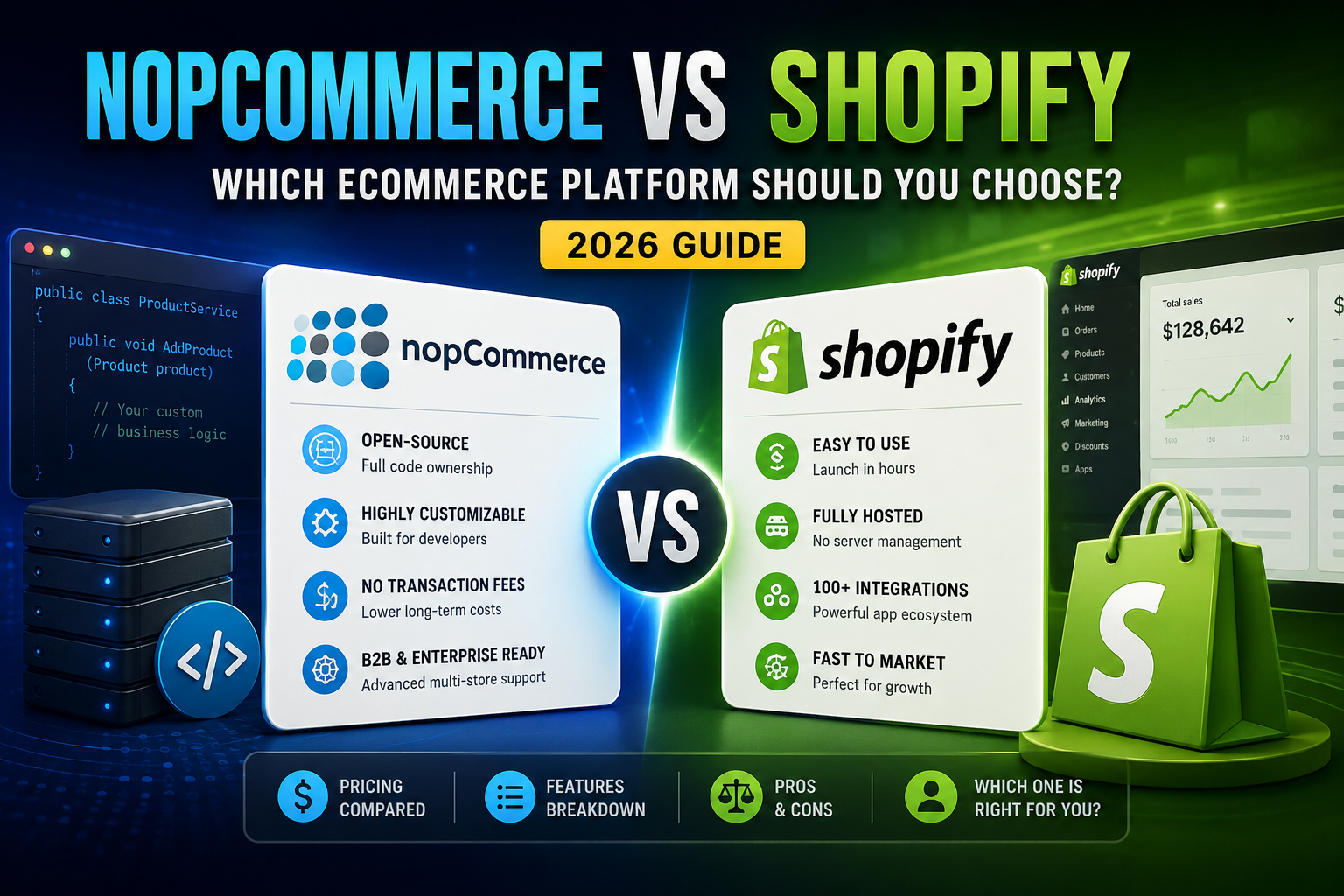
Quick Answer: Choose Shopify if you want a fast, hosted, beginner-friendly store with minimal technical overhead. Choose nopCommerce if you need full code ownership, deep enterprise customization, and lower long-term costs at high transaction volumes. The right pick depends entirely on your technical capacity, business model, and growth strategy.
What Is the Core Difference Between NopCommerce and Shopify?
Shopify and nopCommerce sit at opposite ends of the ecommerce spectrum. Shopify is a fully hosted SaaS platform powering over 9.5 million stores globally — designed for ease of use, fast time-to-market, and scalability without needing to touch code. nopCommerce is a free, open-source platform built on Microsoft’s ASP.NET Core framework — built for developers and enterprises that demand full control over their codebase, infrastructure, and business logic.
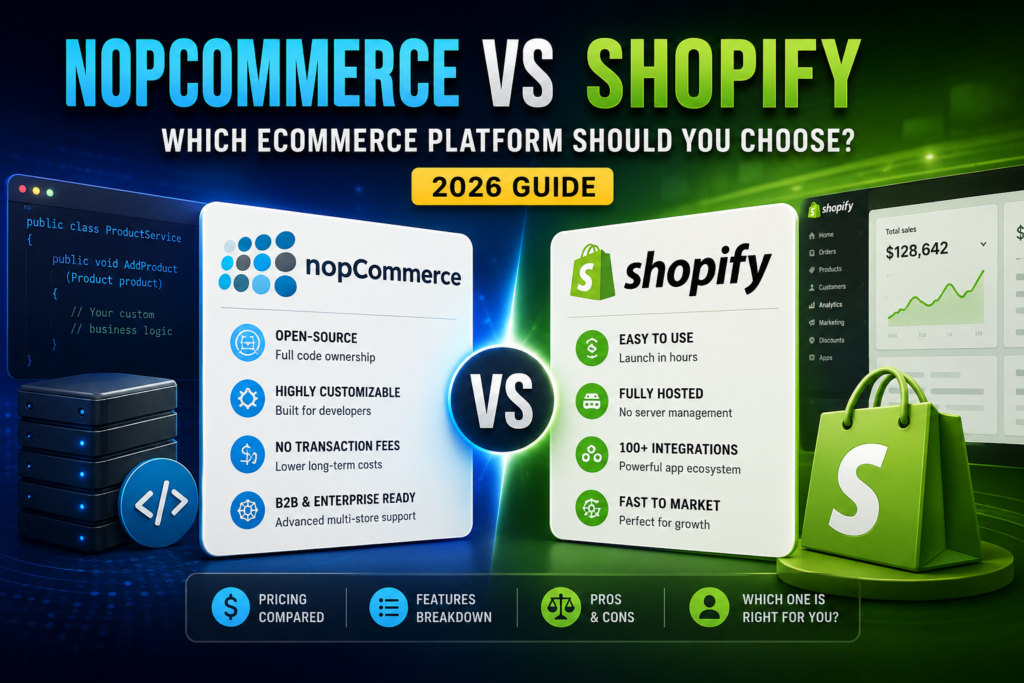
The choice between them is not about which has a longer feature list. It is about how much control you need, how fast you need to launch, and how much technical capacity you can commit.
NopCommerce vs Shopify: At a Glance
| Feature | Shopify | nopCommerce |
| Type | Hosted SaaS | Open-source, self-hosted |
| Pricing | $39–$2,500+/month | Free (pay for hosting + dev) |
| Transaction Fees | 0.5%–2% (non-Shopify Payments) | None |
| Ease of Use | Beginner-friendly | Requires .NET developers |
| Customization | Limited to themes/apps | Full source code access |
| Hosting | Managed by Shopify | You choose and manage |
| Best For | SMBs, startups, fast launches | Enterprises, B2B, developers |
| Payment Gateways | 100+ built-in integrations | 7 out of the box; extendable |
| Product Variants | Up to 2,000 per product | One warehouse per product |
| Multi-store | Via Shopify Plus | Native, out of the box |
1. Pricing: What Does Each Platform Actually Cost?
Shopify Pricing (2026)
Shopify offers five plans:
- Starter — $5/month (checkout links only, no full storefront)
- Basic — $39/month ($29/month annually)
- Grow — $105/month ($79/month annually)
- Advanced — $399/month
- Shopify Plus — from $2,300–$2,500/month (enterprise)
The subscription fee is only part of the story. When using a third-party payment gateway instead of Shopify Payments, Shopify charges an additional transaction fee of 0.5% to 2% on top of your gateway’s own fees. Use Shopify Payments and those extra fees disappear — but Shopify Payments is only available in select countries.
At the enterprise level, Shopify Plus shifts to a variable revenue model: once your monthly GMV exceeds $1 million, Shopify applies a 0.25% revenue share on all sales above that threshold.
Hidden costs to watch for:
- Premium themes: $150–$350 (one-time)
- Apps: $350–$1,400/month for most mid-market brands
- Custom domain: ~$14/year
- Third-party gateway surcharge: 0.5%–2% per transaction
nopCommerce Pricing
The nopCommerce software itself is completely free. There is no licensing fee, no GMV-based charge, and no per-transaction platform surcharge. Your costs are:
- Hosting — typically $50–$300/month depending on traffic and server specs (shared hosting does not work well for .NET applications; a VPS or cloud server is required)
- Development — $1,000 for basic setups up to $80,000+ for complex enterprise builds
- Plugins and themes — community-built, often at lower cost than Shopify’s ecosystem
- Ongoing maintenance — developer time for updates, security patches, and feature additions
Verdict: For low-volume stores, Shopify’s all-in-one price can actually be cheaper in year one. For high-volume merchants processing millions per month, nopCommerce’s zero transaction fee model delivers significant savings over time.
2. Ease of Use
Shopify is widely praised for its beginner-friendly interface. A store can go live in hours using drag-and-drop tools, pre-built themes, and a setup wizard that requires zero coding. The “Markets” feature consolidates B2B, D2C, and wholesale operations into a single unified dashboard — something that would require developer work on other platforms. Real-time analytics are available without a 24-hour data lag, which gives merchants instant business insight.
nopCommerce is a different experience entirely. The platform is not for beginners. It requires a development team familiar with .NET, hosting management, and server administration. The learning curve is steep even for experienced developers, and the initial setup is more time-intensive than Shopify. However, for businesses with the right technical resources, that investment pays dividends in control.
Verdict: Shopify wins on ease of use — decisively and without qualification.
3. Customization and Flexibility
This is where nopCommerce asserts its strongest advantage.
nopCommerce gives you full access to the source code. Any feature, workflow, checkout logic, pricing rule, or third-party integration can be built directly into the platform. There are no restrictions imposed by a SaaS vendor. You can implement AI-driven personalization, custom ERP integrations, region-specific payment logic, and complex B2B workflows — all in native code without middleware dependencies. Payment methods can even be restricted by country, which is valuable for international merchants with region-specific compliance requirements.
Shopify customization happens within defined boundaries. Front-end design uses Shopify’s proprietary Liquid templating language, which is approachable but not as powerful as direct backend access. Deep customization — changing checkout logic, server-side rules, or core platform behavior — requires working around Shopify’s constraints or using apps that each add cost and potential performance overhead. The App Store offers thousands of plugins, but dependence on multiple third-party apps can slow page load times and complicate maintenance.
Verdict: nopCommerce wins on customization depth. Shopify wins on speed and simplicity of routine customization.
4. Hosting and Infrastructure
Shopify handles all hosting automatically. SSL certificates, CDN, server maintenance, uptime, and PCI DSS Level 1 compliance are all included in every plan. You never touch a server. This is a genuine advantage — especially for merchants who do not want to manage infrastructure.
nopCommerce is self-hosted. You choose your hosting provider, manage your server environment, handle security patches, and take responsibility for uptime. This is a burden — but it is also complete data sovereignty. Your customer records, catalog data, and source code are entirely yours. There is no vendor lock-in and no risk of a platform restricting your access.
Verdict: Shopify wins for convenience. nopCommerce wins for data ownership and infrastructure control.
5. SEO Capabilities
Both platforms offer solid foundational SEO tools — customizable meta titles, H1 tags, URLs, and canonical tags. The differences lie in depth and control.
Shopify includes built-in SEO functionality out of the box, but advanced features like structured data management, custom canonical logic, and server-side rendering optimizations often require third-party apps or developer workarounds. Shopify’s managed infrastructure does ensure fast page loads and good Core Web Vitals out of the box.
nopCommerce offers full SEO flexibility at the code level. You can implement any technical SEO requirement directly — structured data schemas, custom sitemaps, server-side rendering configurations, and localized URL structures — without depending on apps. For enterprise brands building long-term organic search authority, this level of control is a meaningful advantage.
Verdict: Both are capable. nopCommerce gives deeper technical SEO control; Shopify offers better SEO out of the box for non-technical users.
6. Payment Processing
Shopify integrates with 100+ payment gateways natively and has its own processor — Shopify Payments — which eliminates extra transaction fees when used. The payment experience is seamless and fast to configure. Shop Pay, Shopify’s accelerated checkout, improves conversion rates and reduces cart abandonment. The downside is the extra 0.5%–2% surcharge on third-party gateways, which becomes significant at high volumes.
nopCommerce supports only seven built-in payment methods out of the box (PayPal variants, manual credit card processing, check/money orders). More gateways can be integrated, but they require development work. The upside is that nopCommerce charges no platform-level transaction fee whatsoever — 100% of what you collect goes to you and your gateway provider. It also allows merchants to restrict payment methods by country, a unique and practical feature for global commerce.
Verdict: Shopify wins on payment ease and gateway breadth. nopCommerce wins on payment cost efficiency at scale.
7. Scalability
Shopify at scale: As your business grows, Shopify Plus unlocks enterprise-grade features — advanced automation, multi-store management (10 expansion stores included), dedicated support, and B2B capabilities. However, the cost structure scales with your revenue, not your infrastructure. The shift to revenue-share pricing above $1M/month GMV means the platform takes more as you earn more. Core platform logic remains in Shopify’s hands.
nopCommerce at scale: Growth means adapting the code itself. Expanding into new regions, building custom pricing engines, implementing AI personalization, or redesigning checkout flows is entirely within your team’s control. Native multi-store and multi-vendor support is available without an enterprise upgrade. For B2B companies with complex approval chains, punchout catalogs, or custom ERP integrations, nopCommerce scales without the cost curve bending against you.
Verdict: Both scale. Shopify scales faster but gets more expensive. nopCommerce scales with more control but requires ongoing developer investment.
8. Support and Community
Shopify offers 24/7 customer support via phone, email, live chat, and tickets. A vast ecosystem of certified partners, agencies, and developers means expert help is easy to find worldwide. G2 reviewers rate Shopify’s customer support at 9.0/10.
nopCommerce relies on community forums, documentation, and its developer ecosystem. There is no centralized 24/7 support team for the free platform. Paid support options exist through nopCommerce’s official partners. Community forums are active and responsive, but the experience is less consistent than Shopify’s support structure. G2 reviewers rate nopCommerce’s support at 7.9/10.
Verdict: Shopify wins on formal support. nopCommerce has a strong community but requires more self-sufficiency.
9. Marketing Features
Shopify includes a strong built-in marketing suite:
- Cart abandonment recovery emails
- 10,000 free marketing emails per month
- Built-in SEO tools (meta tags, localized URLs)
- Shop App integration for product discovery
- Real-time analytics and pre-built performance reports
nopCommerce includes solid marketing functionality out of the box — discount engines, reward points, gift cards, affiliate programs, and multi-store promotional rules — all without requiring paid apps. Because it is open-source, custom marketing workflows can be built directly into the platform.
Verdict: Shopify has more polished, easy-to-use marketing tools. nopCommerce offers more built-in marketing flexibility for developers.
Who Should Choose Shopify?
Choose Shopify if you are:
- A startup or small business that wants to launch fast without a development team
- A mid-sized retailer that needs a reliable, scalable platform with managed infrastructure
- Selling across multiple channels (social commerce, POS, marketplace) from one dashboard
- A merchant who values ease of use over maximum code control
- A business that can use Shopify Payments and avoid third-party transaction fees
- Validating a product idea and need an online store operational within hours
Who Should Choose NopCommerce?
Choose nopCommerce if you are:
- An enterprise or B2B company with complex workflows, custom integrations, or ERP dependencies
- A high-volume merchant where platform transaction fees would cost more than developer salaries
- A business with data residency or GDPR requirements that demand full data ownership
- A company building a multi-vendor marketplace (Shopify is not architected for this)
- A team with in-house .NET developers or a budget for ongoing development resources
- A business that needs deeply custom checkout flows, regional payment rules, or unique pricing logic
NopCommerce vs Shopify: Final Verdict
There is no universally better platform. The right answer depends on where your business is today and where you plan to take it.
Shopify is the better default for most businesses. It removes infrastructure complexity, scales reliably, and empowers non-technical founders to build a professional store. Its cost structure works well for growing businesses — until transaction volumes reach a point where platform fees outpace the value of convenience.
nopCommerce is the better choice for enterprises that need control. If you have the technical team, the business logic complexity, and the transaction volume to justify self-hosting, nopCommerce delivers a lower total cost of ownership, complete data sovereignty, and unlimited customization depth that Shopify simply cannot match.
The simplest decision rule: if you want to focus on selling, choose Shopify. If you want to own the platform, choose nopCommerce.
Frequently Asked Questions
Is nopCommerce really free?
Yes, the nopCommerce software license is free with no recurring fees. You pay for hosting (typically $50–$300/month), development, and any premium plugins or themes.
Does Shopify charge transaction fees?
Shopify charges 0.5%–2% per transaction when using a third-party payment gateway. Using Shopify Payments eliminates those platform fees, though standard credit card processing rates (2.4%–2.9% + $0.30) still apply.
Can nopCommerce compete with Shopify for SEO?
Yes — and for advanced technical SEO, nopCommerce often has an edge because developers have full control over structured data, canonical logic, and rendering. Shopify is easier for non-technical SEO but has more constraints at the expert level.
Which platform is better for B2B ecommerce?
nopCommerce is generally better suited for complex B2B scenarios with custom approval chains, ERP integrations, and regional pricing. Shopify’s B2B features improved significantly in 2026 but still lag behind for highly specialized enterprise workflows.
Can I migrate from Shopify to nopCommerce (or vice versa)?
Yes, migration between both platforms is possible using data migration tools and services. The complexity depends on catalog size, customer data volume, and the number of custom integrations involved.