The global logistics market was valued at $28.13 billion in 2023 and is projected to reach $120.33 billion by 2032 at a CAGR of 17.8% — and logistics companies still relying on phone calls, WhatsApp, and spreadsheets to manage truck bookings are already falling behind.
If your freight business still depends on manual dispatch, missed loads, and zero real-time tracking, you’re losing revenue every single day. A custom truck booking app is no longer a luxury — it’s the competitive baseline.
In this guide, you’ll find everything you need to know about building a truck booking app: the must-have features, the development process, a transparent cost breakdown, and how HT Business Group delivers end-to-end custom logistics app development that actually scales.
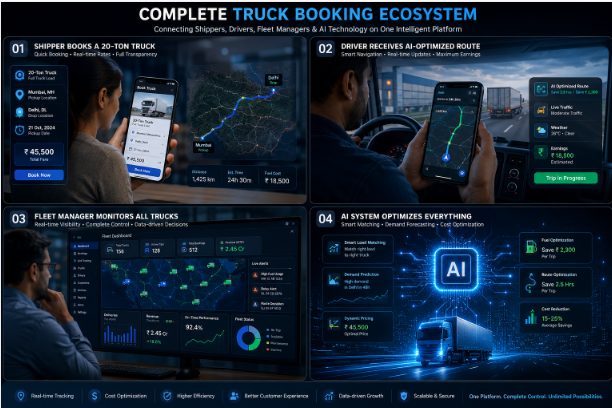
What This Guide Covers:
- What is a custom truck booking app?
- Why logistics companies need a custom app
- Must-have features (shipper, driver, admin, AI)
- How HT Business Group builds your app
- Development process step by step
- Technology stack
- Cost breakdown
- FAQs
What Is a Custom Truck Booking App for Logistics Companies?
A custom truck booking app is a tailor-made digital platform that connects shippers, truck owners, and drivers in real time — enabling seamless booking, dispatching, live GPS tracking, payment processing, and documentation in a single system.
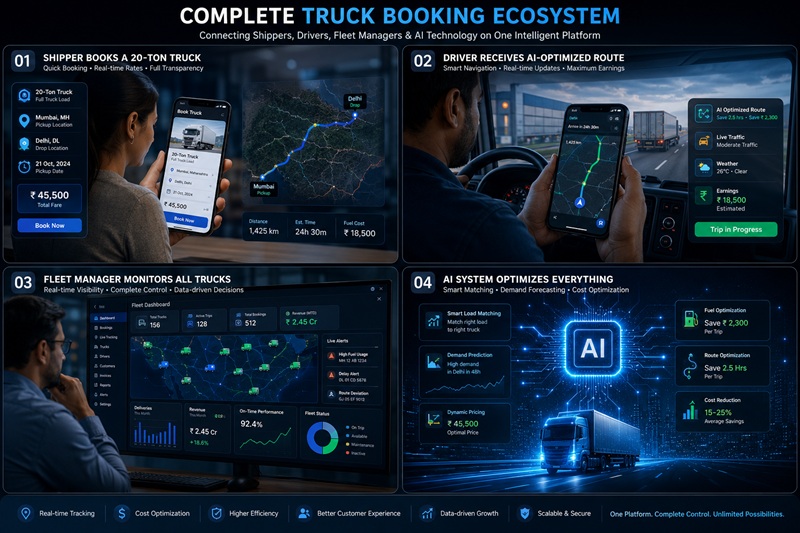
Think of it as Uber — but built specifically for freight, cargo, and industrial logistics. Instead of hailing a cab, a shipper books a 20-ton truck. Instead of a cab driver, a fleet owner’s driver receives an optimized route with full load details.
The key distinction is custom-built versus off-the-shelf:
| Feature | Off-the-Shelf SaaS | Custom-Built App |
| Flexibility | Low — fixed workflows | High — built for your business |
| Branding | Generic platform UI | 100% your brand identity |
| Scalability | Limited by vendor roadmap | Unlimited — scales with you |
| Integrations | Partial (ERP, CRM, GPS) | Full integration suite |
| Long-Term Cost | Ongoing SaaS fees | One-time investment |
Who uses custom truck booking apps? Freight companies, fleet operators, e-commerce brands, manufacturers, cold-chain logistics providers, construction firms, agricultural distributors, and any business that moves goods via road transport.
Why Does Your Logistics Company Need a Custom Truck Booking App?
The Problems Without a Truck Booking App
Manual logistics operations create compounding inefficiencies that directly eat into your margins:
- WhatsApp and phone bookings lead to missed loads, no paper trail, and zero accountability
- Zero real-time visibility frustrates customers who expect live shipment tracking
- Manual invoicing causes revenue leakage — billing errors that quietly drain profits
- Phone-based driver assignment is slow, error-prone, and unscalable
- No centralized data means no analytics, no forecasting, and no ability to make strategic decisions
The Business Case for Going Digital
The numbers speak clearly:
- 73% of logistics companies that digitized booking report a 30%+ reduction in operational costs
- Real-time shipment tracking increases customer retention by up to 40%
- Automated invoicing reduces billing errors by 80%
- AI-powered routing cuts fuel costs by 15–25%
These aren’t aspirational figures — they’re outcomes reported by logistics businesses that made the transition from manual to digital operations.
Industries That Benefit Most
- E-commerce and last-mile delivery
- Construction and raw material transport
- Cold-chain and pharmaceutical logistics
- Manufacturing and production units
- Packers, movers, and relocation services
- Agriculture and farm-to-market distribution
“We’ve worked with logistics operators across India who were managing 50+ trucks entirely through WhatsApp. After building a custom booking platform, they reduced idle truck time by 35% in the first quarter alone.” — HT Business Group, Project Experience
Must-Have Features of a Custom Truck Booking App for Logistics Companies
This is the most critical section for your development planning. A well-architected truck booking app has four distinct panels — each serving a different user with purpose-built functionality.
Shipper / Customer App Features
The shipper panel is your client-facing product. It needs to be frictionless, transparent, and confidence-building:
- Easy registration and profile management
- Real-time truck availability and instant booking
- Freight rate calculator (instant fare estimation)
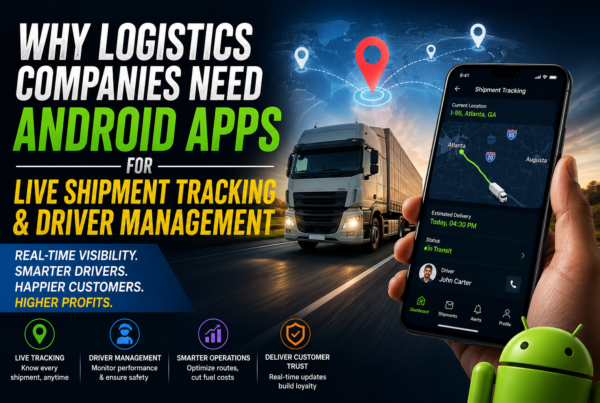
- Live GPS shipment tracking
- Push notifications and shipment status alerts
- Digital documentation and e-POD (electronic Proof of Delivery)
- In-app chat with driver or dispatcher
- Multiple payment modes: UPI, card, NEFT, wallet
- Shipment history and downloadable invoice archive
- Ratings and review system for driver accountability
Driver App Features
The driver-side experience must be lean, intuitive, and functional even on entry-level smartphones:
- Driver registration with document upload (license, RC, insurance)
- Accept or reject booking requests in real time
- AI-optimized route navigation (traffic, weather, load-aware)
- Real-time earnings dashboard
- Digital POD submission (photo + signature capture)
- SOS and emergency alert button
- Fuel and expense tracker
- Online/offline availability toggle
Admin and Fleet Manager Panel Features
The admin dashboard is where operational intelligence lives — the command center for your entire fleet:
- Central dashboard: all bookings, drivers, and trucks in one view
- Real-time fleet tracking on an interactive map
- Driver and vehicle management
- Load and dispatch management
- Dynamic pricing engine
- Revenue and commission reporting
- Automated invoice generation
- Compliance and document management
- Customer support management tools
- Analytics and performance reports
Advanced AI-Powered Features (Competitive Differentiators)
These capabilities separate a basic app from a market-leading platform:
- AI-based route optimization (accounting for weather, traffic, road conditions, and load type)
- Predictive demand forecasting (anticipate freight demand by region and season)
- Automated load matching (algorithmically pair available trucks with shipper requests)
- Dynamic surge pricing engine (maximize revenue during high-demand periods)
- IoT integration (temperature sensors for cold-chain, real-time cargo condition monitoring)
- Blockchain for freight documentation (tamper-proof eBOL, ePOD, and contracts)
- ERP/CRM/WMS integration (sync with your existing business systems)
- Multi-language and multi-currency support (for regional and international operations)
Feature Summary at a Glance:
| Panel | Features | Key Differentiator |
| Shipper App | 10+ | Live tracking + digital POD |
| Driver App | 8+ | AI navigation + earnings dashboard |
| Admin Panel | 12+ | Central dispatch + analytics |
| AI Add-ons | 6+ | Route AI + automated load matching |
How HT Business Group Develops Custom Truck Booking Apps
At HT Business Group, we don’t use templates. Every logistics app we build is designed from first principles around your specific business model, fleet size, customer base, and growth trajectory.
Our development philosophy is built on three pillars: deep discovery, agile delivery, and long-term partnership.
Our 6-Step App Development Process
Step 1 — Discovery and Requirement Analysis
We start by understanding your business model in depth: how loads are currently assigned, how drivers are tracked, how payments are processed, and where the biggest operational pain points are. Competitor analysis and feature prioritization happen at this stage, so development is laser-focused from day one.
Step 2 — UI/UX Design
Our design team creates wireframes, interactive prototypes, and user journey maps specifically for logistics workflows. We prioritize clarity and speed — a driver on the road needs a different interface than a fleet manager at a desk.
Step 3 — App Development
Frontend and backend engineers build simultaneously using an agile sprint model. APIs are integrated, real-time databases are configured, and the core booking and tracking engine is brought to life.
Step 4 — GPS and Third-Party Integration
We integrate Google Maps API (or HERE Maps / Mapbox), payment gateways, SMS and notification services, and your existing ERP or CRM systems.
Step 5 — QA and Testing
Every build goes through rigorous performance testing, security auditing, and load testing across device types and connection speeds before it touches a real user.
Step 6 — Launch and Post-Launch Support
We handle App Store and Google Play deployment, and provide 24/7 maintenance support post-launch. Annual Maintenance Contracts (AMC) are available for ongoing enhancements.
Technology Stack We Use for Truck Booking App Development
We use modern, battle-tested technologies that ensure your app is fast, secure, and infinitely scalable.
| Layer | Technologies |
| Mobile Frontend | React Native, Flutter |
| Web Admin Panel | React.js, Next.js |
| Backend | Node.js, Python (Django) |
| Database | MongoDB, PostgreSQL, MySQL |
| Real-Time GPS | Google Maps API, HERE Maps, Mapbox |
| Cloud Hosting | AWS, Google Cloud, Microsoft Azure |
| Push Notifications | Firebase Cloud Messaging (FCM) |
| Payment Gateway | Razorpay, Stripe, PayU, PayPal |
| AI / ML | TensorFlow, Python ML Libraries |
| IoT Integration | MQTT Protocol, AWS IoT |
| Security | SSL, OAuth 2.0, JWT, Two-Factor Authentication |
Why this stack matters: Cross-platform mobile development with React Native or Flutter means a single codebase delivers a native experience on both Android and iOS — reducing your development cost and timeline without sacrificing performance.
How Much Does Custom Truck Booking App Development Cost?
Cost is driven by five key factors: features, platforms, tech stack, team location, and project timeline. Here’s a transparent breakdown:
Development Cost by App Type
| App Type | Estimated Cost (USD) | Timeline |
| Basic MVP (Single Platform) | $15,000 – $30,000 | 2–3 months |
| Standard App (iOS + Android) | $30,000 – $70,000 | 3–5 months |
| Advanced App (AI + ERP Integration) | $70,000 – $150,000+ | 5–9 months |
| Enterprise-Grade Platform | $150,000 – $400,000+ | 9–18 months |
Cost Factors That Affect Pricing
- Total number of features and user panels required
- Platform scope: Android only, iOS only, both, or web panel included
- Complexity of AI/ML integrations
- GPS and third-party API usage
- Location of your development team (India-based teams offer 60–70% cost savings vs. US agencies)
- Scope of post-launch maintenance and support
Why Choosing HT Business Group Reduces Your Cost
- India-based engineering team — 60–70% lower cost than equivalent US or UK agencies
- Agile development model — no wasted sprint cycles, continuous delivery
- Fixed-price contracts available — zero surprise invoices
- Free project scoping consultation — know your exact cost before committing
💡 Get a FREE custom quote for your truck booking app — contact HT Business Group today and receive your project scoping document within 24 hours.
Why Choose HT Business Group for Truck Booking App Development?
We’ve built logistics and transport apps for fleet owners, freight startups, and enterprise logistics operators. Here’s what makes us different from generic development agencies:
| What We Offer | HT Business Group | Generic Agencies |
| Custom Development | ✅ Built for your workflow | ❌ Template-based |
| Dedicated Project Manager | ✅ Yes, from day one | ❌ Shared team |
| Post-Launch Support | ✅ Included in AMC | ❌ Charged separately |
| Transparent Pricing | ✅ Fixed-price available | ❌ Hidden fees common |
| Logistics Domain Expertise | ✅ Deep industry knowledge | ❌ Generalist approach |
Our credentials:
- End-to-end capability: Design → Development → Launch → Ongoing Support
- Proven expertise in React Native, Flutter, Node.js, and AWS
- Dedicated project manager assigned to every engagement
- Post-launch AMC options for continuous improvement
- Transparent milestone-based billing
Real-World Use Cases of Custom Truck Booking Apps
Use Case 1 — Fleet Owner Going Digital
Problem: A fleet operator managing 50 trucks through WhatsApp groups and phone calls. No visibility into truck locations, no digital load records, constant driver miscommunication.
Solution: Custom booking and dispatch platform with driver app, shipper portal, and admin dashboard.
Result: 35% reduction in idle truck time, 28% revenue increase within the first six months.
Use Case 2 — E-Commerce Brand Seeking Reliable Freight
Problem: An e-commerce company dependent on unreliable third-party logistics (3PL) providers with zero shipment tracking for customers.
Solution: Branded truck booking platform integrated with their existing order management system.
Result: Real-time tracking for every shipment, 95% on-time delivery rate, significant drop in customer support tickets.
Use Case 3 — Freight Aggregator Startup
Problem: A logistics startup looking to compete with established freight aggregators but with no technology product of their own.
Solution: Uber-like truck marketplace application connecting independent truck owners with shippers.
Result: 500+ trucks onboarded within three months of launch, Series A funding secured on the back of platform traction.
Frequently Asked Questions
Q1: What is a custom truck booking app?
A custom truck booking app is a tailor-made digital platform that connects shippers, truck owners, and drivers — enabling real-time booking, GPS tracking, dispatching, and payments in one unified system.
Q2: How long does it take to develop a truck booking app?
Development typically takes 2–9 months depending on complexity. A basic MVP can be delivered in 8–10 weeks, while a full-featured enterprise platform may take 6–9 months.
Q3: How much does truck booking app development cost?
Costs range from $15,000 for a basic MVP to $400,000+ for an enterprise-grade platform. HT Business Group offers affordable, custom solutions — contact us for a free quote tailored to your requirements.
Q4: What features should a truck booking app have?
Essential features include real-time GPS tracking, booking management, driver assignment, dynamic pricing, in-app payments, digital proof of delivery (e-POD), and an admin dashboard with fleet analytics.
Q5: Can HT Business Group integrate AI into a truck booking app?
Yes. HT Business Group integrates AI-powered route optimization, automated load matching, predictive demand forecasting, and dynamic pricing engines into logistics applications.
Q6: Is it better to build a custom app or buy a SaaS logistics solution?
For long-term growth, a custom app delivers significantly more value. It gives you full control, your own branding, unlimited scalability, and no recurring SaaS fees. Off-the-shelf tools impose workflow and integration limitations that constrain growth at scale.
Q7: Do you develop both Android and iOS truck booking apps?
Yes. HT Business Group builds cross-platform apps using React Native and Flutter — a single codebase that delivers native performance on both Android and iOS, reducing cost and development time.
Q8: What industries can use a truck booking app?
E-commerce, manufacturing, construction, cold-chain logistics, agriculture, freight brokerage, packers and movers, and any business that ships goods via road transport can benefit from a custom truck booking platform.
Ready to Build Your Custom Truck Booking App? Let’s Talk.
The logistics industry is digitizing at an accelerating pace. Companies that move now gain the first-mover advantage — better customer retention, lower operational costs, and the data infrastructure to make smarter business decisions.
HT Business Group delivers full-stack custom truck booking apps — not templates, not cookie-cutter SaaS white-labels — built precisely around your fleet size, business model, and growth ambitions.
🚛 Get a FREE Consultation Today
Top queries
truck booking app development company, logistics app development, on-demand truck booking app, freight booking app development, fleet management app development, transport management system app