
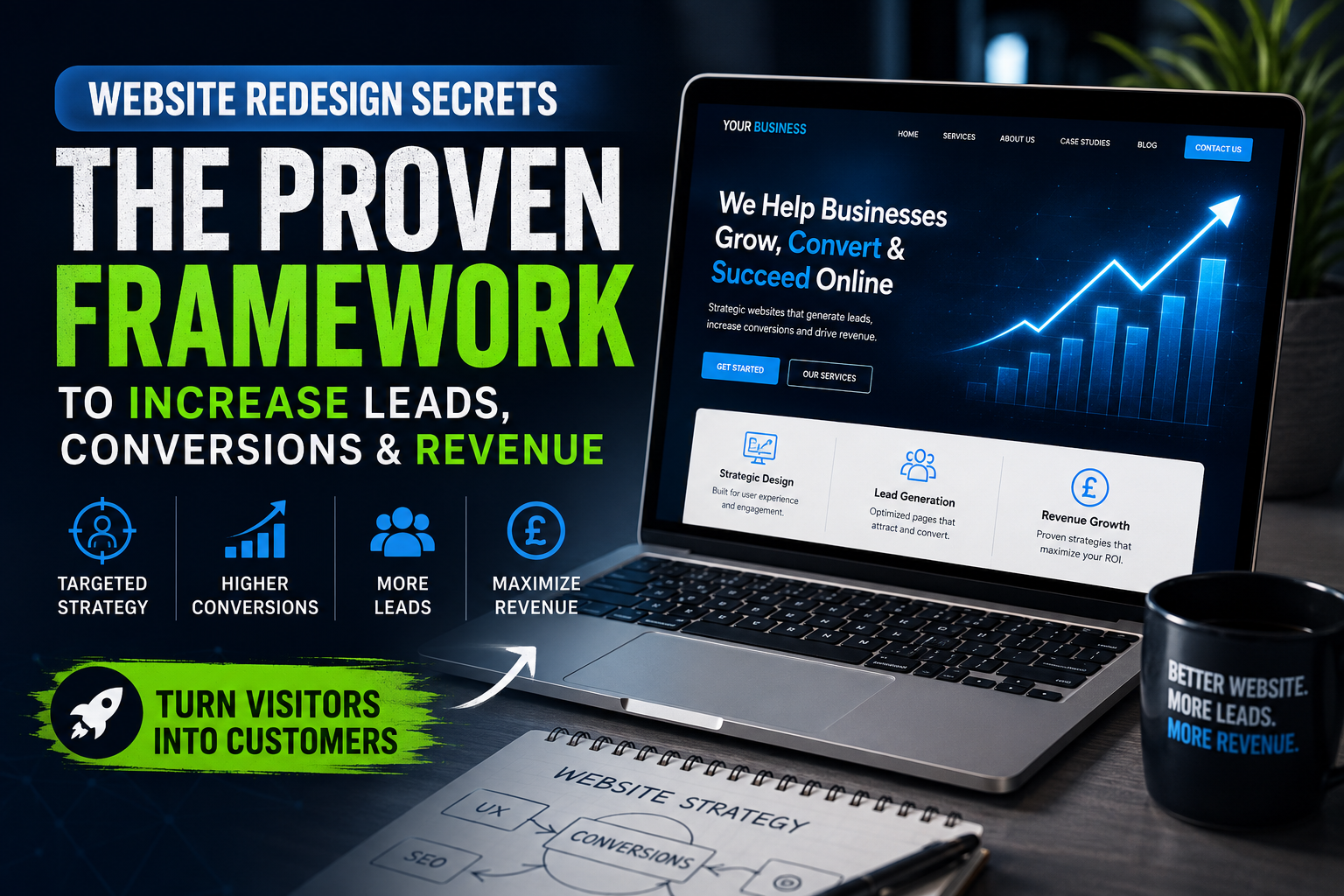
A successful website redesign is more than updating colors, fonts, or layouts. The highest-performing business websites are redesigned with a conversion-first strategy that aligns user experience, search engine optimization (SEO), website performance, and customer psychology to generate measurable business growth.
Businesses that redesign their websites using a structured framework often see improvements in qualified leads, conversion rates, customer engagement, and overall revenue because every page is built to support specific business objectives.
What Is a Conversion-Focused Website Redesign?
A conversion-focused website redesign is the process of improving an existing website to help more visitors become customers. Instead of focusing only on appearance, the redesign prioritizes user experience, page speed, mobile responsiveness, search visibility, trust signals, clear messaging, and optimized calls-to-action.
The goal is to remove friction throughout the customer journey and make it easier for visitors to take the next step — whether that’s requesting a quote, booking a consultation, making a purchase, or getting in touch with your business.
The Proven Framework for Increasing Leads and Revenue
A successful website redesign is not just about making your website look modern. The most successful businesses redesign their websites with one goal in mind: turning more visitors into paying customers.
Every page, image, button, headline, and piece of content should help users move closer to taking action. Whether your goal is to generate leads, increase online sales, schedule consultations, or build brand trust, following a proven framework — ideally guided by an experienced web development partner — ensures your website becomes one of your most valuable business assets.
1. Start With Business Goals
Before choosing colors, layouts, or features, define what success looks like. Many website redesigns fail because businesses focus on aesthetics instead of measurable business outcomes.
A website should support your company’s overall growth strategy. Every design decision should answer one question: “Will this help us achieve our business goals?”
Common Business Goals
- Increase qualified leads
- Generate more online sales
- Improve conversion rates
- Reduce bounce rates
- Increase average order value
- Improve customer engagement
- Strengthen brand credibility
- Generate more phone calls
- Increase appointment bookings
- Grow email subscribers
- Improve customer retention
Why This Matters
Imagine two companies redesigning their websites.
Company A
- Chooses attractive colors
- Adds animations
- Updates fonts
The website looks beautiful but generates the same number of leads.
Company B
- Studies customer behavior
- Improves landing pages
- Simplifies navigation
- Optimizes calls-to-action
- Improves page speed
The result? More leads. Higher conversion rates. More sales. The difference is strategy — and often, the difference is working with a team that offers end-to-end custom application development rather than a template-based approach.
Ask Yourself
Before starting your redesign, answer these questions:
- What is the primary purpose of this website?
- Who is our ideal customer?
- What actions do we want visitors to take?
- What metrics define success?
- How will we measure ROI?
2. Understand Your Audience
Your website should be built around your customers — not your company. Many businesses make the mistake of talking about themselves instead of solving customer problems. Visitors don’t care how long you’ve been in business until they know you can solve their problem.
Understand Customer Pain Points
Ask questions like:
- What challenges do they face?
- What keeps them awake at night?
- What goals are they trying to achieve?
- What frustrations do they experience?
- What questions do they ask before buying?
The better you understand your audience, the easier it becomes to write content that converts — and that’s where working with a specialized content writing team can make a measurable difference.
Analyze Customer Behavior
Use analytics tools to understand:
- Which pages receive the most traffic
- Which pages have the highest bounce rate
- Where users leave the website
- Which buttons receive the most clicks
- Which products generate the most interest
Match Search Intent
Every page should answer the exact question a visitor searched for.
Example: Someone searching “Best Website Development Company” expects a portfolio, reviews, pricing, services, and contact information — not a history of your company. Meeting search intent increases trust and improves conversions, and it’s a core principle behind our own SEO services approach.
3. Improve Website Speed
Speed directly impacts revenue. People expect websites to load almost instantly. If your website is slow, visitors leave before seeing your products or services. Even a one-second delay can reduce conversions and increase bounce rates.
Why Speed Matters
Fast websites:
- Improve user experience
- Increase customer satisfaction
- Improve Google rankings
- Reduce bounce rates
- Increase conversions
- Improve mobile performance
Ways to Improve Speed
- Optimize Images — Large images slow websites dramatically. Compress images without reducing quality and use modern image formats.
- Minimize Code — Remove unnecessary JavaScript, reduce CSS files, and eliminate unused plugins. This is one reason many businesses migrate to a lean custom HTML & CSS build or a well-optimized WordPress setup.
- Enable Browser Caching — Caching stores frequently used files so visitors don’t download them every time, which significantly improves loading speed.
- Choose Better Hosting — Your hosting provider affects website performance. Reliable cloud hosting delivers faster page loads and better uptime.
- Use a Content Delivery Network (CDN) — A CDN serves website files from servers closer to your visitors, reducing loading times worldwide.
4. Design for Mobile Users
More than half of website traffic comes from mobile devices. If your website performs poorly on smartphones, you’re losing potential customers every day. A responsive website automatically adjusts to different screen sizes — a standard we build into every mobile application development and web project.
Mobile Best Practices
- Large readable text
- Fast loading pages
- Touch-friendly buttons
- Simple navigation
- Easy forms
- Click-to-call buttons
- Mobile-friendly menus
Why Mobile Matters
A positive mobile experience leads to higher engagement, more conversions, better SEO, lower bounce rates, and increased customer satisfaction.
5. Create Clear Messaging
Visitors decide within seconds whether your website is relevant. If your messaging is confusing, they leave.
Great messaging answers four questions immediately: What do you offer? Who do you help? Why choose you? What should visitors do next?
Example
Instead of: “We provide innovative digital solutions.”
Write: “We build custom websites that help businesses generate more leads and increase online sales.”
The second statement is specific, benefit-focused, and easier to understand — the kind of messaging a good digital marketing strategy is built around.
Characteristics of High-Converting Messaging
- Clear
- Simple
- Customer-focused
- Benefit-driven
- Easy to scan
- Action-oriented
6. Build Trust Throughout the Website
People buy from businesses they trust. Your website should reduce uncertainty at every stage of the customer journey.
Trust Signals
Include customer testimonials, verified reviews, client logos, industry certifications, awards, case studies, security badges, privacy policy, contact information, physical business location, and professional team photos. You can see how we apply this on our own about us page.
Why Trust Matters
Visitors ask themselves: “Can I trust this company?” Your website should answer that question before they ask it. Trust reduces hesitation and increases conversions.
7. Optimize Every Call-to-Action (CTA)
Every page should have one primary goal. Don’t confuse visitors with too many choices. A great CTA tells users exactly what happens next.
Strong CTA Examples
- Schedule a Free Consultation
- Request a Quote
- Get Started Today
- Book a Demo
- Download the Guide
- Talk to an Expert
CTA Best Practices
Place CTAs above the fold, after key benefits, at the end of pages, inside blog posts, and on service pages. Repeat them naturally without overwhelming visitors — for example, by linking directly to a contact us form at key decision points.
8. Strengthen SEO During the Redesign
Many businesses lose rankings after redesigning their website because they ignore SEO. A redesign should improve search visibility — not damage it. In fact, if your site has already lost visibility, it’s worth reading our guide on how businesses can recover from Google ranking drops.
SEO Checklist
- Preserve valuable URLs
- Use proper 301 redirects
- Optimize title tags
- Write compelling meta descriptions
- Improve page headings
- Strengthen internal linking
- Optimize images
- Add structured data
- Improve page speed
- Fix broken links
Benefits
Good SEO helps you increase organic traffic, improve Google rankings, generate more qualified leads, and reduce advertising costs. Our SEO services are built specifically to protect and grow rankings through a redesign.
9. Improve User Experience (UX)
User experience determines how easily visitors can complete important tasks. A confusing website creates frustration. A simple website increases conversions.
UX Best Practices
- Clear navigation
- Logical page hierarchy
- Consistent design
- Readable typography
- Plenty of white space
- Fast loading pages
- Simple forms
- Accessible design
Remove Friction
Ask yourself: Can visitors find what they need within three clicks? Can they contact you in seconds? Can they complete forms quickly? Small improvements — often delivered through thoughtful Figma design and UX planning — create significant business results.
10. Measure and Continuously Improve
A website redesign is not the finish line. It’s the beginning of continuous optimization. The best-performing websites evolve based on real customer behavior.
Track Important Metrics
Monitor website traffic, conversion rate, bounce rate, average session duration, page load speed, form submissions, phone calls, online sales, revenue, and customer acquisition cost.
Use Data to Improve
Regularly review analytics and ask which pages convert the best, where visitors are leaving, which CTA receives the most clicks, which landing pages need improvement, and what content generates the most leads. Testing and optimizing your website over time — often supported by ongoing social media marketing and paid campaigns — leads to steady improvements in performance and return on investment.
Final Thoughts
A high-performing website is built on strategy — not guesswork. By aligning business goals with customer needs, improving speed and usability, creating clear messaging, strengthening trust, optimizing SEO, and continually measuring performance, your website becomes more than an online presence — it becomes a reliable engine for generating leads, increasing conversions, and driving sustainable revenue growth.
Common Website Redesign Mistakes
Many businesses fail to achieve results because they:
- Focus only on visual design
- Ignore user intent
- Remove valuable SEO content
- Create confusing navigation
- Use weak calls-to-action
- Neglect mobile performance
- Launch without testing
- Skip performance monitoring
Avoiding these mistakes can protect existing traffic while creating a stronger foundation for future growth.
Why Businesses Redesign Their Websites
Companies typically redesign their websites to generate more qualified leads, increase online sales, improve search engine visibility, modernize their brand, enhance mobile usability, increase website speed, improve customer trust, and support business growth.
Key Takeaway
The most successful website redesigns combine strategy, user experience, SEO, performance optimization, and conversion-focused design. When every element is built around customer needs and measurable business goals, a redesigned website becomes a powerful growth asset that attracts more visitors, converts more leads, and supports long-term revenue growth.
Ready to start your redesign? Get in touch with our team or explore our full range of web development services.