How much does OTT platform development cost in 2026?
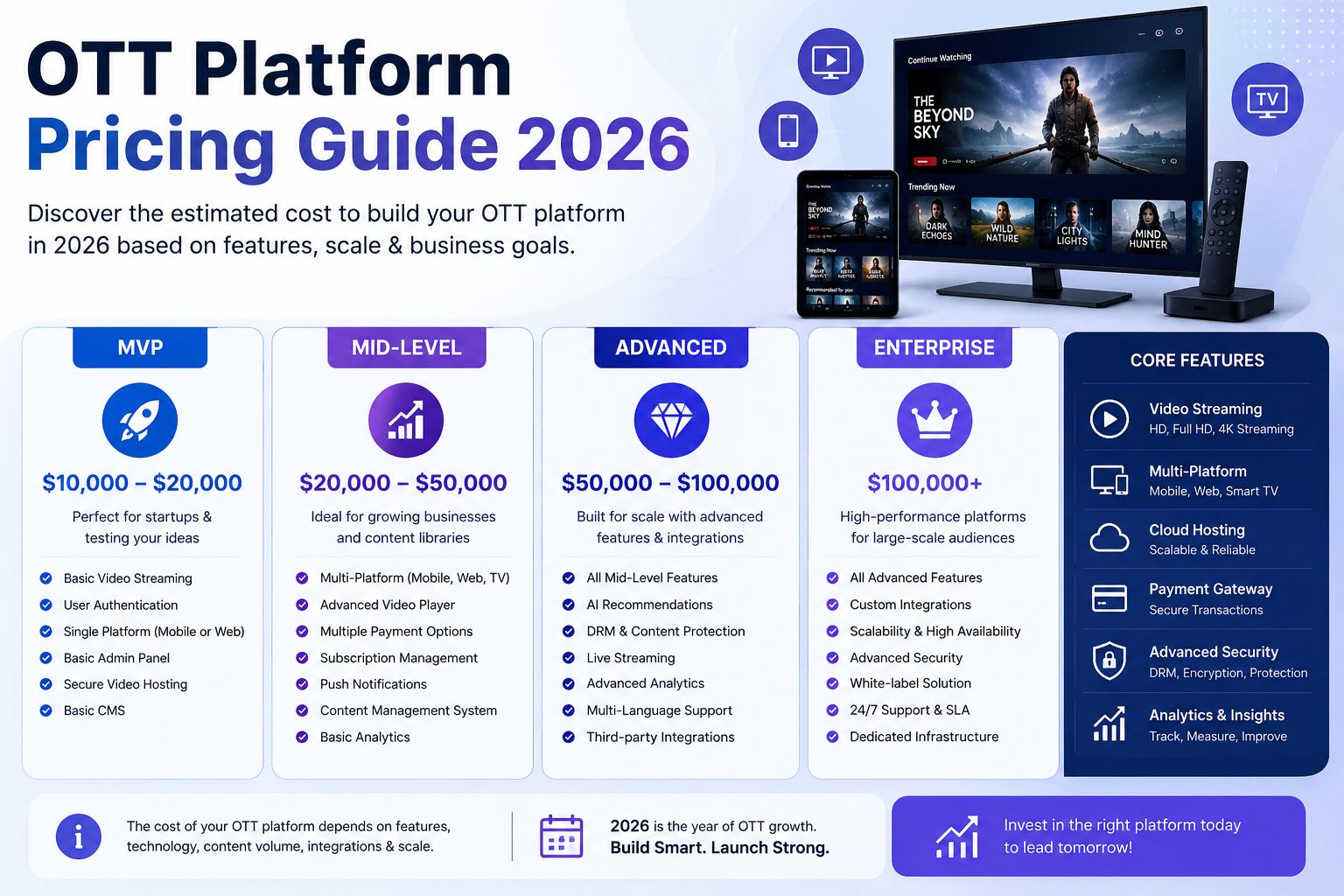
The average OTT platform development cost in 2026 ranges from $30,000 to $600,000+, depending on the platform type, features, number of devices, content delivery setup, monetization model, and level of customization. A basic version with limited content and simple playback sits at the lower end, while a platform built for scale, with personalization and multi-device support, moves toward the higher range.
For startups, the smartest approach is not to build everything at once. Start with an MVP that includes video streaming, user registration, content library, search, subscription/payment integration, basic admin panel, and analytics. Advanced features like AI recommendations, offline downloads, DRM security, live streaming, multi-language support, smart TV apps, and advanced ad monetization can be added in later phases.
OTT Platform Development Cost Breakdown in 2026
| OTT Platform Type | Estimated Cost in 2026 | Best For |
| Basic OTT MVP | $30,000–$80,000 | Early-stage startups testing the market |
| Mid-Level OTT Platform | $80,000–$180,000 | Startups with a defined content library and paid users |
| Advanced OTT App | $180,000–$350,000 | Growing brands needing personalization, payments, analytics, and multi-device support |
| Enterprise OTT Platform | $350,000–$600,000+ | Large-scale streaming businesses, broadcasters, media brands, and Netflix-like platforms |
| White-Label OTT Solution | $500–$10,000+/month | Startups that want faster launch with limited customization |
Platforms covering four or more surfaces with live streaming and hybrid monetization sit in the $120,000–$300,000 range, while full enterprise builds — multi-platform, cloud-native, ultra-low-latency live, complete DRM stack — run $300,000–$800,000 and beyond. Oxagile
What affects the cost of OTT platform development?
OTT app development cost depends on eight major factors: platform selection, UI/UX design, video streaming architecture, content management system, monetization features, security, third-party integrations, and post-launch infrastructure.
The biggest cost drivers are usually not the login screen or homepage. Streaming and storage systems take a large share of spend, especially as content volume increases. The real cost comes from video processing, cloud storage, CDN usage, payment workflows, multi-device compatibility, content protection, and ongoing maintenance. Appinventiv
1. Platform Selection
The more platforms you support, the higher the cost. A startup may begin with a web app and mobile apps, then expand to smart TVs later.
Common OTT platforms include:
- Web platform
- Android app
- iOS app
- Android TV
- Apple TV
- Roku
- Amazon Fire TV
- Samsung Smart TV
- LG webOS
Building native apps for Android TV, iOS, Apple TV, Roku, Samsung Tizen, LG WebOS, Fire TV, and web typically costs $50,000–$150,000 per platform with a development agency. A multi-platform OTT ecosystem requires more development time, testing, device optimization, and app store compliance. MwareTV
2. UI/UX Design
A clean, fast, and easy-to-use OTT interface is essential because users judge streaming apps quickly. UI/UX design cost depends on the number of screens, user flows, branding requirements, and personalization elements.
Basic OTT UI includes:
- Home screen
- Login/signup
- Content categories
- Video detail page
- Video player
- Search
- Watchlist
- Subscription page
- User profile
- Admin dashboard
Advanced UI may include continue watching, personalized rows, trending content, watch history, kids mode, creator profiles, and dynamic banners.
3. Core OTT Features
A basic OTT platform usually includes the following features:
- User registration and login
- Content library
- Video player
- Search and filters
- Categories and genres
- Watchlist
- Subscription plans
- Payment gateway
- Admin panel
- Push notifications
- Basic analytics
- CMS for uploading and managing content
These features are enough for most startup MVPs. The goal of an MVP is to validate user demand before investing in expensive advanced features.
4. Advanced OTT Features
Advanced OTT features increase both development cost and infrastructure cost. These features are useful once the platform has paying users, a larger content library, or strong engagement data.
Advanced features include:
- AI-based content recommendations
- Offline video downloads
- Multi-language audio and subtitles
- Live streaming
- DRM content protection
- In-app ads
- Coupon and referral system
- Parental control
- Multi-profile accounts
- Smart TV support
- Real-time analytics
- Creator dashboard
- Multi-currency payments
- Social login
- Chromecast and AirPlay support
For startups, these features should be prioritized based on the business model. A subscription-based OTT app may need recurring billing and content protection first. An ad-supported OTT app may need ad server integration and viewer analytics first.
OTT Monetization Models and Their Cost Impact
Your monetization model also affects the development cost because every model needs different payment, access control, and analytics logic.
| Monetization Model | Meaning | Cost Impact |
| SVOD | Subscription Video on Demand | Requires recurring payments, plan management, access control |
| TVOD | Transactional Video on Demand | Requires pay-per-view, rentals, purchase history |
| AVOD | Advertising Video on Demand | Requires ad integration, ad tracking, viewer analytics |
| Hybrid OTT | Mix of subscription, ads, and rentals | Highest complexity but more revenue flexibility |
| Free + Premium | Free content with paid upgrades | Requires user segmentation and gated content |
Hybrid models combining subscription tiers with an ad-supported option are the dominant pattern and tend to produce the strongest revenue across different audience segments. For most startups, SVOD or hybrid monetization is the best starting point because it creates predictable revenue while leaving room for ads, rentals, and premium content later. Oxagile
Hidden Costs of OTT Platform Development
Many startups calculate the app development cost but forget the operational cost. Post-launch OTT infrastructure costs — including cloud egress fees, CDN costs for streaming, multi-DRM licensing, and data transfer overhead — can quietly consume up to 50% of gross revenue. TO THE NEW
Common hidden OTT costs include:
- Cloud hosting
- CDN bandwidth
- Video transcoding
- Storage
- DRM licensing
- Payment gateway fees
- App store fees
- Content licensing
- Bug fixing
- Server monitoring
- Security updates
- New device support
- Customer support
- Marketing and user acquisition
The initial build represents roughly 30% of the first-year budget, while 70% is consumed by scaling, multi-DRM, and data transfer overhead. The more users stream, the more bandwidth, CDN, storage, and processing costs increase. TO THE NEW
Estimated Monthly OTT Maintenance Cost
A startup should keep 15%–25% of the development cost per year for maintenance, upgrades, bug fixes, performance monitoring, and security updates.
| Platform Size | Estimated Monthly Maintenance |
| Small OTT MVP | $1,000–$5,000/month |
| Growing OTT Platform | $5,000–$15,000/month |
| Large OTT Platform | $15,000–$50,000+/month |
This does not include heavy CDN usage, large-scale video hosting, paid marketing, or content acquisition costs.
OTT Development Cost by Startup Stage
Early-Stage Startup
An early-stage startup should not build a Netflix-like platform immediately. The right budget range is usually $30,000–$80,000 for an MVP.
Recommended features:
- Web or mobile-first platform
- User login
- Video library
- Basic streaming
- Subscription/payment integration
- Admin panel
- Basic analytics
Best goal: launch fast, test demand, collect user feedback, and improve based on real viewing behavior.
Growth-Stage Startup
A growth-stage startup may spend $80,000–$180,000 to build a stronger OTT platform with better user experience and monetization.
Recommended features:
- Android and iOS apps
- Better CMS
- Multiple subscription plans
- Watch history
- Continue watching
- Push notifications
- Coupons and offers
- Improved analytics
- Basic recommendation engine
Best goal: improve retention, increase paid conversions, and reduce churn.
Scaling OTT Business
A scaling OTT business may spend $180,000–$600,000+ depending on device coverage and infrastructure needs.
Recommended features:
- Smart TV apps
- AI recommendations
- DRM security
- Offline downloads
- Live streaming
- Ad monetization
- Multi-language support
- Advanced analytics
- Multi-region CDN
- High-performance cloud architecture
Best goal: handle scale, protect content, improve personalization, and expand to more devices and markets.
White-Label OTT vs Custom OTT Development
Startups often compare white-label OTT platforms with custom OTT development.
White-label solutions are faster to get live and cost less upfront, but they limit UX flexibility, feature ownership, and scalability over time. Custom OTT app development gives full architectural control and the ability to build something genuinely differentiated. Oxagile
| Option | Pros | Cons |
| White-Label OTT | Faster launch, lower upfront cost, ready-made features | Limited customization, recurring fees, platform dependency |
| Custom OTT | Full control, scalable, unique UX, better long-term flexibility | Higher upfront cost, longer development time |
For most startups, the best path is to begin with an MVP or white-label model, then move toward custom development once the business model is validated.
Must-Have OTT Features for Startups in 2026
A startup OTT platform should focus on features that directly support viewing, payment, retention, and content management.
Must-have features include:
- User registration and secure login
- Video streaming player
- Content library and categories
- Search and filters
- Subscription and payment system
- Admin content management system
- Watchlist and continue watching
- Push notifications
- Basic analytics dashboard
- Cloud hosting and CDN integration
- Data security
- Mobile-responsive design
These features create the foundation for a functional OTT platform without overspending in the first phase.
Advanced Features to Add Later
Once the platform has traction, startups can add advanced features such as:
- AI recommendations
- Offline downloads
- Smart TV apps
- Live streaming
- DRM protection
- Multi-language subtitles
- In-app advertising
- Parental controls
- Loyalty programs
- Referral system
- Advanced user segmentation
- Real-time performance analytics
Adding these features later helps startups control cost while improving the platform based on actual user behavior.
How to Reduce OTT Platform Development Cost
Startups can reduce OTT development cost by building in phases instead of trying to launch a fully loaded platform.
Here are practical ways to reduce cost:
- Start with an MVP
- Launch on one or two platforms first
- Use cloud-based video infrastructure
- Avoid unnecessary custom animations
- Prioritize must-have features
- Use ready-made APIs for payments, analytics, and notifications
- Add smart TV apps later
- Choose scalable architecture from day one
- Keep the admin panel simple in the beginning
- Test monetization before building advanced features
OTT is still a massive opportunity. But in 2026, the winners won’t be the ones who spend the most — they’ll be the ones who understand their costs best. vativeapps
Final Answer: What is the ideal OTT platform budget for startups in 2026?
The ideal OTT platform development budget for startups in 2026 is $30,000–$80,000 for an MVP, $80,000–$180,000 for a growth-ready platform, and $180,000–$600,000+ for a scalable multi-device OTT ecosystem. The global OTT video industry is entering a powerful expansion phase, with the market projected to reach $352.96 billion in 2026, reflecting how streaming has evolved from an alternative viewing option to mainstream infrastructure for content consumption. Orangemantra
Startups should also plan for monthly costs such as hosting, CDN, video processing, security, maintenance, and customer support. For most startups, the best strategy is to launch a focused OTT MVP first, validate the audience, measure watch time and paid conversions, then invest in advanced features like AI recommendations, offline downloads, DRM, live streaming, and smart TV apps.