
Introduction
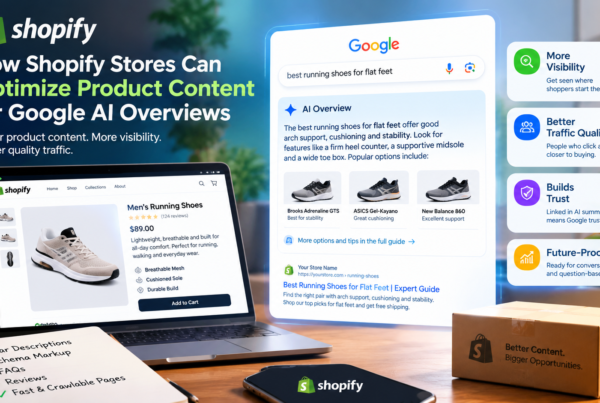
Google Search is changing faster than ever. Instead of showing only a list of websites, Google now uses artificial intelligence to provide direct answers through AI-powered search experiences. These answers often appear at the top of search results and are known as Google AI Overviews. For eCommerce businesses, this shift creates both new opportunities and new challenges.

If you run an online store, relying only on traditional SEO strategies is no longer enough. Ranking on page one is still important, but getting featured inside Google’s AI-generated answers is becoming even more valuable. Stores that adapt to these changes can gain more visibility, attract highly targeted visitors, and increase sales without depending heavily on backlinks.
What Are Google’s AI Search Results?
Google’s AI Search Results use advanced artificial intelligence to understand a user’s question and generate a helpful answer directly within the search results page. Instead of showing only blue links, Google analyzes information from multiple trusted sources and creates a summarized response.
For example, if someone searches for:
“What is the best ergonomic office chair for remote work?”
Google may display an AI Overview that highlights specific products, buying factors, expert recommendations, and links to trusted websites. If your store’s content is considered helpful and trustworthy, Google may cite your website as a source within that AI-generated answer.
This means businesses now have an opportunity to appear above traditional organic rankings and gain visibility directly inside AI Search Results.
Why Traditional SEO Alone Is No Longer Enough
For years, eCommerce SEO focused heavily on keyword optimization, backlinks, and technical SEO. While these factors still matter, Google’s AI systems now evaluate content differently.
Modern AI search algorithms focus on understanding:
- User intent
- Content quality
- Expertise and experience
- Product information accuracy
- Trustworthiness
- Helpful answers to real customer questions
Simply adding keywords to product pages is no longer enough to rank consistently. Google’s AI wants to recommend sources that provide complete, accurate, and valuable information.
Stores that create genuinely helpful content have a much better chance of being featured in AI Overviews than websites that rely on outdated SEO tactics.
How AI Overviews Are Changing eCommerce Traffic
AI Overviews are changing how people discover products online.
Instead of visiting multiple websites to compare options, users can now get recommendations, product comparisons, buying advice, and answers directly from Google’s AI-generated results.
As a result, shoppers often make decisions faster and click on sources that appear most trustworthy within the AI Overview.
This shift means eCommerce brands need to optimize not only for traditional search rankings but also for AI-generated citations. Websites that become trusted sources for Google’s AI can receive highly qualified traffic from users who are already close to making a purchase.
In many cases, appearing in an AI Overview can generate more visibility than ranking in a standard organic position.
The Opportunity for Online Stores to Gain Visibility Without Backlinks
One of the biggest changes in AI Search is that backlinks are no longer the only path to visibility.
Google’s AI systems increasingly prioritize:
- Helpful content
- Original product insights
- First-hand experience
- Detailed product information
- Expert recommendations
- Customer-focused answers
- Structured data and schema markup
A smaller eCommerce store with exceptional content can sometimes outperform larger competitors with stronger backlink profiles.
For example, a product page that answers common customer questions, includes detailed specifications, provides real-world use cases, and demonstrates expertise may be selected by Google’s AI as a trusted source.
This creates a significant opportunity for online stores that focus on quality, authority, and user experience rather than chasing backlinks alone.
What You Will Learn in This Guide
In this complete 2026 guide, you’ll learn how to optimize your eCommerce website for Google’s AI Search Results and AI Overviews.
We’ll cover:
- The ranking factors that influence AI Search visibility
- How Google chooses websites for AI-generated citations
- The role of EEAT (Experience, Expertise, Authoritativeness, and Trustworthiness)
- Product page optimization strategies for AI Search
- Schema markup and structured data best practices
- How to build topical authority in your niche
- Content formats that perform best in AI Overviews
- Ways to improve visibility without relying heavily on backlinks
- Advanced AI Search Optimization techniques for Shopify, WooCommerce, and custom eCommerce stores
By the end of this guide, you’ll have a clear roadmap to help your online store compete in the new era of AI-powered search and increase organic traffic from both traditional search results and Google’s AI-generated experiences.
Understanding Google’s AI Search Ecosystem
Google Search is no longer just a search engine that shows a list of websites. Today, Google uses advanced artificial intelligence to understand questions, analyze content, and provide direct answers to users. This new AI-powered search experience is changing how websites earn visibility and traffic.
For eCommerce businesses, understanding Google’s AI Search ecosystem is essential. If you want to rank in Google’s AI Search Results, you must know how AI Overviews work, how Google selects sources, and what signals influence AI-generated citations.
The good news is that businesses that understand these changes early can gain a major competitive advantage and attract more qualified customers from AI-powered search.
What Are Google AI Overviews?
Quick Answer
Google AI Overviews are AI-generated summaries that appear at the top of search results. They provide direct answers to user questions by combining information from multiple trusted sources across the web. Websites that are cited in these summaries can gain significant visibility and targeted traffic.
Evolution From Featured Snippets to AI Answers
For many years, Google used Featured Snippets to answer questions directly in search results. Featured Snippets typically displayed a short excerpt from a single webpage that best answered a user’s query.
For example, if someone searched for:
“How to choose the best running shoes?”
Google might display a paragraph from one website at the top of the results page.
Today, Google’s AI Search Results go much further.
Instead of pulling information from just one source, Google AI can analyze content from multiple websites, compare information, understand context, and generate a comprehensive answer.
This shift has transformed search from a simple keyword-matching system into an intelligent answer engine.
As a result, businesses now compete not only for traditional rankings but also for inclusion in AI-generated responses.
How Google Generates AI Summaries
Google’s AI systems use advanced language models and search algorithms to understand both the user’s question and the content available online.
The process generally works like this:
- A user enters a search query.
- Google identifies the intent behind the search.
- The AI analyzes trusted content from multiple sources.
- Information is compared and validated.
- A summarized answer is generated.
- Relevant sources may be cited within the AI Overview.
Google’s goal is to provide the most helpful, accurate, and trustworthy answer possible.
For this reason, websites that publish expert content, detailed product information, and helpful resources are more likely to appear in AI Search Results.
Why AI Overviews Matter for eCommerce Stores
AI Overviews often appear above traditional organic search results.
This means users may see your brand before they even scroll to the regular rankings.
For online stores, this creates opportunities to:
- Increase brand visibility
- Build trust with potential customers
- Generate highly targeted traffic
- Improve click-through rates
- Reach buyers earlier in the decision-making process
Businesses that optimize for AI Search Optimization can gain exposure even in highly competitive industries.
Difference Between Traditional Search and AI Search
Although traditional SEO remains important, AI Search SEO focuses on different ranking signals.
The way Google evaluates content is becoming more sophisticated, with greater emphasis on understanding meaning, context, expertise, and user satisfaction.
Traditional SEO vs AI Search SEO
| Traditional SEO | AI Search SEO |
| Keywords | Entities |
| Backlinks | Authority Signals |
| Rankings | Citations |
| Traffic | Visibility |
Let’s look at what these differences mean.
Keywords vs Entities
Traditional SEO focused heavily on keywords.
Website owners often tried to rank by repeating exact phrases throughout their content.
AI Search takes a broader approach.
Instead of focusing only on keywords, Google now understands entities, which are people, brands, products, organizations, and concepts connected to a topic.
For example, an article about eCommerce SEO may naturally include related entities such as:
- Google AI Overviews
- Schema Markup
- Product Pages
- Merchant Center
- User Intent
- EEAT
The more context and relevance your content provides, the easier it becomes for Google’s AI to understand your expertise.
Backlinks vs Authority Signals
Backlinks remain important, but they are no longer the only measure of authority.
Google’s AI evaluates many additional trust signals, including:
- Author expertise
- Brand reputation
- Customer reviews
- Product accuracy
- Content quality
- First-hand experience
- Industry recognition
A smaller eCommerce website with highly valuable content can sometimes earn AI citations over larger websites with stronger backlink profiles.
Rankings vs Citations
Traditional SEO focused on achieving the highest ranking position.
AI Search introduces a new goal: earning citations within AI-generated answers.
When Google’s AI references your content inside an AI Overview, your website gains visibility even if it is not ranked in the first position.
This creates additional opportunities for brands to appear in front of potential customers.
Traffic vs Visibility
Traditional SEO success was measured primarily by clicks and traffic.
AI Search SEO also focuses on visibility.
Even when users do not immediately click, appearing in AI-generated answers increases brand awareness, credibility, and recognition.
Over time, this visibility can lead to more searches, more clicks, and more sales.
How AI Chooses Sources for Citations
One of the most common questions businesses ask is:
How does Google decide which websites appear in AI Overviews?
Google does not randomly choose sources.
Its AI systems evaluate multiple quality signals to determine which content deserves visibility.
Understanding these signals can help eCommerce stores improve their chances of earning citations.
Trustworthiness
Trust is one of the most important ranking factors in AI Search.
Google wants to provide users with accurate and reliable information.
Trustworthy websites typically have:
- Secure HTTPS connections
- Transparent business information
- Clear contact details
- Privacy policies
- Customer support information
- Authentic reviews
The more trustworthy your website appears, the more likely Google’s AI will consider your content as a reliable source.
Expertise
Google wants content created by people who understand the topic.
Expertise is especially important for product recommendations, buying guides, and industry-specific advice.
You can demonstrate expertise by:
- Publishing detailed content
- Sharing first-hand experience
- Including expert insights
- Providing accurate product information
- Updating content regularly
The stronger your expertise signals, the greater your opportunity to rank in Google’s AI Search Results.
Freshness
AI systems prefer information that is current and relevant.
Outdated content may lose visibility over time.
Regularly updating your content helps Google understand that your information remains accurate.
For eCommerce websites, this includes:
- Product specifications
- Pricing information
- Industry trends
- Buying guides
- Comparison articles
Fresh content often performs better in AI-powered search experiences.
Structured Data
Structured data helps Google understand your content more clearly.
Schema markup provides additional context about:
- Products
- Reviews
- FAQs
- Organizations
- Articles
- Prices
- Availability
When structured data is implemented correctly, Google’s AI can interpret information more efficiently and may be more likely to use it in AI-generated answers.
For online stores, Product Schema and FAQ Schema are particularly valuable.
User Satisfaction Signals
Google’s ultimate goal is to satisfy users.
If visitors find your content useful, Google’s systems receive positive signals.
Important user satisfaction indicators include:
- Strong engagement
- Longer time on page
- Helpful content
- Easy navigation
- Fast loading speed
- Mobile-friendly design
- Positive user experience
Content that consistently helps users solve problems has a higher chance of being featured in AI Overviews.
Key Takeaway
Google’s AI Search ecosystem is changing the rules of SEO. Success is no longer based only on keywords and backlinks. Instead, Google’s AI focuses on understanding entities, expertise, trust, structured information, and user satisfaction. eCommerce stores that create helpful content, demonstrate authority, and optimize for AI Search SEO will have the best chance of earning citations, increasing visibility, and ranking in Google’s AI Search Results.
The New Ranking Factors for AI Search
The rise of Google’s AI Search Results is changing how websites earn visibility online. In the past, many businesses focused mainly on keywords and backlinks. While these factors still matter, Google’s AI Search now evaluates content in a much smarter way.
Today, Google’s AI systems are designed to understand who created the content, whether the information is trustworthy, how helpful it is to users, and whether it truly answers the searcher’s question.
If you want to rank in Google’s AI Search Results and appear in AI Overviews, you need to focus on the new ranking factors that Google’s AI values most. These factors include EEAT, brand authority, trust signals, and user intent.
Let’s explore each one in detail.
EEAT Is More Important Than Ever
Quick Answer
EEAT stands for Experience, Expertise, Authoritativeness, and Trustworthiness. It helps Google determine whether content is reliable, accurate, and useful. Websites with strong EEAT signals are more likely to appear in AI Search Results, AI Overviews, and Featured Snippets.
Google’s AI wants to recommend information that users can trust. That is why EEAT has become one of the most important factors in modern SEO and AI Search Optimization.
Experience
Experience refers to first-hand knowledge of a topic.
Google prefers content created by people who have actually used a product, tested a service, or worked in a specific industry.
For example, an eCommerce store selling fitness equipment can demonstrate experience by sharing:
- Product testing results
- Real customer case studies
- Before-and-after examples
- Personal recommendations
- Practical usage tips
AI systems can recognize content that comes from real-world experience. This type of content often provides more value than generic articles written without practical knowledge.
Expertise
Expertise means having deep knowledge about a topic.
Google wants users to receive accurate information from people who understand the subject they are discussing.
You can build expertise by:
- Publishing detailed guides
- Creating educational content
- Answering common customer questions
- Explaining complex topics in simple language
- Sharing industry insights
For eCommerce websites, expertise can help improve rankings for product guides, buying advice, comparison articles, and category pages.
The more helpful and informative your content is, the more likely Google’s AI will view your website as an expert source.
Authoritativeness
Authoritativeness refers to your reputation within your industry.
Google wants to know whether other people recognize your brand as a trusted source of information.
Some common authority signals include:
- Brand mentions across the web
- Industry recognition
- Positive customer reviews
- Expert contributions
- High-quality content
- Strong online presence
A website that consistently publishes valuable information can become an authority in its niche, even without a massive backlink profile.
This is especially important for businesses trying to rank in AI Search Results without relying heavily on traditional link-building strategies.
Trustworthiness
Trustworthiness is the foundation of EEAT.
Google’s AI systems prioritize websites that appear honest, transparent, and reliable.
Ways to improve trust include:
- Using HTTPS security
- Displaying clear contact information
- Showing real customer reviews
- Providing transparent policies
- Including author information
- Keeping content accurate and updated
Trust is particularly important for eCommerce stores because users are making purchasing decisions.
When customers trust your website, Google’s AI is more likely to trust it as well.
Why EEAT Matters for AI Search
Unlike traditional search algorithms, AI Search systems evaluate the overall quality and reliability of content before using it in AI-generated answers.
If your website demonstrates strong Experience, Expertise, Authoritativeness, and Trustworthiness, it has a much better chance of earning AI citations and appearing in Google AI Overviews.
Why AI Prefers Trusted Brands
Quick Answer
Google’s AI prefers trusted brands because they provide reliable information, positive user experiences, and consistent quality. Strong brand signals help Google’s AI determine which websites deserve visibility in AI Search Results.
In many industries, users naturally trust recognized brands. Google’s AI follows a similar approach.
When multiple websites provide similar information, AI systems often choose the source with stronger trust and authority signals.
Brand Mentions
Brand mentions are references to your company across the internet.
These mentions can appear in:
- Blog articles
- Industry websites
- News publications
- Social media discussions
- Forums
- Online communities
Google’s AI uses these mentions to understand how often your brand is discussed and recognized.
The more frequently your brand is associated with a topic, the stronger your topical authority becomes.
For example, if people regularly mention your brand when discussing eCommerce SEO or AI Search Optimization, Google’s AI may view your website as a valuable source for those topics.
Reviews
Customer reviews are one of the strongest trust signals available.
Reviews help both users and search engines understand the quality of your products and services.
Positive reviews demonstrate:
- Customer satisfaction
- Product quality
- Brand reliability
- Business credibility
For eCommerce stores, reviews can directly influence visibility in AI-powered search experiences.
Encouraging authentic customer feedback can help strengthen your overall trust profile.
Reputation Signals
Google evaluates a wide range of reputation signals when determining authority.
These signals may include:
- Customer ratings
- Industry awards
- Media mentions
- Expert recommendations
- Business longevity
- User engagement
A strong reputation helps Google’s AI feel confident when citing your content.
Over time, positive reputation signals can improve your visibility across both traditional search results and AI Search Results.
Expert Content
Google’s AI prefers content that demonstrates expertise and provides genuine value.
Expert content often includes:
- Original insights
- Research findings
- Industry knowledge
- Practical advice
- Detailed explanations
Instead of publishing thin content focused only on keywords, businesses should create resources that genuinely help users solve problems.
The more useful your content is, the more likely Google’s AI will reference it in AI-generated answers.
Key Takeaway
Trusted brands often earn more AI citations because they combine strong expertise, positive reviews, authority signals, and valuable content. Building brand trust is becoming one of the most effective ways to improve AI Search visibility.
User Intent Becomes the Main Ranking Signal
Quick Answer
User intent refers to the reason behind a search query. Google’s AI Search focuses heavily on understanding what users actually want and delivering the most relevant answer. Content that matches user intent has a higher chance of appearing in AI Overviews and Featured Snippets.
In traditional SEO, many websites focused on targeting specific keywords.
Today, Google’s AI focuses on understanding the meaning behind those keywords.
If your content satisfies user intent better than competing pages, you have a stronger chance of ranking.
Informational Intent
Informational searches occur when users want to learn something.
Examples include:
- What is AI Search Optimization?
- How do AI Overviews work?
- What is EEAT in SEO?
- How can eCommerce stores rank in Google’s AI Search Results?
Users are looking for answers, explanations, and educational content.
To satisfy informational intent:
- Answer questions clearly
- Use simple language
- Include examples
- Cover topics comprehensively
Informational content often performs well in AI Overviews because Google’s AI is designed to provide direct answers.
Commercial Intent
Commercial intent occurs when users are researching products or services before making a purchase.
Examples include:
- Best eCommerce SEO tools
- Top AI Search Optimization platforms
- Shopify vs WooCommerce
- Best CRM software for online stores
Users want comparisons, reviews, recommendations, and buying advice.
Content that supports commercial intent should include:
- Product comparisons
- Pros and cons
- Expert opinions
- Feature breakdowns
- Use cases
These content formats are frequently cited in AI-generated search results.
Transactional Intent
Transactional intent means the user is ready to take action.
Examples include:
- Buy wireless headphones
- Order standing desk online
- Sign up for SEO software
- Hire an eCommerce SEO agency
At this stage, users are close to making a purchase.
To optimize for transactional intent:
- Create clear product pages
- Include pricing information
- Add trust signals
- Provide strong calls to action
- Simplify the checkout process
AI Search systems often highlight pages that make it easy for users to complete their goals.
Navigational Intent
Navigational searches occur when users are trying to find a specific website, brand, or page.
Examples include:
- Shopify login
- Amazon customer support
- Nike running shoes
- Google Merchant Center
Users already know where they want to go.
To capture navigational searches:
- Build brand awareness
- Create strong branded content
- Optimize branded pages
- Maintain consistent online profiles
The stronger your brand becomes, the more navigational searches you can attract.
Why User Intent Matters More Than Keywords
In the AI Search era, ranking is no longer about matching exact keywords.
Google’s AI focuses on answering questions and solving problems.
Before creating any content, ask yourself:
- What is the user trying to achieve?
- What information do they need?
- What concerns do they have?
- What action are they likely to take next?
Content that aligns perfectly with user intent will almost always outperform content that focuses only on keywords.
Key Takeaway
The future of AI Search SEO is built on three foundations: strong EEAT signals, trusted brand authority, and a deep understanding of user intent. Businesses that demonstrate real expertise, build trust, and create content that satisfies searchers will have the best chance of ranking in Google’s AI Search Results, earning AI citations, and increasing long-term visibility.
Create Product Pages That AI Can Understand
In the age of Google’s AI Search Results, product pages are no longer just sales pages. They are information sources that help Google’s AI understand your products, answer customer questions, and determine whether your content deserves to appear in AI Overviews.
Many eCommerce stores make the mistake of creating product pages with only a short description, a few images, and a price. While this may have worked years ago, modern AI Search Optimization requires much more.
Google’s AI wants complete, accurate, and helpful product information. The easier it is for AI systems to understand your products, the better your chances of earning visibility in AI Search Results and attracting qualified buyers.
The goal is simple: create product pages that are useful for both people and AI.
Write Product Descriptions for Humans First
Quick Answer
The best product descriptions are written for real customers, not search engines. Focus on explaining benefits, features, use cases, and comparisons in clear language. When users find your content helpful, Google’s AI is more likely to trust and recommend it.
One of the biggest mistakes in eCommerce SEO is writing product descriptions filled with keywords but lacking real value.
Google’s AI Search systems are becoming increasingly effective at identifying content that genuinely helps users.
Instead of asking:
“How many times should I use this keyword?”
Ask:
“What information would help a customer make a buying decision?”
That’s the mindset that wins in AI Search.
Focus on Benefits, Not Just Features
Many product pages only list technical specifications.
Customers care more about what those features actually do for them.
For example:
Feature:
5000mAh Battery
Benefit:
Enjoy all-day battery life without constantly searching for a charger.
Benefits help customers visualize how a product improves their lives.
Google’s AI often prefers content that clearly explains real-world value because it better satisfies user intent.
Explain Product Features Clearly
Features are still important because they provide factual information.
However, they should be explained in simple language.
Instead of simply listing:
- 120Hz Display
- 8GB RAM
- Snapdragon Processor
Explain why these features matter.
For example:
- A 120Hz display creates smoother scrolling and gaming.
- 8GB RAM helps apps run more efficiently.
- A Snapdragon processor improves speed and overall performance.
This approach helps both customers and AI systems understand the product better.
Include Real-World Use Cases
Use cases help shoppers determine whether a product fits their needs.
For example, if you’re selling a laptop, explain who it is designed for:
- Students
- Remote workers
- Gamers
- Business professionals
- Content creators
Use cases answer one of the most common customer questions:
“Is this product right for me?”
Google’s AI frequently looks for this type of context when generating product recommendations.
Add Product Comparisons
Comparison content is highly valuable for both users and AI Search.
Before making a purchase, customers often compare products.
Your product page should answer questions such as:
- How does this product compare to competitors?
- What makes it unique?
- Who should choose this option?
- What are the advantages and disadvantages?
For example:
This standing desk is ideal for professionals who need advanced ergonomic features, while budget-conscious buyers may prefer a basic adjustable desk model.
Comparisons help customers make informed decisions and increase the likelihood of appearing in AI-generated answers.
Product Description Formula That Works
A strong product description should include:
- Product overview
- Key benefits
- Important features
- Best use cases
- Product comparisons
- Customer FAQs
- Call to action
This structure provides both depth and clarity, making it easier for Google’s AI to understand the product.
Add AI-Friendly Product Information
Quick Answer
Google’s AI needs structured, detailed information to understand products accurately. The more complete your product information is, the better your chances of appearing in AI Search Results and AI Overviews.
Think of your product page as a product knowledge hub.
Many AI-generated answers pull information directly from product details.
Incomplete product pages create confusion for both customers and search engines.
AI-Friendly Product Information Checklist
Every product page should include the following information whenever applicable:
✅ Specifications
Specifications provide technical details about a product.
Examples include:
- Processor
- Battery capacity
- Storage
- Resolution
- Weight
- Performance metrics
Specifications help AI systems understand exactly what the product offers.
✅ Dimensions
Dimensions are especially important for:
- Furniture
- Electronics
- Home decor
- Appliances
- Clothing
Include:
- Height
- Width
- Depth
- Length
- Weight
Customers often search for size-related questions, and AI systems frequently reference this information.
✅ Materials
Clearly identify the materials used to create the product.
Examples:
- Stainless steel
- Genuine leather
- Cotton
- Aluminum
- Tempered glass
Material information helps users evaluate quality and durability while providing valuable context for AI Search.
✅ Compatibility
Compatibility information is critical for many products.
Examples:
- Smartphone accessories
- Software
- Electronics
- Automotive products
Specify:
- Supported devices
- Operating systems
- Product versions
- Hardware requirements
Compatibility details help prevent confusion and improve customer satisfaction.
✅ Warranty
Many customers want to know what happens if something goes wrong.
Include:
- Warranty duration
- Coverage details
- Replacement policies
- Repair options
Warranty information increases trust and provides another signal of product quality.
✅ FAQs
Frequently Asked Questions are one of the most powerful tools for AI Search Optimization.
FAQs help answer common customer concerns before they leave the page.
Examples:
- Is this product waterproof?
- How long does the battery last?
- Does it support fast charging?
- What devices are compatible?
- Is professional installation required?
FAQ content often aligns perfectly with conversational searches and AI-generated answers.
Why Detailed Product Information Matters
The more complete your product page is, the easier it becomes for Google’s AI to:
- Understand the product
- Match user intent
- Answer customer questions
- Generate accurate summaries
- Cite your website as a trusted source
Detailed product information improves both search visibility and conversion rates.
Use Semantic Keywords Naturally
Quick Answer
Semantic keywords help Google understand the full meaning of your content. Instead of repeating the same keyword over and over, use related terms, synonyms, and natural language that matches how real people search.
Modern AI Search SEO is based on context, not keyword stuffing.
Google’s AI understands relationships between words, products, and concepts.
The goal is to create content that sounds natural while covering the topic comprehensively.
Use a Main Keyword
Every product page should focus on a primary keyword.
For example:
Main Keyword:
Best Ergonomic Office Chair
This keyword helps Google understand the primary topic of the page.
However, it should be used naturally throughout the content.
Add Related Terms
Related terms provide additional context.
Examples:
- Adjustable office chair
- Ergonomic seating
- Back support chair
- Home office furniture
- Comfortable desk chair
These terms help Google’s AI understand the broader topic.
Include Synonyms
People search using different words for the same concept.
Examples:
- Office chair
- Desk chair
- Work chair
- Ergonomic seat
Using synonyms naturally improves content relevance without overusing the primary keyword.
Add Problem-Solving Phrases
Google AI Search focuses heavily on solving user problems.
Include phrases that address customer pain points.
Examples:
- Reduce lower back pain
- Improve sitting posture
- Stay comfortable during long work hours
- Support remote work productivity
- Prevent neck and shoulder strain
Problem-solving phrases align closely with search intent and often increase visibility in AI Overviews.
Example Semantic Keyword Structure
Let’s say your main keyword is:
Wireless Noise-Canceling Headphones
Your content could naturally include:
Main Keyword
- Wireless noise-canceling headphones
Related Terms
- Bluetooth headphones
- Premium audio device
- Travel headphones
Synonyms
- Wireless headset
- Audio headphones
- Noise reduction headphones
Problem-Solving Phrases
- Block background noise
- Improve focus while working
- Enjoy immersive sound quality
- Reduce distractions during travel
This creates content that feels natural while helping Google’s AI understand the complete topic.
Key Takeaway
To rank in Google’s AI Search Results, your product pages must do more than sell products. They must educate, inform, and answer customer questions. Write product descriptions for humans first, provide complete AI-friendly product information, and use semantic keywords naturally throughout the page. When Google’s AI can easily understand your product and users find the content genuinely helpful, your chances of earning AI citations, AI Overview visibility, and higher organic rankings increase significantly.
Optimize Product Pages for AI Overviews
As Google’s AI Search Results become more advanced, simply listing product features is no longer enough. If you want your product pages to appear in AI Overviews, you must create content that answers questions, solves problems, and helps users make confident buying decisions.
Google’s AI is designed to find the most helpful information on the web. When users search questions like “Which product is best for me?” or “Is this product worth buying?”, AI systems look for pages that provide complete and trustworthy answers.
This means modern product pages should be more than sales pages. They should function as buying guides, comparison resources, and expert recommendation hubs.
Let’s look at the strategies that can help your product pages rank in Google’s AI Search Results and earn valuable AI Overview citations.
Add Comprehensive FAQs
Quick Answer
Comprehensive FAQs help Google understand your product while answering the exact questions customers are asking. Well-written FAQ sections increase your chances of appearing in AI Overviews because they match conversational search queries and provide direct answers.
One of the biggest reasons product pages fail to rank in AI Search Results is that they leave important customer questions unanswered.
Before making a purchase, users naturally want more information.
They ask questions such as:
- Is this product worth buying?
- Who should buy this product?
- How does it compare to competitors?
- Are there better alternatives?
Google’s AI often looks for pages that answer these questions clearly and directly.
Why FAQs Matter for AI Search Optimization
AI systems are designed to understand questions and provide answers.
A detailed FAQ section gives Google exactly what it needs:
- Clear questions
- Direct answers
- Helpful context
- User-focused information
This makes your content easier for AI systems to understand and potentially include in AI-generated summaries.
Is This Product Worth Buying?
This is one of the most common questions buyers ask.
Instead of simply saying “yes,” explain why.
For example:
Yes, this ergonomic office chair is worth buying for professionals who spend long hours at a desk. It offers adjustable lumbar support, breathable materials, and customizable settings that improve comfort and posture throughout the workday.
This type of answer provides useful information that AI can easily summarize.
Who Is It Best For?
Help customers quickly determine whether the product fits their needs.
Examples:
- Best for remote workers
- Ideal for students
- Great for small businesses
- Suitable for gamers
- Recommended for frequent travelers
Google’s AI frequently uses this information when matching products to user intent.
What Are the Alternatives?
Many shoppers compare products before making a purchase.
Instead of forcing users to leave your website, provide alternative options.
Examples:
- Budget-friendly alternatives
- Premium alternatives
- Competitor products
- Similar models
This builds trust and improves user experience.
How Does It Compare?
Comparison-focused FAQs perform exceptionally well in AI Search.
For example:
How does this laptop compare to Model X?
You can answer by discussing:
- Performance
- Battery life
- Display quality
- Features
- Value for money
Comparison content helps users make informed decisions and increases your chances of earning AI citations.
Best Practices for FAQ Sections
For maximum AI Search visibility:
✅ Use real customer questions
✅ Provide clear answers
✅ Keep responses factual
✅ Add relevant product details
✅ Update FAQs regularly
The more customer questions you answer, the more useful your product page becomes for both users and AI systems.
Create Comparison Sections
Quick Answer
Comparison sections help users evaluate products and make buying decisions. Because comparison queries are extremely common in AI Search, detailed comparison content can significantly improve your chances of appearing in AI Overviews.
People rarely purchase products without comparing options first.
Searches like these happen millions of times every day:
- iPhone vs Samsung
- Shopify vs WooCommerce
- Premium office chair vs budget office chair
- Product A vs Product B
Google’s AI actively looks for comparison content because it helps users make informed choices.
Why Comparison Content Works So Well
Comparison sections provide:
- Decision-making support
- Product context
- Buying guidance
- User-focused information
This aligns perfectly with Google’s goal of helping users find the best solution.
Product A vs Product B
A dedicated comparison section allows users to quickly understand differences between products.
Compare factors such as:
| Feature | Product A | Product B |
| Price | Lower | Higher |
| Battery Life | 12 Hours | 18 Hours |
| Weight | Lighter | Heavier |
| Warranty | 1 Year | 2 Years |
Tables are particularly useful because both users and AI systems can easily process the information.
Premium vs Budget Options
Many buyers search for the best value rather than the most expensive product.
Adding a Premium vs Budget comparison helps satisfy this search intent.
Example:
Premium Option
Best for:
- Professionals
- Advanced users
- Long-term use
Benefits:
- More features
- Better performance
- Higher durability
Budget Option
Best for:
- Beginners
- Casual users
- Cost-conscious buyers
Benefits:
- Lower price
- Good basic performance
- Affordable entry point
This type of comparison content often aligns with AI-generated buying recommendations.
Comparison Content Tips
For better AI Search Optimization:
- Be objective
- Highlight strengths and weaknesses
- Use data when possible
- Focus on user needs
- Avoid exaggerated claims
Google’s AI prefers balanced and trustworthy comparisons over promotional content.
Include Expert Recommendations
Quick Answer
Expert recommendations increase trust, demonstrate EEAT, and provide valuable insights that Google’s AI can use when generating search answers. Content supported by expertise is more likely to earn citations in AI Overviews.
One of the biggest goals of AI Search is to provide reliable information.
That’s why Google often favors content that demonstrates real expertise and practical experience.
Expert Insights Build Trust
Instead of simply listing features, explain what experts think about the product.
Examples:
- Why professionals recommend it
- Common industry use cases
- Performance advantages
- Long-term value
Expert insights help users understand not just what a product does but why it matters.
Share Testing Results
Testing data is extremely valuable because it provides objective evidence.
Examples include:
- Battery tests
- Speed tests
- Durability testing
- Performance benchmarks
- Product comparisons
For example:
In our battery test, the laptop lasted over 14 hours of continuous use, making it an excellent choice for remote professionals and business travelers.
Real testing results strengthen trust and provide unique information that competitors may not have.
Include Real-World Usage Examples
Google’s AI strongly favors content based on real-world experience.
Show how the product performs in actual situations.
Examples:
- Daily office use
- Gaming sessions
- Travel scenarios
- Small business operations
- Home office setups
For example:
After using this standing desk for 30 days, we found that the electric height adjustment improved comfort and reduced fatigue during long work sessions.
This type of first-hand experience demonstrates strong EEAT signals and can improve AI Search visibility.
Create a Product Recommendation Section
Adding a recommendation section can make your content more useful.
Example:
Our Recommendation
This product is an excellent choice for professionals who need reliability, strong performance, and long-term durability. While it may cost more than entry-level alternatives, its advanced features and premium build quality make it a worthwhile investment for serious users.
Google’s AI often pulls concise recommendation summaries like this when generating answers.
AI Overview Optimization Checklist for Product Pages
Before publishing a product page, ask yourself:
✅ Does it answer common customer questions?
✅ Does it include detailed FAQs?
✅ Does it compare products effectively?
✅ Does it provide expert insights?
✅ Does it include real-world usage examples?
✅ Does it demonstrate EEAT?
✅ Does it help users make a buying decision?
If the answer is yes, your page is much more likely to perform well in Google’s AI Search Results.
Key Takeaway
To rank in Google’s AI Overviews, your product pages must go beyond basic product descriptions. Add comprehensive FAQs, detailed comparison sections, and expert recommendations that help users make informed decisions. The more helpful, trustworthy, and experience-driven your content is, the greater your chances of earning AI citations, increasing visibility, and driving high-intent traffic from AI-powered search.
Build Topical Authority Around Your Products
If you want to rank in Google’s AI Search Results, simply creating product pages is not enough. Google’s AI wants to recommend websites that demonstrate deep knowledge and expertise around a topic, not just websites that sell products.
This is where topical authority becomes important.
Topical authority means becoming a trusted source for an entire subject area. Instead of creating one product page and hoping it ranks, you build a complete content ecosystem around your products.
For example, if you sell running shoes, Google doesn’t just want to know that you have a running shoe product page. It wants to know whether your website understands running shoes, running techniques, shoe sizing, injury prevention, training tips, and other related topics.
The more helpful content you create around your products, the more likely Google’s AI will view your website as an authority and include it in AI Overviews and AI-generated citations.
Why Topic Clusters Matter
Quick Answer
Topic clusters help Google understand that your website is an expert on a specific subject. By creating multiple pieces of content around a related topic and connecting them together, you build topical authority and improve your chances of ranking in Google’s AI Search Results.
In the past, SEO often focused on ranking individual pages.
Today, Google’s AI Search systems focus on understanding topics and entities.
This means Google looks at your entire website, not just one page.
Understanding Google’s Entity-Based Search
Google no longer relies only on keywords.
Its AI systems understand entities.
An entity can be:
- A product
- A brand
- A person
- A category
- A concept
- An organization
For example, if your website sells running shoes, Google’s AI may connect your content with entities such as:
- Running shoes
- Marathon training
- Foot support
- Athletic footwear
- Running injuries
- Fitness equipment
- Sports performance
The more connected content you publish around these related entities, the stronger your topical authority becomes.
How Topic Clusters Help AI Understand Your Website
A topic cluster consists of:
Pillar Content
A comprehensive page covering a broad topic.
Example:
Complete Running Shoe Buying Guide
Supporting Content
Multiple articles that cover related subtopics.
Examples:
- Best Running Shoes for Beginners
- Running Shoe Size Guide
- How to Prevent Running Injuries
- Running Shoe Cushioning Explained
- Trail Running Shoes vs Road Running Shoes
Together, these pages create a network of related content.
This helps Google’s AI understand:
- What your website is about
- Which topics you specialize in
- How much expertise you have
The stronger your topic cluster, the more authority you build.
Why Topic Clusters Improve AI Overview Visibility
AI systems prefer trusted sources that demonstrate complete knowledge of a topic.
When your website covers an entire subject instead of a single keyword, Google gains confidence in your expertise.
As a result, your content becomes more likely to:
- Appear in AI Overviews
- Earn AI citations
- Rank for long-tail keywords
- Increase organic traffic
- Build brand authority
This strategy works especially well for eCommerce SEO because customers often research products before making a purchase.
Create Supporting Content
Quick Answer
Supporting content helps answer related questions that customers have before they buy. It strengthens topical authority, increases search visibility, and provides more opportunities to appear in Google’s AI Search Results.
Many online stores focus only on product pages.
However, customers rarely search directly for products.
They often search for information first.
For example, someone interested in buying running shoes may search:
- How do I choose running shoes?
- What size running shoes should I buy?
- Which running shoes are best for beginners?
- Can running shoes help prevent injuries?
Creating content around these questions allows you to reach users earlier in their buying journey.
Example Topic Cluster for Running Shoes
Let’s say your online store sells running shoes.
Instead of publishing only product pages, create supporting content around the topic.
Best Running Shoes for Beginners
This article helps new runners choose the right footwear.
Topics may include:
- Comfort
- Cushioning
- Stability
- Budget options
- Common mistakes
This type of content targets informational search intent and attracts potential customers.
Running Shoe Buying Guide
A comprehensive buying guide can explain:
- Different shoe types
- Foot shapes
- Running styles
- Surface types
- Key features to consider
Buying guides often perform extremely well in AI Search because they answer multiple questions in one resource.
Running Shoe Size Chart
Sizing is a common concern for buyers.
A detailed size chart can include:
- Men’s sizing
- Women’s sizing
- International conversions
- Measurement instructions
- Fit recommendations
This content can rank for highly targeted searches and improve customer confidence.
Common Running Injuries
Many runners search for injury prevention advice.
An article could cover:
- Shin splints
- Plantar fasciitis
- Knee pain
- Foot fatigue
- Prevention techniques
You can naturally recommend products that help solve these problems.
This creates value for users while supporting your product pages.
Other Supporting Content Ideas
You can also create:
- Product comparison guides
- Maintenance tips
- Industry trends
- Expert interviews
- Customer success stories
- Frequently asked questions
- Product tutorials
The more useful content you publish, the stronger your topical authority becomes.
Internal Linking Strategy
Quick Answer
Internal linking helps Google understand the relationship between your content. A strong internal linking structure improves crawling, distributes authority, and helps AI systems connect related topics across your website.
Many websites create great content but fail to connect it properly.
Without internal links, Google may struggle to understand how your pages relate to one another.
Strategic internal linking creates clear pathways for both users and search engines.
Product → Category Links
Every product page should link back to its category page.
Example:
Running Shoe Product Page → Running Shoes Category
Benefits include:
- Better site structure
- Easier navigation
- Improved crawling
- Stronger category authority
This helps Google understand where each product belongs within your website.
Blog → Product Links
Blog content should naturally link to relevant products.
Example:
Article:
Best Running Shoes for Beginners
Links to:
- Beginner running shoes
- Lightweight trainers
- Stability running shoes
This helps move users from research to purchase while strengthening topical relevance.
Product → Guide Links
Product pages should also link to educational content.
Example:
Running Shoe Product Page links to:
- Running Shoe Buying Guide
- Running Shoe Size Chart
- How to Prevent Running Injuries
This strategy provides additional value to customers while helping Google’s AI understand content relationships.
Create a Content Hub
The most effective strategy is creating a content hub where all related pages connect to each other.
Example:
Running Shoes Category Page
Links to:
- Product Pages
- Buying Guides
- Size Charts
- Comparison Articles
- Injury Prevention Guides
Each supporting article links back to:
- Product Pages
- Category Pages
- Related Resources
This creates a strong topical network that improves authority and search visibility.
Internal Linking Best Practices
For the best AI Search Optimization results:
✅ Use descriptive anchor text
✅ Link related content naturally
✅ Prioritize user experience
✅ Keep important pages easily accessible
✅ Update links as new content is published
A well-structured internal linking system helps Google understand your expertise and improves the flow of authority throughout your website.
Example of a Complete Topic Cluster
If you sell running shoes, your content ecosystem could look like this:
Main Category Page
- Running Shoes
Product Pages
- Men’s Running Shoes
- Women’s Running Shoes
- Trail Running Shoes
- Marathon Running Shoes
Supporting Content
- Best Running Shoes for Beginners
- Running Shoe Buying Guide
- Running Shoe Size Chart
- Common Running Injuries
- Trail Running vs Road Running
- How Often Should You Replace Running Shoes?
- Best Running Shoes for Flat Feet
Internal Links
All pages connect back to:
- Product Pages
- Category Pages
- Related Guides
This structure sends a powerful signal to Google’s AI that your website is an authority on running shoes.
Key Takeaway
To rank in Google’s AI Search Results, you must become more than an online store. You need to become a trusted resource in your niche. Build topical authority by creating topic clusters, publishing supporting content, and using a strong internal linking strategy. When Google’s AI sees that your website covers an entire topic in depth, your chances of earning AI citations, appearing in AI Overviews, and increasing organic traffic grow significantly.
Schema Markup That Helps AI Understand Your Store
If you want to rank in Google’s AI Search Results, AI Overviews, and other AI-powered search experiences, schema markup should be a core part of your SEO strategy.
Many eCommerce store owners focus on content, keywords, and backlinks but overlook one of the most powerful AI Search Optimization tools available: structured data.
Schema markup helps Google understand exactly what your content means instead of forcing it to guess.
Think of schema markup as a translator between your website and Google’s AI systems.
While visitors see product descriptions, images, and prices, schema markup provides structured information that search engines can easily understand.
This additional context helps Google identify products, reviews, FAQs, business information, and customer policies more accurately.
As AI Search continues to evolve, websites with well-implemented schema markup will have a significant advantage because Google’s AI can process their information faster and with greater confidence.
What Is Schema Markup?
Quick Answer
Schema markup is structured data added to your website that helps search engines understand your content. It provides detailed information about products, reviews, FAQs, business details, and other important elements that can improve visibility in Google’s AI Search Results and AI Overviews.
Without schema markup, Google must interpret your content using text alone.
With schema markup, you explicitly tell Google:
- What the product is
- How much it costs
- Whether it’s in stock
- Who makes it
- What customers think about it
- What your return policy is
This improves content understanding and increases the likelihood of being featured in AI-generated search results.
Product Schema
Quick Answer
Product Schema helps Google understand detailed information about your products, including pricing, availability, reviews, and brand information. It is one of the most important schema types for eCommerce SEO and AI Search Optimization.
Product pages are often the most valuable pages on an eCommerce website.
When implemented correctly, Product Schema helps Google’s AI understand your products in greater detail.
Include Product Name
The product name tells Google exactly what the item is.
Example:
- Wireless Noise-Canceling Headphones
- Ergonomic Office Chair
- Running Shoes for Beginners
A clear and descriptive product name improves product recognition within Google’s AI systems.
Include Product Price
Price information helps users compare products and make purchasing decisions.
Google can use pricing information to:
- Display product details
- Generate shopping recommendations
- Improve search relevance
Always keep pricing information updated and accurate.
Include Availability
Availability tells Google whether a product is currently available.
Examples:
- In Stock
- Out of Stock
- Preorder
- Limited Availability
Accurate inventory information improves user experience and helps prevent customer frustration.
Include Reviews
Customer reviews provide valuable trust signals.
Product Schema can include:
- Average rating
- Review count
- Customer feedback
Reviews help Google’s AI understand product quality and customer satisfaction.
Include Brand Information
Brand details help Google connect products with recognized entities.
Examples:
- Apple
- Samsung
- Nike
- Adidas
Brand information improves entity recognition and helps AI understand relationships between products and manufacturers.
Why Product Schema Matters for AI Search
Product Schema gives Google’s AI a complete understanding of:
- Product details
- Product attributes
- Customer feedback
- Availability status
- Pricing information
This increases the likelihood of appearing in AI Search Results and shopping-related AI recommendations.
FAQ Schema
Quick Answer
FAQ Schema helps Google understand questions and answers on your website. It improves content clarity and increases the chances of your answers being used in AI Overviews and Featured Snippets.
Customers constantly ask questions before making a purchase.
Examples include:
- Is this product worth buying?
- What is the warranty period?
- Does it support international shipping?
- Who is this product best for?
FAQ Schema helps Google identify these questions and their corresponding answers.
Why FAQ Schema Is Important
Google’s AI is designed to answer questions.
FAQ Schema makes it easier for AI systems to:
- Find answers quickly
- Understand user intent
- Match questions to search queries
- Generate accurate summaries
This is particularly valuable for conversational search and voice search optimization.
Best Practices for FAQ Schema
Include questions that customers genuinely ask.
Focus on:
- Product usage
- Compatibility
- Shipping
- Warranty
- Returns
- Product comparisons
The more relevant your FAQs are, the more valuable they become for AI Search.
Review Schema
Quick Answer
Review Schema helps search engines understand customer ratings and feedback. Reviews are powerful trust signals that can influence both users and AI systems.
Online shoppers trust reviews because they provide real customer experiences.
Google’s AI uses review data to evaluate product quality and customer satisfaction.
Information Included in Review Schema
Review Schema may include:
- Star ratings
- Review counts
- Reviewer information
- Customer comments
- Average rating scores
This information helps Google’s AI understand public opinion about your products.
Why Reviews Matter for AI Overviews
AI systems aim to recommend products that users are likely to trust.
Strong review signals can help:
- Increase credibility
- Improve visibility
- Strengthen trustworthiness
- Support EEAT signals
Products with positive reviews often perform better in AI-powered search experiences.
Organization Schema
Quick Answer
Organization Schema helps Google understand your business and establish your brand as a recognized entity.
Google wants to know who is behind a website.
Organization Schema provides important business details that improve trust and authority.
Information Included in Organization Schema
Common fields include:
- Business name
- Logo
- Website URL
- Contact information
- Social profiles
- Customer support details
This information helps Google verify your business identity.
Why Organization Schema Matters
Google’s AI increasingly relies on entity understanding.
Organization Schema helps establish:
- Brand identity
- Business legitimacy
- Industry relevance
- Trustworthiness
For eCommerce websites, this schema plays an important role in building EEAT.
Benefits for AI Search Optimization
Organization Schema helps Google’s AI:
- Recognize your brand
- Connect related content
- Verify business information
- Improve entity relationships
These signals can contribute to greater visibility in AI Search Results.
Breadcrumb Schema
Quick Answer
Breadcrumb Schema helps Google understand your website structure and the relationship between pages.
Breadcrumbs show users where they are within your website.
Example:
Home → Running Shoes → Men’s Running Shoes → Product Page
Breadcrumb Schema communicates this structure directly to Google.
Why Breadcrumbs Matter
A clear site structure helps Google:
- Crawl pages efficiently
- Understand content hierarchy
- Identify category relationships
- Improve navigation signals
For large eCommerce websites, Breadcrumb Schema is especially important.
Benefits for AI Search
Google’s AI uses website structure to better understand content context.
When your pages are logically organized, AI systems can more easily connect:
- Products
- Categories
- Guides
- Supporting content
This strengthens topical authority and improves search visibility.
Merchant Return Policy Schema
Quick Answer
Merchant Return Policy Schema helps Google understand your return and refund policies. It increases trust and provides important information that customers often want before purchasing.
Return policies are a major factor in online buying decisions.
Customers want to know:
- Can I return this product?
- How many days do I have?
- Are returns free?
- What conditions apply?
Merchant Return Policy Schema helps communicate this information directly to search engines.
Information Included in Return Policy Schema
Examples include:
- Return period
- Return methods
- Refund options
- Return costs
- Policy conditions
Why Return Policies Matter for AI Search
Google wants to recommend businesses that provide a positive customer experience.
Clear return policies help build:
- Trust
- Transparency
- Customer confidence
These signals align closely with Google’s EEAT principles.
Benefits for eCommerce Stores
Return policy schema can:
- Improve trust signals
- Increase conversion rates
- Reduce purchase hesitation
- Strengthen AI understanding of your business
For many shoppers, a clear return policy is the final factor that influences a purchase decision.
Schema Markup Best Practices for AI Search Optimization
To maximize visibility in Google’s AI Search Results:
✅ Implement Product Schema on all product pages
✅ Add FAQ Schema to product and category pages
✅ Use Review Schema for authentic customer reviews
✅ Include Organization Schema on your website
✅ Implement Breadcrumb Schema sitewide
✅ Add Merchant Return Policy Schema
✅ Keep all structured data accurate and updated
✅ Test schema regularly using Google’s validation tools
The more structured information you provide, the easier it becomes for Google’s AI to understand and trust your website.
Key Takeaway
Schema markup is one of the most powerful tools for AI Search Optimization because it helps Google’s AI understand your store with greater accuracy. Product Schema, FAQ Schema, Review Schema, Organization Schema, Breadcrumb Schema, and Merchant Return Policy Schema provide valuable context that improves visibility, strengthens EEAT signals, and increases your chances of appearing in Google’s AI Search Results and AI Overviews. For eCommerce websites, schema markup is no longer optional—it is a critical part of modern SEO success.
User-Generated Content Signals AI Trust
As Google’s AI Search Results continue to evolve, trust has become one of the most important ranking factors. Google’s AI wants to recommend products, brands, and websites that real people trust and engage with.
This is where User-Generated Content (UGC) becomes extremely valuable.
User-generated content includes reviews, customer photos, videos, questions, answers, discussions, and testimonials created by actual customers. Unlike marketing content written by brands, UGC provides authentic experiences and unbiased opinions.
Google’s AI sees this content as a powerful trust signal because it reflects real-world experiences.
For eCommerce stores, user-generated content can improve visibility in AI Overviews, increase customer confidence, strengthen EEAT signals, and help products rank higher in AI Search Results.
Customer Reviews
Quick Answer
Customer reviews help Google’s AI understand product quality, customer satisfaction, and real-world performance. Detailed reviews with photos and videos provide strong trust signals that can improve visibility in AI-powered search experiences.
Reviews are often the first thing shoppers check before making a purchase.
Google understands this behavior and uses review signals to evaluate products and brands.
Detailed Reviews
Short reviews such as:
“Great product!”
provide limited value.
Detailed reviews are far more useful because they explain:
- Product performance
- Pros and cons
- User experience
- Real-world results
Example:
“I used this ergonomic office chair for eight hours a day over three months. The lumbar support reduced lower back discomfort, and the adjustable armrests improved overall comfort during long work sessions.”
This type of review provides meaningful information that Google’s AI can understand and trust.
Customer Photos
Photos add another layer of authenticity.
Customer images help:
- Verify product quality
- Show real-world usage
- Build buyer confidence
- Reduce purchase hesitation
Google’s AI increasingly uses visual signals to understand products and customer satisfaction.
Customer Videos
Videos often provide even stronger trust signals than text reviews.
Video reviews can demonstrate:
- Product setup
- Performance testing
- Product quality
- Before-and-after results
Video content creates a richer user experience and provides valuable context that AI systems can analyze.
Best Practices for Reviews
To maximize AI Search Optimization benefits:
✅ Encourage honest feedback
✅ Allow detailed reviews
✅ Support photo uploads
✅ Support video reviews
✅ Respond to customer reviews
✅ Display reviews prominently
Authentic reviews help Google’s AI determine whether a product deserves visibility.
Q&A Sections
Quick Answer
Q&A sections answer common customer questions directly on product pages. They improve user experience, support conversational search, and increase the likelihood of appearing in AI Overviews.
Before buying a product, customers often have specific questions.
Examples include:
- Is this product worth buying?
- Does it support my device?
- How long does shipping take?
- Is assembly required?
A dedicated Q&A section allows customers to find answers quickly.
Why Q&A Content Works for AI Search
Google’s AI is built around answering questions.
Q&A sections naturally align with:
- Conversational search
- Voice search
- AI-generated answers
- Featured snippets
When users ask similar questions in search, Google’s AI can use your content as a trusted source.
Best Practices for Product Q&A
Include answers to:
- Product specifications
- Compatibility questions
- Shipping information
- Warranty details
- Product usage
The more helpful your answers are, the more valuable your page becomes.
Community Discussions
Quick Answer
Community discussions create ongoing conversations around products and topics. These discussions generate fresh content and provide additional trust signals that help Google’s AI understand customer interests and concerns.
People trust recommendations from other users.
That’s why online communities play a major role in buying decisions.
Examples include:
- Product forums
- Community groups
- User discussions
- Brand communities
Why Community Content Matters
Community discussions often reveal:
- Common problems
- Product strengths
- Customer preferences
- Real-world experiences
Google’s AI can use these discussions to better understand how products are used and perceived.
Benefits of Community Discussions
Community content helps:
- Generate fresh content
- Increase engagement
- Improve topical authority
- Build brand loyalty
- Strengthen trust signals
The more active your community becomes, the more valuable your website can appear to Google’s AI.
Customer Testimonials
Quick Answer
Customer testimonials provide social proof and demonstrate real customer success. They help build trust and support EEAT signals.
Testimonials focus on customer outcomes rather than product features.
Instead of saying:
“Our software is easy to use.”
A testimonial might say:
“Our team reduced customer response times by 40% within the first month of using this platform.”
This type of statement is more persuasive because it comes from an actual customer.
What Makes Testimonials Effective?
Strong testimonials include:
- Specific results
- Customer names
- Business names (when possible)
- Real experiences
- Measurable outcomes
These details make testimonials more credible and useful.
Why Testimonials Help AI Trust
Testimonials demonstrate:
- Customer satisfaction
- Product effectiveness
- Real-world results
- Business credibility
These signals align closely with Google’s EEAT framework.
Content Formats That Get Featured in AI Overviews
Google’s AI Search systems favor content that provides clear, helpful, and complete answers.
Certain content formats consistently perform better because they align with how people search and how AI generates responses.
Buying Guides
Quick Answer
Buying guides help users understand products, compare options, and make informed purchasing decisions.
Examples:
- Running Shoe Buying Guide
- Laptop Buying Guide
- Standing Desk Buying Guide
Buying guides perform well because they address multiple questions within a single resource.
Why AI Loves Buying Guides
Buying guides:
- Cover broad topics
- Match informational intent
- Provide expert recommendations
- Help users make decisions
These characteristics make them ideal candidates for AI citations.
Comparison Articles
Comparison content is one of the most powerful formats for AI Search.
Examples:
- Shopify vs WooCommerce
- Product A vs Product B
- Premium vs Budget Options
Users frequently search for comparisons before purchasing.
Google’s AI often references comparison content because it helps users evaluate alternatives quickly.
Best Product Lists
Examples:
- Best Running Shoes for Beginners
- Best Laptops Under $500
- Best Ergonomic Office Chairs
These articles work well because they:
- Save users time
- Simplify decision-making
- Compare multiple options
- Match commercial search intent
Best product lists are commonly cited in AI-generated recommendations.
How-To Tutorials
How-to content answers practical questions and solves specific problems.
Examples:
- How to Set Up a Home Office
- How to Choose Running Shoes
- How to Improve Laptop Performance
Tutorials often rank well because they provide actionable advice.
Google’s AI favors content that helps users accomplish a goal.
Problem-Solution Content
Problem-solving content aligns perfectly with user intent.
Example:
How to Choose the Best Ergonomic Office Chair
This content addresses:
- Back pain
- Posture issues
- Comfort concerns
- Productivity challenges
Google’s AI frequently surfaces problem-solving content because users are searching for solutions, not just information.
Why These Formats Work
The best content formats:
- Answer questions
- Solve problems
- Support decision-making
- Provide expert guidance
These qualities make them highly valuable for AI Overviews.
Entity SEO for E-Commerce Stores
As Google becomes more AI-driven, Entity SEO is becoming more important than traditional keyword-based SEO.
What Is Entity-Based SEO?
Quick Answer
Entity-Based SEO focuses on helping Google understand people, brands, products, and topics as connected entities rather than isolated keywords.
An entity can be:
- A brand
- A product
- A person
- A company
- A category
- An industry
Google’s AI uses entities to understand relationships and context.
For example:
Nike is not just a keyword.
It is a recognized brand entity connected to:
- Running shoes
- Sportswear
- Athletics
- Fitness
The stronger your entity presence, the easier it becomes for Google’s AI to understand your business.
Create Strong Brand Entities
About Page
Every eCommerce store should have a detailed About page.
Include:
- Brand story
- Mission
- Experience
- Expertise
- Company background
This helps Google understand who you are and what your business represents.
Founder Page
Founder pages add transparency and trust.
Include:
- Founder biography
- Industry experience
- Professional credentials
- Personal expertise
This strengthens EEAT signals.
Author Profiles
Every content creator should have an author profile.
Include:
- Experience
- Expertise
- Qualifications
- Published content
Google prefers content created by identifiable experts.
Connect Related Entities
Google wants to understand how your business fits within a larger ecosystem.
Example
Brand → Product → Category → Industry
Example:
Brand:
XYZ Fitness
↓
Product:
Running Shoes
↓
Category:
Athletic Footwear
↓
Industry:
Sports & Fitness
This structure helps Google’s AI connect related concepts and understand your expertise.
Optimize for Conversational Search Queries
AI-powered search is changing how people search online.
Instead of short keywords, users now ask complete questions.
How People Search Using AI
Examples include:
- What is the best laptop for students under $500?
- Which running shoes are best for flat feet?
- What office chair is best for lower back pain?
- Which CRM software is best for small businesses?
These searches sound like conversations because users are interacting with AI systems more naturally.
Why Conversational Search Matters
Google’s AI focuses on understanding meaning and intent.
Content that directly answers questions has a better chance of appearing in AI Overviews.
Create Answer-First Content
One of the best strategies for AI Search Optimization is Answer-First Content.
Formula
Question → Direct Answer → Explanation → Example
Example
Question:
What is the best ergonomic office chair for remote work?
Direct Answer:
The best ergonomic office chair for remote work is one that provides adjustable lumbar support, proper posture alignment, and all-day comfort.
Explanation:
These features reduce strain during long work sessions and improve productivity.
Example:
Popular options include chairs designed specifically for professionals who spend eight or more hours at a desk each day.
This structure is easy for both users and AI systems to understand.
How to Rank Without Backlinks
Many eCommerce businesses assume backlinks are the only way to rank.
That is no longer true.
Google’s AI Search systems increasingly prioritize helpfulness, expertise, and information quality.
Why Backlinks Matter Less in AI Search
Backlinks still help, but AI systems evaluate many additional signals.
Google now looks at:
- Content quality
- User satisfaction
- Expertise
- Brand authority
- Information gain
A smaller website with excellent content can often outperform larger websites with stronger backlink profiles.
Build Information Gain
Quick Answer
Information gain means providing unique value that users cannot easily find elsewhere.
Google rewards content that adds something new.
Examples include:
- Original insights
- New research
- Expert analysis
- First-hand experiences
If your content says the same thing as every competitor, AI systems have little reason to cite it.
Publish First-Hand Experience Content
Google strongly values experience-based content.
Examples include:
Product Testing
Share actual test results.
Case Studies
Show how customers achieved specific outcomes.
User Stories
Highlight real customer experiences and results.
This type of content strengthens EEAT and increases AI trust.
Create Data-Driven Content
Data-driven content is one of the most powerful ways to earn AI citations.
Surveys
Conduct customer surveys and publish findings.
Reports
Create industry reports based on real data.
Industry Statistics
Analyze trends and provide useful statistics.
Data-driven content helps your website become a source of original information rather than simply repeating existing content.
Key Takeaway
To rank in Google’s AI Search Results without relying heavily on backlinks, focus on trust, expertise, and originality. Encourage user-generated content, create content formats that AI Overviews prefer, build strong entities, optimize for conversational search, and publish unique research and first-hand experiences. The more helpful and trustworthy your content becomes, the more likely Google’s AI will cite your website, improve your visibility, and drive high-quality organic traffic.
Technical SEO Factors for AI Search
Even the best content cannot rank in Google’s AI Search Results if search engines struggle to access, understand, or load your website.
Many eCommerce businesses focus heavily on content creation, product optimization, and keywords while ignoring technical SEO. However, technical SEO creates the foundation that allows Google’s AI systems to crawl, index, understand, and trust your website.
Google’s AI Search ecosystem relies on fast, accessible, mobile-friendly websites that provide a seamless user experience. If your website is slow, difficult to navigate, or poorly structured, your chances of appearing in AI Overviews and AI-generated citations decrease significantly.
Technical SEO helps remove these barriers and ensures Google’s AI can fully understand your content.
Let’s examine the most important technical SEO factors for AI Search Optimization.
Core Web Vitals
Quick Answer
Core Web Vitals are Google’s user experience metrics that measure page speed, responsiveness, and visual stability. Strong Core Web Vitals improve user satisfaction and increase the likelihood of ranking in Google’s AI Search Results.
Google wants users to have a positive experience when visiting a website.
If pages load slowly or behave unpredictably, users often leave before engaging with the content.
Core Web Vitals help Google measure this experience.
Largest Contentful Paint (LCP)
LCP measures how quickly the main content becomes visible.
Google recommends:
Under 2.5 seconds
A fast-loading page helps users access information quickly and improves AI trust signals.
Interaction to Next Paint (INP)
INP measures how quickly a page responds when users click, tap, or interact.
A responsive website provides a smoother experience and reduces frustration.
Cumulative Layout Shift (CLS)
CLS measures visual stability.
Have you ever tried clicking a button only to have it move because the page was still loading?
That is layout shift.
Google prefers pages with stable layouts because they create a better user experience.
Why Core Web Vitals Matter for AI Search
Strong Core Web Vitals can:
- Improve user engagement
- Reduce bounce rates
- Increase trust signals
- Enhance page experience
- Support higher search visibility
AI systems favor websites that provide a smooth and reliable experience.
Mobile Optimization
Quick Answer
Google primarily evaluates websites using mobile-first indexing. If your website does not perform well on mobile devices, it may struggle to rank in AI Search Results.
Most online searches now happen on smartphones.
Google understands this and evaluates the mobile version of your website before the desktop version.
Mobile-Friendly Design
Your website should automatically adapt to different screen sizes.
Users should never need to:
- Zoom excessively
- Scroll horizontally
- Struggle to click buttons
A responsive design improves usability and search performance.
Mobile Page Speed
Mobile users expect fast loading times.
Optimize:
- Images
- Scripts
- Fonts
- Videos
Faster pages improve both customer experience and SEO performance.
Easy Navigation
Mobile navigation should be simple and intuitive.
Users should quickly find:
- Products
- Categories
- Search functionality
- Shopping cart
- Contact information
Clear navigation improves engagement and conversion rates.
Why Mobile Optimization Matters for AI Overviews
Google’s AI prioritizes websites that provide excellent mobile experiences.
Mobile-friendly websites often achieve:
- Better visibility
- Higher engagement
- Improved rankings
- Stronger user satisfaction signals
Fast Product Pages
Quick Answer
Fast product pages help users access information quickly and improve the chances of ranking in Google’s AI-powered search experiences.
Product pages are often the most valuable pages on an eCommerce website.
Every second of delay can reduce conversions and increase abandonment rates.
Optimize Product Images
Large image files are one of the most common causes of slow pages.
Best practices include:
- Compress images
- Use modern image formats
- Serve appropriately sized images
- Enable lazy loading
Minimize Unnecessary Scripts
Too many third-party tools can slow down your website.
Review:
- Tracking scripts
- Widgets
- Plugins
- External applications
Only keep tools that provide real value.
Improve Server Performance
A reliable hosting environment helps pages load faster.
Choose:
- Fast hosting
- CDN services
- Optimized caching systems
Better infrastructure improves user experience and crawl efficiency.
Benefits of Fast Product Pages
Fast pages can:
- Increase conversions
- Improve user engagement
- Reduce bounce rates
- Strengthen SEO performance
- Improve AI Search visibility
Crawlability
Quick Answer
Crawlability refers to Google’s ability to discover and access pages on your website.
If Google cannot crawl a page, it cannot understand or rank that page.
Create an XML Sitemap
An XML sitemap helps search engines discover important pages.
Include:
- Product pages
- Category pages
- Blog posts
- Buying guides
A sitemap acts as a roadmap for search engines.
Use Internal Links
Internal links help Google find content throughout your website.
Important pages should never be isolated.
Connect:
- Product pages
- Category pages
- Blog content
- Guides
A strong internal linking structure improves crawl efficiency.
Avoid Broken Links
Broken links create dead ends for both users and search engines.
Regularly check for:
- 404 errors
- Redirect issues
- Missing pages
Fixing these issues improves crawlability.
Why Crawlability Matters
Better crawlability helps Google:
- Discover content faster
- Understand site structure
- Update indexes efficiently
- Evaluate content relationships
Indexability
Quick Answer
Indexability determines whether a crawled page can be stored and displayed in Google’s search results.
A page that is not indexed cannot appear in AI Search Results.
Check Indexing Status
Regularly monitor whether important pages are indexed.
Common indexing problems include:
- Noindex tags
- Blocked pages
- Duplicate content
- Canonical errors
Remove Thin Content
Pages with little value may struggle to get indexed.
Focus on creating:
- Detailed content
- Helpful information
- Unique insights
- Comprehensive product pages
Maintain Unique Content
Every important page should provide unique value.
Avoid publishing duplicate product descriptions across multiple pages.
Unique content improves indexability and ranking potential.
Why Indexability Matters for AI Search
Google’s AI can only reference content that exists in its index.
Ensuring proper indexing is essential for visibility.
Clean Site Architecture
Quick Answer
Site architecture refers to how pages are organized and connected throughout your website. A clean structure helps both users and AI systems understand your content.
Google’s AI prefers websites that are easy to navigate and logically organized.
Create a Clear Hierarchy
A typical eCommerce structure should look like:
Home
↓
Category
↓
Subcategory
↓
Product Page
This hierarchy helps Google understand relationships between pages.
Organize Content by Topic
Group related content together.
Example:
Running Shoes Category
- Men’s Running Shoes
- Women’s Running Shoes
- Trail Running Shoes
- Running Shoe Buying Guide
- Running Shoe Size Chart
This strengthens topical authority.
Keep Important Pages Close to the Homepage
Pages buried too deep may receive less attention from search engines.
Important pages should generally be reachable within a few clicks.
Use SEO-Friendly URLs
Good URL structure:
example.com/running-shoes/mens-running-shoes
Poor URL structure:
example.com/product?id=12345
Descriptive URLs improve clarity for both users and search engines.
Why Clean Architecture Helps AI
A strong website structure helps Google’s AI:
- Understand content relationships
- Identify topic clusters
- Discover important pages
- Build entity connections
- Improve crawling efficiency
Technical SEO Checklist for AI Search
Before publishing new content, verify that your website has:
✅ Strong Core Web Vitals
✅ Mobile-friendly design
✅ Fast-loading product pages
✅ XML sitemap
✅ Proper internal linking
✅ No broken links
✅ Indexable content
✅ Clear site hierarchy
✅ SEO-friendly URLs
✅ Optimized user experience
These technical SEO elements help Google’s AI access, understand, and trust your website.
Key Takeaway
Technical SEO is the foundation of AI Search Optimization. Google’s AI cannot rank content it cannot crawl, index, or understand. By improving Core Web Vitals, mobile optimization, page speed, crawlability, indexability, and site architecture, eCommerce stores can significantly increase their chances of appearing in Google’s AI Search Results, AI Overviews, and featured citations. Great content combined with strong technical SEO creates the perfect formula for long-term AI search visibility.
Common Mistakes Preventing E-Commerce Stores from Appearing in AI Results
Many eCommerce businesses invest heavily in SEO, content marketing, and paid advertising but still struggle to appear in Google’s AI Search Results and AI Overviews.
The reason is often not a lack of effort. Instead, it is a collection of common mistakes that prevent Google’s AI from understanding, trusting, and recommending their content.
Google’s AI Search ecosystem evaluates websites differently than traditional search algorithms. It focuses heavily on content quality, user intent, expertise, trustworthiness, structured data, and overall user experience.
Even a website with great products can miss valuable AI visibility opportunities if these critical areas are neglected.
Let’s explore the most common mistakes that stop eCommerce stores from appearing in AI-generated search results and how to fix them.
Thin Product Content
Quick Answer
Thin product content provides very little information beyond basic product details. Google’s AI prefers comprehensive content that helps users understand, compare, and evaluate products.
One of the biggest mistakes eCommerce stores make is creating product pages with only:
- Product name
- Price
- Short description
- Few images
While this information may help users complete a purchase, it often fails to provide enough context for Google’s AI systems.
Why Thin Content Hurts AI Search Visibility
Google’s AI wants to answer questions such as:
- Is this product worth buying?
- Who is it best for?
- What are the benefits?
- How does it compare to alternatives?
- What problems does it solve?
Thin content rarely answers these questions.
As a result, Google’s AI may choose a competitor’s page that provides more complete information.
Example of Thin Content
Poor Product Description:
“Wireless Bluetooth Headphones with 30-hour battery life and noise cancellation.”
This tells users what the product is but provides little context.
Example of AI-Friendly Content
Better Product Description:
“These wireless noise-canceling headphones are designed for travelers, remote workers, and music enthusiasts who want immersive sound quality and all-day comfort. The 30-hour battery life makes them ideal for long flights, workdays, and extended listening sessions.”
This version provides context, benefits, and use cases.
How to Fix Thin Product Content
Include:
✅ Product benefits
✅ Features
✅ Specifications
✅ Use cases
✅ Comparisons
✅ FAQs
✅ Customer reviews
✅ Expert recommendations
The more useful information you provide, the easier it becomes for Google’s AI to understand and recommend your products.
Duplicate Descriptions
Quick Answer
Duplicate product descriptions reduce uniqueness and make it difficult for Google’s AI to identify original value. Unique content improves rankings, trust, and AI visibility.
Many online stores copy product descriptions directly from manufacturers.
This creates a major problem.
If hundreds of websites use the exact same description, Google has no reason to prioritize one store over another.
Why Duplicate Content Hurts AI Search
Google’s AI looks for:
- Original insights
- Unique information
- First-hand experience
- Additional value
Duplicate descriptions provide none of these signals.
As a result, your pages may struggle to appear in:
- AI Overviews
- Featured Snippets
- Product recommendation searches
Common Sources of Duplicate Content
Examples include:
- Manufacturer descriptions
- Supplier descriptions
- Duplicate category pages
- Repeated product variations
How to Fix Duplicate Descriptions
Create original content that includes:
- Product benefits
- Usage recommendations
- Customer pain points
- Expert insights
- Comparison information
Instead of repeating what everyone else says, explain why the product matters.
Information Gain Matters
Google increasingly rewards content that provides information gain.
Information gain means adding new knowledge that users cannot easily find elsewhere.
The more original your content is, the stronger your AI Search Optimization becomes.
Missing Schema
Quick Answer
Without schema markup, Google’s AI has fewer signals to understand your products, reviews, FAQs, and business information.
Schema markup acts as a language that helps search engines understand your website more accurately.
Many eCommerce stores either ignore schema completely or implement it incorrectly.
Why Missing Schema Is a Problem
Without structured data, Google must interpret information using page content alone.
Schema provides clear signals about:
- Products
- Reviews
- Prices
- Availability
- FAQs
- Business details
Important Schema Types for E-Commerce
Every online store should consider implementing:
Product Schema
Includes:
- Product name
- Price
- Availability
- Brand
- Reviews
FAQ Schema
Helps Google understand common questions and answers.
Review Schema
Provides customer rating information.
Organization Schema
Strengthens brand identity and trust.
Breadcrumb Schema
Improves content structure understanding.
Merchant Return Policy Schema
Provides return and refund information.
How Missing Schema Impacts AI Overviews
Pages without schema may be harder for AI systems to interpret.
Structured data improves:
- Content understanding
- Product recognition
- Entity relationships
- AI citation opportunities
Schema does not guarantee rankings, but it makes your content easier for Google’s AI to process.
Weak EEAT Signals
Quick Answer
EEAT stands for Experience, Expertise, Authoritativeness, and Trustworthiness. Weak EEAT signals make it difficult for Google’s AI to view your website as a reliable source.
Google wants to recommend content that users can trust.
If your website lacks clear expertise or credibility, AI systems may prioritize competitors.
Common EEAT Problems
Many eCommerce websites have:
- No About page
- No author profiles
- No founder information
- No expert content
- No customer testimonials
These missing elements reduce trust signals.
Why Experience Matters
Google increasingly values first-hand experience.
For example:
A product review written by someone who tested the product often performs better than generic content created without practical experience.
How to Strengthen EEAT
Add:
✅ Detailed About page
✅ Founder profile
✅ Author biographies
✅ Expert recommendations
✅ Product testing results
✅ Customer testimonials
✅ Real-world examples
The stronger your EEAT signals, the more likely Google’s AI will trust your content.
Poor Internal Linking
Quick Answer
Internal links help Google understand relationships between pages. Poor internal linking can weaken topical authority and reduce visibility in AI Search Results.
Many websites publish content but fail to connect it properly.
As a result, Google struggles to understand:
- Content hierarchy
- Topic relationships
- Product relevance
Example of Poor Internal Linking
A buying guide exists.
A product page exists.
A category page exists.
But none of them link to each other.
This creates isolated content.
Why Internal Linking Matters
Internal links help Google:
- Discover content
- Understand topics
- Pass authority
- Build entity connections
Effective Internal Linking Structure
Product Page →
Category Page
Blog Article →
Product Page
Product Page →
Buying Guide
Guide →
Related Products
This structure creates a connected content ecosystem.
Benefits for AI Search
Strong internal linking helps Google’s AI:
- Understand topical authority
- Identify important pages
- Connect entities
- Improve crawlability
A well-linked website is much easier for AI systems to understand.
Ignoring User Intent
Quick Answer
Ignoring user intent is one of the fastest ways to lose visibility in AI Search. Google’s AI prioritizes content that directly satisfies the user’s goal.
Many businesses focus entirely on keywords.
However, Google’s AI focuses on intent.
The question is no longer:
“Does this page contain the keyword?”
The question is:
“Does this page solve the user’s problem?”
Types of User Intent
Informational Intent
Users want information.
Example:
“How do I choose the best running shoes?”
Commercial Intent
Users are comparing options.
Example:
“Best running shoes for beginners.”
Transactional Intent
Users are ready to buy.
Example:
“Buy running shoes online.”
Navigational Intent
Users want a specific brand or website.
Example:
“Nike running shoes.”
Why Intent Matters for AI Overviews
Google’s AI is designed to provide the most useful answer.
If your content does not satisfy the searcher’s intent, it is unlikely to appear in AI-generated answers.
Example
Keyword Focused Content:
“Our office chair features adjustable armrests and lumbar support.”
Intent Focused Content:
“If you work more than eight hours a day at a desk and struggle with lower back discomfort, this ergonomic office chair provides adjustable lumbar support designed to improve posture and reduce strain.”
The second version better addresses the user’s problem.
How to Align Content with User Intent
Before creating content, ask:
- What is the user trying to achieve?
- What problem are they solving?
- What information do they need?
- What action do they want to take next?
The more closely your content aligns with user intent, the better it will perform in AI Search.
Quick AI Search Audit Checklist
Ask yourself these questions:
❌ Are product pages thin or incomplete?
❌ Are descriptions copied from manufacturers?
❌ Is schema markup missing?
❌ Does the website lack strong EEAT signals?
❌ Are pages poorly linked internally?
❌ Is content focused on keywords instead of user intent?
If you answered yes to any of these questions, there is a good chance those issues are limiting your AI Search visibility.
Key Takeaway
Most eCommerce stores fail to appear in Google’s AI Search Results because they overlook the fundamentals that AI systems value most. Thin product content, duplicate descriptions, missing schema markup, weak EEAT signals, poor internal linking, and ignoring user intent all make it harder for Google’s AI to trust and recommend your website. By fixing these common mistakes and focusing on helpful, trustworthy, and user-focused content, you can dramatically improve your chances of earning AI citations, appearing in AI Overviews, and increasing organic traffic without relying heavily on backlinks.
Future of E-Commerce SEO in the AI Era
The world of eCommerce SEO is changing faster than ever.
For more than a decade, online stores focused on keywords, backlinks, and traditional rankings. While those factors still matter, Google’s AI Search Results are transforming how products are discovered, evaluated, and purchased.
Today, search engines are becoming intelligent shopping assistants rather than simple search tools.
Instead of showing a list of links, Google’s AI can now answer questions, compare products, summarize reviews, recommend purchases, and guide users through the buying process.
As AI technology continues to evolve, eCommerce businesses that adapt early will gain a significant competitive advantage.
The future belongs to brands that help Google’s AI understand their products, expertise, and customer value.
Let’s explore what the future of eCommerce SEO looks like in the AI era.
AI Agents and Shopping
Quick Answer
AI agents are becoming digital shopping assistants that help users research, compare, and purchase products. Online stores that provide accurate, trustworthy, and structured information will benefit the most from this shift.
Traditional search often requires users to:
- Search multiple times
- Compare websites
- Read reviews
- Evaluate products manually
AI agents simplify this process.
A user may ask:
“What is the best ergonomic office chair for someone who works from home 8 hours per day and has lower back pain?”
Instead of displaying ten blue links, Google’s AI can:
- Analyze products
- Compare features
- Evaluate reviews
- Summarize recommendations
- Suggest the best options
This creates a completely different shopping experience.
How AI Shopping Agents Will Change SEO
In the future, success will depend less on ranking for a keyword and more on becoming a trusted source that AI agents choose to recommend.
Google’s AI will increasingly evaluate:
- Product quality
- Brand trust
- Customer satisfaction
- Product data accuracy
- Expert content
- Real-world experience
Stores that provide the most complete information will have the greatest visibility.
What This Means for E-Commerce Stores
Businesses should focus on:
✅ Detailed product information
✅ Strong customer reviews
✅ Expert content
✅ Accurate schema markup
✅ High-quality product feeds
✅ First-hand experience content
The goal is no longer simply ranking pages.
The goal is becoming the source AI trusts most.
Personalized Search Results
Quick Answer
AI-powered search is becoming increasingly personalized. Different users may see different recommendations based on their needs, preferences, location, behavior, and search history.
Traditional search results often looked similar for everyone.
AI-powered search is moving toward personalized recommendations.
For example:
A student searching for:
“Best laptop under $500”
may receive different recommendations than:
- A graphic designer
- A business owner
- A gamer
Google’s AI can understand context and recommend products that better match individual needs.
How Personalization Changes E-Commerce SEO
Future SEO will focus on answering highly specific user needs.
Instead of optimizing for:
Best Running Shoes
Stores may optimize for:
- Best running shoes for flat feet
- Best running shoes for beginners
- Best running shoes for marathon training
- Best running shoes for overweight runners
The more specific and helpful your content becomes, the more opportunities you create for AI visibility.
Why User Intent Will Matter Even More
AI systems are becoming better at understanding:
- User goals
- Pain points
- Preferences
- Purchase intent
Content that directly solves user problems will outperform generic content.
What Store Owners Should Focus On
Create content for:
✅ Specific customer personas
✅ Buying stages
✅ Common problems
✅ Product comparisons
✅ Frequently asked questions
The future belongs to businesses that deeply understand their customers.
Google’s Shopping Graph Expansion
Quick Answer
Google’s Shopping Graph is becoming one of the most important sources of product information for AI Search. Stores with accurate product data will gain greater visibility across Google’s ecosystem.
The Shopping Graph is Google’s massive database containing billions of:
- Products
- Brands
- Reviews
- Sellers
- Product attributes
- Shopping-related information
Google continuously updates this information to improve shopping experiences.
Why the Shopping Graph Matters
When Google’s AI recommends products, it often relies on Shopping Graph data.
The more complete your product information is, the easier it becomes for Google’s AI to understand and recommend your products.
Factors That Will Become More Important
Future product visibility will depend heavily on:
Product Data Quality
Include:
- Accurate titles
- Detailed descriptions
- Product attributes
- Technical specifications
Inventory Accuracy
Keep stock levels updated.
Google wants to recommend products that users can actually purchase.
Pricing Consistency
Pricing should remain consistent across:
- Website pages
- Structured data
- Merchant Center feeds
Product Reviews
Authentic reviews help Google’s AI evaluate customer satisfaction.
Product Images
Visual search is growing rapidly.
High-quality product images improve both search visibility and user engagement.
Future Shopping Graph Opportunities
Stores with strong product data may gain visibility in:
- AI Search Results
- AI Overviews
- Google Shopping
- Visual Search
- Voice Search
- AI Shopping Assistants
The Shopping Graph will likely become even more important as AI-powered commerce continues to expand.
What Store Owners Should Do Today
Quick Answer
Store owners should focus on becoming trusted sources of information rather than simply selling products. The businesses that build authority, trust, and expertise today will be best positioned for future AI Search growth.
The future of SEO is not about gaming algorithms.
It is about helping users.
Google’s AI is increasingly rewarding websites that provide the most helpful, accurate, and trustworthy information.
Build Topical Authority
Create content that covers your niche comprehensively.
Example:
If you sell office furniture, publish content about:
- Ergonomics
- Productivity
- Workspace design
- Remote work solutions
This helps establish expertise.
Strengthen EEAT Signals
Improve:
- About pages
- Author profiles
- Founder information
- Expert content
- Customer success stories
Trust will become even more important in AI Search.
Improve Product Pages
Every product page should include:
✅ Benefits
✅ Features
✅ Specifications
✅ FAQs
✅ Reviews
✅ Comparisons
✅ Use cases
The more useful your pages become, the easier they are for AI systems to recommend.
Invest in Structured Data
Use:
- Product Schema
- FAQ Schema
- Review Schema
- Organization Schema
- Breadcrumb Schema
- Merchant Return Policy Schema
Structured data helps Google’s AI understand your content more accurately.
Create Original Content
Google increasingly rewards:
- Product testing
- Case studies
- Industry research
- Surveys
- Expert insights
Original content creates information gain, which helps differentiate your website from competitors.
Focus on User Experience
Improve:
- Core Web Vitals
- Mobile optimization
- Site speed
- Navigation
- Internal linking
A better user experience often leads to better AI visibility.
Build Brand Authority
The strongest long-term strategy is building a recognizable brand.
Encourage:
- Reviews
- Brand mentions
- Community engagement
- Customer loyalty
Trusted brands are more likely to be cited and recommended by AI systems.
The Future Belongs to Trusted Brands
The biggest shift happening in SEO is that Google is moving away from simply ranking pages and toward understanding brands, entities, expertise, and trust.
In the future, AI systems will increasingly recommend businesses that demonstrate:
- Real expertise
- First-hand experience
- Customer satisfaction
- Accurate product information
- Strong brand reputation
The stores that invest in these areas today will be positioned to dominate tomorrow’s AI Search landscape.
Key Takeaway
The future of eCommerce SEO will be driven by AI agents, personalized search experiences, entity-based search, and Google’s expanding Shopping Graph. Traditional ranking factors will still matter, but trust, expertise, product data quality, user experience, and brand authority will become even more important. Store owners who focus on helping users, building topical authority, improving EEAT signals, and creating AI-friendly content today will have the greatest opportunity to earn visibility, citations, and sales in the next generation of search.
Final Thoughts
Google’s AI Search is transforming the future of eCommerce SEO. Traditional ranking factors still matter, but authority, expertise, and genuinely helpful content are becoming far more important than backlinks alone.
Online stores that provide exceptional product experiences, strong trust signals, accurate product data, and valuable customer-focused content are more likely to earn visibility in AI Overviews and AI-powered search results.
As AI continues to shape how people discover and buy products, the biggest winners will be brands that make it easy for Google to understand their products, expertise, and value. Start optimizing for AI understanding today, and your store will be better positioned to dominate search visibility in the years ahead.